



Intent: research — school trophy case shelf clip inspection is a structured evaluation of the small metal or plastic clips that support removable shelves inside enclosed display cases, conducted to confirm that every clip is fully seated in its mounting hole, correctly oriented, free of corrosion or deformation, and matched to the case’s pin-hole gauge. Shelf clips are the only load-bearing hardware standing between the weight of trophies, plaques, and championship hardware and the shelf dropping. Because clips are inexpensive and inconspicuous, they are frequently overlooked in routine facilities rounds — yet a single bent, missing, or mismatched clip can cause a shelf to tilt, shift, or fall. This guide explains what shelf clips are, how to inspect them systematically, and how to use a replacement decision table to turn inspection findings into documented action items.
Shelf clips fail quietly. Unlike a cracked hinge or a broken lock cylinder, a bent or incorrectly seated clip shows no obvious outward sign from the corridor — the case looks intact, the trophies appear level, and the glass panels show no distress. The failure only becomes visible when a shelf shifts, tilts forward, or drops. A ten-minute shelf clip inspection for each trophy case unit creates a documented record that confirms every shelf is supported correctly — or identifies the specific clips that need replacement before that record becomes an incident report.

Trophy cases that hold championship hardware across multiple shelf levels depend entirely on shelf clips to distribute load safely — inspection confirms each clip is seated, oriented, and structurally sound
What Are Trophy Case Shelf Clips?
Shelf clips are the small hardware components — typically metal or molded plastic — that insert into a row of pre-drilled holes along the interior side panels of a trophy case and provide a horizontal support surface on which a removable shelf rests. The shelf sits directly on the clips; no fasteners attach the shelf to the clips in most standard configurations. The clips’ design provides enough friction and contact area to hold the shelf level under static display load, while still allowing staff to lift and reposition shelves by removing or repositioning clips.
In school trophy cases, shelf clips appear in several standard configurations:
| Clip Type | Material | Mounting Method | How It Fails |
|---|---|---|---|
| Pin-peg (L-bracket) | Zinc-plated steel or nickel-plated steel | Single pin inserts into drilled hole; shelf rests on horizontal arm | Pin bends under overload; hole elongates over repeated repositioning; clip becomes loose in hole |
| Spoon clip | Plated steel or stainless steel | Flared body seats in hole with friction; shelf rests on spoon face | Spoon face bends down under sustained load; friction retention in hole loosens over time |
| Locking shelf pin | Steel with locking collar | Pin inserts into hole; collar rotates to lock clip in place | Locking collar corrodes or strips; clip can be removed by accidental upward pressure |
| Nylon or plastic peg | Injection-molded nylon | Presses into hole; shelf rests on flat platform top | Plastic creeps under sustained load; becomes brittle in low humidity; chips or fractures if struck |
| Shelf-bracket clip (slotted rail) | Steel | Clips into vertical aluminum or steel rail rather than individual holes | Rail mounting screws loosen; clip slides in rail rather than locking at intended height |
The hole pattern into which clips insert is typically drilled at 25mm (approximately one inch) intervals along the full interior height of each side panel, giving considerable adjustability in shelf positioning. This same adjustability creates a maintenance variable: clips that were installed at one height by a previous facilities team may have been moved, replaced with a different clip type, or left partially inserted when shelves were repositioned during awards updates.
Why Shelf Clip Condition Matters in School Trophy Cases
Each shelf in a trophy case is typically supported by four clips — two on the left side panel and two on the right, one near the front and one near the rear of each side. The load from everything displayed on that shelf distributes across all four clips. If one clip is missing, bent downward, or seated incorrectly, the load that clip was designed to carry redistributes to the remaining three — increasing the stress on each by approximately one-third for a missing single clip, and more significantly when clips on the same side fail together.
Trophy case shelves accumulate significant concentrated weight. Championship trophies range from a few pounds for smaller hardware to fifteen or more pounds for large multi-sport awards. A full shelf holding a trophy, two or three plaques, a framed team photograph, and a nameplate block may carry thirty to fifty pounds across four clips. The clips themselves are rated for this load when fully and correctly seated — but a clip that is bent five degrees from horizontal, seated only halfway into its hole, or installed upside down may carry a fraction of its rated load.
Schools with active athletic and academic recognition programs use their trophy cases intensively. Athletic directors add hardware after each banquet season; coaches reposition trophies during hallway decoration events; facilities staff dust interiors several times per year. Each access event is an opportunity for a clip to be inadvertently dislodged, incompletely reseated, or replaced with a clip from a different manufacturer that does not match the hole gauge of the original case.
Schools running recognition programs that span multiple award categories — from athletic championships to academic achievement awards — often have cases that hold a diverse mix of hardware types, shapes, and weights that may be redistributed several times per year. That access frequency makes systematic clip inspection more valuable than it would be in a static display environment.
Signs of Damaged, Mismatched, or Incorrectly Seated Shelf Clips
Most shelf clip problems are visible from inside the open case without removing the shelf, though a flashlight improves detection of bent pins and corroded surfaces at the rear of the case interior.
High-Priority Warning Signs
The following conditions require action before returning a shelf to service under full display load:
Shelf tilts visibly from front to back or side to side — a level trophy shelf is horizontal in both axes. A tilt visible to the eye indicates that one or more clips are lower than the others, either because they are in a different hole row, bent downward, or partially extracted from their holes.
Shelf rocks or shifts under light lateral pressure — apply light sideways pressure to the front edge of the shelf with both hands. A shelf correctly supported on all four clips should not move laterally. Movement indicates that one or more clips have insufficient lateral retention — typically because the clip pin is too small for the hole gauge, the clip is seated at an angle, or the hole has elongated from repeated use.
Clip visibly bent downward at the load arm — the horizontal arm of a pin-peg clip should be approximately parallel to the shelf plane. An arm that is bent downward by five degrees or more has been overloaded or struck and is no longer providing full rated support surface to the shelf edge.
Clip missing on one or both sides — a shelf resting on three clips instead of four is supported with an uneven load distribution. A shelf resting on clips on only one side is effectively cantilevered and is at high risk of tipping under load.
Clip body cracked, fractured, or fragmenting — plastic or nylon clips that have cracked through the body can no longer provide rated load support. Metal clips with visible corrosion through their cross-section have lost structural integrity.
Secondary Warning Signs
These conditions warrant documentation and scheduled follow-up within a defined timeframe:
Surface corrosion on metal clips — light rust or surface oxidation on plated steel clips indicates that the protective coating has broken down. Surface corrosion does not immediately compromise structural capacity but will progress to pitting corrosion that weakens the clip body if not addressed.
Clips from different manufacturers mixed on the same shelf — clips that appear visually inconsistent — different colors, different arm profiles, different heights — may be from different manufacturers with different load ratings and hole-size tolerances. Mixed clips can seat at slightly different heights, introducing a tilt that is not immediately obvious but loads the shelf asymmetrically.
Clip seated at an angle in its hole — a clip that is not inserted straight into its hole — visible as the clip body angling to one side when viewed from directly in front of the panel — is not contacting the full wall of the hole and may pull free under vibration or lateral load.
Hole shows wear or elongation — if the hole into which a clip inserts has been drilled out or elongated from repeated use, the clip will seat with reduced friction retention. Test by inserting the clip and applying gentle upward pressure — a properly engaged clip in a sound hole should not lift free without deliberate extraction effort.
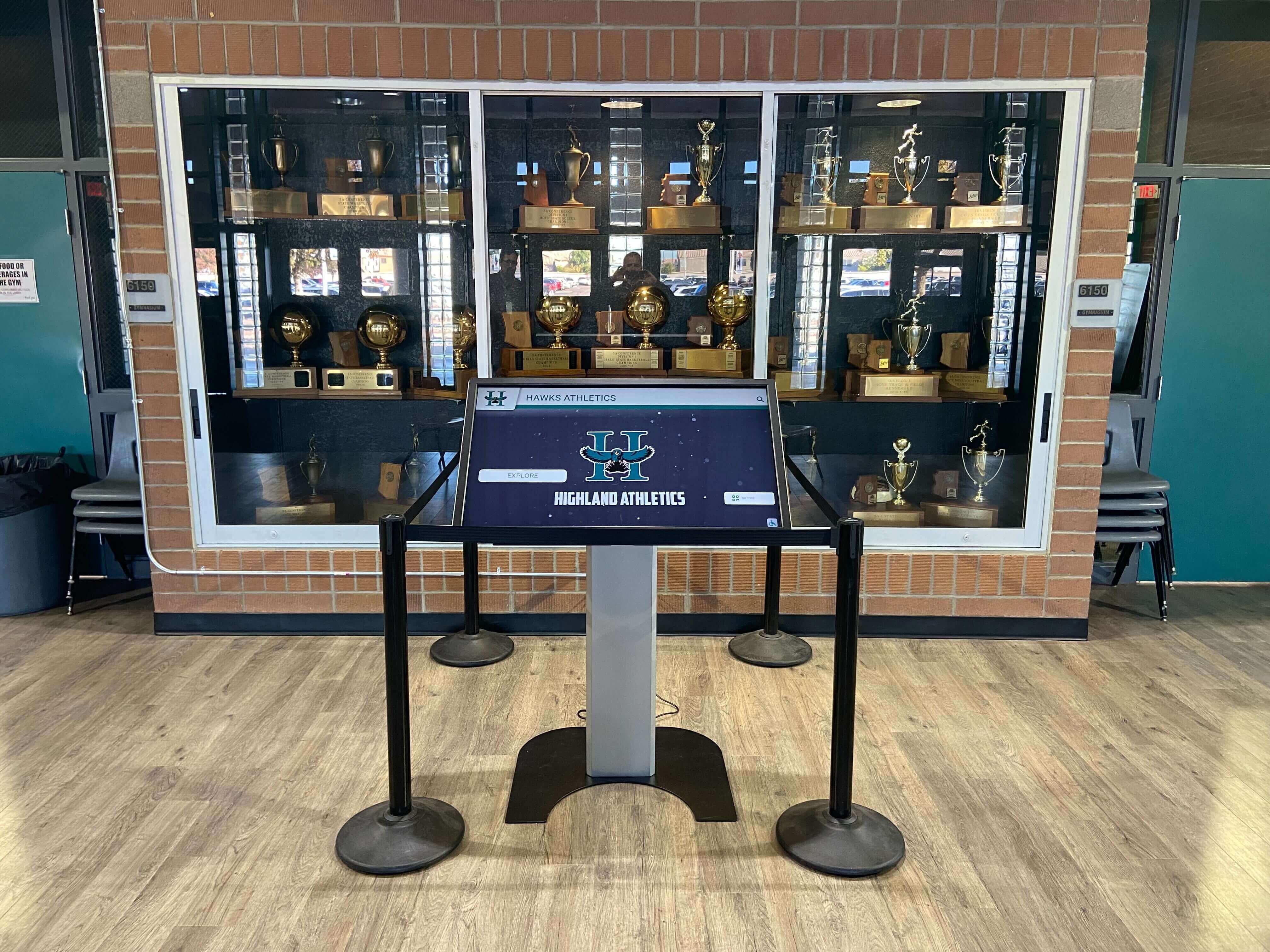
Trophy cases combining physical hardware shelves with integrated digital displays concentrate load at multiple shelf levels simultaneously — clip inspection should cover every shelf regardless of what is displayed on it
Common Causes of Shelf Clip Failure in School Settings
Understanding why clips fail helps facilities teams identify higher-risk cases and adjust inspection frequency accordingly.
Overloading during event preparation: When athletic directors or coaches add a season’s worth of new hardware to a case at the start of the year, a single shelf may temporarily hold more weight than it was originally loaded with. Clips sized for a lighter load may deform permanently under the higher load even if the shelf appears stable.
Incorrect replacement after shelf repositioning: When shelves are moved to accommodate taller trophies, clips are extracted and reinserted at new hole positions. An incorrectly seated clip that was functional at the original position may not seat fully in a hole that was previously unused and has slightly tighter dimensional tolerances.
Humidity and temperature cycling: Cases in exterior-adjacent corridors or near gymnasium entry doors experience wider humidity and temperature variation than cases in climate-controlled interior hallways. Metal clips in these environments oxidize faster; plastic clips cycle through thermal expansion and contraction that can gradually reduce their dimensional fit in the pin holes.
Impact during cleaning or access: Facilities staff and student aides who clean case interiors may inadvertently strike clips with cleaning tools, displacing or bending clips that are close to the front edge of the shelf resting on them.
School Trophy Case Shelf Clip Inspection: Step-by-Step Checklist
The following inspection sequence is designed for a single facilities team member working through the building’s trophy case inventory. No power tools are required. Recommended materials: flashlight, small flathead screwdriver (for unseating clips to check fit), inspection record form, and a camera or phone for photographs.
Step 1: Unlock and Open the Case — Observe Before Touching
Before touching any shelf or clip, open the case door and observe the interior from a distance.
What to check before contact:
- Are all shelves visibly level? Sight along the shelf front edge horizontally — it should appear parallel to the floor.
- Are there any visible gaps between a shelf edge and the clips beneath it on either side?
- Do any clips appear to be protruding from holes at an angle rather than straight?
- Is there any hardware sitting on a shelf edge or leaning against a side panel, indicating a shelf that has shifted?
Record your initial observation before handling any component, so the as-found condition is documented separately from the post-inspection condition.
Step 2: Check Each Clip for Full Seating
Without removing the shelf, examine each clip on both the left and right side panels.
What to check at each clip:
- Is the clip pin fully inserted to the base? A pin that is not fully seated will show a visible gap between the clip body and the panel face.
- Is the load arm (the horizontal surface the shelf rests on) horizontal? Use a small level if precision is needed, or use visual comparison to the adjacent row of holes.
- Is the clip body sitting flush against the panel face, or is it angled in the hole? A clip seated at an angle will show the body protruding at one side.
Gently apply upward pressure to the shelf at each corner to test whether the clips retain the shelf. A properly seated clip should retain the shelf under light upward pressure — the shelf should not lift free of the clips without deliberate effort to extract the pins.
Step 3: Apply Lateral Load Test
After checking seating, test lateral stability.
What to check:
- Apply light lateral (side-to-side) pressure to the front edge of the shelf at the center span. The shelf should not shift measurably.
- Apply light front-to-back pressure at the center span. The shelf should not rock.
- If movement is detected, identify which corner of the shelf has the loosest clip seating — movement typically pivots around the most firmly seated corner.
Document any movement detected, which axis it occurs in, and the approximate magnitude — whether it is barely perceptible or whether the shelf edge moves more than a few millimeters.
Step 4: Extract and Inspect Individual Clips
For each clip identified as having a seating issue, loose fit, visible damage, or incorrect orientation during Steps 2–3, extract the clip and inspect it directly.
What to check on the extracted clip:
- Is the pin diameter appropriate for the hole? Insert the clip back into the hole and check for play — the pin should seat with firm friction, not wobble in the hole.
- Is the load arm bent? Hold the clip at eye level and compare the arm angle to a straight edge or to a known-good clip from the same manufacturer.
- Is the clip body cracked, corroded through, or fragmenting?
- Does the clip orientation match the other clips on the same shelf? Compare to the opposite side panel’s clip to confirm they are installed with the same orientation.
Retain extracted clips for comparison when ordering replacements. Clip dimensions — pin diameter, hole engagement depth, arm length, and arm height — must match the case manufacturer’s specifications for proper load rating.
Step 5: Check the Hole Condition
After extracting each clip for direct inspection, check the hole it was seated in.
What to check in the hole:
- Is the hole circular and at its original diameter? An elongated or irregular hole will not provide adequate retention for a new clip of the correct specification.
- Is the hole free of corrosion, debris, or sealant residue that could prevent full seating?
- Does the inside edge of the hole show wear marks consistent with repeated clip extraction?
Holes that are elongated or corroded should be documented with a photograph. Replacement clips in elongated holes may require oversize pins or a sleeve insert — both of which require the case manufacturer or a qualified technician to specify the correct remediation approach.
Replacement Decision Table
Use this table to translate inspection findings into prioritized action items. Apply the highest-severity rating for each shelf — if a shelf has one clip that is bent and one that is missing, apply the missing-clip rating (High), not the bent rating (Moderate).
| Finding | Severity | Recommended Action | Action Timeline |
|---|---|---|---|
| All clips fully seated, level, load arm horizontal, no corrosion | None | Document as confirmed sound | At next scheduled inspection |
| Surface corrosion (rust spotting, no structural loss) on one or two clips | Low | Monitor; photograph for comparison; plan replacement in next maintenance cycle | 60–90 days |
| Clip seated at slight angle, passes lateral load test with minor movement | Low–Moderate | Re-seat clip; retest; replace if movement persists | Within 30 days |
| Clip bent at load arm, still seated in hole | Moderate | Replace clip before next shelf loading event | Within 14 days |
| Mixed clip types on same shelf (different heights or manufacturers) | Moderate | Replace all clips on shelf with matched set from case manufacturer | Within 30 days |
| Clip pin too small for hole — seated loosely, wobbles in hole | Moderate–High | Remove shelf from load; replace all clips and assess hole condition | Within 7 days |
| One clip missing on a loaded shelf | High | Remove or redistribute shelf load; install replacement before reloading | Immediately |
| Hole elongated or corroded — clip does not retain | High | Remove shelf from service; contact case manufacturer for hole remediation guidance | Immediately |
| Clip body cracked or fractured | High | Remove and replace all clips on that shelf; inspect adjacent shelves | Immediately |
| Multiple clips failed or missing on same shelf | Critical | Remove shelf from service; do not reload until all clips are replaced and tested | Same day |
Recording Inspection Findings
A shelf clip inspection that is not recorded provides no institutional benefit beyond the day of the inspection. A documented inspection establishes:
- The condition of every shelf clip in the building’s trophy case inventory on a specific date
- Which clips were found sound (confirmed — no action needed)
- Which clips require monitoring, replacement, or escalation
- Which facilities staff member conducted the inspection and is accountable for follow-up
The following fields cover the minimum documentation needed for a useful inspection record:
| Field | Format | Notes |
|---|---|---|
| Case Location | Text (building name, hallway, room number) | Use the same identifier as the building’s maintenance management system |
| Inspection Date | YYYY-MM-DD | |
| Shelf Level | Number or description (top, middle-1, middle-2, bottom) | Number from top for consistency |
| Left Front Clip Rating | 1–5 scale | 1 = confirmed sound; 5 = immediate replacement required |
| Left Rear Clip Rating | 1–5 scale | |
| Right Front Clip Rating | 1–5 scale | |
| Right Rear Clip Rating | 1–5 scale | |
| Overall Shelf Rating | 1–5 scale (highest of the four clips) | Drives the action timeline |
| Photographs Taken | Yes / No | Always photograph any clip rated 3 or higher |
| Escalation Required | Yes / No | Yes for ratings 4 and 5 |
| Replacement Parts Needed | Text (clip type, quantity, case manufacturer) | Include manufacturer and part number where available |
| Follow-Up Action | Text | Specific next step with responsible party and target date |
| Inspector Name | Text | Full name for accountability |
Inspection records for each case should be stored in a location accessible to future facilities staff, not in a personal binder or individual staff member’s files. Schools using a computerized maintenance management system should attach inspection records to the asset record for each trophy case unit. Paper records should be stored in a dedicated facilities binder with the case location noted on the record itself.
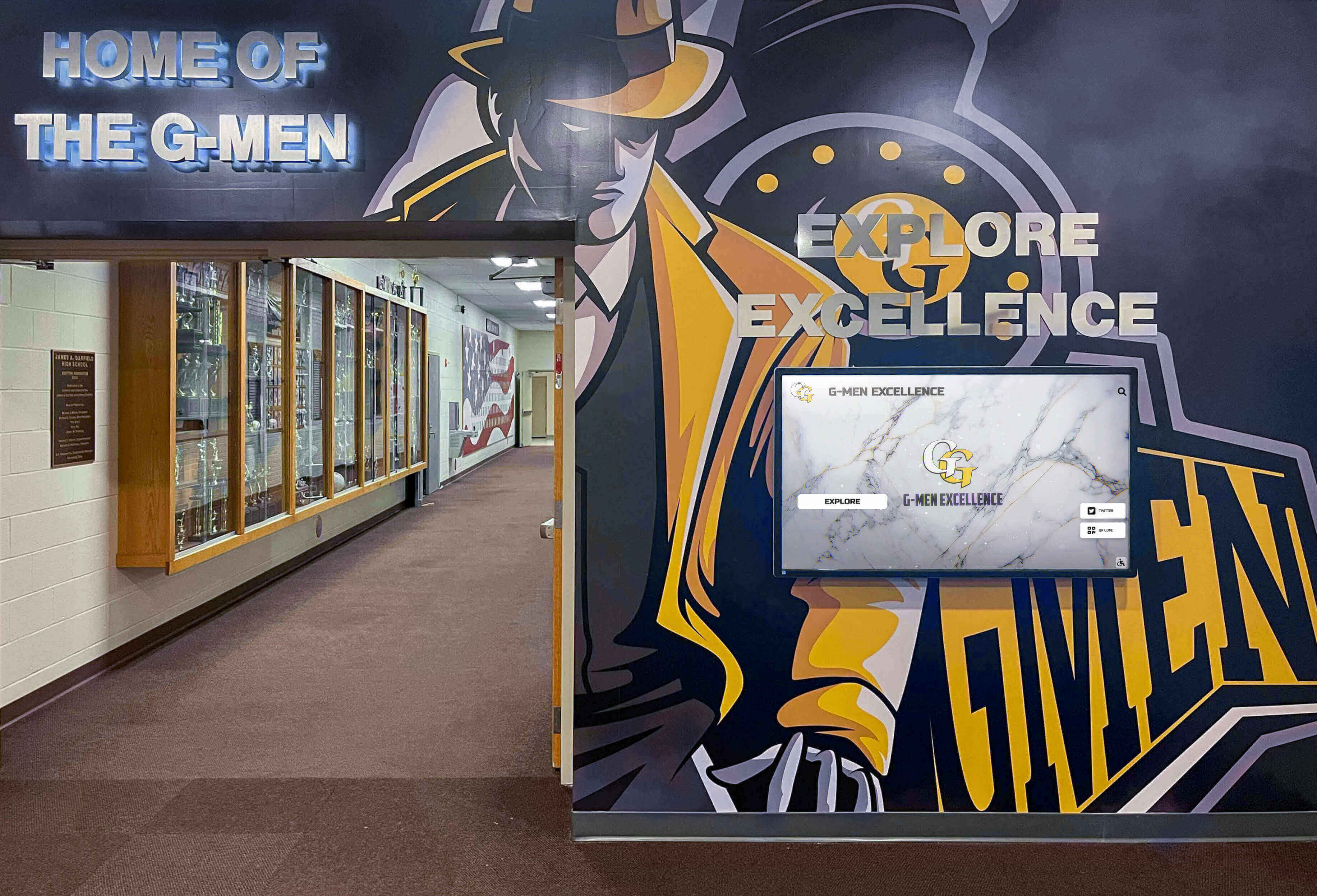
Trophy cases in active school corridors experience frequent access events that can dislodge or misalign shelf clips — documentation of clip condition after each high-traffic event provides a useful change record
Ordering Replacement Clips
Shelf clips are not universal hardware. The pin diameter, engagement depth, load arm length, and arm height vary among trophy case manufacturers. Installing clips that are close-but-not-exact matches to the original specification will produce shelves that appear level initially but may fail to retain the shelf under dynamic load — such as when a trophy is placed on or removed from the shelf edge.
When ordering replacement clips, collect the following information before placing an order:
Identify the case manufacturer — the manufacturer name appears on a label affixed to the case interior (typically in a corner or on the back panel), on the original purchase documentation, or on a building equipment inventory record.
Measure the existing clips — use calipers or a millimeter ruler to measure the pin diameter (typically 3mm, 5mm, or 6mm in common trophy case specifications), the overall clip height, and the arm length. Photograph both the clip and an unoccupied hole for reference.
Order from the original manufacturer — where the manufacturer is identifiable and still supplies replacement hardware, ordering directly ensures dimensional compatibility. Generic shelf clips from hardware or display suppliers should be test-fitted in an unloaded hole before committing to a full replacement order.
Order in sets of four per shelf — replace all four clips on a shelf simultaneously when any clip on that shelf is rated Moderate or higher. Mixed-age, mixed-wear clips on the same shelf create uneven load distribution even when all clips are nominally within specification.
When to Schedule Shelf Clip Inspections
Shelf clip inspection is a recurring maintenance activity, not a one-time documentation task. The appropriate frequency depends on how actively the cases are accessed and what they hold.
At installation or case acquisition — document clip condition on all shelves when a new case is installed, when a used case is acquired from another school or reseller, or when a building undergoes renovation that may have involved moving or reloading the cases.
Annually — before the fall awards cycle — most schools experience their highest trophy case access frequency in the fall, when athletic directors load new hardware from the prior year’s championship season and summer banquets. Inspecting clips before this loading event ensures that every shelf going into the high-load season is supported by clips confirmed to be sound.
After any shelf repositioning event — when shelves are moved to accommodate taller or wider hardware, all clips on the repositioned shelves should be re-inspected. The act of extracting and reinserting clips is the most common source of incorrect seating.
After renovation or construction adjacent to trophy cases — vibration from construction work can loosen clips that were correctly seated. Cases near hallway renovation zones or gymnasium projects should receive a targeted clip check after construction concludes.
When a related finding is documented — a trophy case where a lock cylinder inspection identified evidence of forced entry, or a hinge alignment inspection identified door sag that may have vibrated the case interior, warrants a concurrent clip inspection. Hardware problems rarely occur in complete isolation.
Schools developing structured hall-of-fame recognition programs will find that hall of fame tools for athletics, donors, arts, and history require the same documentation discipline for physical infrastructure that digital platforms require for content management — a regular check schedule, a recorded outcome, and a clear escalation path.
Integrating Shelf Clip Inspection into Existing Facilities Rounds
The most sustainable shelf clip inspection program attaches to existing walk schedules rather than requiring standalone inspection events. A building with ten trophy cases requires approximately two hours for a complete clip inventory across all shelves — a commitment that fits within a morning facilities shift when coordinated with the building’s quarterly safety walk or annual equipment inspection.
Facilities teams that already conduct case inspections for glazing beads, hinge alignment, lock cylinders, or glass condition can include shelf clips as an additional check point on the same inspection form. The cases are already open, the inspector is already on site, and the documentation workflow is already established. Adding clip condition to the same record requires adding four clip-rating fields per shelf — a few additional seconds per shelf, yielding a meaningfully more complete picture of the case’s structural condition.
Schools using touchscreen hall-of-fame platforms alongside physical trophy cases benefit from the same integrated inspection approach — physical case hardware and digital display hardware checked together, documented together, and escalated through the same facilities workflow.
What Shelf Clip Inspection Cannot Cover
A shelf clip inspection conducted by facilities staff addresses the clips themselves and the holes they mount in. It does not evaluate:
Shelf structural integrity — a shelf that is warped, cracked, or delaminated at its edges may be unsafe to load even if the clips supporting it are sound. Inspect shelf substrate condition as a separate check, particularly for shelves that appear bowed or that have visible finish damage at the edges.
Weight distribution on the shelf surface — clips may be rated for the total distributed load across the shelf, but a single heavy trophy placed at the center of a long span may create a bending load that exceeds the shelf material’s capacity regardless of clip condition. Cases where a single trophy exceeds approximately fifteen pounds should be positioned near the clip support points rather than at mid-span.
Case structural integrity — clips attach to the side panels of the case interior. If the panels themselves have delaminated, warped, or separated from the case frame, clip condition may be sound while the panel is not providing adequate backing for clip retention. Check panel attachment as part of a broader case condition review when any panel surface shows buckling or separation.
Clip load ratings — facilities staff cannot calculate whether a given clip model is rated for the weight currently placed on its shelf without manufacturer load-rating documentation. When in doubt about load adequacy for heavy hardware, contact the case manufacturer for clip load specifications before adding additional hardware to that shelf.
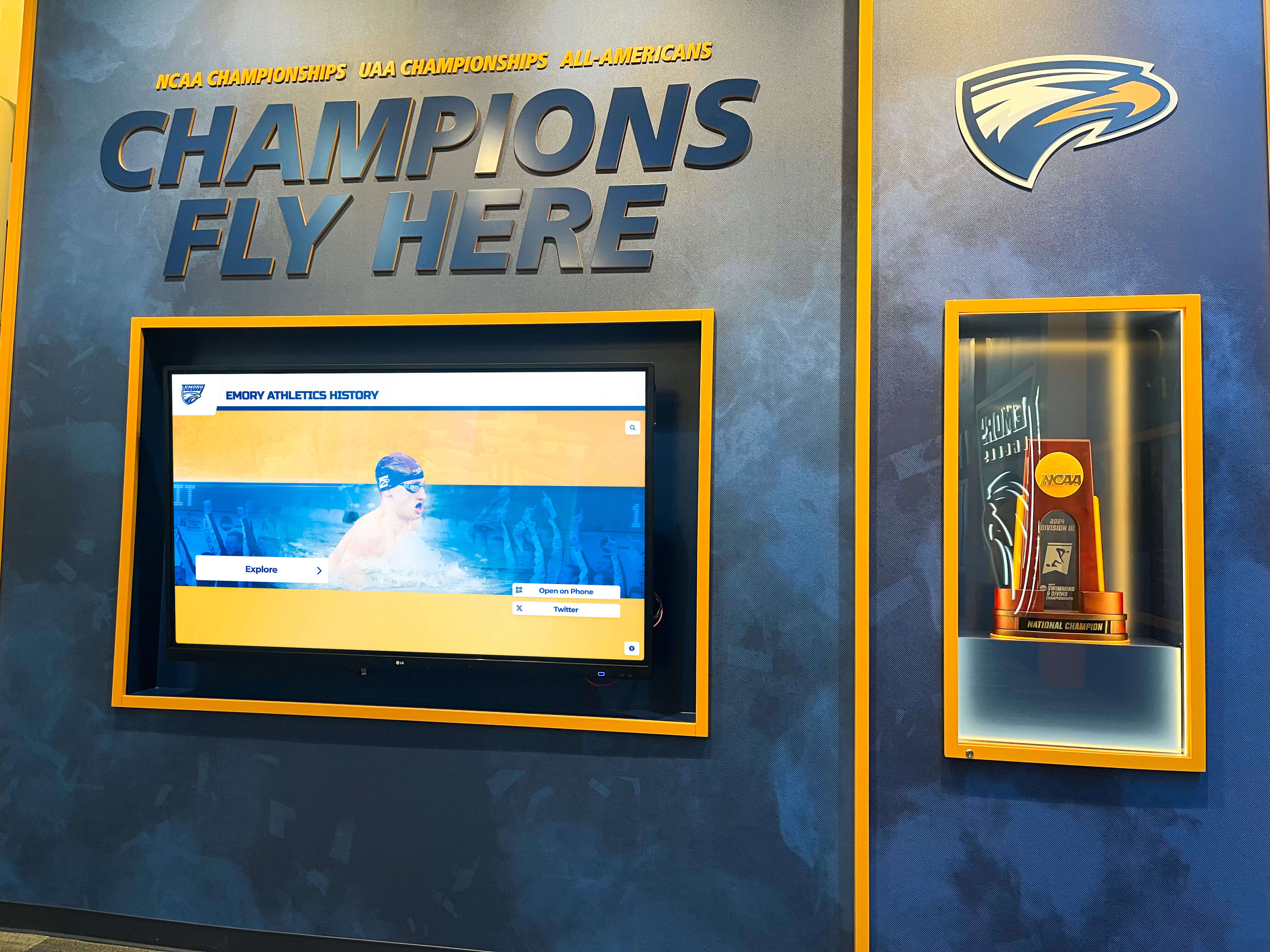
Championship trophy collections that span multiple shelf levels represent significant concentrated load — clip inspection at each level protects both the hardware and the students who walk past the case daily
Connecting Shelf Clip Inspection to the Full Recognition Program
The hardware behind a trophy case glass panel represents something more than display furniture. State championship trophies, retired jersey plaques, honor society awards, and athletic achievement recognition that spans decades cannot be replaced. A shelf failure that drops hardware to the case floor — even if no glass breaks and no students are present — can damage irreplaceable recognition items and destroy the physical evidence of accomplishments that may not exist in any other format.
Schools running comprehensive recognition programs that extend across sports, academics, the arts, and community service are accumulating hardware at a pace that makes shelf clip maintenance increasingly important over time. More shelves, more clips, more access events, more load — the inspection discipline that was adequate for a three-shelf case with light hardware may not be adequate for a case that has been reconfigured to hold a decade of championship hardware and newly added academic plaques.
Schools researching interactive digital hall-of-fame tools alongside their physical case programs will find that the documentation workflows developed for physical maintenance translate directly to digital platform management: a regular check schedule, a recorded outcome, a clear escalation path for problems that exceed the first responder’s scope.
When Physical Cases Are Maintained — and Still Cannot Hold Everything
A fully-inspected, well-maintained trophy case with sound shelf clips, confirmed glazing beads, and aligned hinges is still a fixed-capacity physical object. The school that has been accumulating recognition hardware for thirty years has a finite number of cases, a finite number of shelves, and a finite number of shelf clips — and at some point the math of one new award per season exceeds the available display space.
Schools that have resolved the inspection and maintenance question and turned their attention to the capacity question have increasingly added digital recognition platforms alongside their physical cases. A digital wall of honor kiosk makes an unlimited institutional recognition record searchable by touchscreen — every athlete, every season, every academic honor — without adding weight to any shelf or requiring another access event that puts wear on the clips supporting it. The physical case holds the irreplaceable objects. The digital platform holds the complete record.
Schools exploring the range of touchscreen recognition display options available to K–12 programs will find that platforms built specifically for school athletics and academic recognition can operate alongside physical trophy cases in the same hallway — the two systems complementing each other rather than competing.
Frequently Asked Questions
What are shelf clips in a trophy case?
Shelf clips are the small metal or plastic hardware components that insert into drilled holes along the inside vertical panels of an enclosed trophy case and support removable shelves. The shelf simply rests on the clips; no fasteners attach the shelf to the clips in most standard configurations. Clips are available in several styles — pin-peg, spoon, and locking pin are the most common — and the correct clip for a given case is determined by the pin-hole diameter drilled by the case manufacturer.
How do I know if a shelf clip is damaged?
The most common signs of clip damage are: the load arm is visibly bent downward from horizontal, the pin body shows through-corrosion or fracturing, or the clip sits at an angle in its hole rather than straight. Functional damage that is less visually obvious includes: the pin being too small for the hole (the clip wobbles when inserted) and the load arm being permanently compressed flat from overload. Any clip that fails the seating check or lateral load test should be treated as damaged regardless of its visual appearance.
Can facilities staff replace trophy case shelf clips themselves?
Staff can replace shelf clips when the replacement part is confirmed to match the original specification — same pin diameter, same arm dimensions, same case manufacturer. Direct clip-for-clip replacement on a shelf with sound holes is a straightforward task. What is outside staff scope: repairing elongated or corroded holes, determining load ratings for unfamiliar clip types, or selecting replacement clips when the original manufacturer is unknown. Those assessments should involve the case manufacturer or a qualified technician.
How many clips does a trophy case shelf need?
Standard trophy case shelves are supported by four clips — two on the left side panel (one front, one rear) and two on the right side panel (one front, one rear). Some longer shelves in wide-format cases use six clips, with an additional center support on each side. If a shelf appears to have only three clips when checked, the fourth clip is missing and should be replaced before the shelf is loaded.
What happens if I use the wrong clip size?
A clip with a pin diameter smaller than the hole it is seated in will wobble in the hole rather than seating firmly. Under vibration or lateral load — such as when a door is opened or when hardware is placed on the shelf — a loose clip can pull free of its hole. A clip with a pin diameter larger than the hole cannot be fully inserted and will either sit proud of the panel face (reducing arm height relative to the opposite clips) or damage the hole during forced insertion. Neither scenario provides rated shelf support.
How often should shelf clips be inspected?
Most school facilities programs benefit from a full-building clip inventory annually — ideally before the fall awards loading cycle — with targeted re-inspection after any shelf repositioning event, after construction or renovation work near the cases, or when a prior inspection rated any clip as Moderate or higher. Cases in high-traffic corridors accessed frequently by multiple staff members warrant more frequent inspection than cases in administrative areas.
Should I photograph shelf clips during inspection?
Photograph any clip rated Moderate (3) or higher on the five-point scale. Photographs document the as-found condition before any correction is made, provide a comparison baseline for the next inspection, and give the case manufacturer or a technician enough visual information to specify the correct replacement part or remediation approach without a site visit.
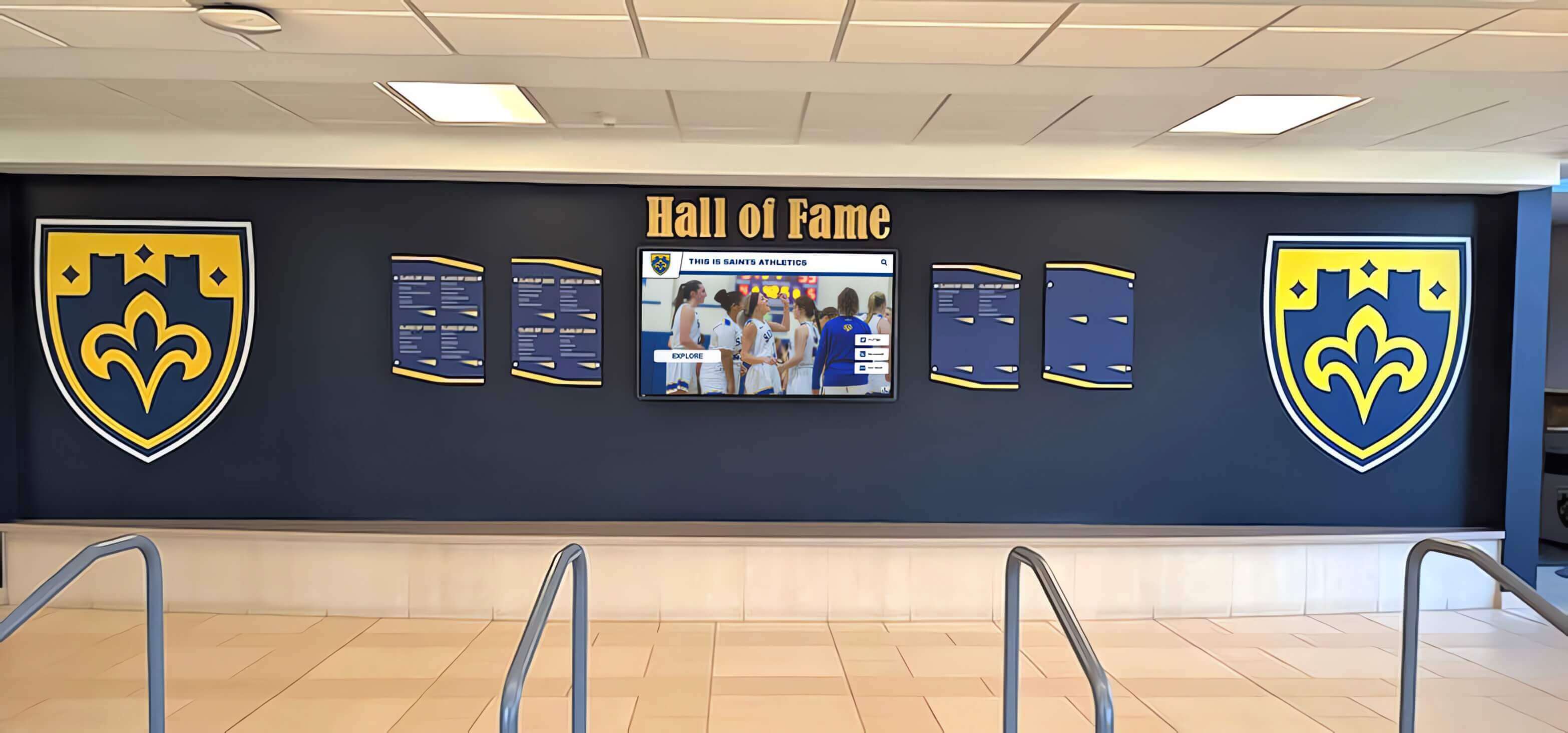
A lobby recognition area that combines physical trophy cases with a digital recognition screen represents two parallel maintenance tracks — shelf clip inspection for the physical display, and content and hardware management for the digital platform
Building a Documentation Culture Around Recognition Infrastructure
The shelf clip inspection checklist is one element of a broader facilities discipline that treats school recognition infrastructure as the institutional asset it is. Schools that maintain systematic documentation — clip condition, glazing bead condition, hinge alignment, lock cylinder function, glass safety film status — are not conducting extra work. They are converting the unrecorded assumption that “everything looks fine” into a documented confirmation of what is actually fine, what needs attention, and who is responsible for the next step.
That documentation culture extends naturally to digital hall-of-fame tools and recognition platforms when schools add interactive touchscreen systems alongside their physical cases. The facilities team that follows a clip inspection checklist and escalates bent hardware before it fails is operating from the same discipline that a content administrator uses when auditing a digital recognition platform for outdated records, missing photographs, and display hardware that requires attention.
For schools developing recognition programs that will outlast any individual facilities team member or athletic director, the investment in systematic documentation pays forward across staff transitions. A new facilities team member who inherits a building with twelve trophy cases and a complete clip inspection log — every shelf rated, every replacement documented, every escalation resolved — knows exactly what they have and what condition it is in. That is the value of a repeatable inspection workflow: not a guarantee that nothing will fail, but a documented record of what was confirmed, what was found, and what was done about it.
Ready to Extend Your Recognition Program Beyond the Physical Case?
Rocket Alumni Solutions builds touchscreen digital trophy cases, interactive halls of fame, athletic record boards, and scholar-athlete recognition systems for schools of every size. When physical cases are fully inspected and maintained — and still running out of space — a digital platform gives every athlete, every honoree, and every season permanent, searchable, unlimited visibility.
Book A DemoA completed school trophy case shelf clip inspection log tells the facilities team exactly which shelves are confirmed sound, which clips require replacement, and which cases need to come out of service until remediation is complete. No shelf is assumed to be level because it looked level last year. No clip is assumed to be sound because no trophy has fallen yet. That is the standard a systematic inspection workflow is designed to meet: documented knowledge, not deferred assumptions.