



Intent: research — a school trophy case roller track inspection is a structured evaluation of the upper and lower slide channels, roller wheels or glide inserts, door alignment, and track mounting hardware on enclosed display cases with sliding glass doors, conducted to confirm that each door panel moves smoothly across its full travel range without binding, grinding, or derailing. Roller tracks on sliding trophy case doors accumulate fine debris — grit from corridor floors, eraser dust, particulate shed by trophies and display materials — that embeds in track channels and gradually impedes roller travel. Tracks can also become dented, warped, or loosened from their mounting points, and rollers can develop flat spots, fractures, or axle wear that cause a door to ride unevenly and eventually derail during a routine access event. A systematic roller track inspection prevents the progression from minor friction to a stuck or dropped door and provides facilities teams with documented findings to prioritize maintenance before recognition hardware or glass is damaged.
Sliding trophy case doors that feel stiff, catch mid-travel, or require force to close are not operating as designed — and the resistance accumulates. A door that slides with moderate friction today will slide with significantly more friction after another season of corridor dust, another round of athletic banquet loading, and another summer of humidity cycling through an unoccupied building. By the time a door requires two hands or an upward lift to move, the rollers and track have been working under abnormal load for months, and the next failure — a roller cracking, a track denting, or a door panel lifting out of its lower channel — may be sudden rather than gradual.
A school trophy case roller track inspection documents the actual condition of the track system — where debris has accumulated, which rollers are worn, which track sections are deformed, and which doors are already outside normal operating tolerances — so that corrective action happens at the scheduled maintenance stage rather than the emergency stage.

Sliding-door trophy cases in active school corridors are accessed repeatedly during recognition seasons — roller track inspection before each high-traffic period ensures doors operate safely and without forced handling
What Roller Tracks Do on Trophy Case Sliding Doors
Trophy case sliding doors operate on a two-channel system: an upper channel that captures the top edge of the glass door panel and guides it laterally, and a lower channel that supports the door’s weight through one or more roller wheels or glide inserts mounted in the door frame. The door hangs from the upper channel in some designs and rests on lower-channel rollers in others; in most common school-grade enclosed trophy cases, the lower channel bears the primary load while the upper channel provides lateral stability and keeps the panel from tipping forward.
The components that require inspection fall into three categories:
| Component | Location | Function | Primary Failure Mode |
|---|---|---|---|
| Lower track channel | Floor of the case or bottom frame rail | Guides the roller wheel or glide insert during door travel | Debris fill, denting from dropped hardware, warping from moisture exposure |
| Upper track channel | Top of the case interior or header rail | Retains the door top edge and prevents the panel from tipping outward | Debris buildup at channel ends, channel deformation at corner joints |
| Roller wheels | Mounted in lower door frame, one or two per panel | Roll along the lower track to carry the door’s weight during lateral travel | Flat spots from static load, cracking (plastic rollers), worn axle bearing |
| Glide inserts | Some designs use nylon glides rather than wheels | Slide along the lower track channel face | Surface wear groove that catches on track irregularities; swelling in humid conditions |
| Track end stops | Pressed or screwed into track ends | Prevent the door from rolling past its intended travel limit | Loosening or dislodgement, leaving the channel open at the end |
| Track mounting screws | Secure the track channel to the case frame | Hold track in correct position relative to door panel | Vibration-loosened screws allow track to shift, changing door alignment |
Understanding which component type is present in each case determines what the inspector looks for — a roller-wheel door fails differently from a glide-insert door, and the cleaning and replacement approaches differ accordingly.
Why Roller Track Condition Deteriorates in School Settings
School trophy cases experience a combination of use patterns and environmental conditions that place unusually consistent demand on roller tracks relative to cases in lower-traffic settings.
High access frequency during recognition seasons: Athletic directors update trophy case contents after each awards banquet; coaches reposition hardware for hallway events; facilities staff clean case interiors several times per year. Each opening-and-closing cycle deposits a small amount of corridor particulate into the lower track channel and applies load to the roller wheels. A case accessed thirty or forty times per year accumulates measurable debris in its track channels within one season.
Corridor floor particulate: Trophy cases positioned adjacent to gymnasium entries, locker room hallways, or exterior door vestibules receive elevated quantities of coarser particulate — grit, sand, and rubber particles from athletic shoe soles — that most readily jams between roller wheels and track channel walls.
Humidity and temperature cycling: Cases in buildings without consistent HVAC humidity control experience seasonal dimensional changes in their wooden frames and case bodies. Frame expansion narrows the track clearance that rollers or glides travel through; contraction may allow a track to shift from its mounting points. Either change affects how smoothly the door panel travels across its full range.
Infrequent cleaning of the track channel: Routine case cleaning typically focuses on glass surfaces and shelf contents. The lower track channel — which collects debris at the lowest point of the case interior — is frequently overlooked because it is not visible from corridor height and does not affect the appearance of the display from the hallway.
Heavier door panels after hardware reconfiguration: When additional shelving is added, lighting is integrated into the door panel, or glass is upgraded to thicker safety glass, the door panel weight increases. Roller wheels and glide inserts rated for the original door weight are now operating at higher load, which accelerates wear on the rolling or sliding surface.
Schools managing school trophy case display installations alongside digital recognition systems will find that roller track maintenance is one of the most frequently deferred physical case tasks — and one of the most consequential when deferred long enough for rollers or track channels to reach failure condition.
Symptom, Cause, and Action: Roller Track Failure Recognition Table
The following table supports rapid triage during a corridor walkthrough. Each observable symptom maps to its most likely cause and the appropriate initial action.
| Symptom | Likely Cause | Initial Action |
|---|---|---|
| Door requires noticeable hand force to start moving from rest | Debris pack in lower track channel at the door’s rest position; flat spot on roller at contact point | Open case; inspect and clean lower track channel; check roller surface at the contact zone |
| Door slides smoothly for part of travel, then catches or stutters | Localized debris accumulation, a dent in the track, or a damaged track section | Identify the exact catch point by slowly sliding the door; clean that zone; check for track deformation |
| Grinding or gritty noise during door travel | Grit embedded between roller and track surface; debris in upper channel | Clean both upper and lower channels; inspect roller surface for embedded debris |
| Door top edge tilts forward (away from case) during travel | Debris packing the upper channel, or upper track mounting has shifted | Inspect upper channel depth and debris load; check upper track mounting screws |
| Door will not close fully — stops short of end stop | Track blocked by debris at travel end; end stop dislodged; track dented near end | Clear the travel path; locate and re-seat or replace the end stop; check track geometry at the end zone |
| Door can be lifted out of the lower track without deliberate effort | Lower track channel worn, dented flat, or roller height has dropped below design minimum | Measure track depth against door roller height; replace worn rollers or deformed track sections |
| Door bottom edge contacts the lower track frame audibly during travel | Roller cracked or missing; roller axle has collapsed; roller height dropped below design minimum | Inspect all rollers on that door panel; replace any cracked, missing, or collapsed-axle rollers immediately |
| Door panel vibrates or rattles during normal corridor activity | Upper channel clearance too large; debris has shifted track enough to change the panel’s lateral position | Inspect upper channel for excessive lateral play; clean and check upper track mounting |
| Track visibly bowed, kinked, or misaligned at a joint | Physical impact from dropped trophy; thermal warping; mounting screw loosening | Document the deformation extent; determine whether track can be straightened in place or requires replacement |
School Trophy Case Roller Track Inspection: Numbered Step-by-Step Sequence
The following inspection sequence is designed for a facilities team member working through the building’s sliding-door trophy case inventory. Required materials: flashlight, stiff-bristle cleaning brush or vacuum with crevice attachment, clean cloth or cotton swabs, feeler gauge or business cards for clearance measurement, inspection record form, and a camera for photographs. No power tools are required.
Step 1: Observe the Door at Rest and During Full Travel — Before Any Cleaning
Open and close each sliding door panel across its complete travel range before touching the track. Observe the door in motion with no cleaning or adjustment applied so the as-found condition is documented accurately.
What to observe and record during Step 1:
- Does the door start moving immediately under light hand pressure, or does it require force to break from its rest position?
- Is the movement smooth across the full range, or are there catch points, stutters, or zones where friction increases?
- Is there any audible noise — grinding, squeaking, or rattling — and at what point in the travel range does it occur?
- Does the door panel maintain a consistent vertical angle throughout travel, or does the top or bottom edge shift position relative to the case frame?
- Does the door reach its end stop cleanly, or does it stop short or impact the stop with more force than expected?
Record observations by panel position: for a three-panel case, note each panel’s behavior independently. A panel that operates correctly provides a reference baseline for panels that show friction or noise.
Step 2: Inspect the Lower Track Channel for Debris and Deformation
With the door panel slid to one end, examine the entire length of the lower track channel with a flashlight.
What to inspect in the lower channel:
- Is the channel visibly filled with debris — grit, dust, hair, eraser particles, or any material that reduces the clear space the roller travels through? Note whether debris is uniformly distributed or concentrated at specific zones, typically the rest position where the door spends most of its time and the ends of the travel range where the door pushes debris ahead of the roller.
- Is the channel profile continuous and uniform along its full length? A dent, kink, or section where the channel walls have been compressed inward will be visible as a change in the channel’s cross-sectional profile. Run a finger along the channel floor to detect deformation not clearly visible under flashlight.
- Are the channel mounting screws (where visible) fully seated, or are any screws raised above flush?
- Are the end stops present at both ends of the channel and firmly seated? An end stop that has been dislodged or is missing leaves the roller travel path open past the intended limit — a door that slides past its end stop may either contact the case frame or derail off the track end.
Photograph any debris accumulation, deformation, or missing end stop before cleaning so the as-found condition is documented. Then clean the lower channel of debris using a stiff-bristle brush followed by a vacuum crevice attachment or folded cloth pulled through the channel length.
Step 3: Inspect the Upper Track Channel for Debris and Clearance
With the lower channel inspected, examine the upper track channel using a flashlight directed along its length.
What to inspect in the upper channel:
- Is debris present in the upper channel? Fine dust and particulate collect in the upper channel more slowly than the lower but can accumulate to the point where the door panel’s top edge catches during travel or where the panel is held forward of its correct alignment plane.
- Does the channel maintain consistent depth along its full length? The upper channel must retain the door panel top edge at a consistent depth to prevent the panel from tipping outward at any point during travel. A section of upper channel that has been crushed or deformed will hold the panel at a different depth, potentially producing the forward-tipping behavior noted in the symptom table.
- Is the upper channel mounting secure? Check visible mounting screws or clips and verify they are fully engaged.
Clean the upper channel with a crevice brush or compressed air directed along the channel length, followed by a clean cloth to remove loosened debris.
Step 4: Remove and Inspect the Roller Wheels or Glide Inserts
After cleaning both channels, access each roller wheel or glide insert on the door panel for direct inspection. In most school-grade trophy cases, rollers are accessible by lifting the door panel upward out of the lower channel while tilting the top edge inward — the upper channel provides enough clearance for the panel to be removed and reinserted without tools. Consult the case manufacturer’s documentation if this is not immediately clear, as some panel designs require a different extraction sequence.
What to inspect on each roller wheel:
- Is the roller surface continuous and round, or does it show a flat spot, chip, or crack? A flat spot is caused by the door resting in one position under load for an extended period — the roller stops rotating and develops a flat contact zone that creates a bump during travel each time that spot contacts the track.
- Does the roller spin freely on its axle, or is there resistance, wobble, or grinding in the bearing? Hold the roller between thumb and forefinger and spin it manually — it should rotate smoothly with minimal friction.
- Is the roller body cracked through? Plastic rollers that have cracked through their body cannot provide full load support and should be replaced before the door is returned to service.
- Does the axle show visible wear — scoring, corrosion, or deformation at the mounting points where the axle engages the door frame? A worn axle reduces roller height and can eventually allow the roller to detach entirely during door travel.
What to inspect on glide inserts (where applicable):
- Is the glide surface flat and smooth, or does it show a worn groove at the contact zone? A groove worn to correspond to the track channel width may catch on track irregularities or edges.
- Is the insert material swollen, distorted, or hardened beyond its original flexibility? Nylon glides exposed to repeated humidity cycling can swell or harden, reducing the smooth travel that is the insert’s primary function.
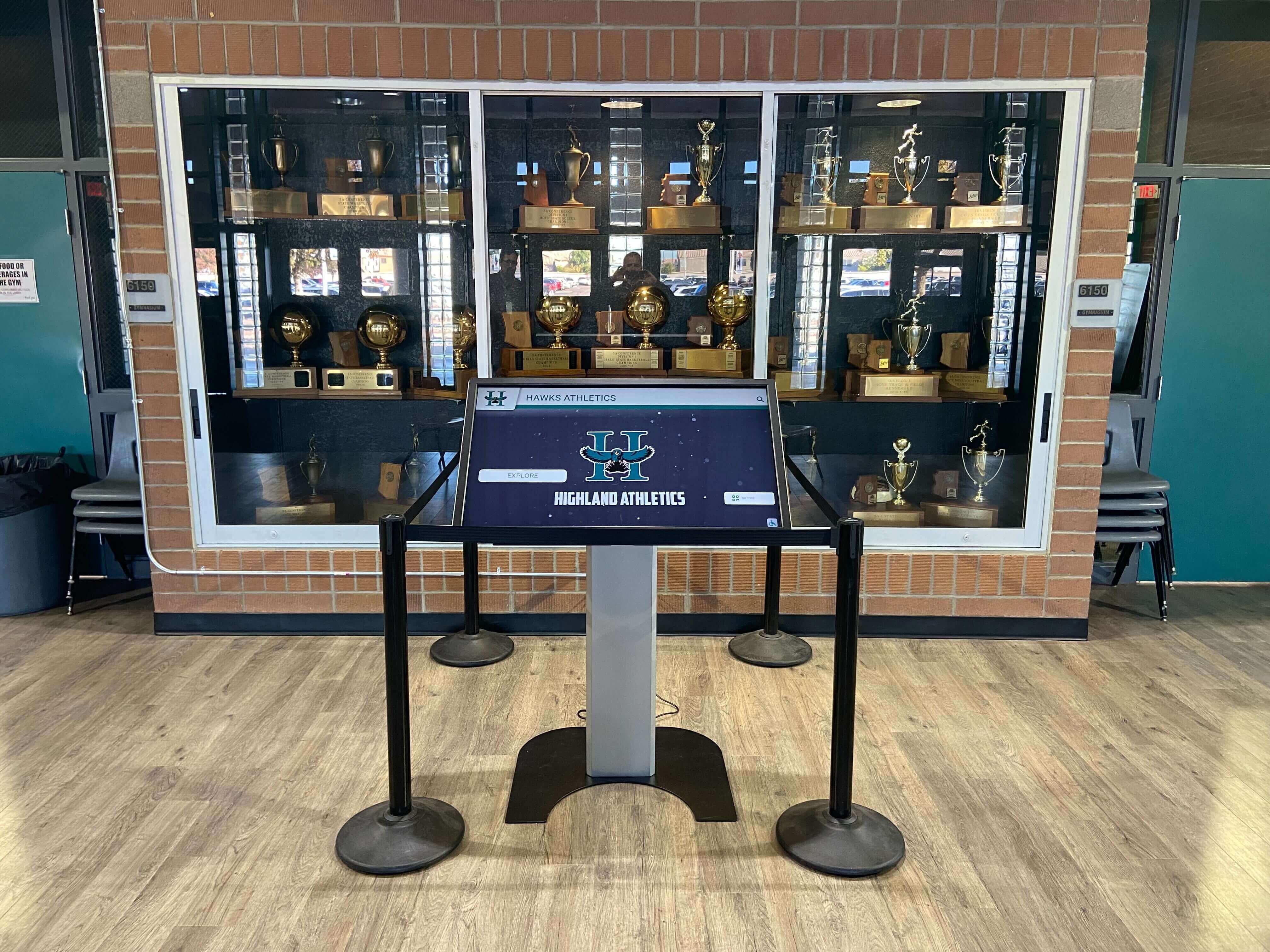
Trophy cases that combine physical display hardware with integrated digital displays require the same roller track inspection discipline as cases holding only physical trophies — the roller and track system operates the same regardless of display content
Step 5: Test the Cleaned Track and Reassembled Door
After cleaning the channels, inspecting the rollers, and reseating the door panel, test the door’s travel before closing the inspection.
What to test after reassembly:
- Slide the door across its full travel range under light, consistent hand pressure. The door should require no more than minimal force — approximately the weight of a single hand resting on the door handle — to travel smoothly from one end stop to the other.
- Listen for any residual noise during travel. Grinding that persists after cleaning the track indicates either an embedded particle on the roller surface or a track deformation that cleaning alone cannot resolve.
- Observe the door panel angle throughout travel. Any tipping of the panel top edge away from the case indicates an upper channel issue that was not resolved by cleaning — check upper channel depth and mounting again.
- Apply light forward pressure to the door panel face at mid-travel: the panel should not flex inward or outward measurably. Lateral play that exceeds approximately 2mm indicates that the upper channel clearance is too large for the panel’s top edge, either because the original channel is worn or because the panel has been replaced with one of a different thickness.
- Confirm that the door seats correctly at its closed end stop and that the lock mechanism (if present) engages without lifting or pushing the door to reach the latch position.
Document the post-cleaning test result separately from the as-found condition recorded in Step 1. A door that was stiff before cleaning and moves freely after cleaning has been serviced; a door that remains stiff after cleaning has a component-level problem (roller, track deformation, or alignment) that requires part replacement or escalation.
Step 6: Rate Each Door Panel and Record Findings
After completing Steps 1 through 5 for each panel, assign a condition rating and document findings in the inspection record.
| Rating | Conditions Present | Recommended Action | Reinspection Interval |
|---|---|---|---|
| Serviceable — No Action | Door travels full range under light pressure; no audible noise; panel angle stable; rollers round and spin freely; track clean and undamaged | Document as confirmed serviceable | Annual |
| Clean and Monitor | Minor debris accumulation; door requires slightly more than light force from rest but travels smoothly after debris cleared; rollers and track sound | Clean both channels; test after cleaning; re-inspect in six months | Semi-annual |
| Component Inspection Required | Moderate catch point, noise persisting after cleaning, visible flat spot or surface wear on roller, minor track dent not affecting full travel | Inspect rollers for replacement; assess track dent depth; re-test after any replacement; escalate if door does not reach serviceable rating | Quarterly until resolved |
| Take Out of Service | Door requires significant force, cannot complete full travel, roller cracked or axle collapsed, track bent enough to block travel, panel derails or lifts out during normal travel | Do not use door until repaired; contact case manufacturer; temporarily limit access to case contents if necessary | Inspect after repair; confirm serviceable before returning to service |
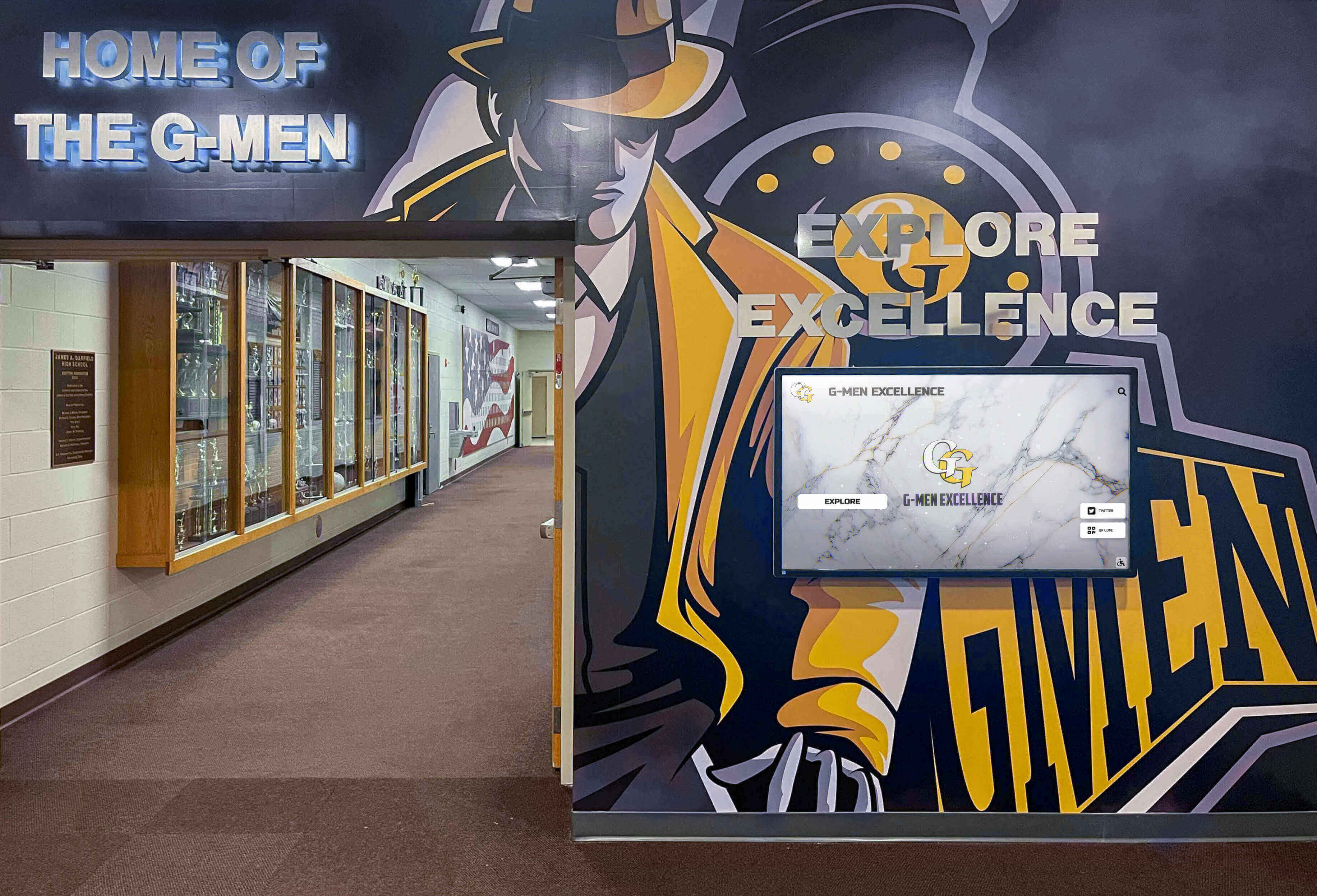
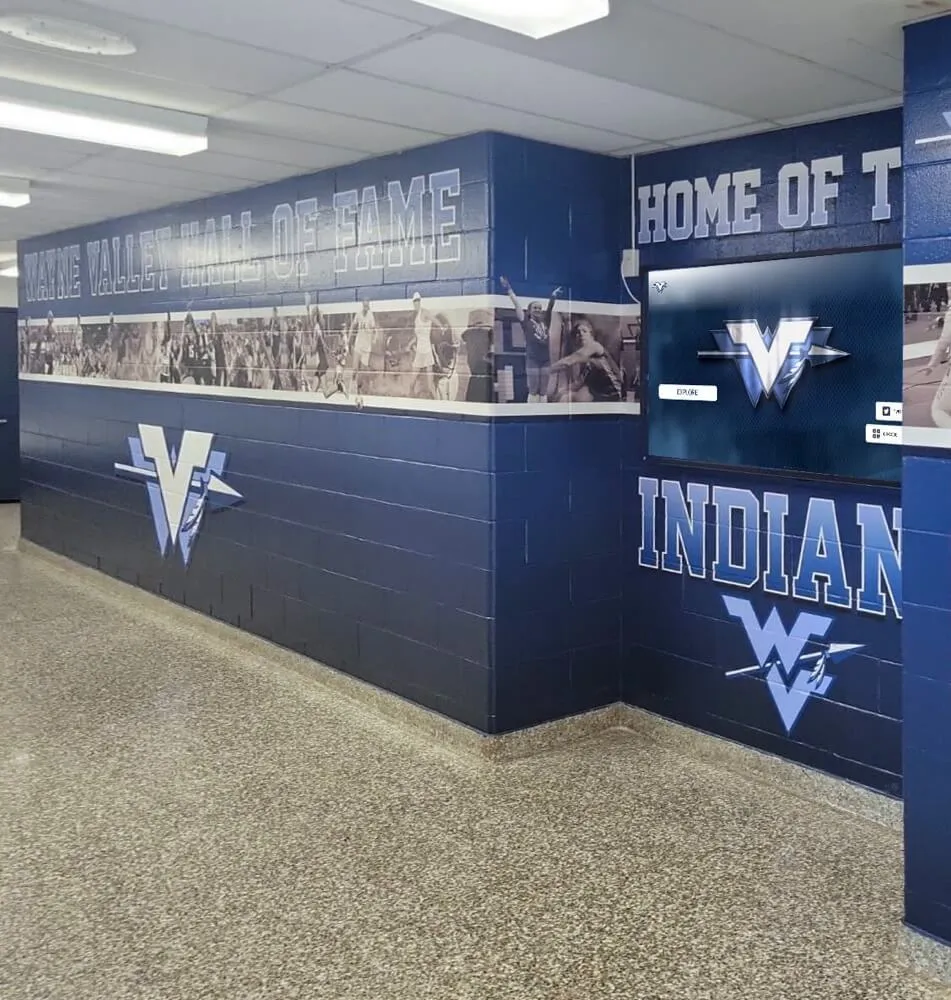
Trophy cases in active recognition corridors often have three or four sliding panels per case — each panel operates independently on its own section of roller track and requires individual inspection and rating
Recording Roller Track Inspection Findings
A roller track inspection that is not recorded provides no institutional benefit beyond the day of the inspection. A documented record establishes the condition of each panel’s track system on a specific date, identifies which panels are confirmed serviceable, and identifies which require cleaning, part replacement, or escalation. The following fields cover the minimum documentation for a useful inspection record:
| Field | Format | Notes |
|---|---|---|
| Case Location | Text (building name, hallway, room number) | Use the same identifier as the building’s maintenance management system |
| Inspection Date | YYYY-MM-DD | |
| Panel Position | Left / Center / Right (or numbered 1–N from left) | Each panel documented independently |
| As-Found Travel Condition | Smooth / Minor resistance / Moderate resistance / Cannot complete travel | Recorded before any cleaning or adjustment |
| Debris Present in Lower Track | None / Light / Moderate / Heavy | Photograph if Moderate or Heavy |
| Debris Present in Upper Track | None / Light / Moderate / Heavy | |
| Track Deformation | None / Minor dent — does not affect travel / Moderate dent — affects travel / Severe — blocks travel | Photograph any deformation rating |
| Roller Condition | Sound / Flat spot / Cracked / Axle wear / Missing | Note the specific roller position (left or right in door frame) |
| End Stops Present | Both present / One missing / Both missing | |
| Post-Cleaning Travel Condition | Smooth / Residual resistance / Unresolved — requires parts | |
| Overall Panel Rating | Serviceable / Clean and Monitor / Component Inspection / Take Out of Service | Drives the action timeline |
| Photographs Taken | Yes / No | Always photograph any rating of Component Inspection or worse |
| Parts Required | Text (roller type, quantity, case manufacturer) | Include manufacturer and part number where available |
| Inspector Name | Text |
Inspection records should be stored in a location accessible to future facilities staff — attached to the asset record in a computerized maintenance management system, or in a dedicated facilities binder with the case location noted on the record. A new facilities team member inheriting a building with ten sliding-door trophy cases and a complete roller track inspection log — every panel rated, every cleaning documented, every part replacement recorded — knows exactly the condition of the track system at each case without having to discover it through a failure event.
Ordering Replacement Rollers and Track Sections
Roller wheels and track channel sections are not universal hardware. The roller diameter, axle diameter, roller material (nylon, polyurethane, or steel), and the track channel profile (width, depth, and wall thickness) vary among trophy case manufacturers. Installing rollers that are nominally similar but dimensionally different from the original specification will produce a door that appears to slide after repair but operates at an incorrect height in the channel — either riding too high (reducing upper channel retention) or sitting too low (increasing lower channel friction).
When ordering replacement rollers:
- Identify the case manufacturer — the manufacturer name typically appears on a label inside the case (corner or back panel) or on the original purchase documentation.
- Remove one roller from the panel and measure its overall diameter, axle diameter, and body width using calipers. Photograph both the roller and the axle mounting point in the door frame.
- Order from the original manufacturer where the manufacturer is identifiable and still supplies replacement hardware. Generic rollers from display case suppliers should be test-fitted in the track with no load applied before committing to a full replacement order.
- Replace all rollers on a panel simultaneously when any roller on that panel is rated Component Inspection or worse. Mixed-age, mixed-wear rollers on the same panel create uneven door height across the panel’s travel and accelerate wear on the newer rollers.
When ordering replacement track sections:
- Track deformation that affects door travel — dents that create catch points or sections where the channel is crushed inward — typically requires replacing the affected track section rather than attempting to straighten the channel in place. Straightening attempts on aluminum track often produce additional deformation at the repair point.
- The replacement track section must match the original channel profile exactly. Provide the case manufacturer with photographs and dimensional measurements of the original track before ordering.
Common Causes of Premature Roller and Track Wear
Understanding why roller tracks fail helps facilities teams identify higher-risk cases and adjust inspection frequency.
Impact loading during access events: The most common source of track dents is a heavy trophy or display item contacting the lower track channel during placement or removal. Championship trophies that are base-heavy and require two-handed handling can strike the track channel when lowered into the case, particularly in cases where the door opening width limits the angle at which tall hardware can be introduced.
Door held open under weight: Facilities staff who prop a sliding door open against its end stop while loading shelves place sustained load on the roller at the end-stop position. If the roller is stationary under this load for an extended period, a flat spot forms at the contact zone. Propping sliding doors using a stopper rather than holding them against the track end reduces this risk.
Inappropriate cleaning agents in track channels: Cleaning agents applied to case interiors can run into the lower track channel and degrade the roller material or leave residue that bonds with track debris. Track channels should be cleaned using only dry methods (brush, vacuum, dry cloth) or with cleaning agents confirmed by the case manufacturer to be compatible with the roller and track material.
Misaligned panel reinstallation: When a door panel is removed for shelf access and reinserted, a panel that is not correctly aligned in the upper channel before its rollers are seated in the lower track will ride at a slight angle — placing asymmetric load on the rollers and track walls. The misalignment may not produce obvious symptoms immediately, but it accelerates wear at the contact points where the roller or glide is pressing against one track wall more than the other.
Integrating Roller Track Inspection into the Facilities Maintenance Cycle
The most sustainable roller track inspection program attaches to existing walk schedules rather than requiring standalone inspection events. A building with eight sliding-door trophy cases requires approximately ninety minutes for a complete roller and track inventory — a commitment that fits within a facilities shift when coordinated with the building’s quarterly safety walk or annual equipment inspection.
Facilities teams already conducting case inspections for setting block condition or hinge alignment can include roller track assessment as an additional check point on the same inspection form. The cases are already open, the inspector is already on site, and the documentation workflow is already established. Adding roller and track condition fields to the same record requires no additional equipment and yields a meaningfully more complete picture of the case’s operating status.
The practical timing recommendation for most schools: conduct a full roller track inspection in late summer before fall recognition events populate the cases with the most recent year’s awards and before elevated student and visitor traffic increases door cycling frequency. A track cleaned and a roller replaced in August before fall installation is resolved before any additional load is applied. The same condition found in November, after the case has been populated and cycling has continued for three months, has had time to advance.
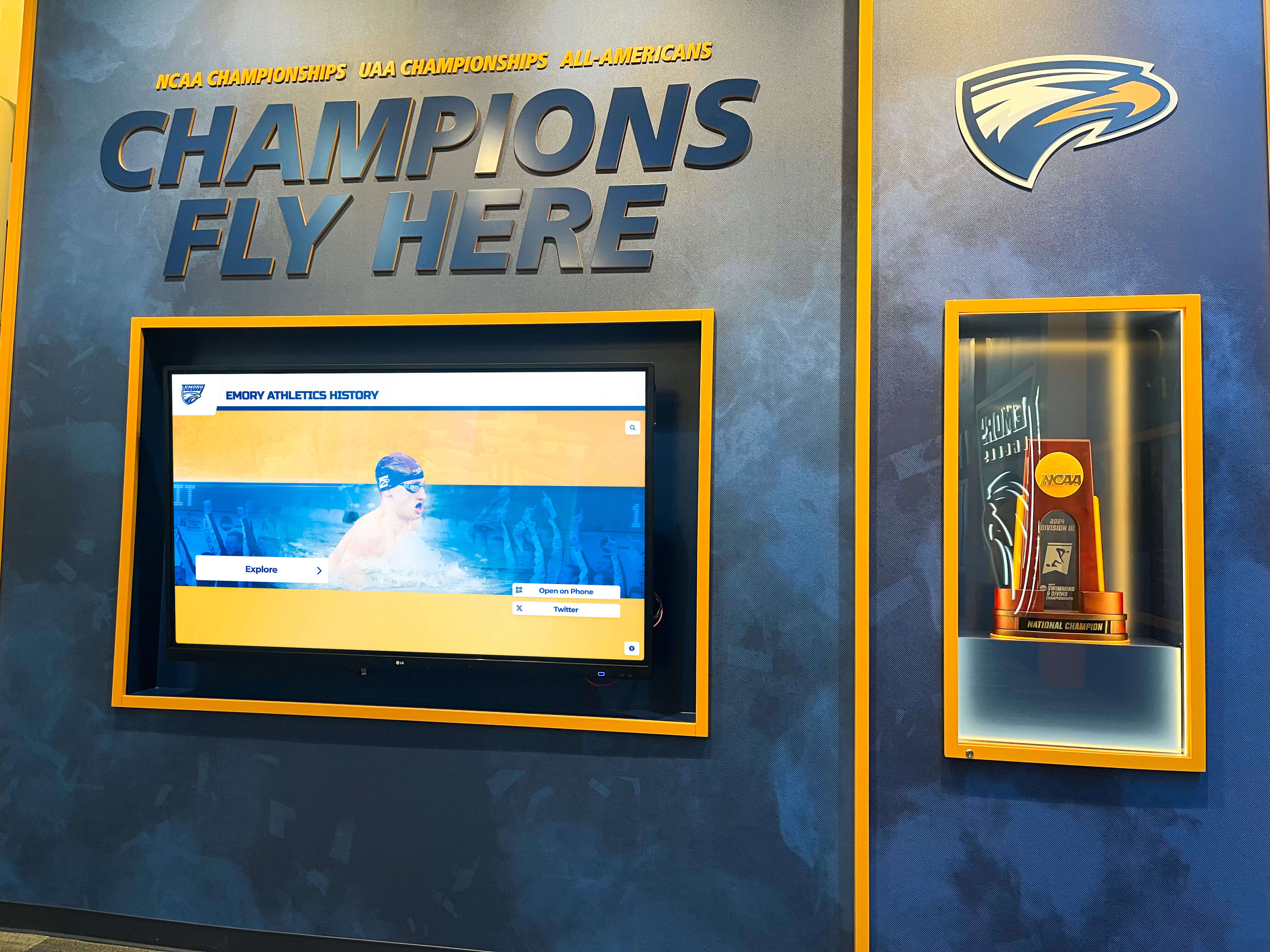
Championship trophy collections that require frequent access during recognition seasons depend on properly maintained roller tracks — a door that requires excessive force to open puts both the glass panel and the display hardware at risk
What Roller Track Inspection Cannot Cover
A roller track inspection conducted by facilities staff addresses the rollers, channels, and track mounting hardware. It does not evaluate:
Glass panel structural integrity: A door panel that slides smoothly may still have glass that is chipped at the edges, stressed at the frame channels, or showing micro-fractures from prior misalignment. Glass condition inspection is a separate assessment that should accompany any roller track inspection finding where the door was previously stuck or required forced operation — forced handling of a stiff door can transmit shock loads into the glass panel.
Lock and latch hardware condition: The lock cylinder, latch bolt, and strike plate that secure a sliding door in its closed position are separate hardware from the roller track system. A door that slides and latches correctly may still have a lock cylinder that is worn, corroded, or not providing the security engagement it should. Lock condition inspection should be conducted as a parallel assessment.
Case body structural integrity: The roller track mounts to the case body frame. If the case body has racked, warped, or separated at its structural joints, the track may appear sound while the frame geometry is causing the alignment problems that produce door friction. A case where roller track cleaning and roller replacement do not resolve door resistance should be assessed for case body geometry issues before additional track repairs are attempted.
Appropriate weight distribution on shelves behind the door: Roller and track capacity ratings apply to the door panel weight, not to the total load in the case. Shelf overloading is a separate risk that should be assessed through a shelf clip inspection.
Connecting Roller Track Condition to the Recognition Program
The sliding doors in front of a trophy case represent the access point to objects that are, in many cases, irreplaceable — state championship trophies, retired jersey plaques, decade-long series of team photographs, and donated memorabilia that the school could not reconstruct if damaged. A door that derails during a routine access event and falls into the case interior does not merely damage the door hardware. It potentially damages every item that the door contacts on its way down, at the exact moment when the case was open for an update or cleaning.
Schools running active recognition programs — adding hardware after each athletic season, displaying academic and arts honors alongside athletic trophies, and maintaining visual records of alumni achievement — access their trophy cases more frequently than schools with static or minimally updated displays. That access frequency is what makes roller track maintenance most important: the more often a door is opened and closed, the more critical it becomes that the track system is confirmed sound before the high-traffic season begins.
Schools exploring how digital trophy case platforms complement physical display infrastructure will find that the documentation discipline developed for physical maintenance translates directly to digital platform management: a regular check schedule, a recorded outcome, and a clear escalation path for problems that exceed the first responder’s scope.
For facilities teams coordinating trophy case maintenance across multiple buildings or athletic facilities, interactive school trophy case display resources provide a useful reference for understanding how physical and digital recognition infrastructure can be maintained in parallel.
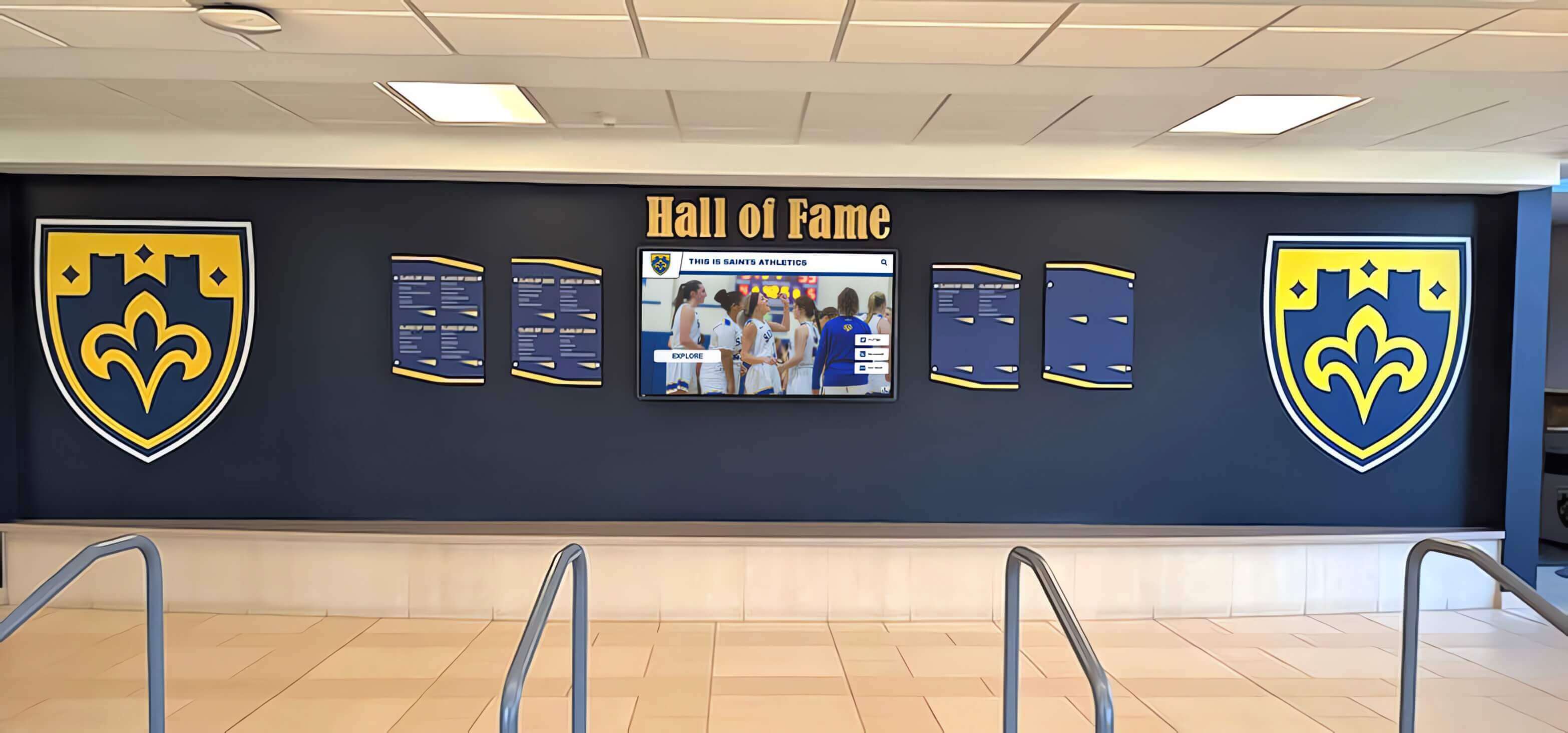
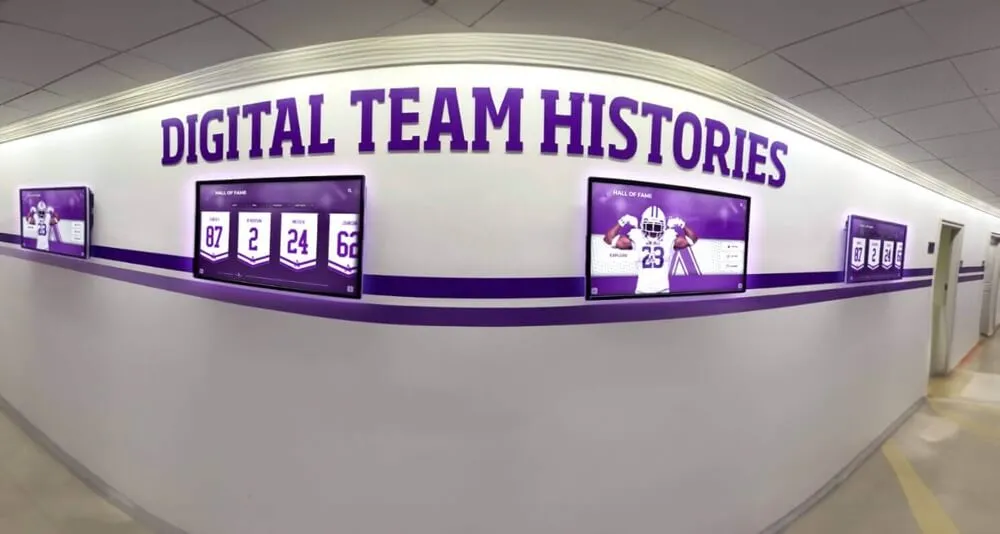
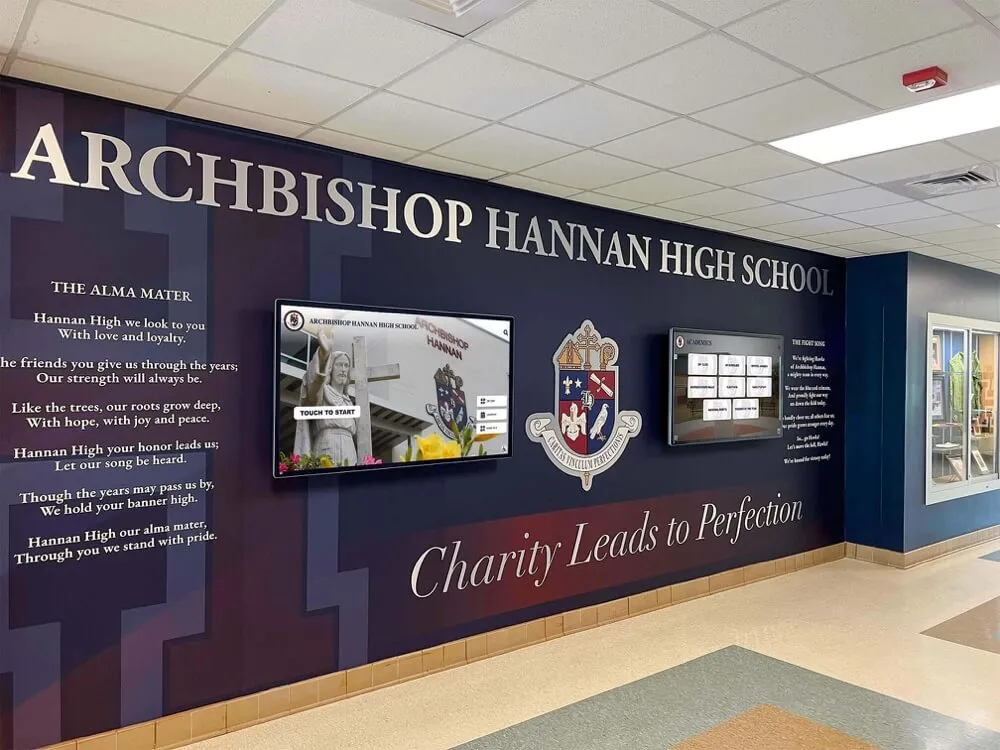
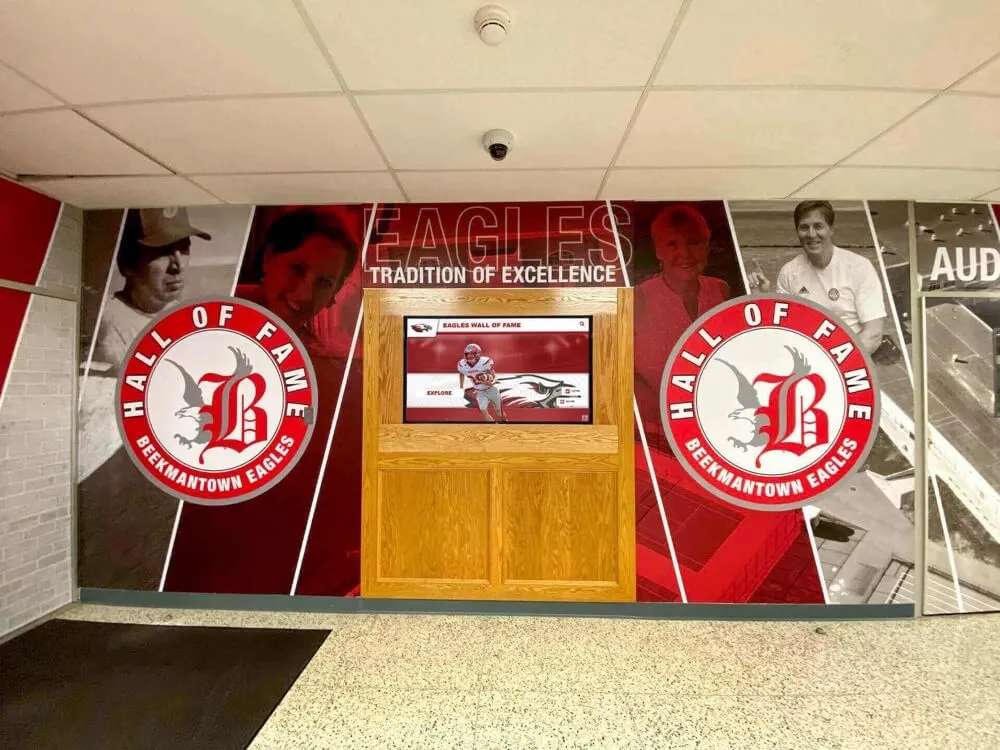
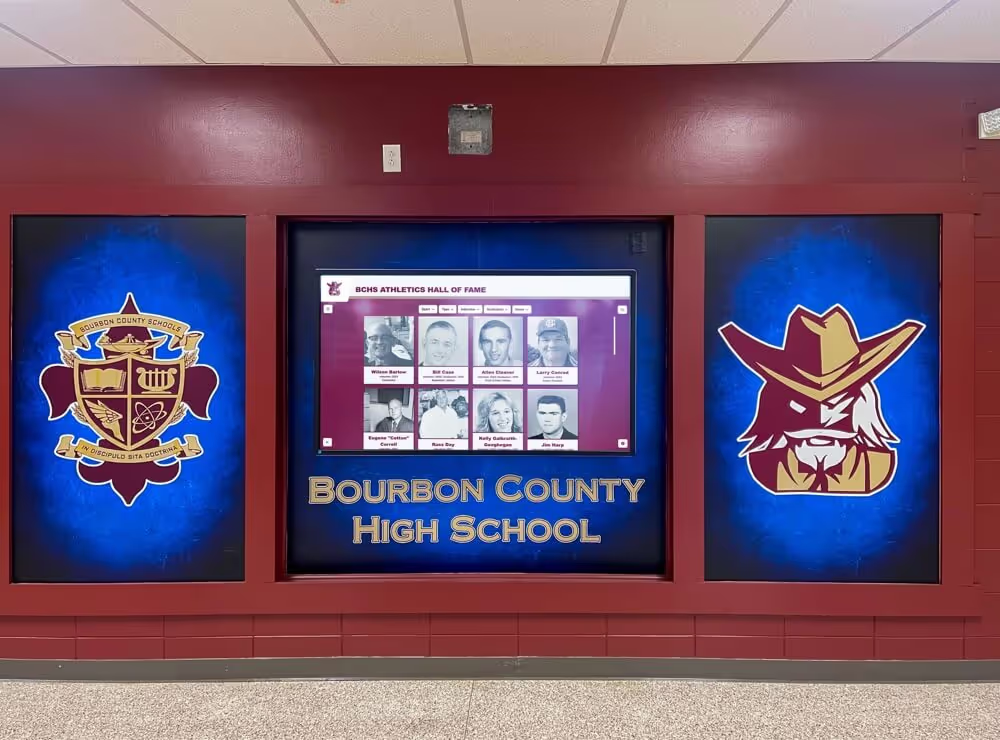
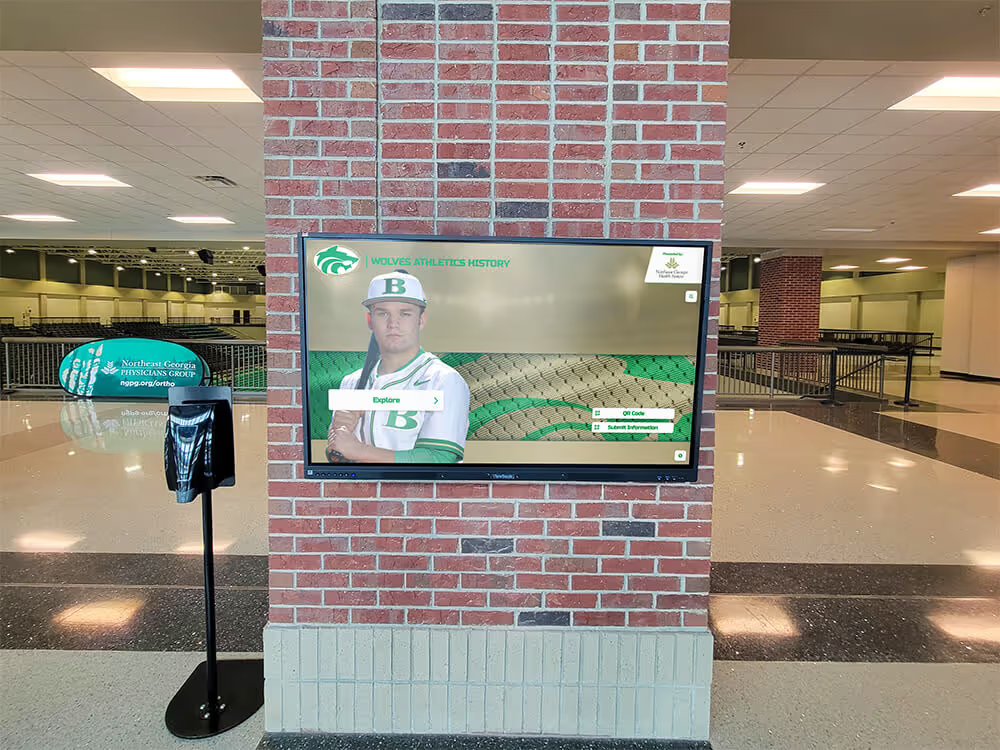
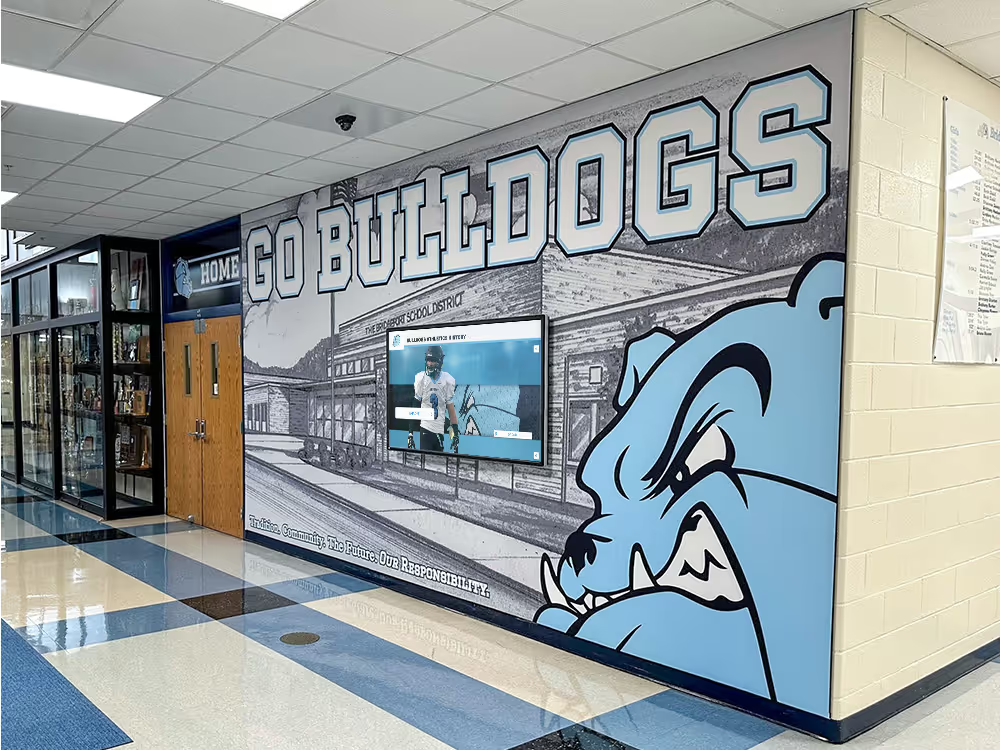
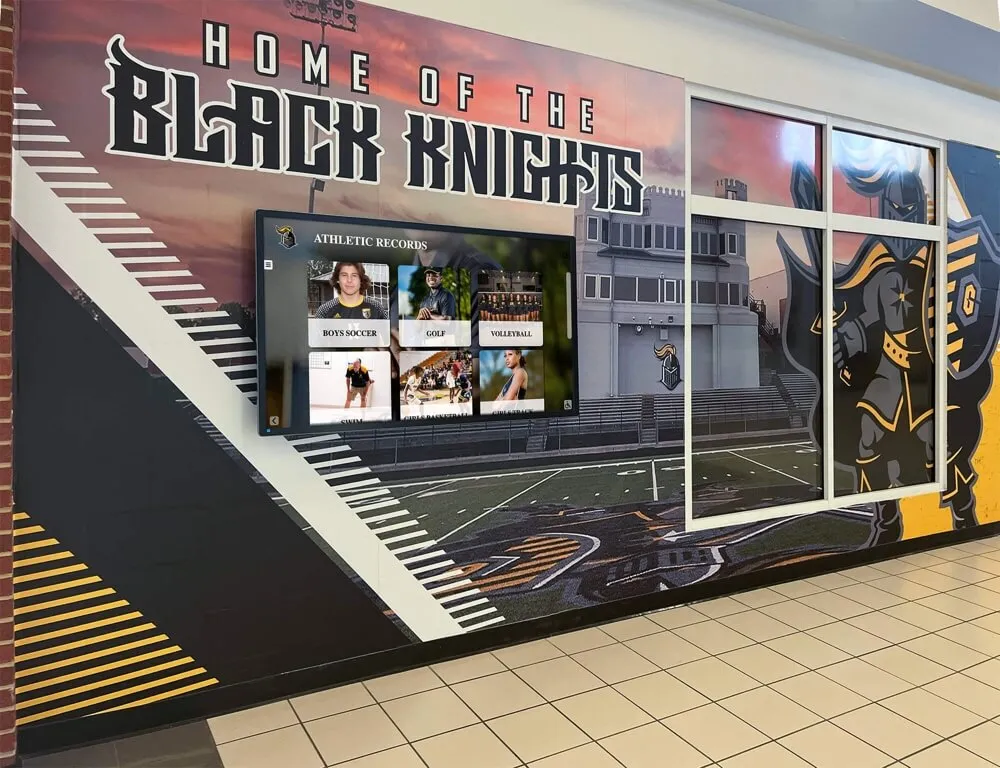
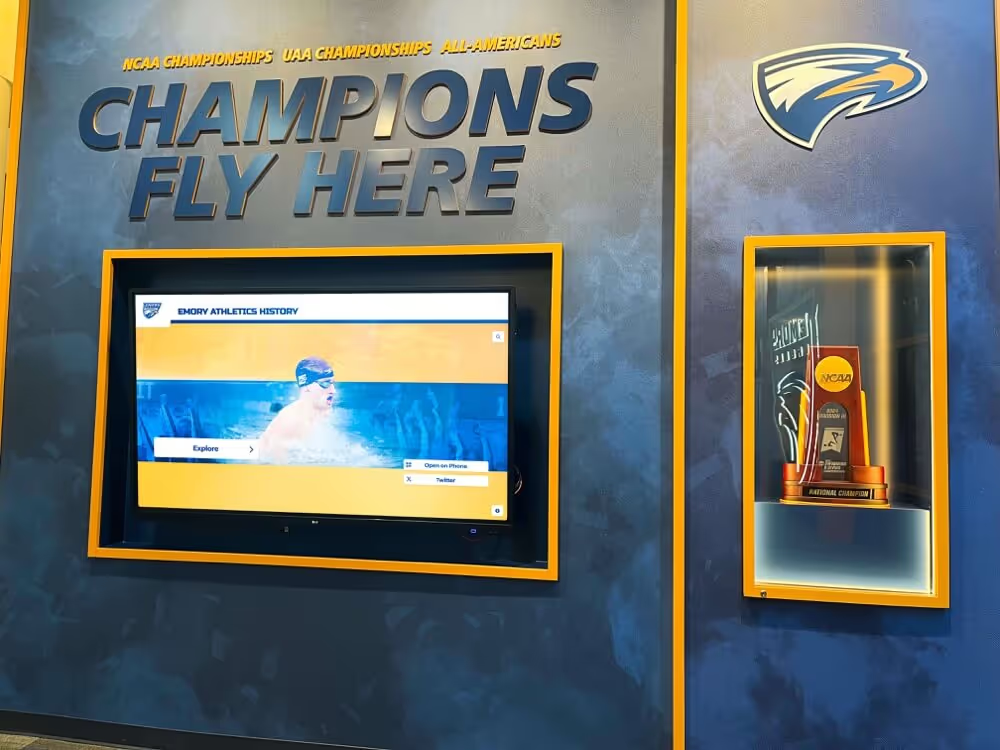
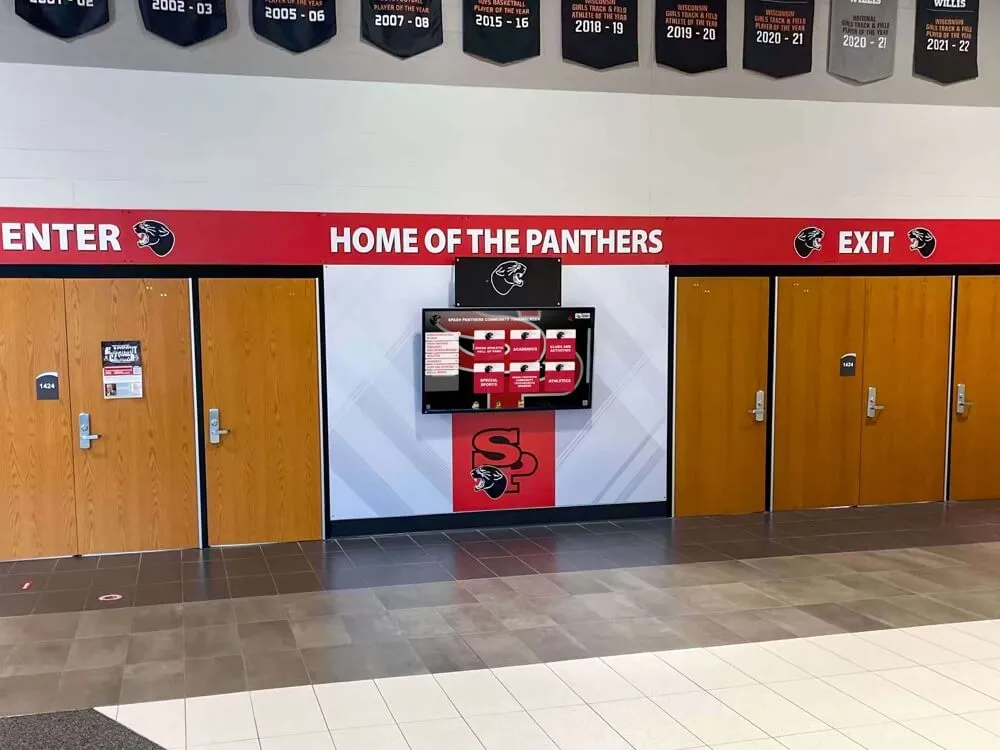
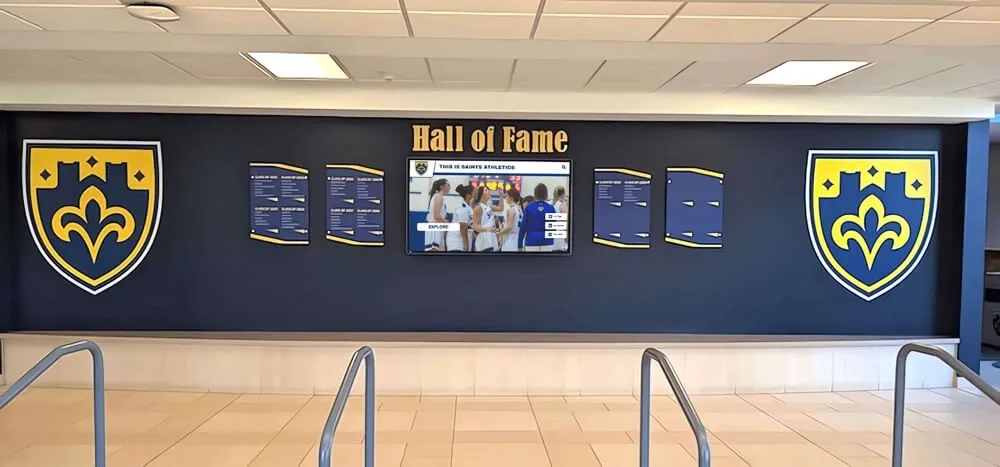
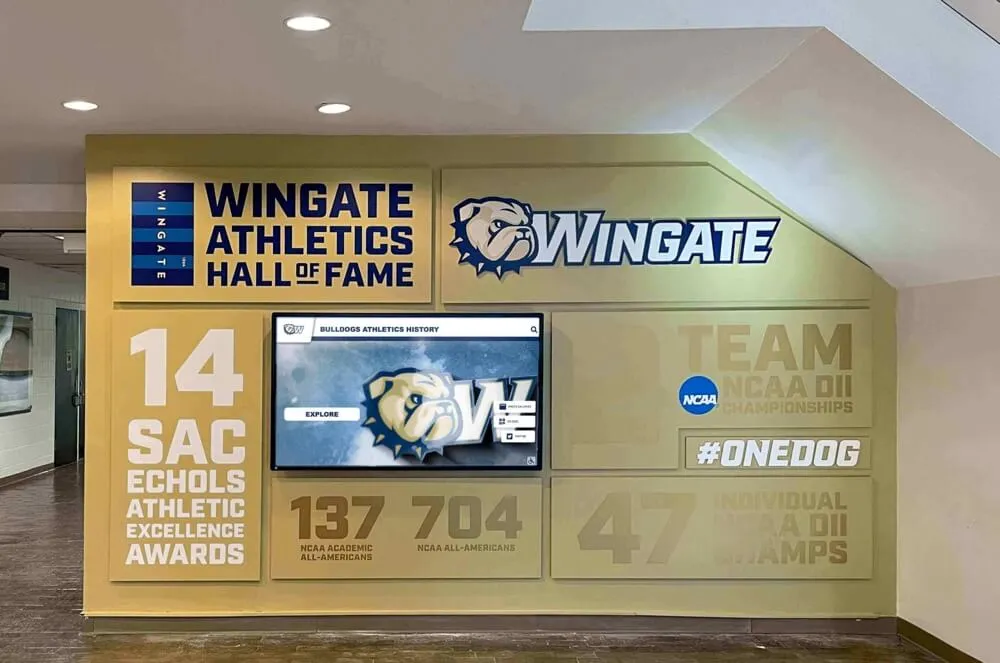
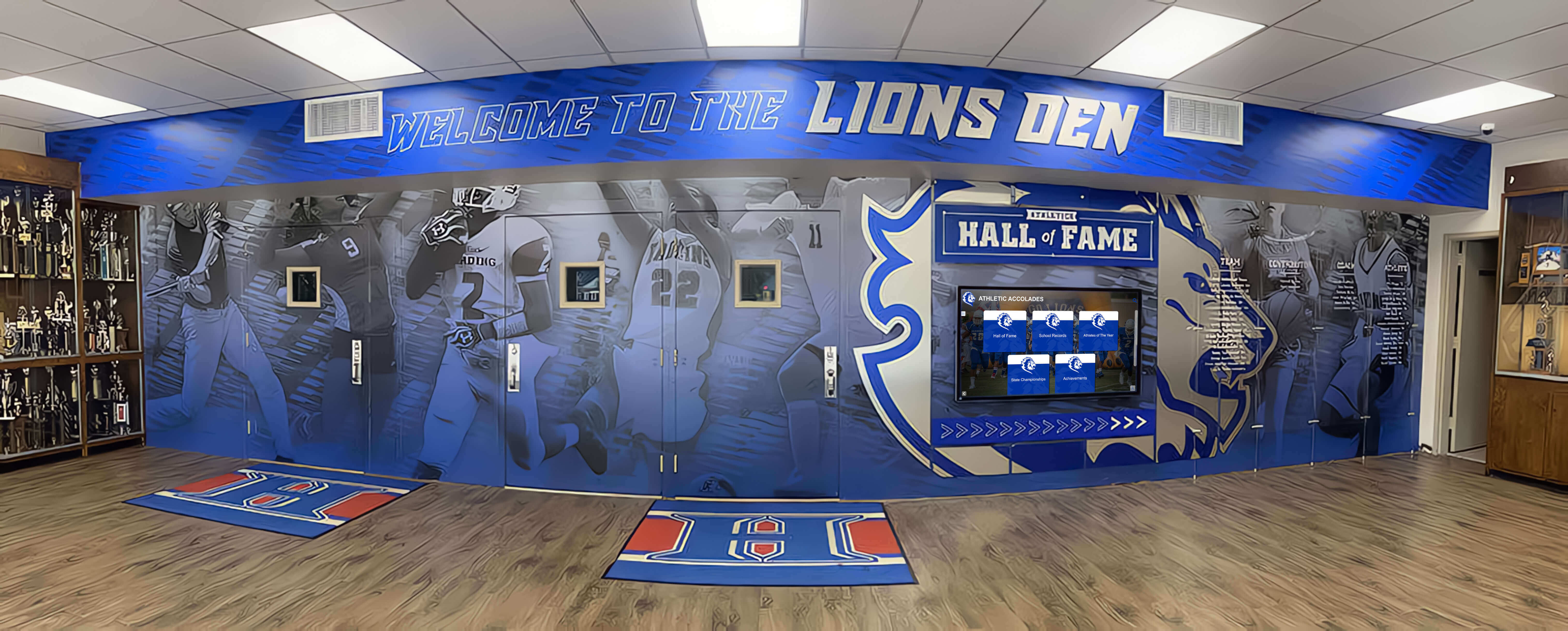
A lobby recognition installation that combines physical trophy cases with a digital recognition screen represents two parallel maintenance tracks — roller track inspection for the physical display hardware, and content management for the digital platform
When Physical Cases Are Maintained — and Still Cannot Hold Everything
A trophy case with clean roller tracks, sound rollers, and correctly seated door panels is still a fixed-capacity physical object. The school that has been accumulating recognition hardware for thirty years has a finite number of cases, a finite number of shelves, and a finite number of doors — and at some point the math of one new award per season exceeds the available display space regardless of how well the physical infrastructure is maintained.
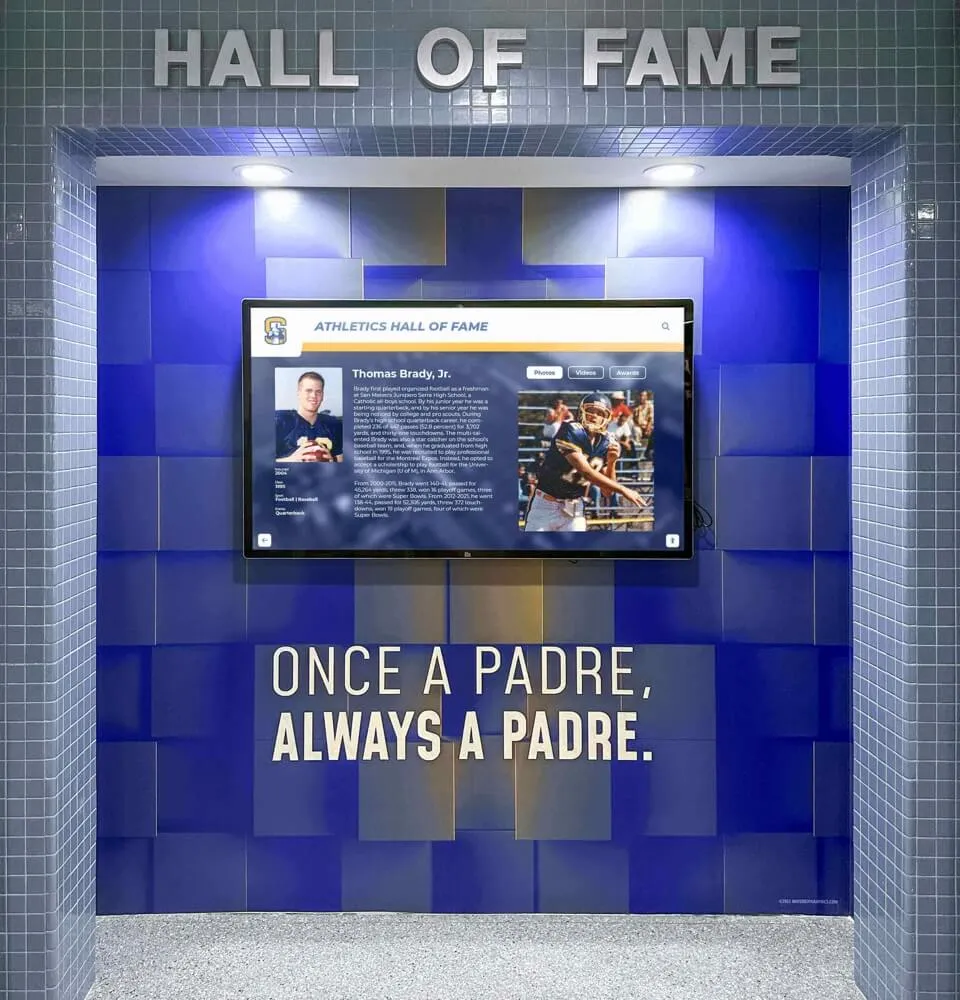
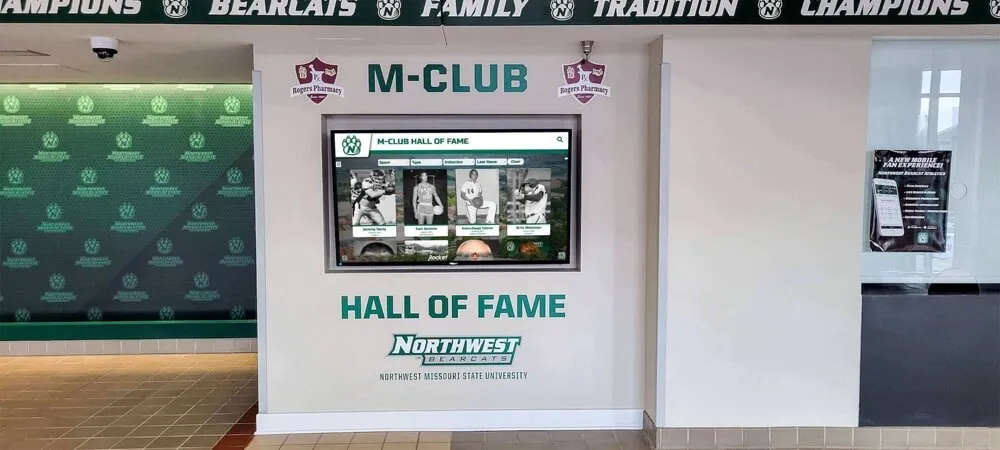
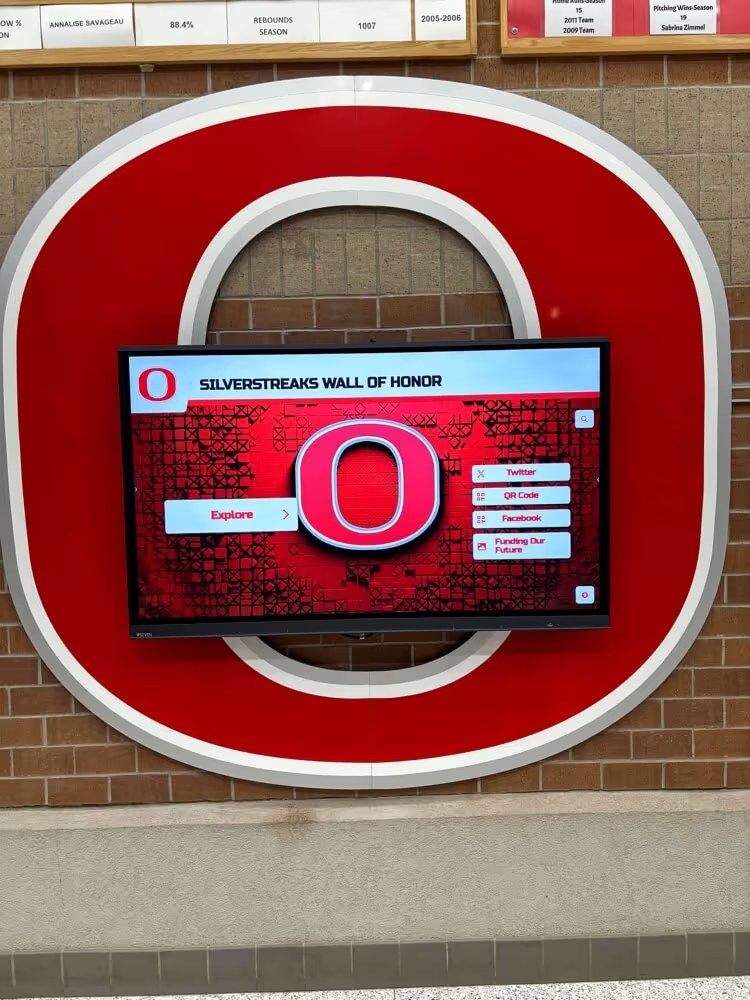
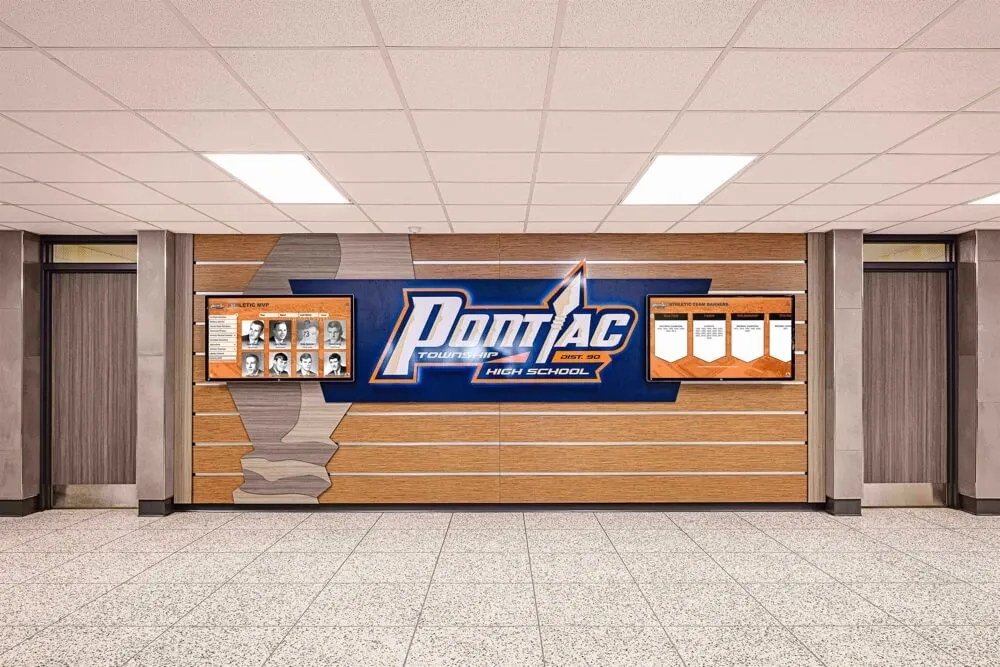
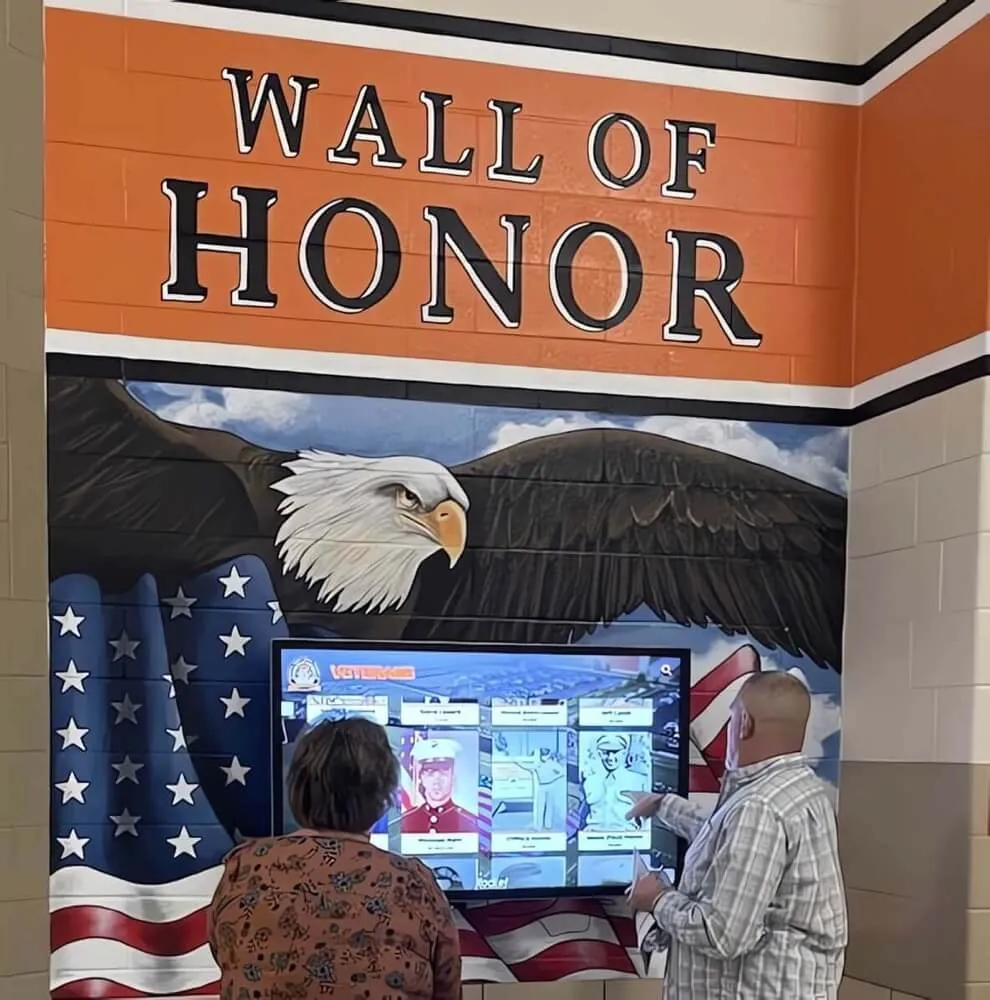
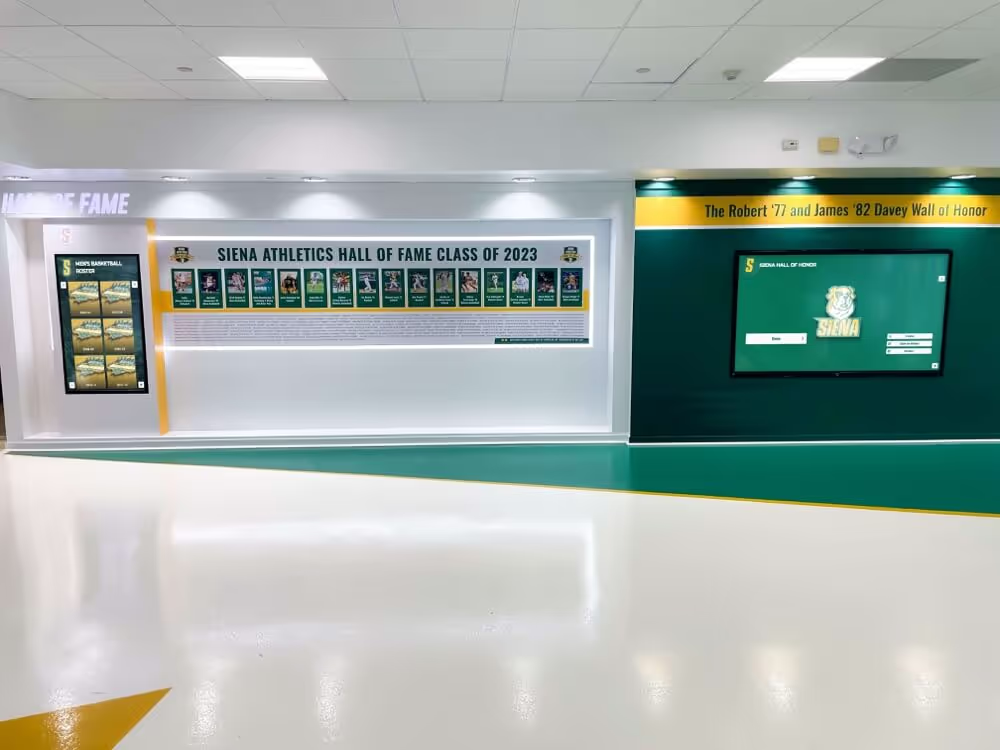
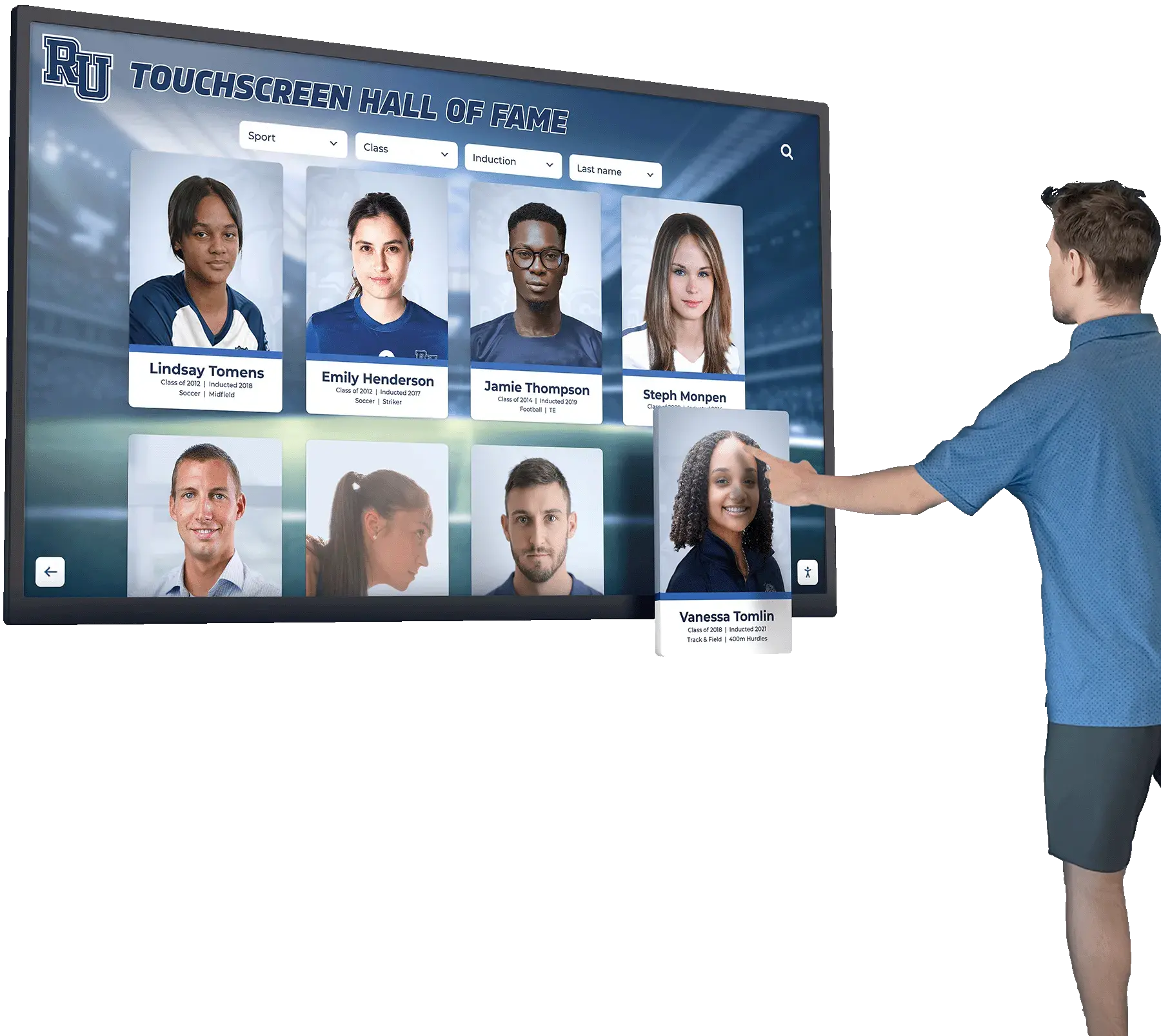
Schools that have resolved the inspection and maintenance question and turned their attention to capacity are increasingly adding digital recognition platforms alongside their physical cases. A digital wall of honor kiosk makes an unlimited institutional recognition record searchable by touchscreen — every athlete, every academic honor, every season — without adding weight to any shelf, requiring a door to be opened, or placing any demand on the roller track that the facilities team just inspected. The physical case holds the irreplaceable objects. The digital platform holds the complete record.
Schools researching the full range of options for digital trophy case design and implementation will find that platforms built specifically for K–12 athletics and academic recognition can operate alongside physical trophy cases in the same corridor — the two systems complementing each other rather than competing for the same display space.
Frequently Asked Questions
What is a school trophy case roller track inspection?
A school trophy case roller track inspection is a structured evaluation of the upper and lower slide channels, roller wheels or glide inserts, end stops, and track mounting hardware on sliding-door display cases, conducted to confirm that each door panel travels its full range without binding, catching, derailing, or making abnormal noise. The inspection documents the as-found condition of the track system — including debris accumulation, track deformation, and roller wear — before and after any cleaning or maintenance is performed.
How do I know if a trophy case roller track needs service?
The most common indicators are: the door requires noticeable force to start moving from rest, there is a catch point or stutter somewhere in the travel range, the door makes grinding or gritty noise during travel, or the door panel tilts outward during travel. Any of these symptoms indicates that the track system is not operating within design parameters. A door that shows no symptoms but has not been cleaned in more than twelve months should receive a cleaning inspection regardless of whether symptoms are present, because debris accumulation is progressive and symptoms may not appear until the track is significantly impeded.
Can facilities staff service trophy case roller tracks in-house?
Staff can clean track channels, inspect and replace roller wheels where the replacement part is confirmed to match the original specification, and re-seat door panels that have been removed and incorrectly reinstalled. What is outside staff scope without manufacturer guidance: repairing or replacing track sections where channel deformation is present, correcting case body frame geometry issues that are causing track alignment problems, and specifying replacement rollers when the original manufacturer is unknown. Those assessments should involve the case manufacturer or a qualified technician.
How often should roller tracks be inspected?
Most school facilities programs benefit from a full-building roller track inventory annually — ideally before the fall awards loading cycle — with targeted re-inspection after any event where a door was operated under abnormal conditions (forced handling, a heavy item contacting the track, or a door stuck in an open position for an extended period). Cases in high-traffic corridors accessed frequently by multiple staff members warrant semi-annual inspection.
What happens if a worn roller is not replaced?
A roller with a flat spot produces a bump in the door’s travel path that applies an impact load to the track channel with each door cycle — gradually denting the track at the contact point. A roller with a cracked body may shed debris into the track channel or lose structural integrity and allow the door to drop on one side during travel. A roller whose axle bearing has worn to the point of significant play will allow the door to shift laterally during travel, pressing the glass panel against the upper channel walls. Each failure mode, if continued, produces additional damage to the track, the channel, or the glass panel.
Should I photograph roller tracks during inspection?
Photograph any track deformation, any roller that is not round and sound, any missing end stop, and any debris accumulation rated Moderate or Heavy. Photographs document the as-found condition before any cleaning is performed, provide a comparison baseline for the next inspection, and give the case manufacturer or a technician enough visual information to specify the correct replacement parts or remediation approach without a site visit.
How is roller track inspection different from other trophy case inspections?
Roller track inspection is specific to sliding-door trophy cases. Cases with hinged glass doors require a hinge alignment inspection rather than a roller track assessment. Cases with fixed glass panels require neither, but may require glazing bead and seal inspection. A building with a mix of sliding-door and hinged-door cases requires both types of inspection in the same facilities round — each addressing the operating mechanism specific to that door type.
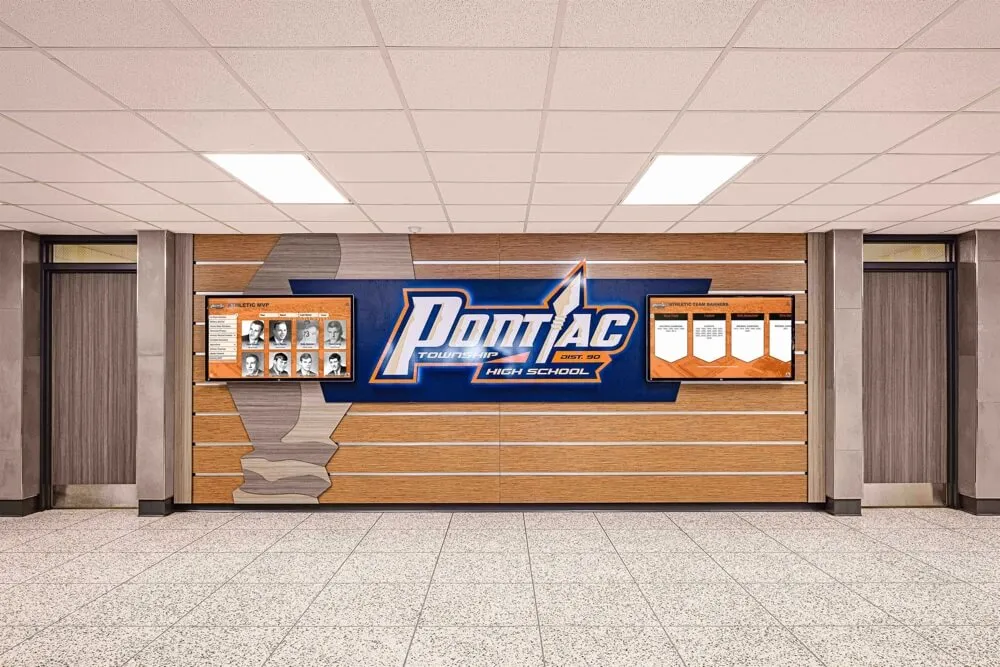
Athletic recognition installations across multiple corridors may include both hinged and sliding-door trophy cases — facilities teams should identify which door type is present in each case and apply the appropriate inspection protocol
Building a Documentation Culture Around Recognition Infrastructure
The roller track inspection checklist is one element of a broader facilities discipline that treats school recognition infrastructure as the institutional asset it is. Schools that maintain systematic documentation — roller and track condition, shelf clip condition, hinge alignment, lock cylinder function, glass safety film status — are not conducting extra work. They are converting the unrecorded assumption that “everything slides fine” into a documented confirmation of what is actually sound, what needs attention, and who is responsible for follow-up.
That documentation culture extends naturally to digital recognition platforms when schools add interactive touchscreen systems alongside their physical cases. The facilities team that follows a roller track inspection checklist and replaces a worn roller before the door derails is operating from the same discipline that a content administrator uses when auditing a digital recognition platform for outdated records, missing photographs, and display hardware that requires attention. The work looks different, but the workflow — regular schedule, recorded outcome, clear escalation path — is the same.
For schools developing recognition programs that will outlast any individual facilities team member or athletic director, systematic documentation pays forward across staff transitions. A new facilities team member inheriting a building with twelve trophy cases and a complete roller track inspection log — every panel rated, every cleaning recorded, every replacement documented — knows exactly what they have and exactly what condition it is in. That is the value of a repeatable inspection workflow: not a guarantee that no door will ever stick, but a documented record of what was confirmed, what was found, and what was done about it.
Ready to Extend Your Recognition Program Beyond the Physical Case?
Rocket Alumni Solutions builds touchscreen digital trophy cases, interactive halls of fame, athletic record boards, and scholar-athlete recognition systems for schools of every size. When physical cases are fully inspected and maintained — and still running out of space — a digital platform gives every athlete, every honoree, and every season permanent, searchable, unlimited visibility without adding a single door to the track system.
Book A DemoA completed school trophy case roller track inspection log tells the facilities team exactly which door panels are confirmed serviceable, which rollers require replacement, and which cases need to come out of service until remediation is complete. No door is assumed to be sliding correctly because it slid correctly last fall. No roller is assumed to be sound because no door has derailed yet. That is the standard a systematic inspection workflow is designed to meet: documented knowledge, not deferred assumptions.