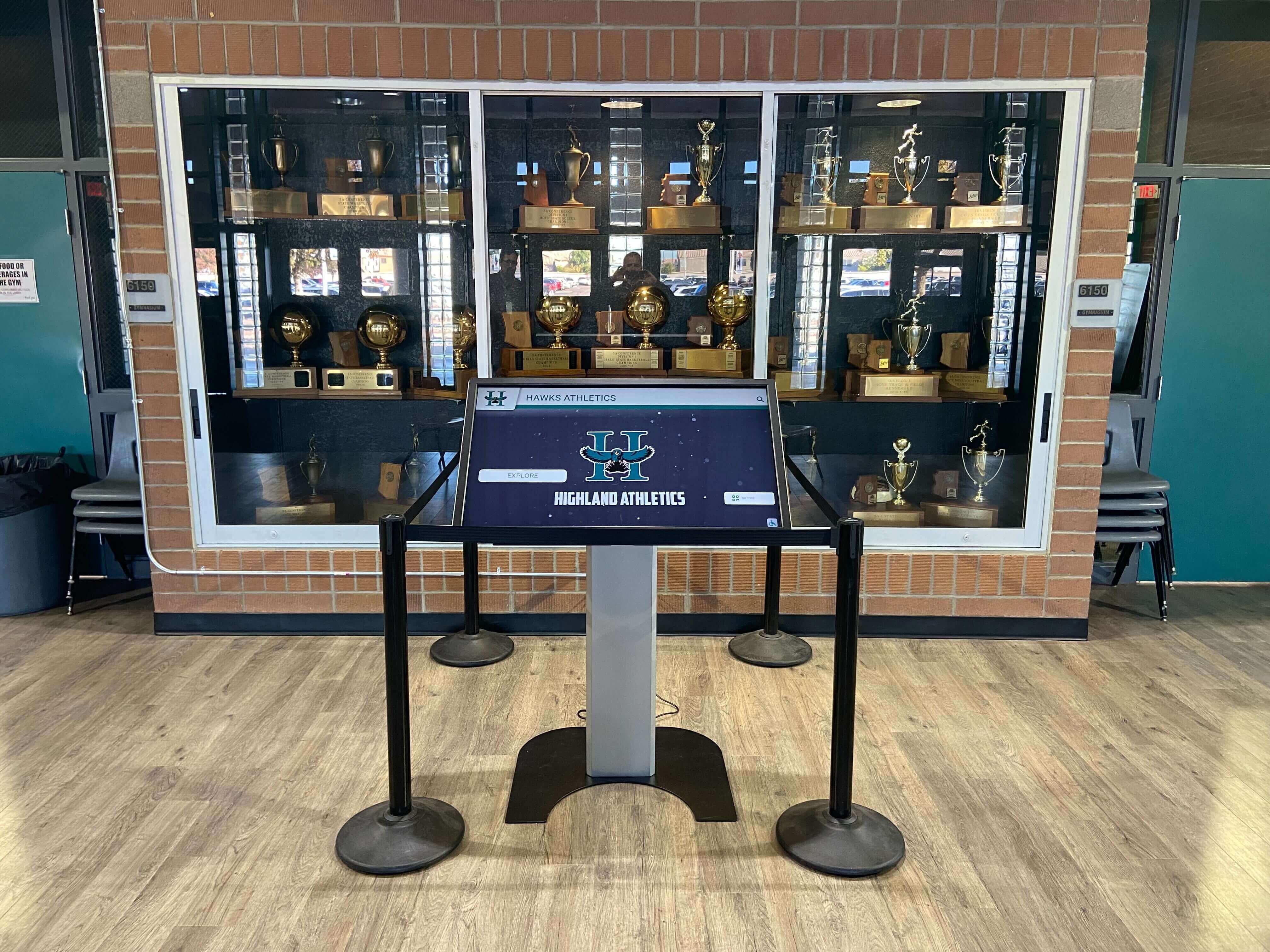
The Easiest Touchscreen Solution


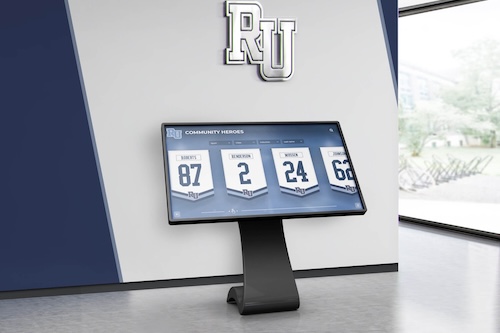

Live Example: Rocket Alumni Solutions Touchscreen Display
Interact with a live example (16:9 scaled 1920x1080 display). All content is automatically responsive to all screen sizes and orientations.
Historic championship ribbons, pennants, and game jerseys in a school trophy case carry decades of athletic identity—but many were dyed with colorants whose light sensitivity has never been measured. When a textile fades visibly in a display case, the damage is already permanent. Microfade testing is a specialist assessment method that characterizes how quickly a specific dye responds to light, giving school administrators the data they need to decide how long a historic textile can safely stay on display, when it should rotate into protected storage, and whether an accurate digital facsimile should stand in for the original. This checklist guides athletic directors and facilities staff through the referral process—from identifying candidates to acting on results.

Trophy cases hold irreplaceable championship textiles whose light sensitivity may be unknown—a problem specialist microfade assessment can help quantify before visible damage occurs
What Microfade Testing Is—and What It Is Not
A microfading tester directs a tightly focused beam of light onto a very small area of an object’s surface while a spectrophotometer measures any resulting color change in real time. The rate and magnitude of that change are compared against calibrated reference standards, giving conservators a data-driven way to classify the colorant’s light sensitivity as low, moderate, or high. Schools can use that classification to set display time limits, choose appropriate lighting conditions, and decide whether originals should be exhibited at all or replaced by faithful reproductions for most of the year.
The test is not nondestructive. Although the induced color change at the test spot is tiny—often below what the human eye can detect under normal viewing conditions—a real, measurable change does occur at the sampled point. For irreplaceable historic textiles, that distinction matters and should be part of any decision about whether to proceed. The Getty Conservation Institute has published detailed research and guidance on microfading tester methodology and its application to light exposure management in institutional collections; their project documentation is available on the Getty’s Advancing Microfading Tester Practice project page.
Microfade testing is not a DIY procedure. The instrument requires calibrated light sources, precise spectrophotometric measurement, and trained interpretation of results in context. Only conservation professionals with appropriate equipment and experience should carry out assessments on objects with historical value.
Microfade testing is also not the same as monitoring ambient lux or UV levels in a display case. Lux and UV measurements describe the light environment a textile is already experiencing. Microfade testing characterizes how the textile’s own colorants respond to that light—two distinct questions that together build a complete picture of display risk, and neither replaces the other.
The Sampling Limitation Every School Must Understand
Because the instrument contacts only one small spot at a time, results describe that specific location—not the entire garment, ribbon, or pennant. A championship pennant may carry multiple dye colors applied to the same fabric: the red background, the gold lettering, and the blue border may each have entirely different light sensitivities. Testing only the red background provides no data about how quickly the gold letters will fade.
A complete assessment of a multicolored textile ideally samples each visually distinct colorant area, which increases both the number of test points and the amount of specialist time required. Schools should understand this before contacting a conservator: the more complex the textile’s color scheme, the more comprehensive the sampling plan needs to be, and the more micro-scale test marks the original will carry afterward.
No assessment, however thorough, provides a guarantee of remaining useful display life. Microfade data characterizes sensitivity under controlled test conditions; real display environments involve variation in temperature, relative humidity, light source spectrum, and cumulative dose that the test cannot fully predict. A result that classifies a pennant as low-sensitivity is not a permanent clearance—it is a data point that informs a specific decision at a specific point in time.
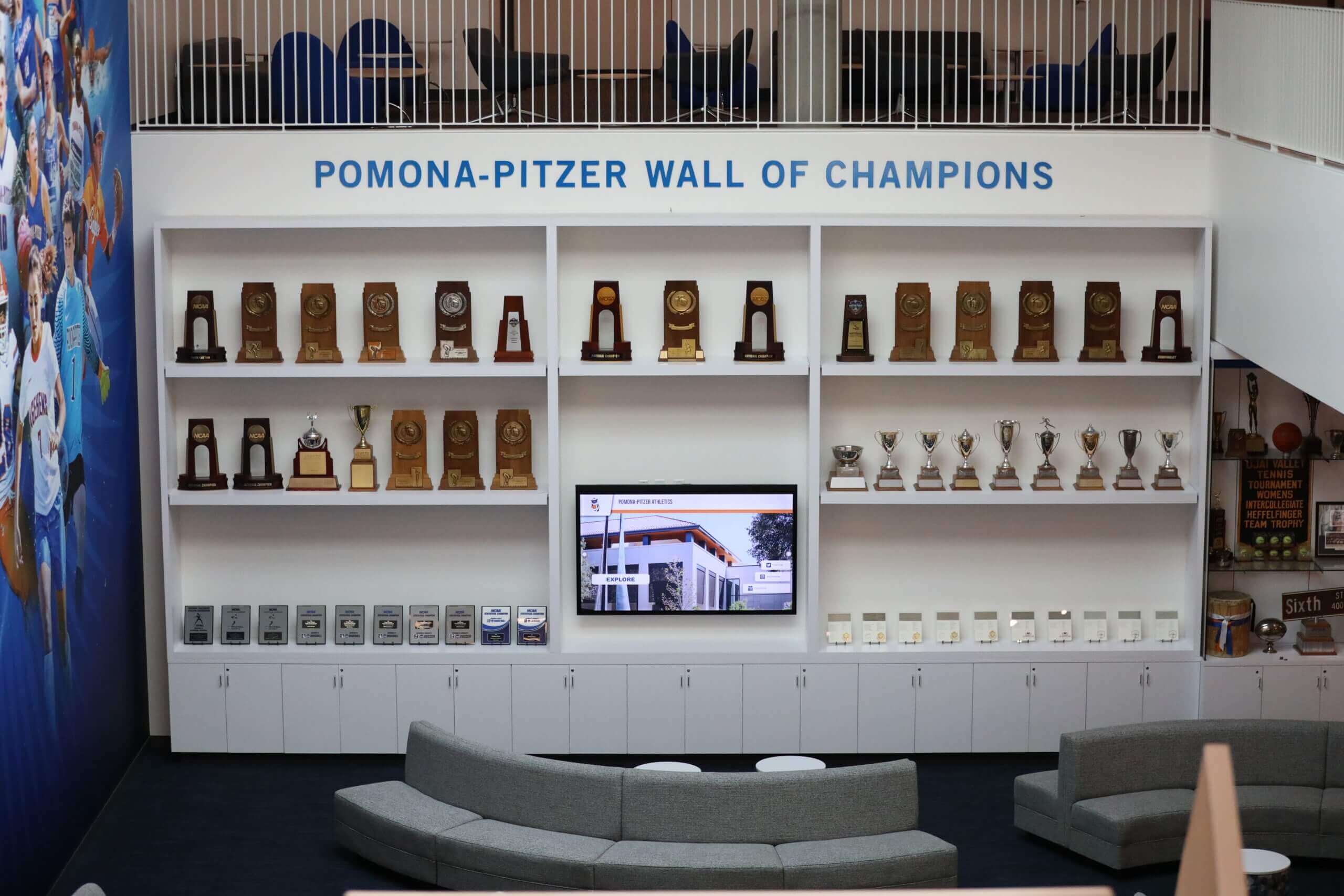
Championship trophies and associated textiles in lounge-style trophy installations often receive continuous ambient light with no rotation schedule—precisely the situation that benefits from a light-sensitivity assessment
Who Should Refer Historic Textiles for Microfade Testing
Not every item in a school trophy case needs specialist assessment. The following profile describes the candidates most likely to benefit from a formal referral:
- Pre-1980 championship ribbons whose dye type is unknown and whose color already shows uneven shading or slight discoloration near light sources
- Wool pennants with aniline or early synthetic dyes, especially those displaying any color shift, since aniline dyes were used widely through the mid-twentieth century and many are highly light-sensitive
- Retired game jerseys more than 30 years old, particularly those with screen-printed lettering or embroidered numbers in colors that may have faded differentially from the base fabric
- Silk or satin ribbons from championship competitions, whose protein-based fibers degrade under both light and humidity exposure over decades
- Any textile scheduled for a permanent or long-term display installation rather than a short-term seasonal rotation
- Items with significant institutional meaning where irreversible fading would represent a genuine loss to school athletic history and the names associated with it
Items that are already severely faded, structurally fragile beyond safe handling, or known reproductions typically have lower priority. The display decision for those items is often already clear from visual inspection alone.
The Referral Checklist: Before, During, and After Assessment
Use the following numbered steps to organize a microfade testing referral from initial identification through post-assessment action.
Before the Referral
Photograph each candidate textile in consistent, controlled lighting—indirect daylight or a calibrated light box—before the item leaves your care. These baseline photographs document pre-assessment color and condition and become the reference against which any future change can be compared.
Create a written condition record for each item: dimensions, fiber type if known, estimated date, dye method if documented (screen-printed, embroidered, woven), and any visible existing damage such as fading, staining, or fiber loss.
Research the item’s display history as completely as possible: how many years it has been in a lit case, the approximate lux level of that case, and whether it has spent time in storage or been displayed continuously. Even rough estimates help the conservator contextualize results and frame realistic expectations.
Note the current case environment: average lux level if you have been monitoring it, presence or absence of UV-filtering glazing, case temperature range, and ventilation. Schools without existing monitoring records should note that gap; it is relevant information for the conservator, not a source of embarrassment.
Confirm institutional authorization to allow a conservator to make micro-scale test contact with each textile. For items with significant historical weight—a championship pennant from a celebrated era of school athletics, a retired jersey bearing a name that means something to the community—this decision may involve school board leadership, an athletics advisory committee, or historical society input.
Contact a textile conservator with documented experience in museum or archival collections. Professional conservator directories maintained by organizations such as the American Institute for Conservation can help you identify credentialed candidates searchable by specialty and region.
During the Assessment
Ask the conservator to document each test point location with a scaled photograph before, immediately after, and at a short interval following the test. These records form part of the object’s permanent condition file and establish a baseline for any future reassessment.
Request a written report identifying each test point, the colorant sampled, the light sensitivity classification, and the conservator’s recommended maximum annual light exposure—typically expressed in lux-hours per year—for each tested area.
Ask specifically about sampling limitations: which colorant areas on each textile were not tested, and what the conservator’s professional judgment is about those untested areas based on visual inspection and material knowledge.
Clarify what the results do and do not predict: microfade data characterizes sensitivity under controlled test conditions, not a precise schedule for how long the textile will remain stable in your specific display environment. Any conservator who presents results as definitive longevity predictions should prompt careful follow-up questions.
After the Assessment
Review the recommended lux-hour limits against your case’s measured light levels to calculate a realistic rotation schedule—how many hours per year, and therefore how many months per display cycle, each item can remain lit without exceeding its safe exposure budget.
Commission or create accurate digital facsimiles of each high-sensitivity textile before scheduling its next display period. High-resolution calibrated photography captures color and texture in enough detail that a printed or screen-displayed reproduction can stand in for the original without misleading viewers about what they are seeing.
Label displayed reproductions clearly. Visitors and students should understand that what they are viewing is a reproduction made to protect the irreplaceable original. A label explaining that the original is preserved in climate-controlled storage adds interpretive context rather than diminishing the display.
Update the item’s condition record with the assessment date, conservator name and credentials, test point locations, and recommended limits. Store this documentation with the textile itself, not only in a separate administrative file that may be separated from the object over time.
Schedule a follow-up assessment at the interval the conservator recommends—typically every five to ten years, or whenever a significant change in display conditions occurs such as a case relocation or light source upgrade.

Preserving the names and stories behind championships means protecting the physical objects that carry that history—and creating accurate digital backups when originals are too fragile for continuous display
Decision and Referral Priority Table
The table below summarizes common school trophy case textile scenarios and the appropriate referral priority. Use it for initial triage, not as a substitute for professional assessment.
| Textile Type | Estimated Age | Dye Type | Current Condition | Referral Priority |
|---|---|---|---|---|
| Grosgrain championship ribbon | Pre-1970 | Unknown | Slight yellowing or uneven color near light | High — refer before next display period |
| Wool pennant, multicolor | 1950s–1970s | Likely aniline | Any color shift visible, especially at edges | High — aniline dyes frequently fugitive |
| Silk or satin competition ribbon | Any era | Unknown | Lustrous but unexamined | High — silk degrades under light and humidity |
| Game jersey, cotton with screen print | 1980s | Screen-printed lettering | Print cracking, color appears stable | Medium — assess before long-term installation |
| Game jersey, synthetic fabric | 1990s–2000s | Likely synthetic dye | Color appears stable | Low — monitor with lux log; refer if change appears |
| Pennant with documented UV-stable materials | Post-2000 | Modern documented dye | Color stable | Low — periodic monitoring sufficient |
| Known reproduction jersey or pennant | Any | Modern synthetic | Stable | Not indicated — manage by rotation; test originals instead |
When a textile falls between categories—for instance, a 1985 jersey whose dye type is undocumented and whose color appears unchanged—err toward a medium-priority referral if the item is scheduled for a permanent or high-visibility installation.
Pairing Protected Originals with Accurate Digital Images
A microfade assessment that classifies a pennant as highly light-sensitive does not mean the pennant must disappear from school life. It means the pennant should be stored under conditions that minimize further light exposure, while an accurate representation takes its place in the display case and in the digital record.
High-resolution photography—shot under consistent, calibrated light before the textile enters protective storage—provides the source material for display-quality printed reproductions and digital files. Those digital versions can also appear in a searchable touchscreen platform alongside the item’s full story: the year it was won, the athletes’ names, the final score, the coach’s tenure, the conference record it represented. That surrounding context, which a glass trophy case cannot communicate anyway, is exactly what makes the names and stories behind championships accessible to current students who weren’t there and to alumni who were.
Schools exploring what a modern recognition platform can hold alongside digitized historic items may find the overview at why schools are switching to digital trophy case systems a useful orientation to the range of athletic, academic, and archival content those platforms support.
For programs coordinating public recognition announcements around newly digitized historic collections—such as a hall of fame induction where the inductee’s archived jersey becomes part of a permanent digital profile—press release templates for school hall of fame inductees and digital profiles offer a structured starting point for the communication side of that work.
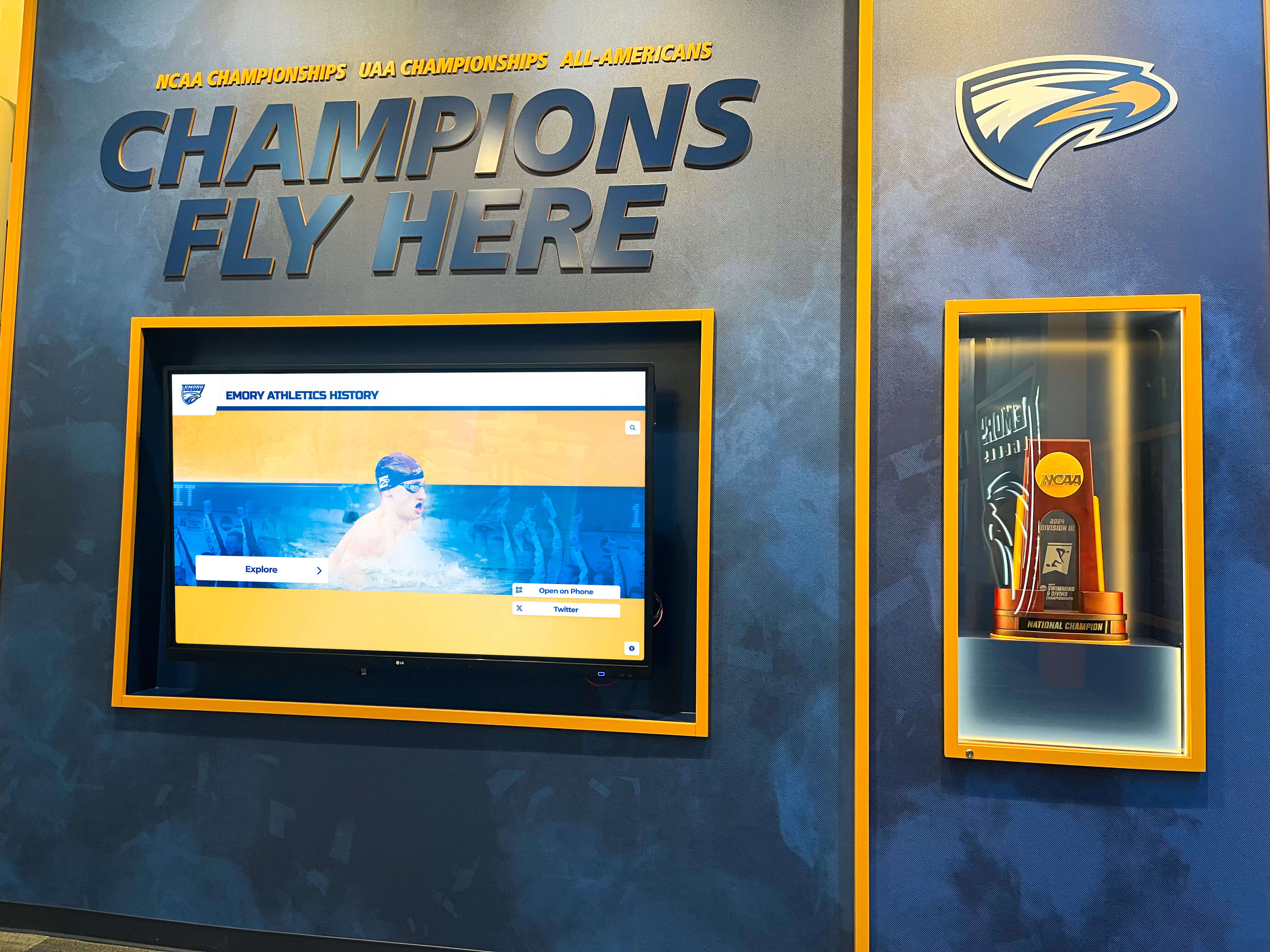
Championship hardware installations may include historic textile items alongside trophies—each with its own light-sensitivity profile that merits individual assessment before a long-term display plan is finalized
Questions to Ask the Conservation Specialist
When speaking with a prospective conservator about microfade testing for school trophy case textiles, the following questions help evaluate their approach and clarify what the school will receive.
Qualifications and process:
- What is your professional affiliation, and are you listed in a recognized conservator directory?
- How many textile microfade assessments have you conducted, and in what institutional settings?
- What light source and colorimetric instrumentation does your testing setup use, and how do you calibrate against reference standards?
Sampling approach:
- For a multicolored textile, how will you determine which areas to sample and how many test points to make?
- Will you leave a scaled condition map showing each test point location?
- What will the test marks look like immediately after assessment, and how stable are they over time?
Results and limitations:
- How will you express the results—as a light sensitivity classification, a lux-hour annual limit recommendation, or both?
- What factors specific to our display environment should we account for that the test data does not capture?
- Are there areas on our textiles you would choose not to test, and what is the reasoning?
Follow-up:
- What written documentation will we receive, and in what format?
- At what interval do you recommend reassessment?
- If we commission digital reproductions for display, what color accuracy specifications would you suggest?
When Microfade Results Change the Display Decision
Schools often assume that historic textiles can remain on display indefinitely as long as conditions appear reasonable. Microfade data sometimes confirms that assumption. It sometimes challenges it significantly.
The result that most dramatically changes a display decision is a high-sensitivity classification on an item that has already accumulated substantial light exposure—a pennant, for instance, that has been in a continuously lit case for forty years. In that scenario, the conservator’s recommended annual exposure limit may already be exceeded many times over, and the remaining time before visible fading becomes likely may be short. The practical response is not to display the original at all, or only for very brief, carefully tracked intervals with long dark-storage periods between them.
That outcome is not a failure of the testing process. It is the process working correctly: providing real information that allows a school to make a genuinely informed stewardship decision about the next decade, rather than continuing on autopilot until the damage becomes obvious to everyone standing in the hallway.
Schools developing frameworks for evaluating athletic recognition across multiple formats—not only textiles but trophies, photographs, and records—may find the criteria in athletic awards display eligibility rubrics a useful complement to the conservation-specific lens that microfade results provide.

Digital platforms can display championship textile images alongside athlete names and complete seasonal context—keeping history visible without subjecting fragile originals to additional light exposure
Schools building digital archives of historic athletic materials as a long-term complement to physical preservation should also account for the integrity risks that affect digital files over time. Athletic archive bit rot detection and fixity checklists explain how to verify that scanned files remain intact and readable across storage migrations and format changes—a necessary companion discipline to any physical preservation program.
For administrators evaluating tools available for comprehensive athletic recognition programs that span both physical and digital components, a guide to hall of fame recognition tools for schools and athletics programs provides context on how different platforms handle historic content, archival depth, and ongoing recognition.
Frequently Asked Questions
What is microfade testing for textiles? Microfade testing is a specialist conservation assessment in which a tightly focused light beam is directed at a tiny spot on a textile while a spectrophotometer measures how much the color at that point changes. The rate of change characterizes the dye’s light sensitivity. Results help conservators and institutions set safe display limits and rotation schedules.
Is microfade testing safe for historic championship ribbons and pennants? The test induces a real, measurable color change at the sampled spot, making it not completely nondestructive. In practice, the change is typically too small to detect visually without instruments. Whether testing is appropriate for a specific item is a professional judgment that belongs to a qualified conservator, made in consultation with the institution.
Can a school conduct microfade testing without a conservator? No. The procedure requires calibrated equipment, trained operation, and professional interpretation. It cannot be replicated with consumer instruments or by staff without conservation training and experience.
What happens if a textile tests as highly light-sensitive? The conservator will typically recommend strict limits on annual light exposure, often expressed in lux-hours per year. For most historic school textiles classified as high-sensitivity, this means rotating the original out of display and replacing it with an accurate reproduction for the majority of the time.
Does microfade testing tell us exactly how long a textile will last? No. The test characterizes sensitivity under controlled conditions. It cannot predict remaining useful life precisely, because real display environments involve variables—light spectrum, temperature, humidity, cumulative dose—that differ from the test setup.
Should every old jersey or pennant in the trophy case be tested? Not necessarily. Items in clearly stable condition with documented modern dyes and a monitored, low-light display environment may not need formal assessment. Prioritize textiles with unknown dye histories, visible color change, or long planned display periods where accurate data directly changes a decision.
How do we find a qualified textile conservator? The American Institute for Conservation maintains a public directory of professional conservators searchable by specialty and location. Ask candidates specifically about textile experience and microfade testing equipment before committing to an assessment.
Is there a universal safe lux level for all historic championship textiles? No. Light sensitivity varies significantly by fiber type, dye chemistry, and age of the object. A lux level that is safe for one textile may cause rapid fading in another. Microfade testing exists precisely because no universal tolerance applies across all historic materials.
Keep Championship Stories Visible When the Original Must Rest
When microfade testing shows that a historic pennant, ribbon, or jersey needs protected storage, Rocket Alumni Solutions helps schools keep those championship stories visible and searchable. A cloud-managed digital trophy case displays accurate images of protected textiles alongside athlete names, season records, and full historical context—on an ADA-compliant touchscreen that current students and returning alumni can explore without putting fragile originals at further risk. See how schools are building permanent digital archives alongside their physical preservation programs.
Schedule a DemoLive Example: Rocket Alumni Solutions Touchscreen Display
Interact with a live example (16:9 scaled 1920x1080 display). All content is automatically responsive to all screen sizes and orientations.