



Intent: research — a school trophy case magnetic catch adjustment is a structured evaluation and realignment of the magnet-and-striker assembly that keeps hinged display case doors closed in the latched position, conducted by facilities staff or athletic directors to confirm that each door holds securely at rest, releases cleanly under deliberate hand pressure, and does not drift open on its own during normal building activity. Magnetic catches on enclosed school trophy cases — the paired hardware consisting of a magnet body recessed into the case frame and a steel striker plate attached to the door face or door edge — maintain holding force by precise face-to-face contact between the magnet and the striker. When that contact degrades through mounting screw loosening, door sag, frame humidity swelling, or magnet age, the catch provides less resistance than the door’s weight or air pressure requires, and the door begins to drift, bounce, or fall open without any deliberate action by staff. A systematic magnetic catch inspection and adjustment prevents a door from swinging open into a heavy trophy, into a visitor’s hand, or into a glass shelf — outcomes that are straightforward to prevent at the adjustment stage and significantly more consequential once the door has already moved.
A trophy case door that swings open on its own is not a minor inconvenience — it is an unsecured access point in front of a collection that may include state championship hardware, retired jerseys, and memorabilia representing decades of athletic achievement. The magnetic catch is a small component: typically a 25–50 mm magnet body and a matching striker plate, connected by nothing more than magnetic attraction and the friction of their mounting screws in the case frame. But it is the only mechanism keeping a hinged display door in a closed and secured position between access events, and when it fails, nothing else in the door hardware takes over that function.
The direct answer to recognizing a magnetic catch that needs adjustment: the door does not hold at rest without being pushed firmly into contact, the door opens with noticeably less resistance than it used to, or the door visibly fails to close unless the handle is directed to a specific location on the door frame. Any of these symptoms indicates that the magnet-to-striker contact distance or alignment has changed, and adjustment — rather than replacement — is often all that is required to restore full holding force.
A school trophy case magnetic catch inspection and adjustment documents the holding condition of every catch in the building’s hinged-door case inventory, identifies which catches require only positional correction and which require part replacement, and provides facilities teams with a recorded baseline for comparing catch condition at future inspections.

Hinged-door trophy cases in active school corridors depend on functional magnetic catches to remain closed between access events — a catch that provides insufficient holding force leaves the door unsecured in front of irreplaceable athletic hardware
What Magnetic Catches Do on Trophy Case Doors
A magnetic catch on a school trophy case door performs a single function: it holds the door in the closed position without requiring a keyed lock or a positive latch mechanism. The catch allows the door to be opened by deliberate hand pressure without a key, which makes it suitable for cases where staff need routine access without managing a key at every interaction, while still providing enough holding force to keep a door closed against the minor pressure differentials, vibrations, and air movements present in an active school corridor.
The components that make up a magnetic catch system vary slightly by case manufacturer and case age, but the functional elements are consistent across most school-grade enclosed display cases.
| Component | Location | Function | Primary Failure Mode |
|---|---|---|---|
| Magnet body | Recessed into case frame, door frame rail, or interior sidewall | Provides the magnetic holding force that pulls the striker into contact | Magnet strength loss over time; mounting screws loosening and allowing the body to shift; magnet body cracking from impact |
| Striker plate | Mounted on the door edge or door face, positioned to align with the magnet body when the door closes | Ferromagnetic plate that the magnet attracts and holds — the door stays closed as long as the striker is in magnetic contact range | Mounting screws backing out; plate shifting laterally off the magnet face; plate surface corrosion reducing contact quality |
| Mounting substrate | The wood, composite, or metal panel that the magnet body and striker plate screw into | Holds each component at the correct position relative to the door’s closed position | Substrate swelling from humidity changes the face-to-face distance; stripped screw holes allow components to drift |
| Screw fasteners | Two or more screws per component, depending on the catch size | Secure the magnet body and striker plate to their respective mounting substrates at the correct depth and position | Vibration-driven backing out; screw head stripping if overtightened during installation or service; screws pulled through soft substrate |
| Face contact surface | The flat contact face of both the magnet and the striker plate | Maximizes magnetic force through full face-to-face contact when the door is fully closed | Surface corrosion, paint or debris accumulation reducing contact area; parallel offset causing edge-to-face rather than face-to-face contact |
The holding force a magnetic catch delivers is a function of three variables: the rated strength of the magnet, the face-to-face contact area between magnet and striker, and the gap distance between them when the door is nominally closed. A magnet rated for 3 kg of holding force delivers that force only when the striker plate is in full face-to-face contact with the magnet face at zero gap. A striker plate that is offset laterally by 3 mm — so that only partial magnet face area contacts the plate — may reduce effective holding force by 30 to 50 percent. A striker plate that is set 2 mm proud of the door face, creating a small gap when the door appears closed, reduces holding force further. These are the conditions that magnetic catch adjustment corrects.
Why Magnetic Catch Alignment Deteriorates in School Settings
School trophy cases experience specific conditions that place consistent stress on catch alignment and magnet holding force relative to cases in lower-traffic or more environmentally stable settings.
Seasonal humidity cycling: School buildings in many climates experience significant humidity variation between summer (often unoccupied, potentially without active climate control) and the academic year. Wood-based case bodies and door frames absorb and release moisture with these humidity changes, causing dimensional shifts in the frame and door that change the gap distance and lateral alignment between the magnet body and striker plate. A catch aligned correctly in September — after summer moisture absorption has reached its seasonal peak — may be out of optimal alignment by January after the building’s heating season has reduced interior relative humidity.
Door cycling under load: Each time a staff member opens and closes a trophy case door to update awards, adjust display hardware, or clean the interior, the door flexes slightly at its hinges and rebounds at the catch position. If the hinge hardware is not providing full damping of the door’s momentum, the door contacts the catch with a small impact force rather than a gentle close. Over hundreds of access cycles, this repeated impact can drive the striker plate mounting screws slightly outward from their countersink, increasing the striker’s standoff distance from the door face — which increases the gap the magnet must bridge.
Heavy door panels after hardware additions: When trophy case shelves are reorganized to accommodate heavier championship hardware, or when additional lighting is added inside the case and routed through the door frame, the effective door weight increases. A magnetic catch specified for the original door weight is now working at higher load — the door’s gravitational pull on its hinges creates a tendency for the door to sag at the latch-side corner, moving the striker plate downward relative to the magnet body’s fixed position on the frame.
HVAC airflow and pressure differentials: Trophy cases installed near HVAC supply or return registers, or near exterior doors that create pressure differentials when opened, can experience air pressure loads on their door faces that either assist or oppose the catch. A case positioned near a return air register may experience a slight suction that assists the catch; one near a supply register or in a drafty corridor may experience positive pressure on the door face that the catch must resist in addition to the door’s weight. Catches adjusted without accounting for these pressure conditions may appear functional during inspection and then fail to hold during HVAC operating cycles.
Schools managing display cases alongside interactive digital recognition boards for track meets and athletics events will find that facilities teams already familiar with digital display hardware maintenance have a natural discipline for physical catch inspection — the same scheduled check, the same recorded outcome.
Symptom, Cause, and Adjustment: Magnetic Catch Failure Recognition Table
The following table supports rapid triage during a corridor walkthrough or scheduled facilities inspection. Each observable symptom maps to its most likely cause and the appropriate first corrective action.
| Symptom | Likely Cause | Initial Action |
|---|---|---|
| Door drifts or swings open from rest without being touched | Holding force below the door’s gravitational load; catch contact area too small to maintain attraction | Verify face-to-face contact between magnet and striker; check lateral offset and gap distance; adjust striker position |
| Door requires specific “sweet spot” push location to close and hold | Striker plate has shifted laterally — only partial magnet face makes contact near one edge of the striker | Loosen striker plate mounting screws; reposition striker directly opposite the magnet face center; retighten |
| Door holds initially after closing but releases after a few minutes | Magnet holding force is marginal; minor vibration or thermal expansion is sufficient to break contact | Measure gap distance; reduce gap by adjusting striker plate depth; if gap is correct, test magnet force with a steel object for comparative strength |
| Door closes with an audible “thud” but does not hold | Striker plate is making contact but at an angle — the door is overshooting the magnet center and bouncing off | Check door hinge condition; verify striker plate is perpendicular to the door face; adjust striker depth to place magnet contact at the door’s natural rest position |
| Door holds well when pushed directly at the catch but poorly when closed by the handle | Holding force is adequate but striker plate is offset from the door’s natural closing path | Observe door motion when closed slowly from the handle position; identify where the door naturally rests; realign striker to that position |
| Door requires noticeably more force to open than it did previously | Striker plate has shifted to increase contact area beyond the magnet face; or a second magnet source is attracting the striker | Verify only the intended catch components are present; check striker position; if force is excessive, the strike may need to be adjusted outward to reduce contact area |
| Magnet body visibly cracked or striker plate corroded | Physical damage from impact or long-term moisture exposure | Replace the damaged component; do not attempt to correct alignment on a cracked magnet body |
| Mounting screws for magnet or striker are visibly raised above flush | Screws have backed out; holding force is unreliable because the component can shift under load | Drive screws fully into countersink; if substrate is stripped, fill the hole and re-pilot before driving screws |
| Door closes correctly in summer but drifts open in winter | Seasonal humidity cycling is changing the frame geometry and altering the gap or lateral offset | Inspect in both conditions; adjust the striker to the geometric midpoint between summer and winter positions, or adjust in winter when the problem is active |
School Trophy Case Magnetic Catch Adjustment: Numbered Step-by-Step Sequence
The following inspection and adjustment sequence is designed for a facilities team member working through the building’s hinged-door trophy case inventory. Required materials: small Phillips and flathead screwdrivers, a 1–2 mm feeler gauge or folded paper (for gap measurement), a small steel object such as a key ring (for magnet force testing), cleaning cloth, mild cleaning solution for contact surface preparation, inspection record form, and a camera for documenting as-found conditions. No specialized tools are required.
Step 1: Observe Each Door at Rest — Before Any Adjustment
With the case undisturbed, observe each hinged door in its as-found closed position before touching any hardware.
What to observe and record during Step 1:
- Does the door sit in full contact with the frame seal around its full perimeter, or does the latch-side edge stand away from the frame at any point?
- Is there any visible gap between the striker plate and the magnet body face when the door is in its resting closed position? A gap visible to the naked eye — typically 1 mm or more — is significant for magnetic catch function.
- Apply light pressure to the door face at its geometric center: does the door move toward the frame under light pressure (indicating it is resting at an offset position) or does it resist movement (indicating it is already in full catch contact)?
- Open and close the door once under deliberate hand pressure. Does the door hold closed without being pushed firmly into contact, or does it rebound and drift open?
- If the door holds, apply a deliberate but gentle outward pull on the door face at the catch location: estimate the resistance in broad terms — firm, moderate, minimal, or none.
Document the as-found condition for each door panel separately before beginning any cleaning or adjustment. A door that is confirmed functional provides a reference baseline; a door that shows any of the failure symptoms in the table above is a priority for adjustment in the steps that follow.
Step 2: Clean and Inspect the Contact Surfaces
Before adjusting any hardware positions, clean the contact surfaces of both the magnet body face and the striker plate face. Even a thin layer of dust, paint overspray, or oxidation on the contact surfaces reduces the area of full magnetic contact and meaningfully reduces holding force.
How to clean the contact surfaces:
- With the door open, wipe the magnet body face with a clean cloth lightly dampened with a mild cleaning solution. Allow to dry fully before testing.
- Wipe the striker plate face with the same cloth. Check for surface corrosion (rust-colored discoloration) or paint accumulation that has built up over previous maintenance cycles. Light surface oxidation can be gently removed with a fine cloth; heavy corrosion on the striker plate face indicates the striker should be replaced rather than cleaned.
- After cleaning, test the magnet by holding a small steel object (a key ring or paper clip) against the magnet face: the attraction should be immediate and firm. A magnet that does not attract a small steel object at contact distance has lost significant strength and requires replacement.
Record whether contact surfaces were clean or required cleaning. A striker plate that required significant cleaning — removing visible debris or oxidation — should be re-inspected in three months rather than at the standard annual interval, because surface contamination tends to recur at a predictable rate.
Step 3: Measure the Gap and Lateral Offset
With the contact surfaces clean, close the door to its resting position and measure the gap between the magnet face and striker plate. This measurement establishes whether the problem is a distance issue, a lateral alignment issue, or a magnet strength issue.
Gap measurement:
- Insert a feeler gauge or a folded strip of paper between the magnet face and striker plate while the door is in its resting closed position. A gap of more than 1.5–2 mm between the contact faces reduces holding force significantly for most school-grade magnetic catches. A gap of 3 mm or more reduces holding force to a small fraction of the rated value.
- If no gap is present — the surfaces are in direct contact — but the catch still fails to hold, the issue is magnet strength, lateral offset reducing contact area, or surface contamination not fully resolved in Step 2.
Lateral offset measurement:
- Observe the striker plate position relative to the magnet face center. The striker plate should be centered on the magnet face — equal coverage on all sides of the magnet. A striker plate that is visibly offset to one side means only partial magnet face is pulling on the striker, reducing effective force in proportion to the offset.
- On most school trophy cases, the magnet body is fixed in the case frame. Adjustment is made by repositioning the striker plate on the door.
Step 4: Adjust the Striker Plate Position
After measuring the gap and confirming the direction of offset, loosen the striker plate mounting screws enough to allow the plate to slide in its mounting position. Most striker plates have slotted mounting holes specifically to allow this lateral and depth adjustment without re-drilling.
Adjusting for lateral offset:
- With the screws loosened, close the door carefully and allow the magnet to pull the striker into its natural aligned position. The magnet itself is the most accurate alignment guide — when the door is free to settle, the striker will center on the magnet face if the striker is free to slide.
- With the door held lightly closed in the magnet-aligned position, carefully retighten the mounting screws through the door edge or door face access point while maintaining the striker position. Avoid overtightening — the screws need to be firm but the substrate in many wood-based door frames is soft enough to strip if excess torque is applied.
Adjusting for gap (striker depth):
- If the measurement shows the striker plate is set too deep — flush with the door face rather than standing proud enough to contact the magnet at the door’s natural resting position — the striker plate needs to be shimmed outward. Thin washers or peel-and-stick shim material placed between the striker plate base and the door face can correct a small gap deficit without drilling new mounting holes.
- If the striker plate is standing too proud — making contact before the door fully reaches its resting position, causing the door to bounce off rather than settle — the striker needs to be recessed slightly. This may require a slight enlargement of the recess in the door face to allow the striker plate to sit at a reduced standoff height.
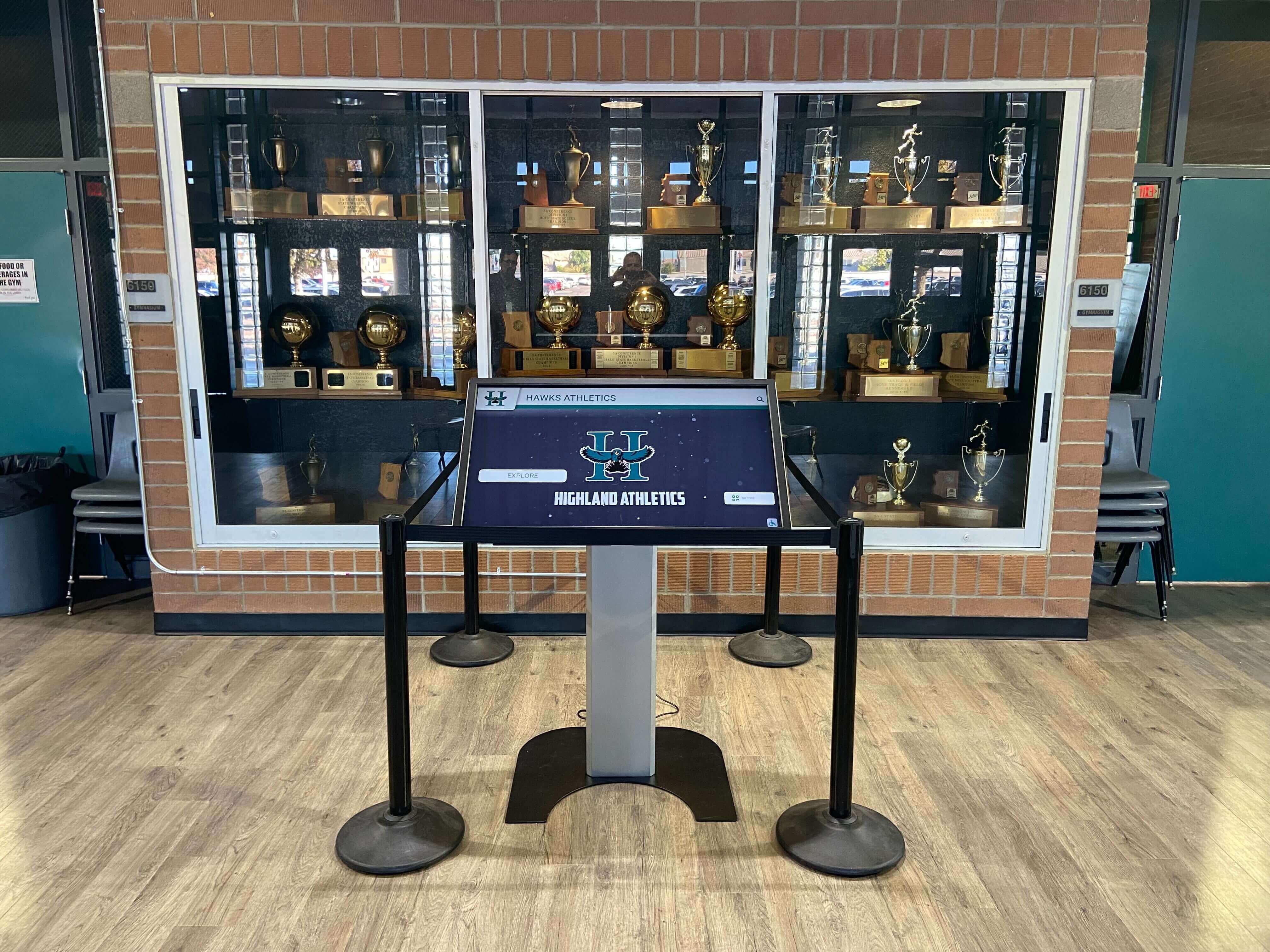
Trophy cases combining digital and physical display hardware require the same magnetic catch inspection discipline as cases holding only physical trophies — the catch system operates the same regardless of display content
Step 5: Test the Adjusted Catch Before Closing the Inspection
After any striker plate repositioning or depth adjustment, test the door under realistic conditions before recording the result and moving to the next case.
What to test after adjustment:
- Close the door from the handle position without directing the door to a specific location on the frame. The door should settle into the catch and hold with no additional force applied after the initial close.
- Allow the door to rest in the closed position for thirty seconds, then observe whether it remains fully closed or begins to drift. A door that drifts within thirty seconds of closing has not reached the holding threshold needed for an unsupervised environment.
- Apply a slow, steady outward pull on the door face at the catch location: the door should require deliberate effort to release. Quantify the resistance as closely as practical — compare to the as-found condition noted in Step 1 and to the other doors in the building for relative comparison.
- Apply a light side load on the door face perpendicular to the swing direction: the door should not rotate or shift from its closed position. A catch that holds under direct pull but releases under a side load is providing directional holding force only, which is insufficient for a door facing corridor air pressure or HVAC flow.
- Confirm that the door opens cleanly under deliberate hand pull without the catch dragging the door back. A striker plate that is too proud relative to the magnet face will cause the magnet to pull the door firmly back to the closed position when the door is at mid-swing — a spring-door effect that can damage hinge hardware over time.
Document the post-adjustment test result separately from the as-found condition.
Step 6: Rate Each Door and Record Findings
After completing Steps 1 through 5 for each door, assign a condition rating and document findings in the inspection record.
| Rating | Conditions Present | Recommended Action | Reinspection Interval |
|---|---|---|---|
| Serviceable — No Action | Door holds closed without deliberate force; no drift at rest; catch releases cleanly under deliberate pull; striker surface clean and undamaged; no visible gap | Document as confirmed serviceable | Annual |
| Adjusted — Monitor | Striker repositioned or gap corrected during this inspection; door now holds correctly under test conditions | Re-inspect in three months to confirm adjustment has held through a seasonal humidity cycle | Quarterly for one cycle, then annual |
| Component Replacement Required | Magnet shows measurably reduced attraction; striker plate surface heavily corroded or deformed; substrate stripped so screws cannot hold the striker in adjusted position | Order replacement catch hardware matching the case manufacturer’s specification; re-inspect after replacement | After replacement, re-inspect at thirty days, then annual |
| Take Out of Use | Door cannot be held closed by any adjustment — catch magnet has failed entirely, substrate has separated, or door hinge sag prevents striker from reaching magnet contact range | Do not leave door unattended in open position; apply a temporary clip or tie if needed; contact case manufacturer for repair guidance | After repair, confirm serviceable before returning to normal access |
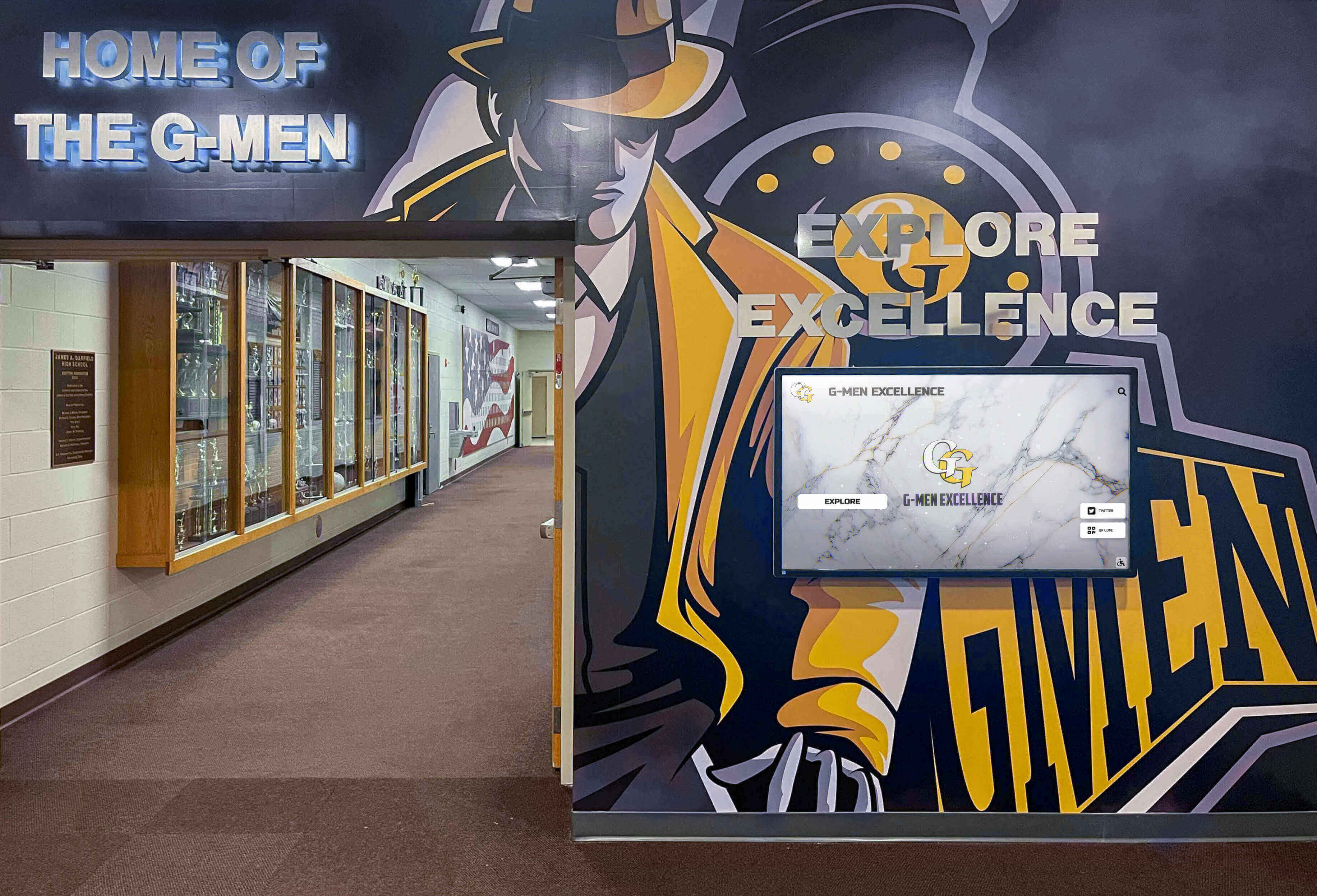
Trophy cases in active recognition corridors often have two or more hinged panels per case — each door operates on its own catch hardware and requires individual inspection and rating
Recording Magnetic Catch Inspection Findings
A catch inspection that produces no documentation provides no institutional benefit beyond the day of the inspection. The following fields support a complete and reusable inspection record.
| Field | Format | Notes |
|---|---|---|
| Case Location | Text (building, hallway, room number) | Use the same identifier as the building’s maintenance management system |
| Inspection Date | YYYY-MM-DD | |
| Door Position | Left / Right / numbered 1–N from left | Document each door panel independently |
| As-Found Hold Condition | Firm / Moderate / Minimal / Does not hold / Drifts open | Assessed before cleaning or adjustment |
| Visible Gap Present | Yes (measured: _mm) / No | Measure with feeler gauge where gap is present |
| Lateral Offset Present | Yes (estimated: _mm, direction) / No | Estimate from visual observation of striker-to-magnet alignment |
| Striker Surface Condition | Clean / Required cleaning / Corroded / Damaged — replace | |
| Magnet Attraction Test | Full / Reduced / Minimal / Failed | Steel object contact test in Step 2 |
| Adjustment Made | Striker repositioned / Striker shimmed outward / Striker recessed / None required / Component replaced | |
| Post-Adjustment Hold Condition | Firm / Moderate / Minimal / Does not hold | |
| Overall Door Rating | Serviceable / Adjusted — Monitor / Component Replacement Required / Take Out of Use | |
| Photographs Taken | Yes / No | Photograph any rating of Component Replacement or worse |
| Parts Required | Text (catch model, striker size, case manufacturer) | Include manufacturer and part number where available |
| Inspector Name | Text | |
| Next Inspection Date | YYYY-MM-DD | Determined by rating assigned |
Inspection records should be stored with the asset record in the building’s maintenance management system or in a facilities binder accessible to future staff. A facilities team member inheriting a building with trophy cases and a complete catch inspection log knows exactly which doors hold correctly, which were adjusted, and which require hardware attention — without needing to discover conditions through a door that swings open during an awards update.
Ordering Replacement Magnetic Catch Hardware
Magnetic catches are not fully interchangeable across trophy case manufacturers. The magnet body dimensions, the mounting hole pattern, the rated holding force, and the striker plate profile vary enough between case lines that installing a nominally similar catch from a different supplier may produce a door that appears to close but holds at a different force than the original specification.
When ordering replacement magnets or striker plates:
- Identify the case manufacturer — the label is typically inside the case at a corner or on the back panel — and contact them for the correct replacement part. Many institutional case manufacturers supply replacement catch hardware directly.
- Remove the magnet body and measure its overall dimensions and mounting hole spacing. Photograph the mount orientation and the direction in which the magnet face is oriented relative to the case frame, so the replacement is installed with the magnet face in the correct plane.
- Confirm the rated holding force of the replacement catch. School trophy case doors range from 2–6 kg in typical glass-door configurations. A catch rated significantly below the door weight will fail in service; a catch rated significantly above may make the door difficult to open for students and smaller staff members.
- Replace both the magnet body and the striker plate when either component is being replaced — mismatched catch components from different product generations may not produce the contact geometry needed for the rated holding force.
Common Causes of Premature Catch Failure
Understanding why catches fail helps facilities teams identify higher-risk cases and adjust inspection intervals accordingly.
Door propped open under sustained load: When staff prop a trophy case door open against a shelf or case frame edge while loading display hardware, they are holding the door at an angle that places asymmetric load on the hinge hardware. When the door is released, it closes with more velocity than a deliberate close — the striker contacts the magnet face with an impact that, repeated over time, can drive the striker plate screws outward and crack the magnet body.
Cleaning solutions applied to catch surfaces: Some cleaning products applied to case interiors reach the magnetic catch components, particularly when the interior is cleaned with a spray rather than a cloth. Cleaning agents can deposit a film on the striker plate face that dries to a coating that reduces contact area. The door appears to close, but the magnetic holding force is operating through the residue rather than direct surface contact. Use only dry cleaning methods within 10 cm of magnetic catch components.
Multiple catch bodies on one door: Some facilities staff, discovering a door that does not hold, install an additional adhesive-backed magnetic catch strip without removing the original. The two catch components may work at cross-purposes — one may be positioned to attract the striker at a slightly different point than the other, so neither reaches full face contact. Always address the root cause of catch failure rather than adding supplementary catches.
Painting or refinishing without masking catch surfaces: When cases are refinished during summer maintenance, paint applied to or near the catch surfaces — particularly the striker plate face — reduces contact area in proportion to paint thickness. Mask catch components fully before any case interior or door frame painting.
Integrating Magnetic Catch Inspection into the Facilities Maintenance Cycle
The most sustainable catch inspection program attaches to existing walk schedules. A building with eight hinged-door trophy cases requires approximately forty-five to sixty minutes for a complete magnetic catch inventory — including the as-found observation, contact surface cleaning, gap and offset measurement, any required adjustment, and post-adjustment testing. That time fits within a scheduled facilities shift when combined with the building’s quarterly safety walk or annual equipment inspection.
Facilities teams already conducting case inspections for hinge alignment or lock cylinder condition can include magnetic catch assessment as an additional checkpoint on the same inspection form. The cases are already open, the inspector is already present, and the documentation workflow is already established. Adding catch condition fields to the same record requires no additional equipment and adds meaningfully to the picture of how each case’s door hardware is functioning.
The practical timing recommendation for most schools: conduct a full-building magnetic catch inventory in late summer before fall recognition events populate the cases and before elevated corridor traffic increases air pressure differentials near display areas. A catch adjusted and confirmed in August — before championship hardware is added and before HVAC heating season begins its humidity-reduction cycle — is at full holding force before the combination of heavier door loads and lower-humidity frame contraction puts the greatest demand on it.
Schools building comprehensive recognition programs that include school lobby design and welcoming spaces for student achievement will find that physical case hardware maintenance and recognition environment design are more connected than they may first appear: a display corridor with well-maintained catch hardware, properly closed cases, and consistent lighting communicates the same institutional respect for achievement that the recognition program itself is meant to convey.

Championship trophy collections that are accessed regularly during recognition seasons depend on properly functioning magnetic catches — a door that drifts open exposes irreplaceable hardware to corridor contact, visitor handling, and accidental impact
What Magnetic Catch Inspection Cannot Cover
A magnetic catch inspection conducted by facilities staff addresses the magnet body, striker plate, mounting hardware, and contact geometry. It does not evaluate:
Hinge alignment and load distribution: The hinge hardware that carries the door’s weight determines whether the striker plate reaches the magnet face at the correct position. A door with worn hinge barrel play or loose hinge mounting screws may have a perfectly adjusted striker plate that is still misaligned with the magnet because the door is hanging 3 mm lower than its design position. If magnetic catch adjustment alone does not resolve a holding problem, inspect the hinge alignment as a parallel assessment.
Gasket seal integrity: The perimeter gasket that seals the door to the frame when the catch holds it closed is a separate system. A door that holds well at the catch may still allow air and dust infiltration through a degraded gasket. Catch inspection confirms the door is in the closed position; gasket inspection confirms what that closed position is providing in terms of environmental protection for the collection inside.
Lock cylinder condition: On cases with keyed locks in addition to magnetic catches, the lock cylinder condition should be assessed separately. A magnetic catch in good adjustment and a functioning lock provide complementary security — one keeps the door closed during normal access intervals; the other prevents unauthorized opening during times when the key is not in use.
Glass panel structural integrity: A door that has been drifting open and contacting the door frame repeatedly may have transmitted impact loads into the glass panel at its frame channel contact points. If a door has been confirmed to swing open under normal conditions for an extended period, add a glass panel edge inspection to the findings for that door.
Connecting Magnetic Catch Condition to the Recognition Program
The doors in front of a school trophy case represent more than access hardware — they are the physical boundary between an active corridor and objects that may be genuinely irreplaceable. A state championship trophy from 1987 cannot be reprinted or re-ordered. A retired jersey donated by an alumnus who has since passed cannot be replaced. A series of team photographs spanning thirty years of a program’s history represents an institutional record that exists nowhere else in the building.
A magnetic catch that fails to hold keeps none of those objects behind glass. It means any corridor event — a student running past, a door in an adjacent room slamming, an HVAC surge — can swing the case door open and expose the collection to contact, handling, and the risk of a heavy trophy shifting off a shelf and falling into an open door frame.
Schools running active recognition programs — updating cases after each athletic season, adding new awards during banquet cycles, and maintaining visible records of alumni achievement — access their trophy cases more frequently than schools with static displays. That access frequency makes each door cycle an opportunity to discover that a catch is marginal, or to miss the discovery entirely if no systematic inspection is in place. The catch that held when the athletic director last opened the case in May may not hold in October after a summer of humidity cycling has shifted the door frame geometry by 2 mm in each direction.
For athletic directors coordinating recognition activities that include athletic award result publication policies and formal recognition timelines, the physical case maintenance calendar and the award publication calendar share a common timing requirement: hardware confirmed before results are published and hardware is installed is hardware that is confirmed before visitors are present to observe it.
Schools that invest in systematic recognition infrastructure — from facilities maintenance through to the depth and quality of the recognition record itself — understand that the physical display is one part of a complete program. A case with clean glass, functional catches, and properly aligned doors communicates the same institutional commitment that the trophies inside represent. A case with a door that drifts open communicates the opposite.
For facilities teams coordinating trophy case maintenance across multiple buildings, the recognition display quality practices that extend to color accuracy and display fidelity offer a useful frame: the same standard of care that applies to how achievement is displayed digitally applies to how the physical display hardware is maintained.
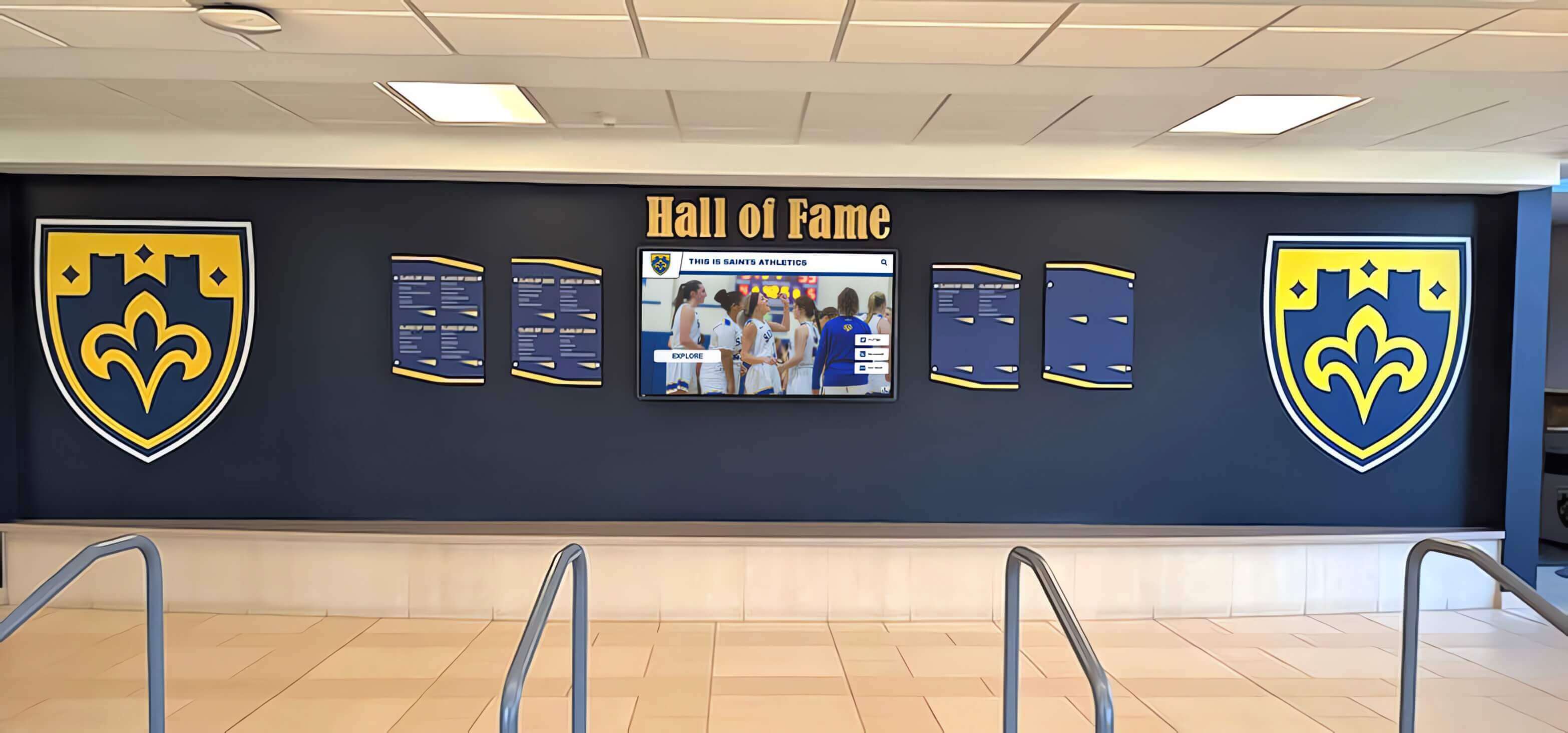
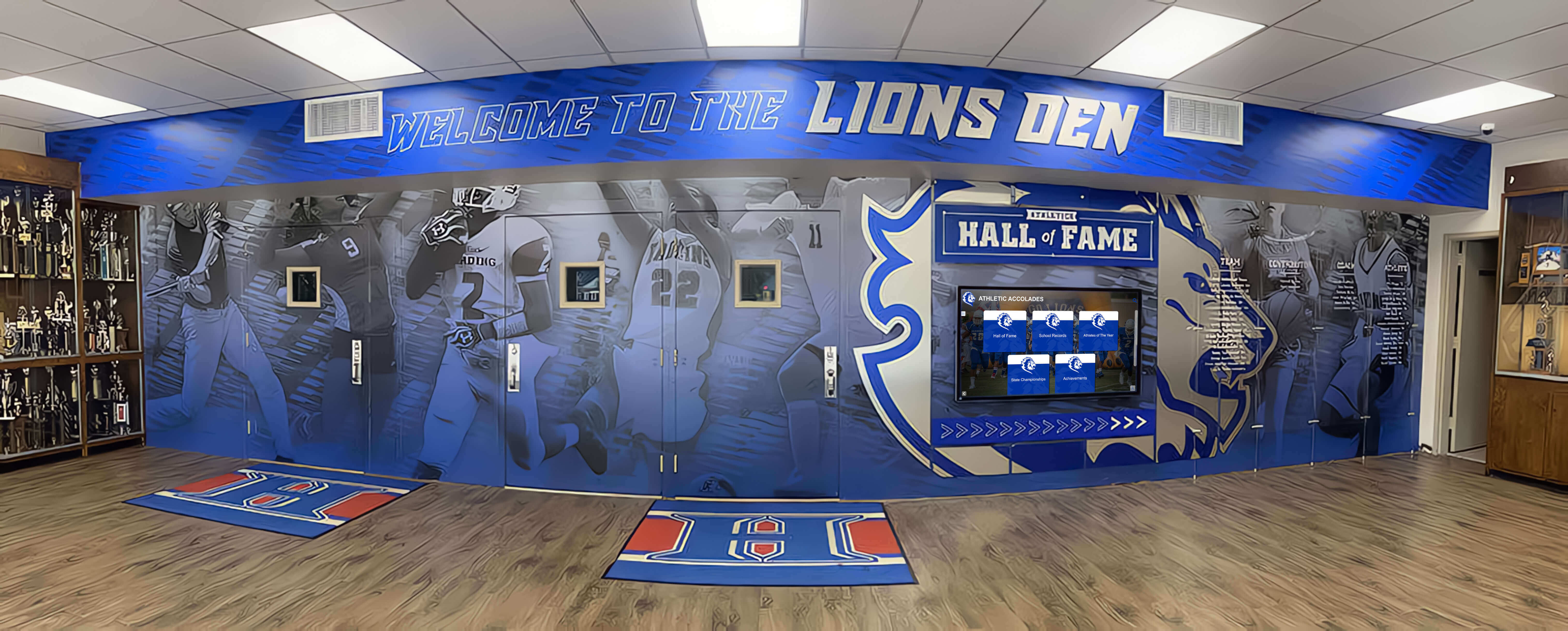
A lobby recognition installation that combines physical trophy cases with a digital recognition screen represents two parallel maintenance tracks — catch inspection for the physical display hardware, and content management for the digital platform
When Physical Cases Are Maintained — and Still Cannot Hold Everything
A trophy case with functional magnetic catches, confirmed hinge alignment, and clean gasket seals is still a fixed-capacity physical object. The school that has been accumulating recognition hardware for thirty years has a finite number of cases, a finite number of shelves, and a finite number of doors — and at some point the math of one new award per season exceeds the available display space regardless of how well the physical catch hardware is maintained.
Schools that have resolved the inspection and maintenance question and turned their attention to capacity are increasingly adding digital recognition platforms alongside their physical cases. For schools researching how halls of fame and recognition platforms address data integrity across growing digital records, the parallel is direct: the physical case requires hardware integrity; the digital platform requires data integrity — and both require active, documented maintenance.
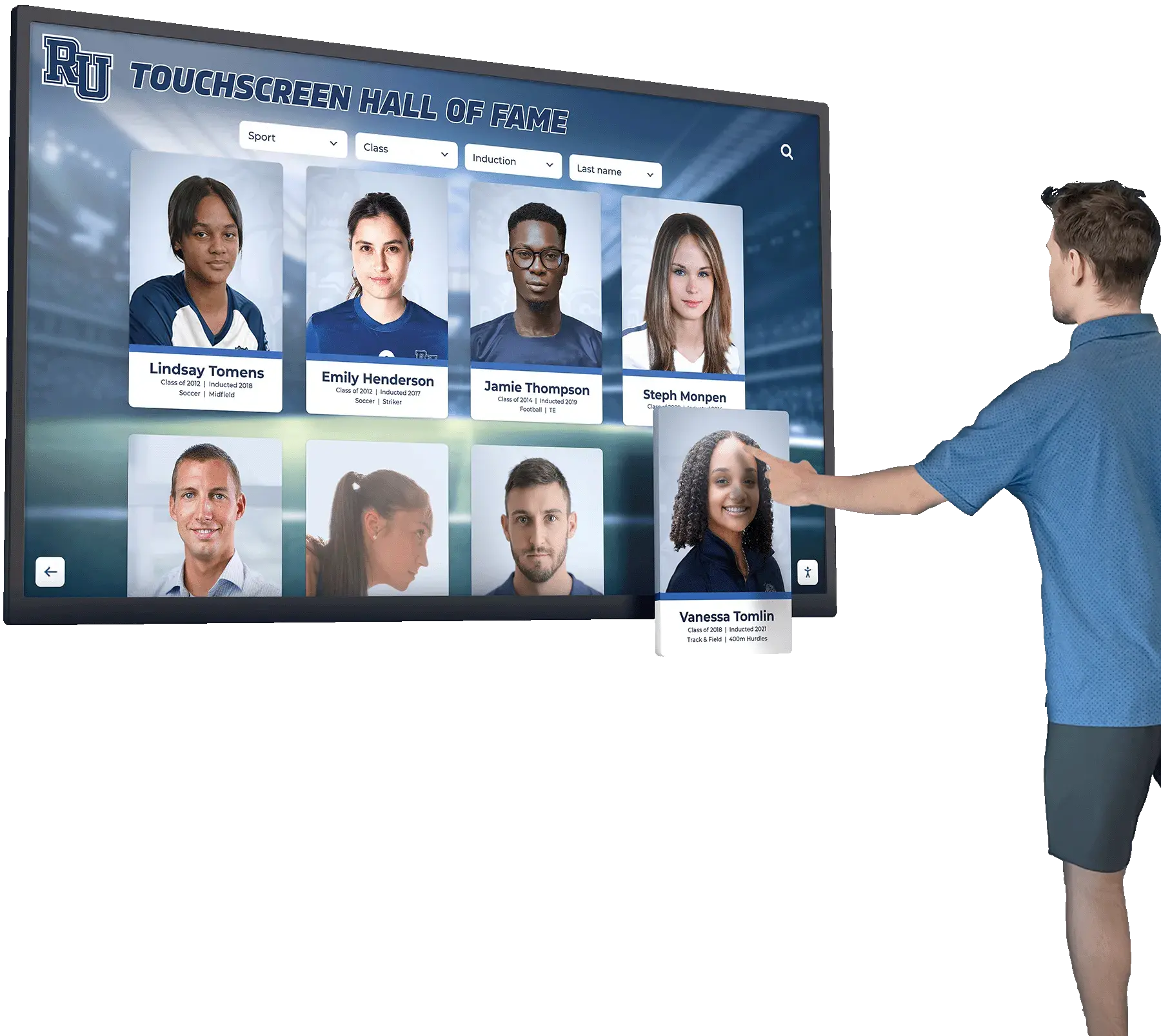
A digital wall of honor kiosk makes an unlimited institutional recognition record searchable by touchscreen — every athlete, every academic honor, every season — without adding weight to any shelf, requiring a door to be opened, or placing any demand on a magnetic catch. The physical case holds the irreplaceable objects. The digital platform holds the complete record.
For schools also considering how accessibility in digital recognition displays extends the reach of the recognition program to all members of the school community, the combination of a well-maintained physical display and an accessible digital archive creates a recognition infrastructure that is both historically grounded and practically inclusive.
Frequently Asked Questions
What is a school trophy case magnetic catch adjustment?
A school trophy case magnetic catch adjustment is a structured inspection and realignment of the magnet-and-striker hardware that holds a hinged display case door in the closed position. The adjustment process involves measuring the gap distance and lateral offset between the magnet body (mounted in the case frame) and the striker plate (mounted on the door), cleaning the contact surfaces, repositioning the striker plate for full face-to-face magnet contact, and verifying that the adjusted door holds securely at rest under realistic corridor conditions.
How do I know if a trophy case magnetic catch needs adjustment?
The clearest indicators are: the door does not hold in the closed position without being pushed firmly into contact, the door drifts open from rest without being touched, the door requires a specific push location to close successfully, or the door closes with noticeably less resistance to opening than it previously did. Any of these symptoms indicates that the contact area, gap distance, or magnet strength has changed from the condition needed for reliable holding force. A door that shows no symptoms but has not been inspected in more than twelve months should receive a cleaning and functional check regardless.
Can facilities staff adjust magnetic catches in-house, or does it require a professional?
Striker plate repositioning and gap adjustment are within facilities staff capability in most cases. The process requires only a screwdriver, a feeler gauge or folded paper for gap measurement, and a clean cloth. Magnet body replacement — where the magnet body itself has cracked, lost strength, or pulled free from a stripped substrate — may require the case manufacturer’s specification for the correct replacement part, and installing the replacement at the correct depth and orientation benefits from reviewing the manufacturer’s documentation. Substrate repair (filling stripped screw holes before re-piloting) is within facilities staff scope but should be done with a filler appropriate to the substrate material.
How often should magnetic catches be inspected?
Most school facilities programs benefit from a full-building magnetic catch inventory annually, timed to late summer before fall recognition hardware is installed. Cases identified with marginal holding force during any inspection — particularly those that were adjusted rather than found fully functional — should be re-inspected quarterly for one inspection cycle to confirm the adjustment has held through a seasonal humidity change. Cases in buildings with significant summer-to-winter humidity variation, or cases near exterior doors or HVAC supply registers that create pressure loads on door faces, warrant semi-annual inspection.
What holding force should a school trophy case magnetic catch provide?
For most school-grade enclosed trophy cases with glass doors, a catch rated for 2–4 kg of holding force is appropriate for single-door panels in the 2–5 kg weight range typical of this hardware category. The correct rated force depends on the specific door weight — which increases when lighting, heavier glass, or display hardware is added to the door — and on the ambient pressure conditions the door faces. A catch that requires more than moderate deliberate effort to open is likely providing more force than necessary and may make the case difficult to access for smaller staff members; a catch that releases under a light touch or a corridor air movement is providing insufficient force for the door weight.
Should magnetic catches be replaced rather than adjusted?
Adjustment is appropriate when the catch hardware is intact — the magnet body is undamaged, the striker plate surface is clean and uncorroded, and the mounting substrate can hold the striker plate screws in adjusted position. Replacement is appropriate when: the magnet body is cracked or visibly damaged, the attraction test in Step 2 shows significantly reduced force with no gap present, the striker plate surface is corroded beyond effective cleaning, or the mounting substrate is stripped and cannot hold adjustment. When one component requires replacement, replace both the magnet body and the striker plate simultaneously to ensure matching specification.
How is magnetic catch inspection different from other trophy case door hardware inspections?
Magnetic catch inspection is specific to hinged-door trophy cases and addresses only the catch hardware — the magnet body and striker plate. It is separate from hinge alignment inspection (which addresses how the door hangs), lock cylinder inspection (which addresses the keyed security hardware), gasket seal inspection (which addresses the perimeter seal that controls environmental infiltration), and roller track inspection (which addresses sliding-door panels that have no hinge or catch hardware). A building with both hinged-door and sliding-door cases requires both catch inspection and roller track inspection in the same facilities round.
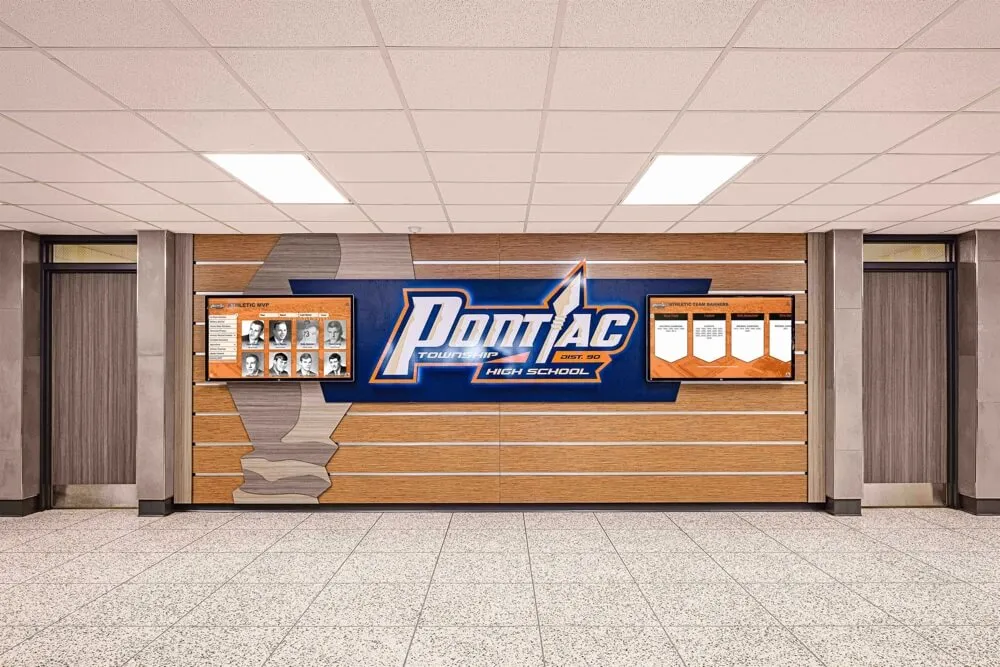
Athletic recognition installations across multiple corridors may include both hinged-door and sliding-door trophy cases — facilities teams should apply the appropriate inspection protocol for each door type present
Building a Documentation Culture Around Recognition Hardware
The magnetic catch inspection record is one element of a broader facilities discipline that treats school recognition infrastructure as the institutional asset it is. Schools that maintain systematic documentation — catch condition, hinge alignment, roller track condition, lock cylinder function, gasket seal status — are not conducting extra work. They are converting the unrecorded assumption that “the cases are fine” into a documented confirmation of what is actually functional, what needs attention, and who is responsible for follow-up.
That documentation culture scales naturally as recognition programs grow. A school whose athletic director is building a comprehensive recognition program that documents athletic awards results and eligibility is already operating from a documentation-first discipline — and that discipline extends directly to the physical case hardware that displays those awards.
The schools that invest in systematic physical case maintenance and parallel digital recognition documentation are building recognition infrastructure that will outlast any individual facilities team member, athletic director, or technology platform. A new facilities team member inheriting a building with twelve trophy cases and a complete catch inspection log — every door rated, every adjustment documented, every replacement recorded — knows exactly what they have and what condition it is in. That is the value of a repeatable inspection workflow: not a guarantee that no door will ever drift, but a documented record of what was confirmed, what was found, and what was done about it.
Recognition programs that include valedictorian recognition, academic excellence, and multi-year achievement records hold their most irreplaceable documentation — framed certificates, honor rolls, and formal recognition records — inside the same cases whose catches this inspection addresses. Keeping those doors securely closed is the most basic act of preservation available to any school facilities team, and it requires nothing more than a screwdriver and a thirty-minute inspection cycle.
Ready to Extend Your Recognition Program Beyond the Physical Case?
Rocket Alumni Solutions builds touchscreen digital trophy cases, interactive halls of fame, athletic record boards, and scholar-athlete recognition systems for schools of every size. When physical cases are fully inspected, catches are confirmed, and doors hold — but the collection still exceeds the available space — a digital platform gives every athlete, every honoree, and every season permanent, searchable, unlimited visibility without adding a single hinge to the building.
Book A DemoA completed school trophy case magnetic catch inspection log tells the facilities team exactly which doors are confirmed to hold, which were adjusted and need a follow-up check, and which catches require hardware replacement before the door can be returned to unsupervised operation. No door is assumed to be holding because it was holding last fall. No catch is assumed to be functional because no door has drifted open yet. That is the standard a systematic inspection workflow is designed to meet: documented knowledge, not deferred assumptions.