



Intent: research — a school trophy case glass haze inspection is a structured visual and tactile examination of each glass panel in an award display case, performed to determine whether observed cloudiness originates from removable surface residue, mineral or acid etching bonded to the glass, sealant or gasket off-gassing deposits on interior panel faces, or laminate interlayer fogging that cannot be removed without panel replacement. The distinction matters before any cleaning attempt: applying an acidic cleaner to a panel that is already acid-etched accelerates permanent damage, and scrubbing an interior surface fogged by laminate failure wastes effort while potentially introducing new residues that obscure the underlying condition. This guide walks facilities teams, athletic directors, and school administrators through a four-step decision tree — surface-location test, dry cloth test, water test, and solvent test — that assigns every haze pattern to the correct category and specifies whether the finding is cleanable on-site, requires a glazier, or should prompt a conversation about permanently digitizing the recognition records housed inside the affected case.
Glass panels on school trophy cases carry a maintenance expectation that rarely appears in a facilities work order: they must remain clear enough for a hallway visitor to read the championship trophies, athletic plaques, and honor certificates inside, while enduring years of cleaning sprays, humidity variations, seasonal temperature swings, and the occasional disinfectant blast aimed too close to the case frame. Haze accumulates on these surfaces through multiple mechanisms, and the visible result — a cloudy, milky, or uneven film across the glass face — looks similar regardless of whether the cause is a thin soap film, a hard-water mineral deposit, an off-gassed sealant residue, or a laminate interlayer beginning to fail.
Cleaning the wrong type of haze with the wrong product produces one of two outcomes: no improvement, because the treatment was mismatched to the cause, or visible damage to a surface that was still recoverable before the incorrect cleaner was applied. A school trophy case glass haze inspection — conducted before any cleaning attempt — takes the same panel a custodial crew would otherwise spray and wipe, and identifies with a brief, structured examination which haze category applies, what the appropriate response is, and whether the finding requires facilities staff action alone or a glazier’s assessment.

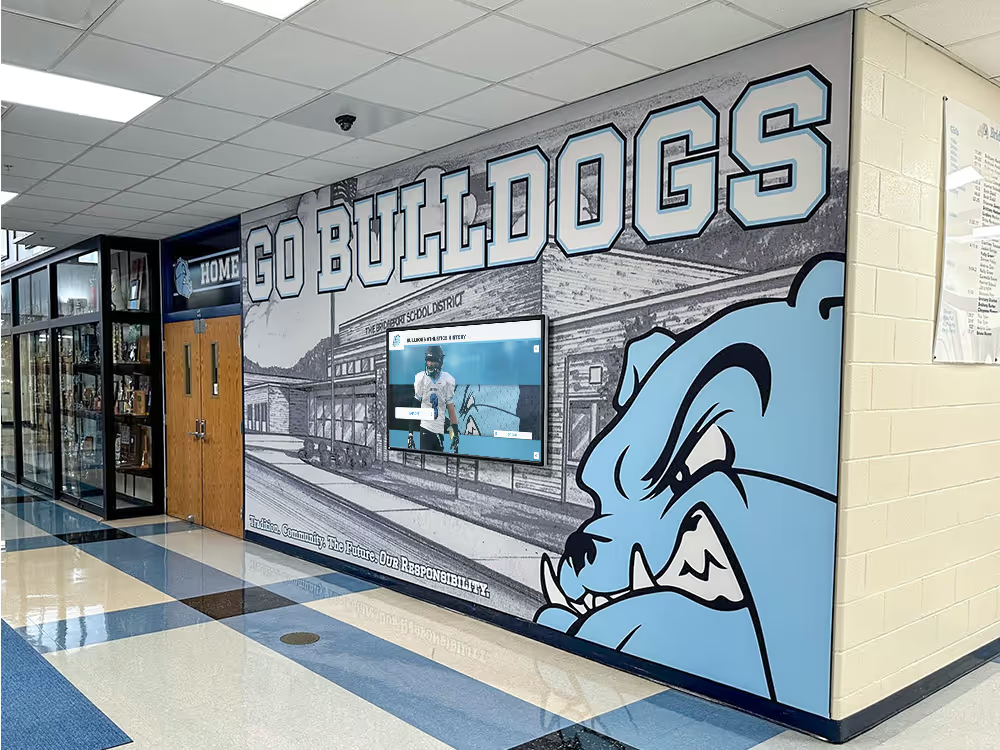
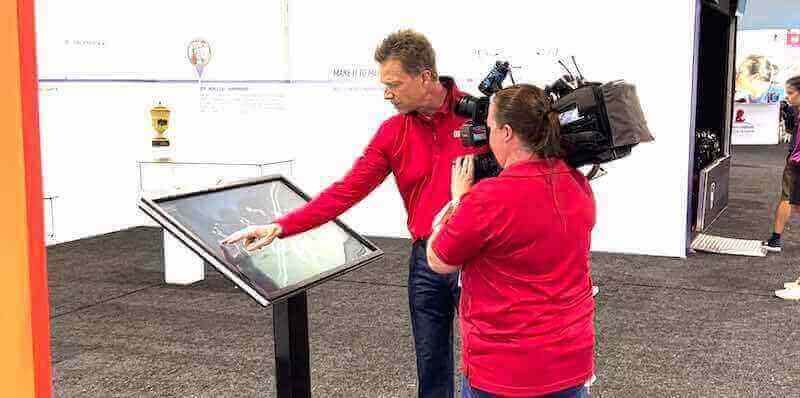
Athletic hallway trophy cases accumulate surface haze through multiple mechanisms — a structured inspection determines which type of haze is present before any cleaner is applied to award display glass
The Four Categories of Trophy Case Glass Haze
Not all glass haze has the same cause, the same location on or in the glass, or the same treatment response. The school trophy case glass haze inspection framework begins by assigning every observed haze pattern to one of four categories. The categories are mutually exclusive by cause, though a single panel may display more than one simultaneously — a panel with sealant off-gas deposits on the interior face can simultaneously display hard-water mineral deposits on the exterior face.
| Haze Category | Location | Visual Character | Cleanable? |
|---|---|---|---|
| Surface residue | Exterior or interior glass face | Smears, streaks, or uniform film that shifts or smears when touched with a dry cloth; often directional | Yes — appropriate cleaner matched to the residue type |
| Mineral / acid etching | Exterior glass face (sometimes interior) | Matte or frosted appearance; does not smear when touched; persists after cleaning; may have geometric edge boundaries from a pooled cleaner contact event | Partially — light deposits may reduce; surface etching is permanent |
| Sealant / gasket off-gassing | Interior glass face (case closed) | Faint oily or waxy film; often present symmetrically on the face nearest the gasket or frame; does not match the exterior haze pattern | Yes — appropriate solvent safe for glass; recheck after gasket removal or replacement |
| Laminate interlayer fogging | Inside the glass itself — between the two glass layers | Uniform or patchy cloudiness with no surface feel; unchanged when exterior and interior surfaces are cleaned; may be worst at panel edges where moisture entered | No — panel replacement required |
Determining which category applies to a given panel is the core task of the inspection. The decision tree below provides a systematic sequence of observations and simple physical tests that assigns every haze finding to one of these four categories without any specialized equipment.
Pre-Inspection Setup
Gather these items before beginning the inspection:
- A clean, dry microfiber cloth — no cleaning solution applied
- A second cloth dampened with distilled water
- Isopropyl alcohol at 70% concentration in a small spray bottle
- A flashlight with a narrow beam
- A printed inspection log, one row per case panel
- A camera or phone for photographing findings
Do not bring acidic cleaners, ammonia-based glass cleaners, or abrasive compounds to the inspection. The inspection sequence determines which cleaner — if any — is appropriate after the inspection is complete. Applying a cleaner before completing the inspection risks adding a treatment residue that obscures the original haze pattern and makes accurate categorization impossible.
School Trophy Case Glass Haze Inspection: Four-Step Decision Tree
Apply this sequence to every hazed panel. Each step is a binary test; follow the result to the next step or to a treatment category. Record the result of each step on the inspection log before proceeding.
Step 1 — Locate the Haze: Exterior Surface, Interior Surface, or Through-Glass
Open the case door and examine both the exterior face (the hallway side) and the interior face (the side facing the trophies). Illuminate each face with the flashlight at a low angle — approximately 20 to 30 degrees from the glass surface — to make surface films visible as a sheen distinct from the background. Then close the case and examine the panel from the front without touching the glass.
Exterior face only: If the haze is visible from the hallway side and disappears when you look from the interior side out through the glass, the haze is on or near the exterior surface. Proceed to Step 2.
Interior face only: If the haze is visible only when examining the open case from the inside, on the interior panel face, the haze is on the interior surface. Likely causes include sealant or gasket off-gassing, or condensation mineral deposits from interior humidity. Proceed to Step 2, applied to the interior face.
Both sides equally — cannot be located on either surface: If the haze appears with equal visibility from both sides and cannot be located on either glass face by the low-angle flashlight test, the haze sits inside the glass. This is laminate interlayer fogging. Skip directly to the Laminate Fogging section below. Do not attempt surface cleaning.
Step 2 — Dry Cloth Test: Does the Haze Move?
Press a clean, dry microfiber cloth against the hazed area with light hand pressure. Make one slow pass. Examine the surface.
Haze smears, shifts, or partly clears: Surface contamination is confirmed — the haze consists of a material that is not bonded to the glass. It may be a cleaning fluid residue, a low-adhesion mineral film, body oil from fingerprints, or a sealant vapor that condensed as a thin movable layer. Proceed to Step 3.
No change after the dry cloth pass — no smearing, no shift, no clearing: The haze is either a bonded deposit or originates below the surface. If laminate fogging was ruled out in Step 1, proceed to Step 4 for the bonded deposit assessment.

Pressing a dry microfiber cloth against a hazed panel reveals whether the haze is a movable surface film or a condition bonded into the glass — the two cases require entirely different responses
Step 3 — Water Test: Does Distilled Water Clear It?
Dampen the second cloth with distilled water. Wipe a 10 × 10 centimeter test area of the hazed surface with moderate pressure. Allow to dry completely — approximately 60 seconds at normal corridor temperature — and examine the test area.
Haze clears in the wiped area and does not reappear as the surface dries: The haze is a water-soluble surface residue, most commonly evaporated cleaning solution, dried water spots from tap water, or a low-concentration mineral film. Treatment: clean the full panel with distilled water and a clean cloth, working in straight overlapping passes. No chemical cleaner is necessary.
Haze clears while wet but reappears in the same pattern as the water dries: A hard-water mineral deposit — calcium or magnesium carbonate — is dissolving partially in water and recrystallizing as the water evaporates. Proceed to the mineral deposit treatment protocol. Do not use straight tap water for treatment; it will redeposit its own mineral content as it dries.
Haze does not clear with distilled water, wet or dry: Proceed to Step 4.
Step 4 — Isopropyl Alcohol Test: Oil-Based Residue vs. Bonded Etching
Spray a light mist of 70% isopropyl alcohol onto a 10 × 10 centimeter test area of the hazed surface. Wipe immediately with a clean section of the microfiber cloth. Allow to dry for 30 seconds and examine.
Haze clears or significantly reduces in the test area: The haze is an oil-based or sealant residue — body oils, silicone off-gassing from door gaskets, plasticizer migration from neoprene seals, or a wax-based polish residue from prior maintenance. Proceed to the sealant and oil residue treatment protocol.
No response to isopropyl alcohol: The haze is a bonded condition — most likely acid etching from prior cleaning product use, mineral etching with high bond strength, or, on the interior face, a condensation deposit with a mineral matrix that isopropyl alcohol does not dissolve. Proceed to the mineral etching and acid damage assessment.
Treatment Protocols by Haze Category
| Haze Category | Confirmed By | Treatment | Products to Avoid | Escalate If |
|---|---|---|---|---|
| Water-soluble surface residue | Clears with distilled water, no reappearance on drying | Distilled water with clean microfiber; straight passes, no circular motion | Tap water (redeposits minerals); ammonia-based glass cleaners | Haze returns within 48 hours — unresolved contamination source |
| Hard-water mineral deposit | Clears wet, reappears on drying | Diluted white vinegar (1:4 vinegar:distilled water) or commercial calcium-lime remover formulated for glass; apply with cloth, 2-minute dwell, wipe clean | Full-strength vinegar; abrasive compounds; steel wool | Deposit does not respond after two treatment cycles — may be transitioning to etching |
| Oil / sealant residue | Clears with 70% isopropyl alcohol | Isopropyl alcohol (70%) applied with lint-free cloth; follow with distilled water wipe | Acetone or MEK solvents (damage gaskets and coatings); petroleum-based products | Haze returns within one week — gasket replacement likely needed to stop the off-gassing source |
| Mineral or acid etching | Does not respond to any prior step; matte or frosted surface texture | Mild cerium oxide polish (facilities grade, not automotive) applied with soft felt pad; test one corner before the full panel | Acidic cleaners of any concentration (worsen etching); abrasive scrubbing pads | Etching is deep — rough texture under fingernail drag; panel replacement discussion warranted |
| Laminate interlayer fogging | Haze inside the glass, not on either surface; surface tests show no change | None — surface cleaning has no effect on interlayer fogging | Any cleaner applied to the surface (wasted effort; may damage exterior coatings) | Immediately — schedule glazier assessment; panel is at end of useful display life |
Mineral Etching and Acid Damage: Recognition Criteria
Mineral etching and acid etching are the two bonded-surface conditions most frequently misidentified as surface residue during trophy case glass maintenance. Both produce a matte or semi-opaque appearance that looks like a film from a distance. Distinguishing them from each other and from surface residue matters because the source of each differs, and eliminating the source prevents recurrence after cleaning.
Mineral etching occurs when hard water is left on the glass surface long enough for calcium and magnesium carbonates to bond to the silica surface through a slow chemical reaction. Standing mineral deposits — spray drift from corridor mopping, condensation from a case near an exterior wall, repeated cleaning with tap water that is never fully removed — progressively etch the surface over seasons. Early-stage mineral etching responds partially to the dilute vinegar treatment. Advanced mineral etching has a distinct rough texture perceptible to a fingernail dragged gently across the surface, and no chemical treatment restores smoothness at that stage.
Acid etching occurs when an acidic cleaner — undiluted vinegar, citrus-based degreasers, or toilet bowl cleaners accidentally applied to adjacent glass — contacts the surface and reacts with the silica. Acid etching typically has a defined edge boundary corresponding to where the cleaner pooled or dried, and it produces a frosted appearance uniform within the etched zone and sharply different from the surrounding untreated glass. It does not respond to cleaning attempts because the surface material has been chemically altered, not merely coated.
Identifying the boundary pattern of a suspected etching condition is the most reliable differentiator:
- A pooling pattern — worst at the bottom edge where liquids collect — suggests mineral deposit or, if severe, acid etching from cleaning products that were allowed to dwell.
- A spray drift pattern — faint across a wide area, lighter at center and heavier at edges where atomized spray settled and dried — suggests mineral deposit from tap water cleaning spray.
- A geometric boundary — a sharp-edged rectangular or circular frosted zone that does not correspond to any pooling or spray pattern — suggests acid etching from a concentrated cleaning product contact event.
- A perimeter-heavy pattern — worst near the case frame and lighter toward the glass center — may indicate off-gassing from gasket or sealant material reacting with the glass surface over time.
Recognizing that a school trophy case houses irreplaceable institutional history — from academic achievement awards recognized at the high school level to decades of athletic championship hardware — makes accurate damage assessment essential. A panel with deep etching that cannot be restored partially obscures the display contents it was installed to protect, and the case for scheduled replacement strengthens as the condition progresses.

Multi-panel trophy display cases require individual panel inspection — etching conditions often affect one panel while adjacent panels show only surface residue, because cleaning spray contact patterns vary by panel location and orientation
Laminate Interlayer Fogging: Recognition and Escalation
Laminated glass — two or more glass layers bonded through a polyvinyl butyral (PVB) or ionoplast interlayer — appears in some trophy cases as a safety-glazing upgrade, particularly in cases near gymnasium doors, high-traffic hallways, or locations where impact resistance is a design priority. Laminated glass that has sustained moisture intrusion into the interlayer develops a fogging that no surface cleaner can address.
The PVB interlayer in laminated glass bonds strongly to dry glass but is vulnerable to delamination when edge seals fail and water vapor enters. The resulting fogging appears as milky or yellowish cloudiness, often worst at panel edges and corners where moisture entered, and sometimes extending inward in irregular patterns. Under reflected light, interlayer fogging can resemble a heavy surface residue. The differentiating test is the surface-location check in Step 1: interlayer fogging appears equally from both sides and cannot be located on either glass face by the low-angle flashlight test.
Once interlayer delamination has begun, it is progressive — the fogged zone expands as moisture migrates further into the interlayer. No field treatment arrests this process or restores transparency to a delaminated zone. The panel requires replacement.
When scheduling laminate panel replacement, document the current state of all recognition content inside the affected case. Schools that have not digitized their case contents face a period of case inaccessibility during replacement — an interval during which recognition records are not visible to hallway visitors. Schools that have connected their physical recognition programs to a digital recognition platform maintain full visitor access to the complete recognition record during any maintenance interval. For schools considering academic recognition programs at the touchscreen scale, a laminate replacement event is often the practical catalyst for digitizing a case’s contents before it is sealed back up.
Glass maintenance protects hardware. A digital record protects the history. Rocket Alumni Solutions builds cloud-managed digital trophy cases — touchscreen displays, QR code mobile access, and unlimited recognition capacity — that keep your complete school recognition record visible regardless of what is happening with the physical glass. See how schools are making their athletic and academic history permanently accessible: schedule a demo to explore the platform.
Sealant and Gasket Off-Gassing: Interior Face Deposits
Trophy cases that use neoprene compression gaskets, silicone-based sealant, or butyl tape at door edges and panel perimeters can develop a characteristic interior-face haze as those materials off-gas over time. Plasticizers in neoprene gaskets, volatile siloxanes in silicone sealants, and solvent residues in butyl tape can all vapor-deposit on the interior glass surface as a thin oily or waxy film, visible in low-angle light as a faint sheen that is absent from the exterior face.
Sealant off-gassing haze has three distinguishing characteristics:
- It appears exclusively on the interior face of the glass — the side facing the case contents — and not on the exterior hallway face.
- It follows the geometry of the gasket or sealant source: panels nearest the most recently installed or replaced gasket show the heaviest deposit, and the deposit is typically heaviest at the bottom of the panel where any gravity-settled vapors concentrate.
- It responds to isopropyl alcohol in Step 4, because plasticizer and siloxane deposits are oil-soluble.
Treatment is the 70% isopropyl alcohol protocol, applied to the interior face with the case open. If the deposit recurs within a week of cleaning, the gasket source has not been addressed. This is the point at which facilities teams benefit from reviewing the gasket seal inspection record for the affected case alongside the haze inspection — a gasket with significant degradation will continue producing off-gas deposits regardless of how often the glass is cleaned. Gasket replacement eliminates the source.
For schools with extensive trophy case collections supporting ongoing hall of fame recognition programs, maintaining clean, transparent case glass is part of the recognition experience. Visitors who cannot see clearly through a haze-covered panel receive a degraded view of the championship hardware and individual achievement plaques the school has preserved.
Inspection Record: What to Document
The inspection record for a glass haze inspection should capture the following for every panel assessed:
| Field | Record Content |
|---|---|
| Date and case identifier | Date of inspection; unique case location or ID from facilities inventory |
| Panel location within case | Door panel, fixed panel; upper or lower position if multi-panel case |
| Haze observed (Y/N) | Note if no haze is present — absence is also a meaningful data point |
| Haze location (surface) | Exterior face, interior face, or through-glass (interlayer) |
| Step 2 result | Dry cloth: moves / does not move |
| Step 3 result | Distilled water: clears / clears wet only / no change |
| Step 4 result | Isopropyl alcohol: clears / no change |
| Haze category assigned | Surface residue, mineral or acid etching, sealant off-gas, or laminate fogging |
| Treatment applied | Description of cleaner used, if any, during the inspection visit |
| Result after treatment | Cleared / partially improved / no change |
| Recommended next action | None / re-clean at next cycle / glazier assessment / panel replacement |
| Inspector name | For records with a single responsible reviewer |
Maintain inspection records alongside the facility’s other trophy case maintenance logs — cam lock inspection records, glazing bead condition assessments, and gasket inspection findings. A panel that shows a worsening category across three consecutive inspection cycles — from movable residue to bonded deposit to incomplete treatment response — is telling a consistent maintenance story that combined records make visible. Schools applying digital data integrity practices to their hall of fame recognition programs can apply the same documentation discipline to physical case maintenance logs.
Inspection Frequency and Scheduling
The inspection frequency for trophy case glass haze follows the same risk-tier logic as other trophy case inspection types.
Quarterly inspection is appropriate for cases in main athletic lobbies, gymnasium entrances, and front-of-building corridors where visitor volume is high, cleaning events are frequent, and the risk of accumulated cleaning residue is greatest. Cases with any previous documented haze finding in the mineral etching or sealant off-gas category should also be on a quarterly schedule until at least two consecutive clean inspections confirm the condition has resolved.
Semiannual inspection applies to interior hallway cases accessed primarily for seasonal display changes and cleaned as part of standard corridor cleaning cycles without special attention to glass products or contact time.
Annual inspection is the minimum for cases in restricted or archive areas with low visitor traffic, infrequent cleaning, and no recent haze findings.
Any case that generates a staff report of visibility reduction — “you can’t see the trophy clearly through the glass” or “there’s a fog on the inside of the case” — should receive an unscheduled inspection immediately. Interior face haze reports in particular warrant prompt attention because they indicate either a gasket off-gassing source that needs to be addressed or an early laminate failure that will worsen without intervention.
Staff accessing trophy cases for recognition event preparation depend on clear glass panels — a glass haze inspection confirms that what visitors see through the glass is the recognition hardware, not a cleaning residue or etching film
Connecting Glass Condition to the Digital Recognition Layer
A school trophy case glass haze inspection is ultimately a maintenance protocol in service of a recognition goal: ensuring that the championship trophies, honor plaques, athletic letters, and individual achievement records inside the case are visible and legible to everyone who walks past.
When a panel reaches a haze condition that cannot be reversed — deep acid etching, advanced mineral etching with surface roughness, or laminate interlayer delamination — the glass is no longer fully serving its recognition function. It is partially obscuring the content it was installed to display. This is the practical moment at which the digital recognition layer proves its value: recognition content that exists only inside a hazing or delaminating case is at risk of becoming inaccessible before the case is repaired or replaced.
Schools that have already built comprehensive digital recognition archives — searchable, accessible through touchscreens and QR codes, cloud-updated without requiring case access — face a hazing glass panel as a maintenance item to be scheduled. Schools that have not connected their physical case contents to a digital record face a more urgent situation: the recognition content inside an opaque or obscured case is effectively invisible to visitors. For schools evaluating the best hall of fame tools for athletics, donors, and arts history, physical case maintenance events are a natural trigger for evaluating whether a permanent digital recognition layer is overdue.
Role Assignments for the Haze Inspection Program
Effective haze inspection programs assign clear responsibility across three roles:
Facilities staff conduct the physical inspection sequence — Steps 1 through 4, surface tests, inspection log completion, and any on-site cleaning for confirmed removable residue categories. They are the appropriate party to apply distilled water and isopropyl alcohol treatments during the inspection visit and to flag panels for glazier assessment when the inspection reveals a bonded or internal condition.
Athletic director reviews inspection logs for recurring findings — panels that show haze at every inspection, or panels where the category escalates from removable residue to bonded etching over successive cycles. The athletic director also makes the priority call on panel replacement when a case contains significant athletic recognition content. Schools with athletic and academic decathlon recognition displays across a large case inventory need clear triage to direct glazier resources to the most critical cases first.
Principal or assistant principal authorizes glazier assessments and panel replacement expenditures. For laminate panel replacement in particular — which involves case disassembly, panel disposal, and new glazing installation — budget authorization is needed before work can proceed. Document the authorization tier for each role in writing so responsibility is clear when staff change positions.
Frequently Asked Questions
What causes haze on the outside of a school trophy case? The most common exterior-face causes are cleaning fluid residue left after routine custodial cleaning, hard-water mineral deposits from tap water spray, and body oils from fingerprint contact near the keyway and handle area. All three are surface conditions that respond to the decision tree’s Steps 2 through 4. Acid etching — which produces a permanent matte finish — is less common but occurs when an acidic cleaner was used on the glass and left in contact too long or used at too high a concentration.
How do I tell the difference between a dirty glass panel and an etched one? A dirty panel changes when a dry or damp cloth contacts it: it smears, clears partially, or shows the cloth’s passage as a cleaner track through the haze. An etched panel shows no change when touched with a dry or damp cloth. The haze on an etched panel is part of the glass surface, not a coating on top of it. The dry cloth test in Step 2 makes this distinction in under 30 seconds.
Can mineral etching on trophy case glass be removed? Light mineral etching — early-stage, with a slightly dulled appearance but no roughness perceptible to touch — can sometimes be partially reduced using a cerium oxide polishing compound applied with a soft felt pad. Deep mineral etching with a rough texture perceptible to a fingernail cannot be reversed by any field treatment. At that stage, polishing reduces the haze somewhat but does not restore the original smooth, fully transparent surface. Panel replacement is the definitive solution for deeply etched glass.
What is laminate fogging on trophy case glass? Laminate fogging is cloudiness that originates inside a laminated glass panel, between the two glass layers, rather than on either surface. It occurs when moisture enters the polyvinyl butyral (PVB) or ionoplast interlayer through a failed edge seal, causing the interlayer to delaminate from one or both glass layers. The resulting cloudiness cannot be removed by surface cleaning because the cause is internal to the glass construction. Panel replacement is required.
Is it safe to use vinegar to clean trophy case glass? Diluted white vinegar — one part vinegar to four parts distilled water — is appropriate for mineral deposit treatment on glass surfaces, applied with a cloth and removed within two minutes. Full-concentration vinegar should not be used directly on glass because its acidity can initiate surface etching on extended contact. Vinegar solutions should also be kept away from metal frames, aluminum extrusions, and gasket materials, where prolonged contact can cause corrosion or gasket swelling. Use it only as the Step 3 follow-on treatment for confirmed mineral deposit, not as a general-purpose glass cleaner.
How does this inspection connect to other trophy case glass inspections? A school trophy case glass haze inspection focuses on surface transparency and the identification of cleaning-related conditions. It is complementary to, but distinct from, a glass bow measurement inspection (which assesses panel flatness deviation), a stress birefringence inspection (which evaluates internal residual stress in the glass), and a glazing bead inspection (which checks the perimeter retention system). A complete glass maintenance program covers all four inspection types on a coordinated schedule tied to case location and access frequency.
How should schools document haze findings for insurance or historical purposes? Photograph each hazed panel before and after any treatment attempt, with the case identifier and date visible in the frame or recorded in the image metadata. Maintain the inspection log alongside other case maintenance records in a binder or restricted-access spreadsheet. For cases housing irreplaceable recognition items — retired championship trophies, original athlete photographs, handwritten honor certificates — consider photographing case contents as part of every inspection visit. Schools with active alumni award display and reunion recognition programs benefit from having a complete photographic record of case contents that exists independently of the physical case condition.
What is the most effective way to prevent haze from returning after cleaning? Address the source rather than the glass surface alone. For exterior-face haze: switch to distilled water or a silicone-free commercial glass cleaner, apply with a microfiber cloth rather than spraying directly on the glass, and wipe dry immediately without allowing solution to pool at the bottom edge. For interior-face sealant haze: inspect the gasket condition and schedule replacement if off-gassing is a recurring issue — cleaning the glass without replacing the gasket solves nothing for more than a few days. Schools that need guidance on the best hall of fame and recognition display tools for long-term recognition program health can apply the same systematic prevention discipline to their physical case glass maintenance schedules.

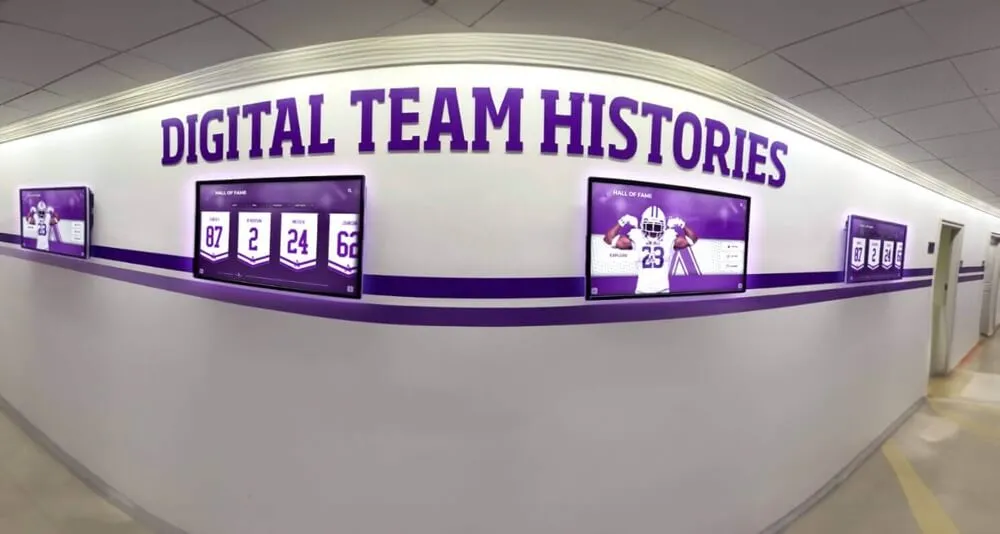
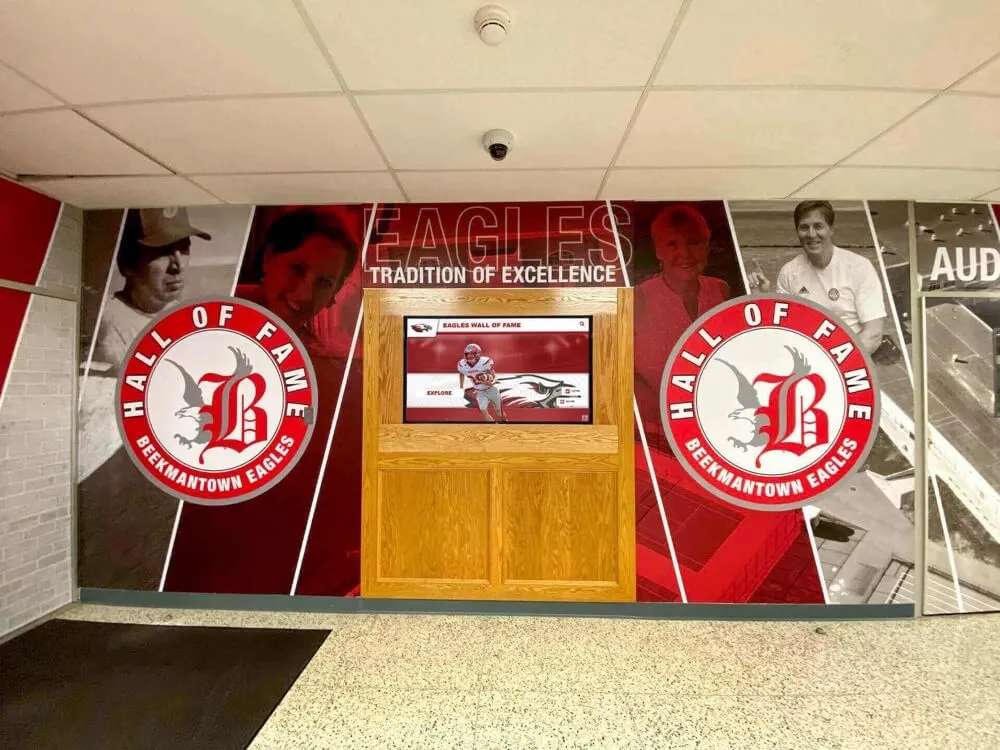
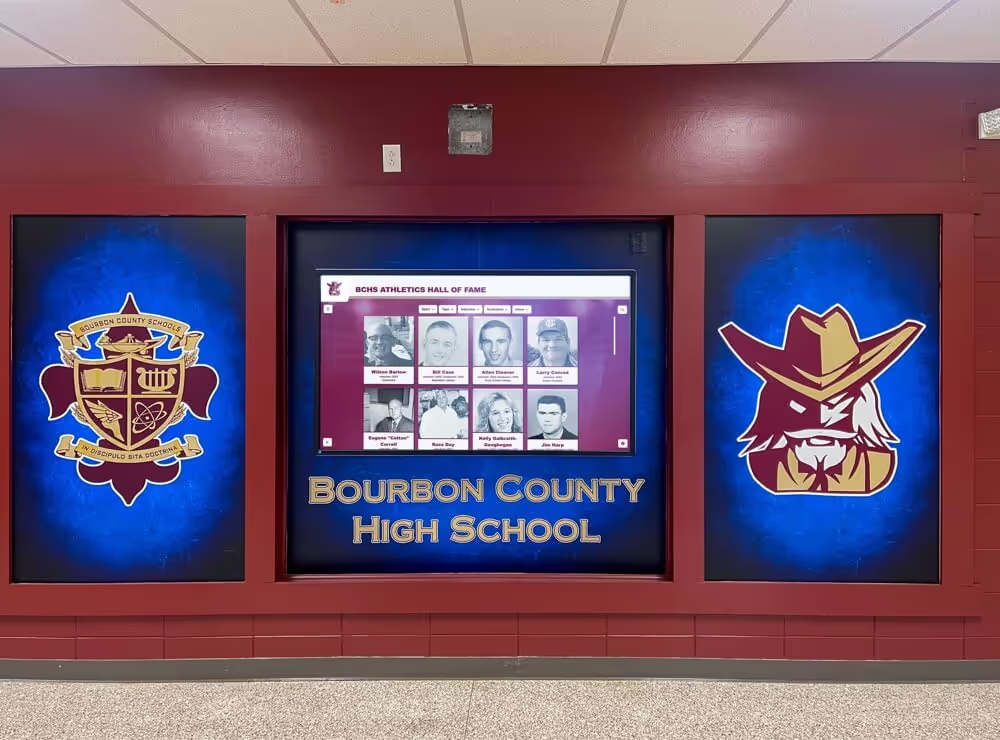
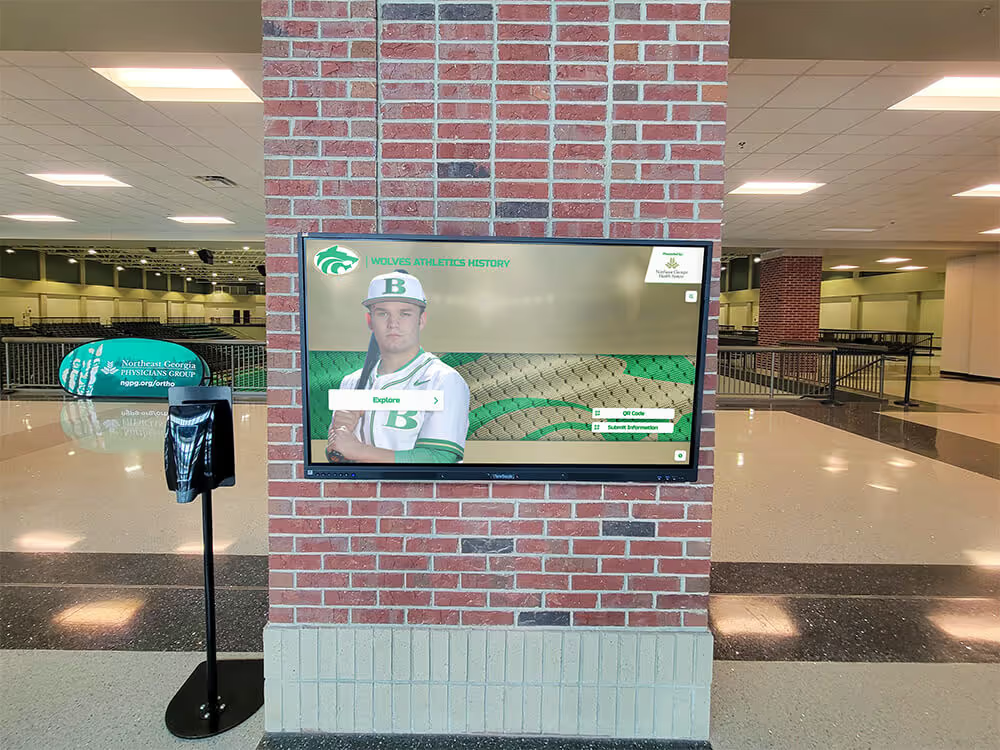
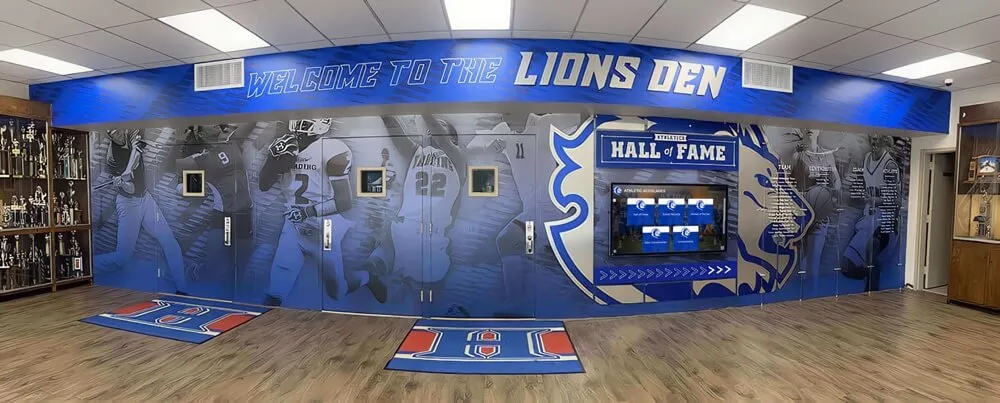
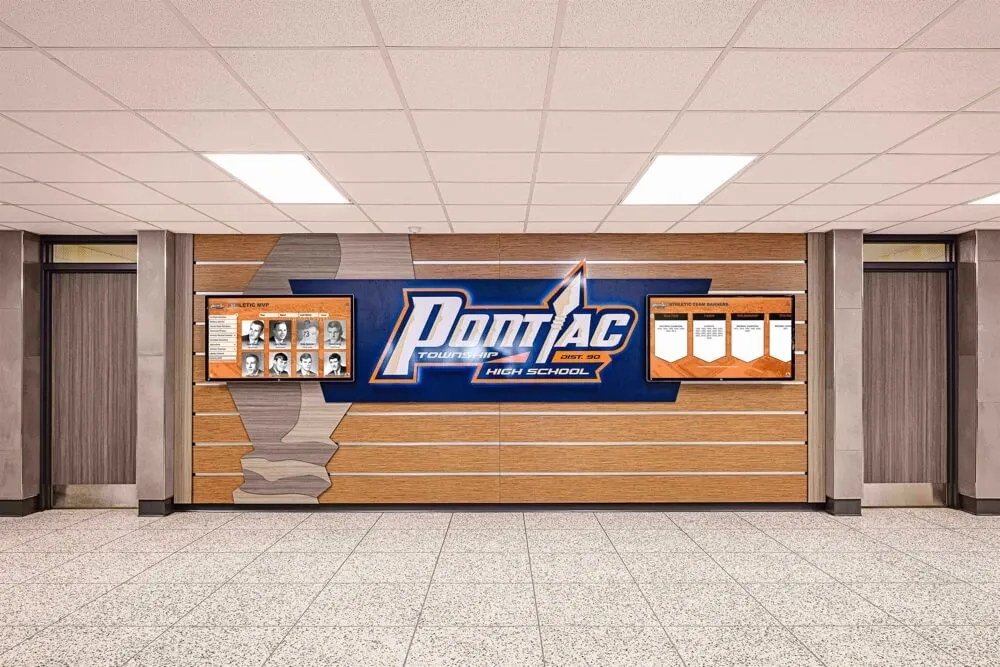
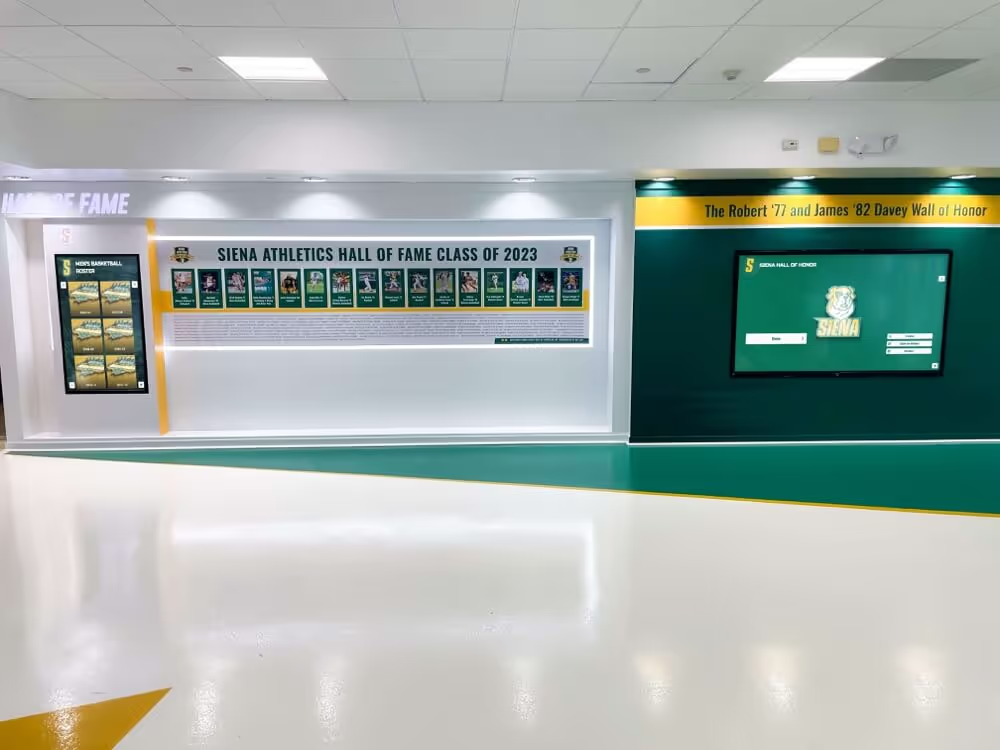
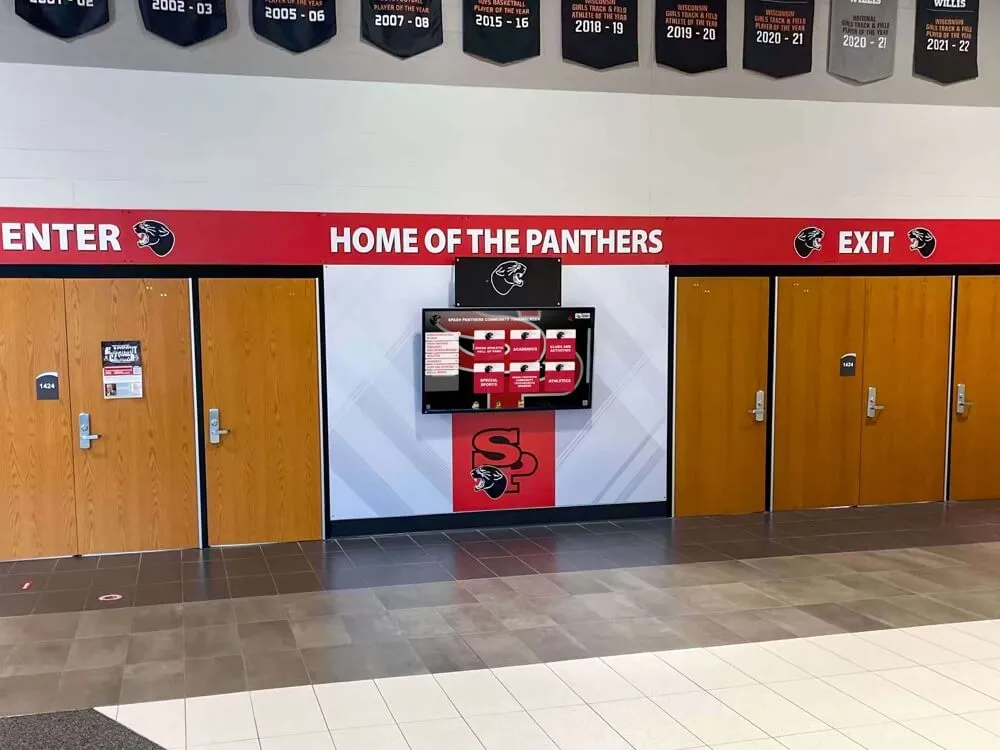
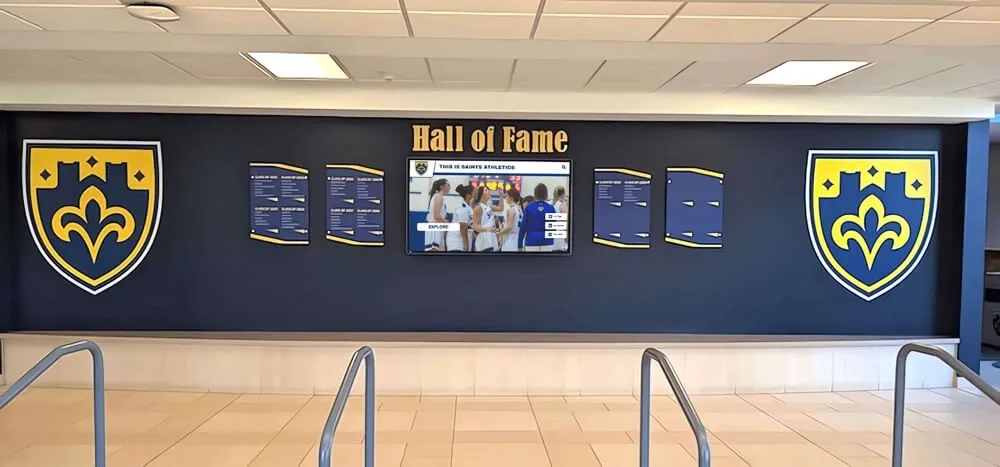
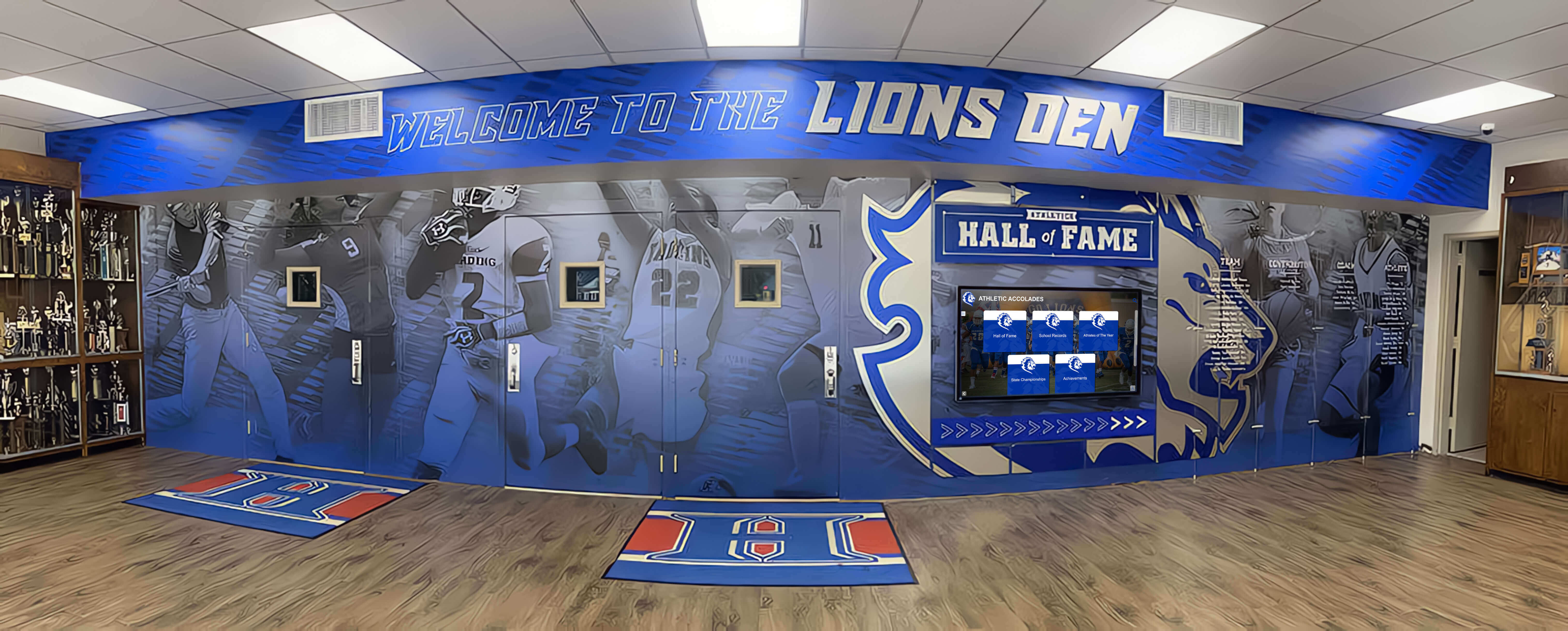
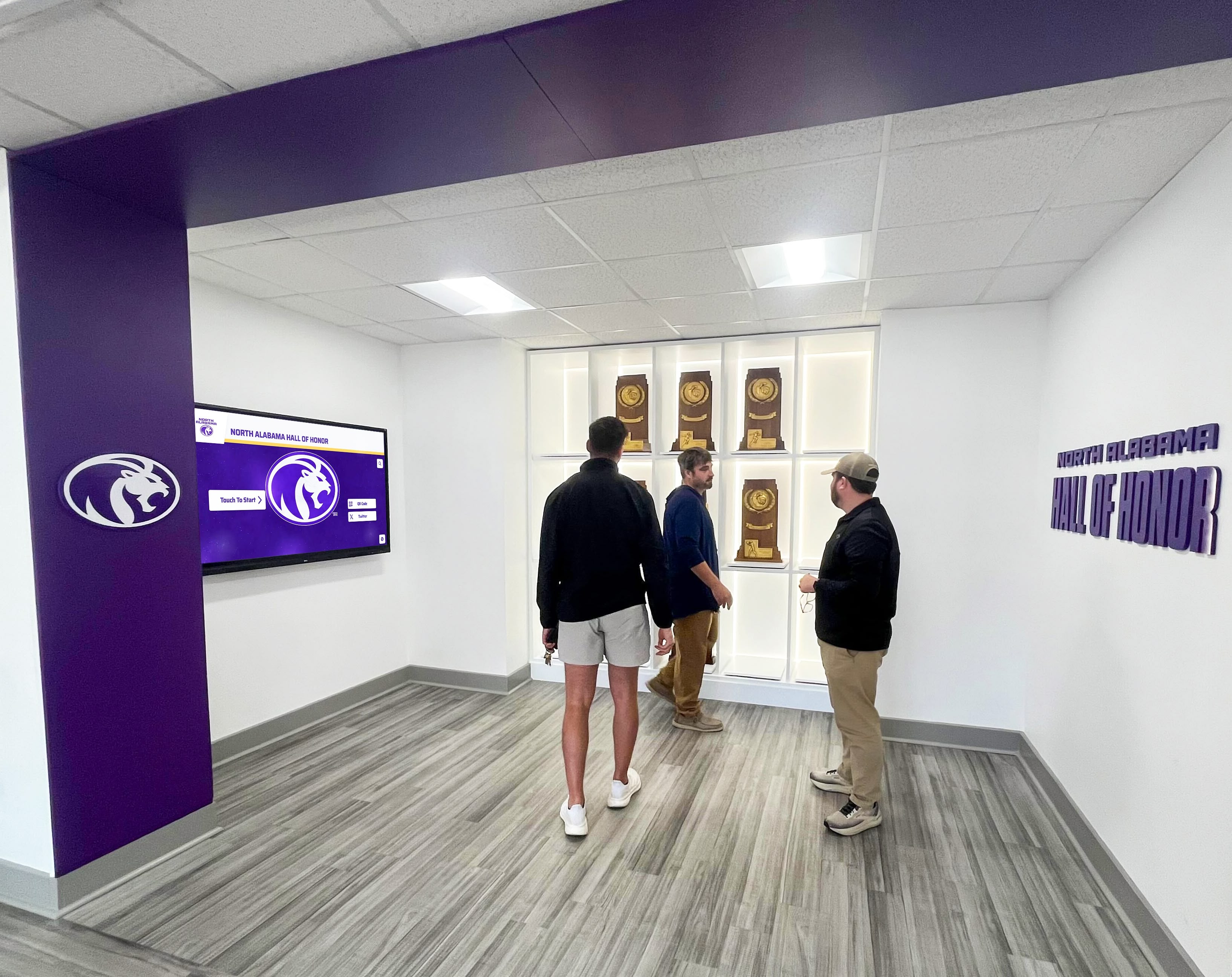
Athletic hallways that combine physical trophy cases with digital recognition screens maintain full record visibility even when individual case panels require maintenance — the digital layer provides continuity that glass alone cannot guarantee
Keep Your School's Recognition Record Visible — Beyond the Glass
Rocket Alumni Solutions builds interactive digital trophy cases and touchscreen walls of fame for schools nationwide — cloud-managed updates, unlimited recognition capacity, ADA WCAG 2.1 AA compliant displays, and QR code mobile access. When trophy case glass haze, etching, or laminate failure limits what visitors can see, the digital record keeps every championship, honor, and individual achievement fully visible and searchable. See how schools are building permanent digital recognition programs that complement their physical case maintenance programs.
Book A Demo