



Intent: demonstrate how schools use jersey frame ideas to build lasting recognition for retired athletes, hall of fame programs, and signed uniform collections that honor athlete stories across generations.
Every school athletic program eventually faces the same question: what do you do with a jersey that meant everything? The #22 that helped win a state title. The signed football jersey donated by an alum who went on to play professionally. The basketball uniform worn during a program-defining season that the community still talks about decades later. These aren’t just garments — they are artifacts carrying the full weight of what a program achieved and who achieved it.
Yet most schools handle these pieces in ways that undercut their value. Jerseys sit folded in storage closets. Signed uniforms hang in a coach’s office where only a handful of people ever see them. Retired numbers get painted on a gymnasium wall with no supporting context. The jersey frame ideas explored in this guide are designed to help schools move beyond these approaches and build recognition systems where every jersey gets the presentation — and the story — it deserves.
Whether you’re planning a single retired jersey ceremony or designing a full athletic hall of fame wing, the way you frame and display those uniforms communicates something important to every student-athlete who walks past them. This guide covers physical framing options, display location strategy, the athlete stories that make framed jerseys meaningful, and the digital solutions that extend jersey recognition beyond what glass and wood alone can accomplish.

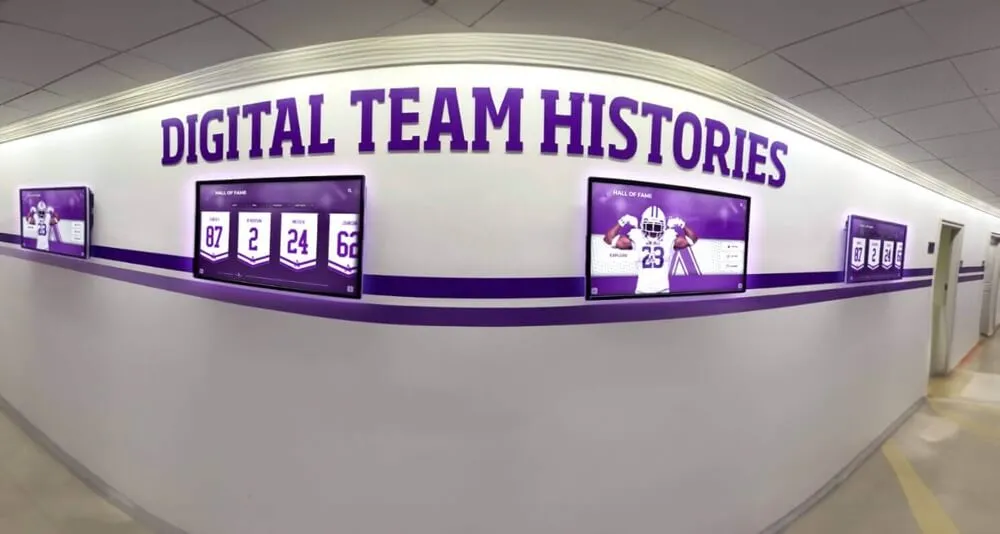
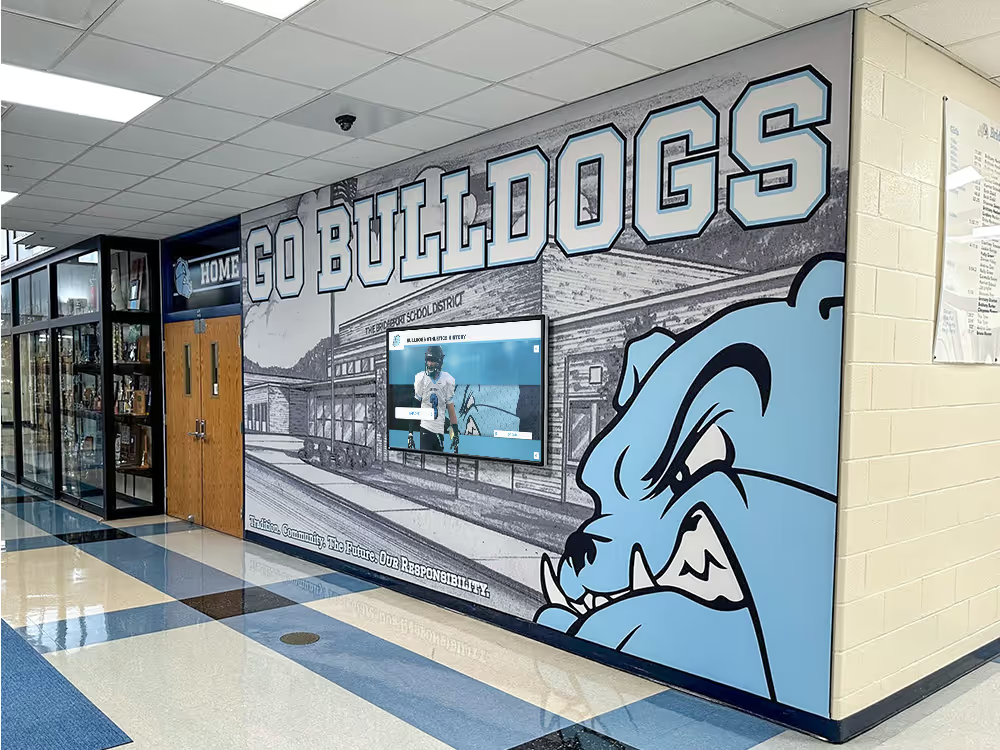
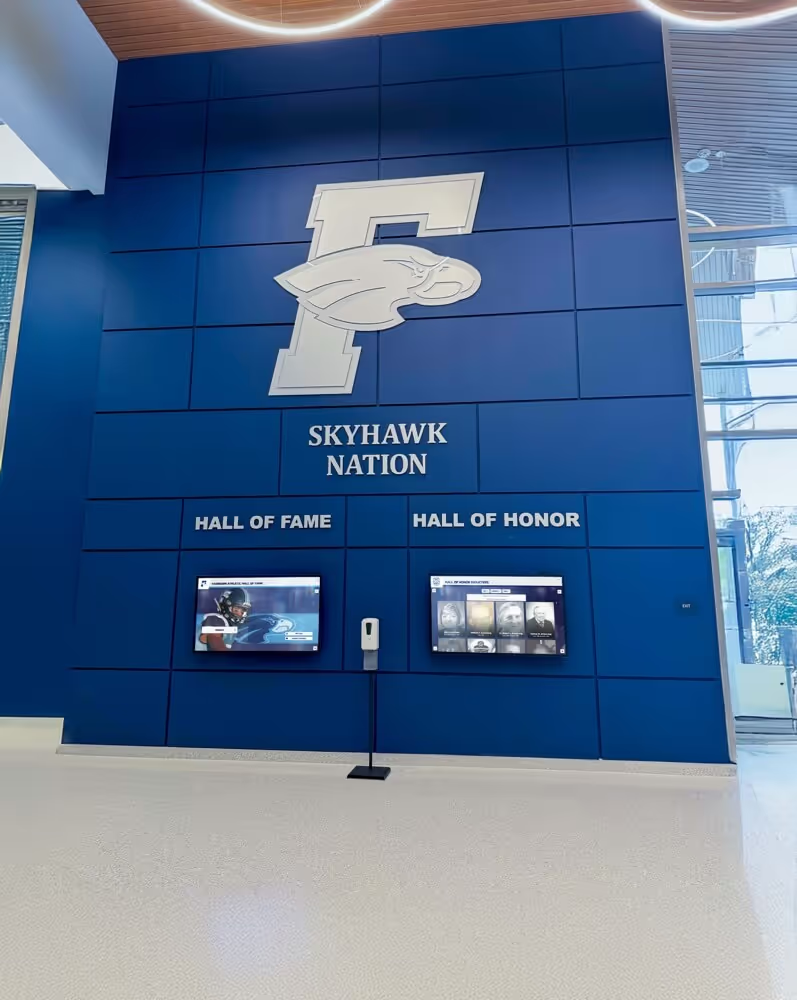
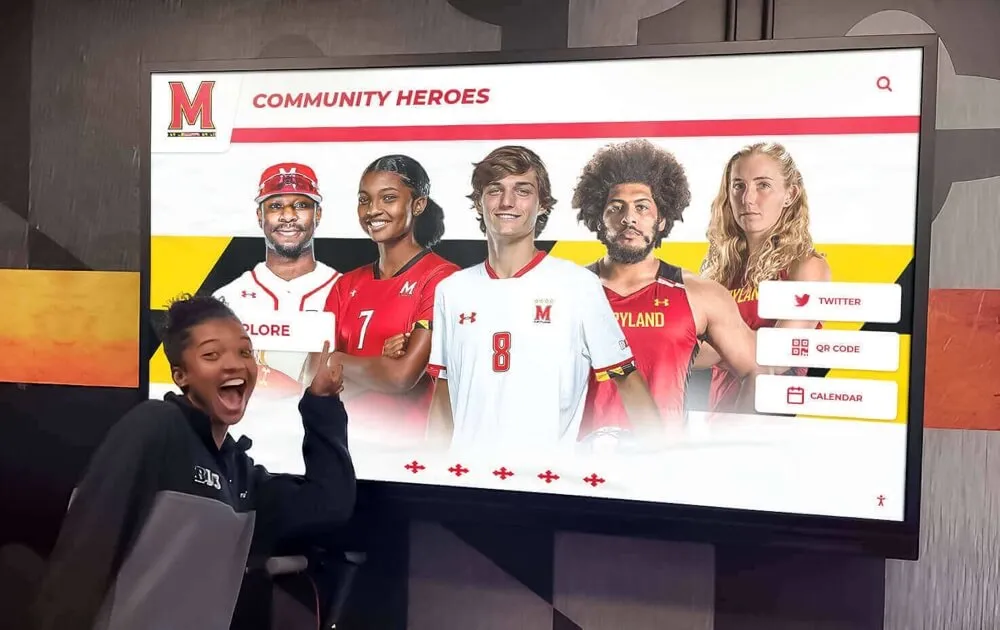
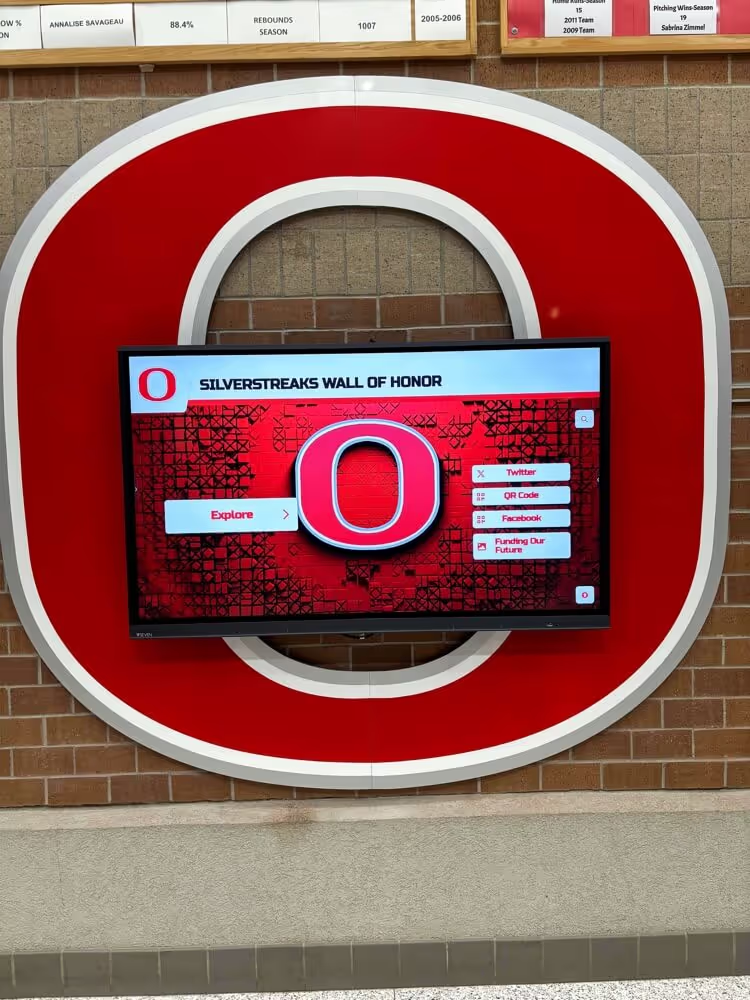
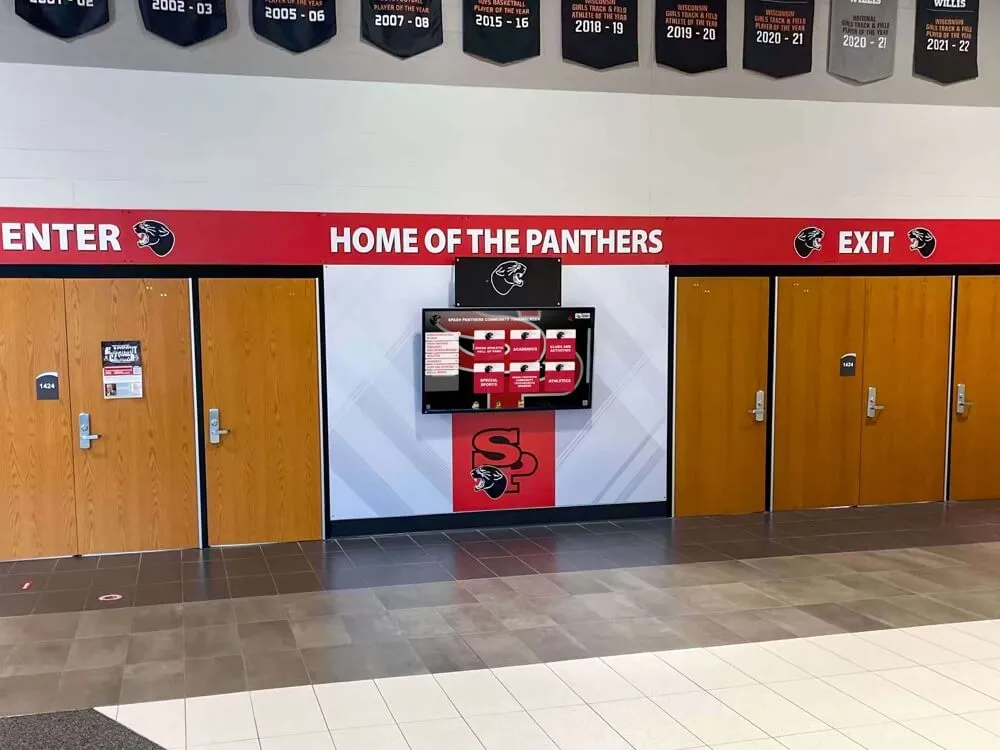
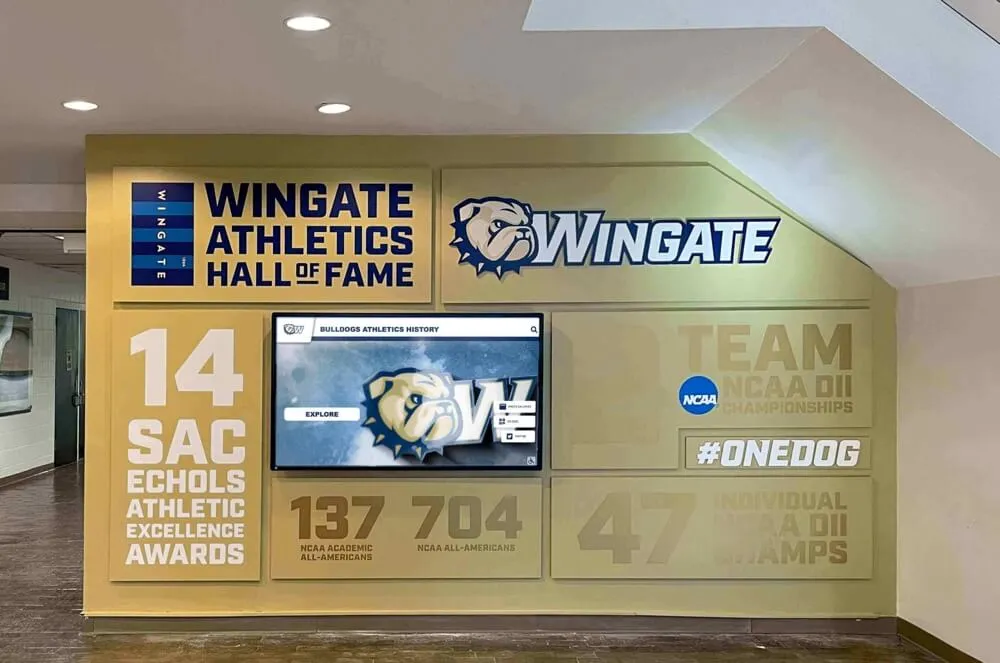
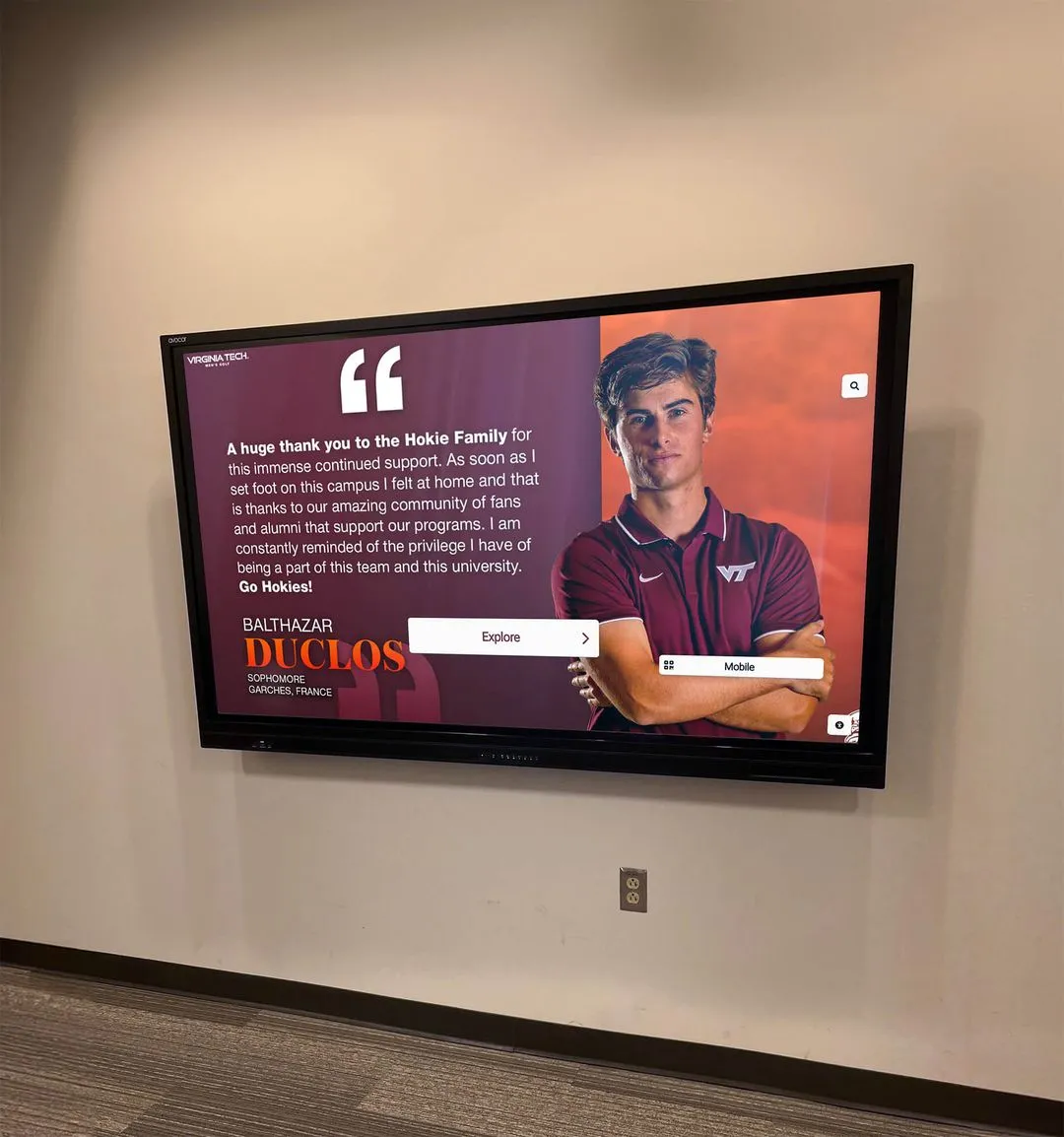
Digital lobby displays integrate retired jersey recognition with player statistics, team history, and career achievements — extending what a physical frame alone can hold
Why Jersey Framing Decisions Matter More Than Schools Realize
A framed jersey is not simply a decoration. It is a recognition decision — one that communicates to current student-athletes what the program values, to alumni that their contributions are remembered, and to visitors what kind of institution they are entering.
Schools that treat jersey framing as an afterthought — ordering a standard shadow box and calling it done — miss the recognition value those jerseys could be generating. Schools that approach jersey display with intention, by choosing the right framing format, location, accompanying context, and supporting story, turn each jersey into a recognition asset that works year-round.
The stakes are highest for retired jersey programs. When an athletic department formally retires a number, it is making a permanent institutional statement. The framing and display of that jersey either honors the weight of that statement or diminishes it. A cheap shadow box in a hallway corner sends one message. A dedicated display with name, number, era, achievements, and supporting imagery sends a very different one.
Signed jersey collections carry a different kind of significance — particularly when the athlete who signed the jersey went on to play at a higher level. These pieces connect school history to broader achievement narratives and strengthen alumni relationships in ways that generic trophy cases cannot match.
The Recognition Gap Most Schools Have
Physical trophy cases and banner systems have been the default solution for jersey recognition for decades. They work, to a degree — they make retired numbers visible, and they communicate that the program values its history. But they have consistent gaps:
- A jersey on a wall shows the number; it rarely tells the story behind it
- Physical frames hold one moment in time with no ability to update
- Static displays compete for attention with everything else in a busy athletic hallway
- Storage capacity limits how many jerseys can receive prominent placement
- Signed jerseys in particular often end up in office displays seen by almost no one
The schools building the strongest jersey recognition programs today are filling these gaps — pairing physical frames with digital platforms that add depth, searchability, and story to every displayed uniform.
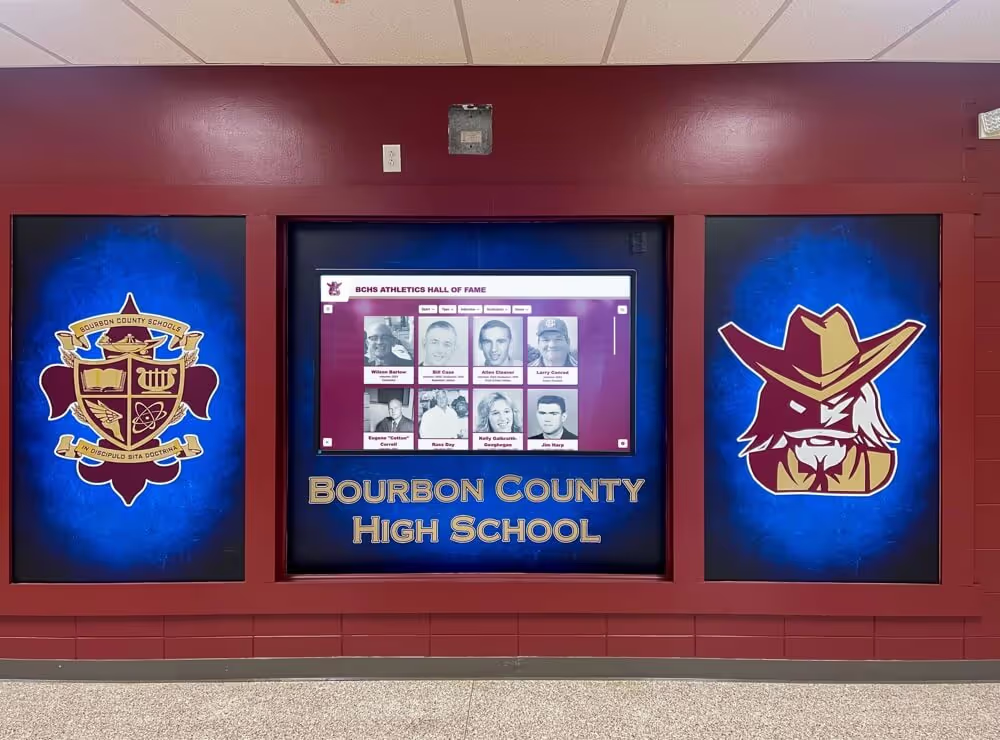
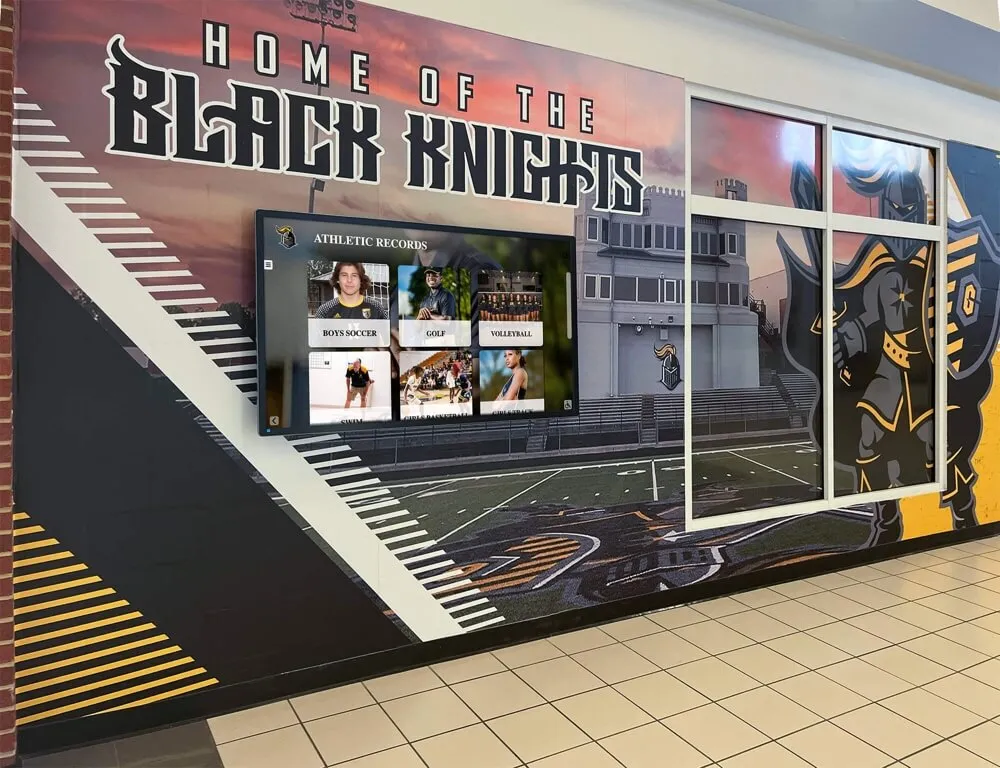
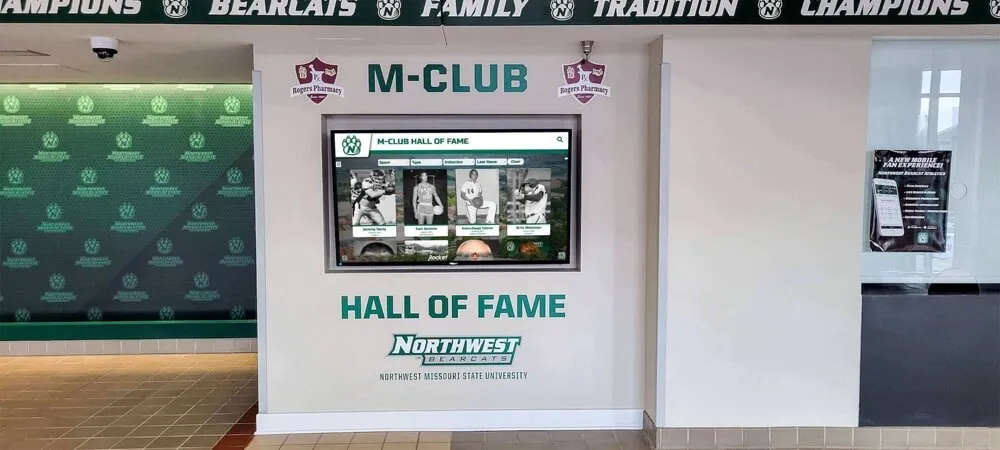
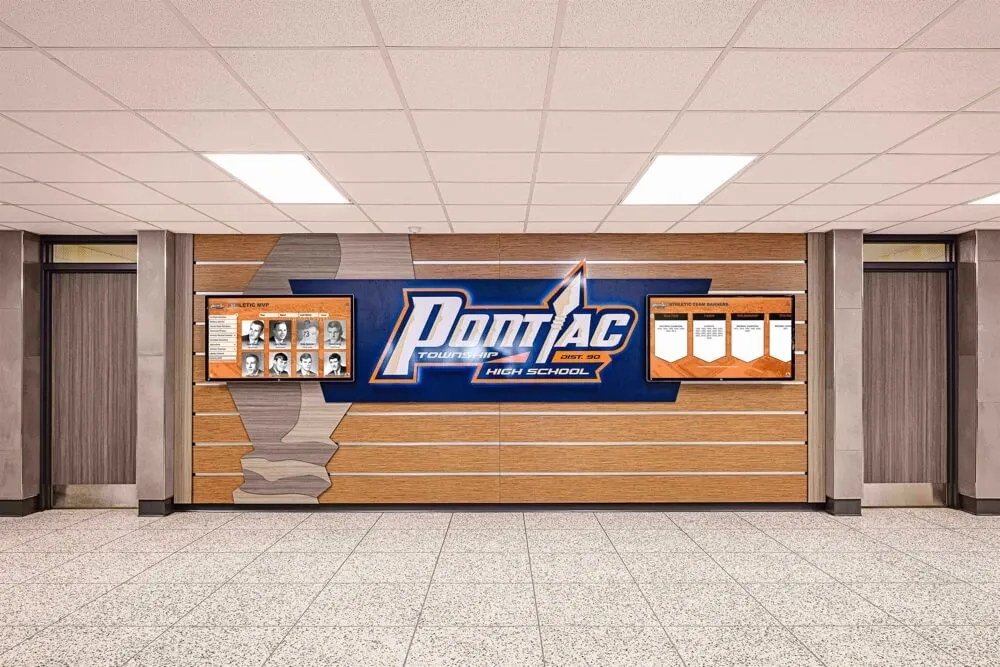
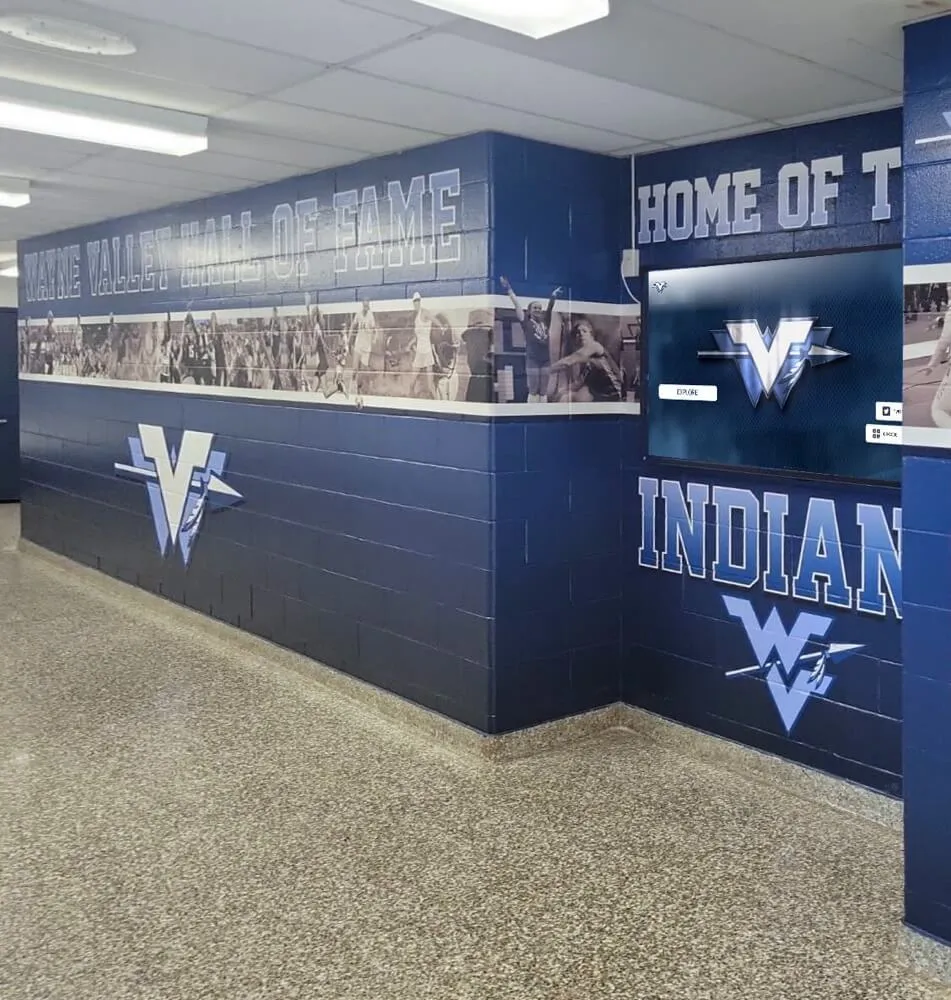
Hall of fame displays that pair athlete portraits with recognition context create richer stories than numbered jersey frames alone
Physical Jersey Frame Ideas for Schools
Physical framing remains the foundation of most school jersey recognition programs — and for good reason. A well-executed framed jersey is a permanent, visible statement that requires no technology to communicate impact. The key is choosing the right format for each jersey type.
Shadow Box Frames: The Standard Option
Shadow box frames are the most common choice for school jersey displays, and when executed well, they remain highly effective. The shadow box format provides depth to accommodate the dimensional nature of folded or arranged jerseys and allows space for accompanying items.
What makes a shadow box work for school jerseys:
- UV-protective glazing prevents fabric fading from hallway light exposure
- Acid-free matting and backing protect jersey fibers over decades
- Sufficient depth (typically 2–3 inches) allows the jersey to lie naturally without compression
- A backing color that complements school colors without competing with the jersey itself
- Hardware that supports the weight of a framed jersey without wall damage over time
Schools displaying multiple jerseys often standardize on a single shadow box dimension and style to create visual consistency across the display — particularly important when building dedicated retired jersey walls or hall of fame corridors.
What to include alongside the jersey in a shadow box:
- Engraved nameplate with player name, number, sport, and years
- Season record or championship notation
- A small photograph from game action or the retirement ceremony
- For signed jerseys: authentication documentation inside the frame or in accompanying display
Multi-Jersey Display Configurations
When a school is building out a retired jersey wall or a signed collection display, individual shadow boxes need to work together as a coherent system. Several configuration approaches work particularly well in school athletic spaces.
Grid arrangements place jerseys in consistent rows and columns, typically organized by sport or by era. This format works best in dedicated hallway alcoves or purpose-built display walls where spacing can be planned from the beginning.
Cascading arrangements stagger jersey frames at varying heights, creating visual movement that draws attention. This approach suits lobbies and entrance areas where impact matters more than systematic organization.
Sport-sectioned walls group all retired jerseys from a single sport together, allowing viewers to trace program history within each athletic discipline. Large athletic programs with multiple sport traditions often prefer this approach.
Mixed-media arrangements pair jersey frames with banner reproductions, championship plaques, and photograph collections to create comprehensive recognition environments rather than isolated jersey displays. The most visited jersey displays in school settings are typically mixed-media — a framed jersey surrounded by the season’s story draws more engagement than the jersey alone.
For schools looking at hall of fame tool options that complement physical jersey frames, digital platforms increasingly handle the storytelling layer that frames cannot accommodate on their own.
Football Jersey Display Cases: Specific Considerations
Football jerseys present specific framing challenges due to their size, shoulder pad bulk (if displayed with pads), and the additional protective equipment that many school programs want to incorporate into display presentations.
Jersey-only football displays are the most common approach. The jersey is folded or partially stretched over a backing to show the number prominently, with shoulder areas folded neatly. Shadow boxes at 20x24 inches or larger accommodate most football jersey sizes comfortably.
Jersey with helmet combinations require deeper shadow box construction or custom case fabrication. These displays carry stronger visual impact — the helmet and jersey together read as a complete uniform and attract more viewer attention than the jersey alone. Schools with dedicated display budgets often invest in these for top-tier athletes.
Number retirement banners pair with framed jerseys in gymnasiums and fieldhouses where banner traditions already exist. The banner carries the number at banner scale; the framed jersey in a case nearby provides the physical artifact and supporting story.
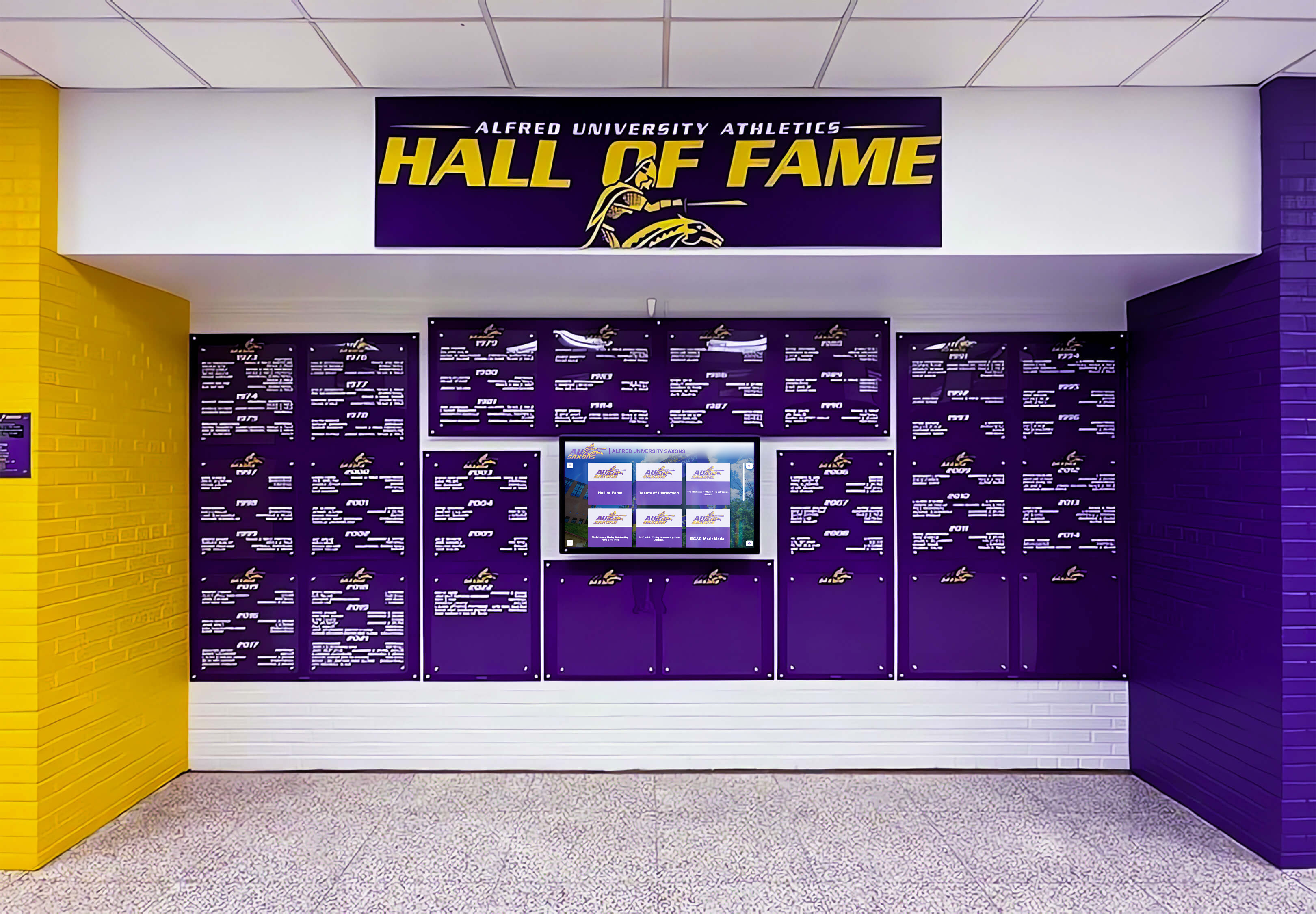
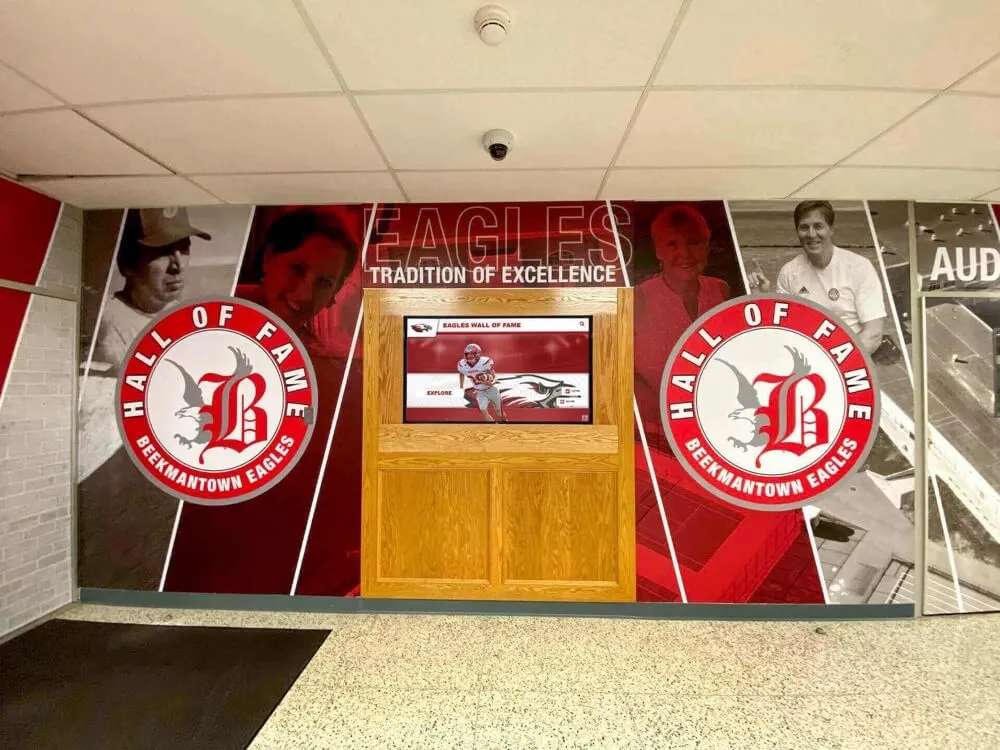
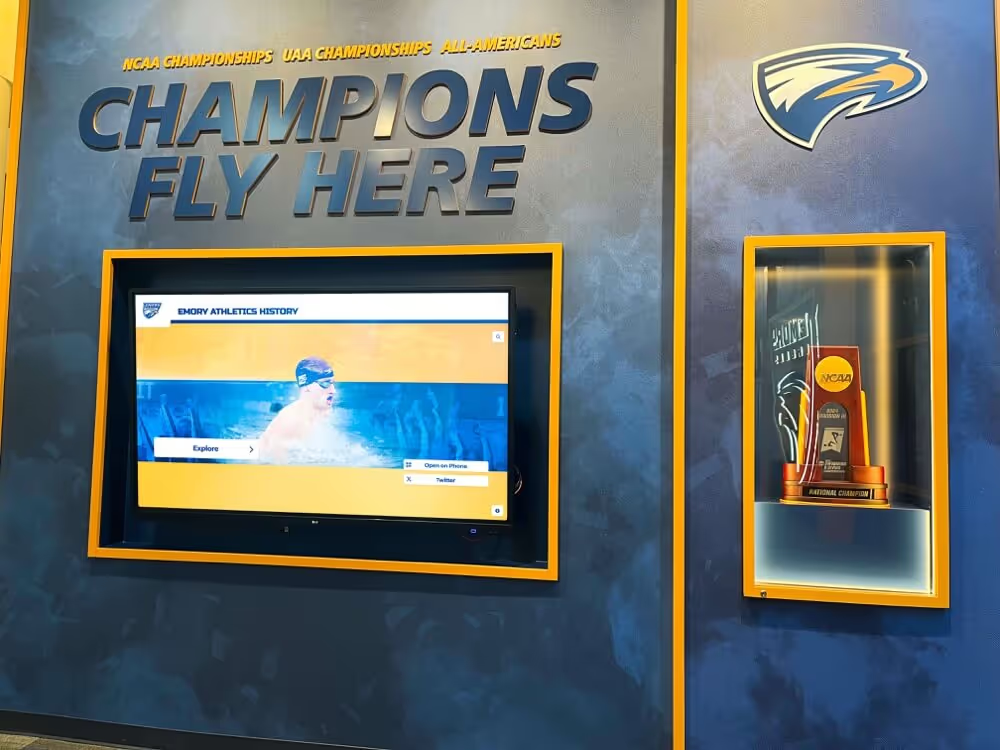
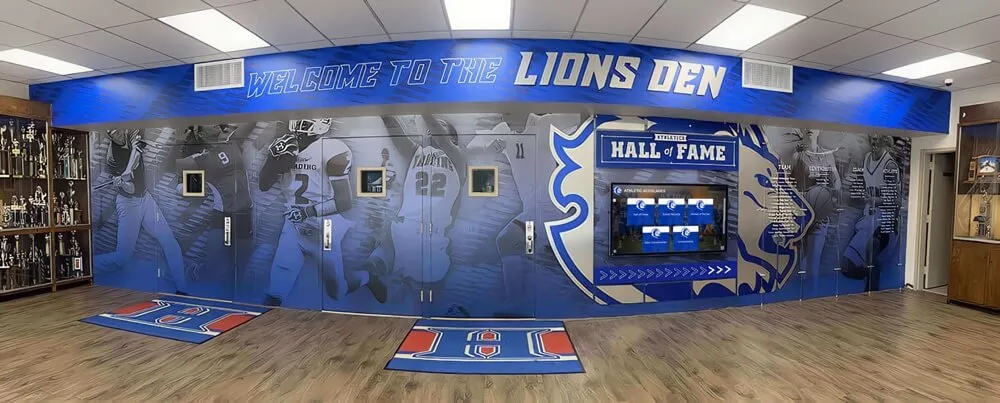
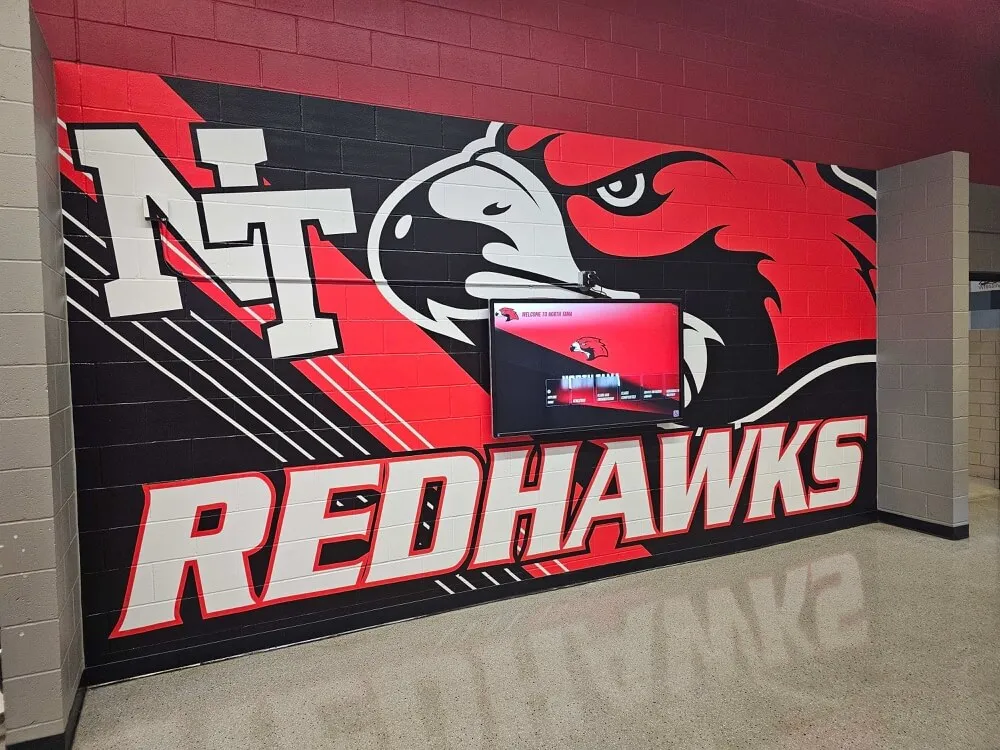
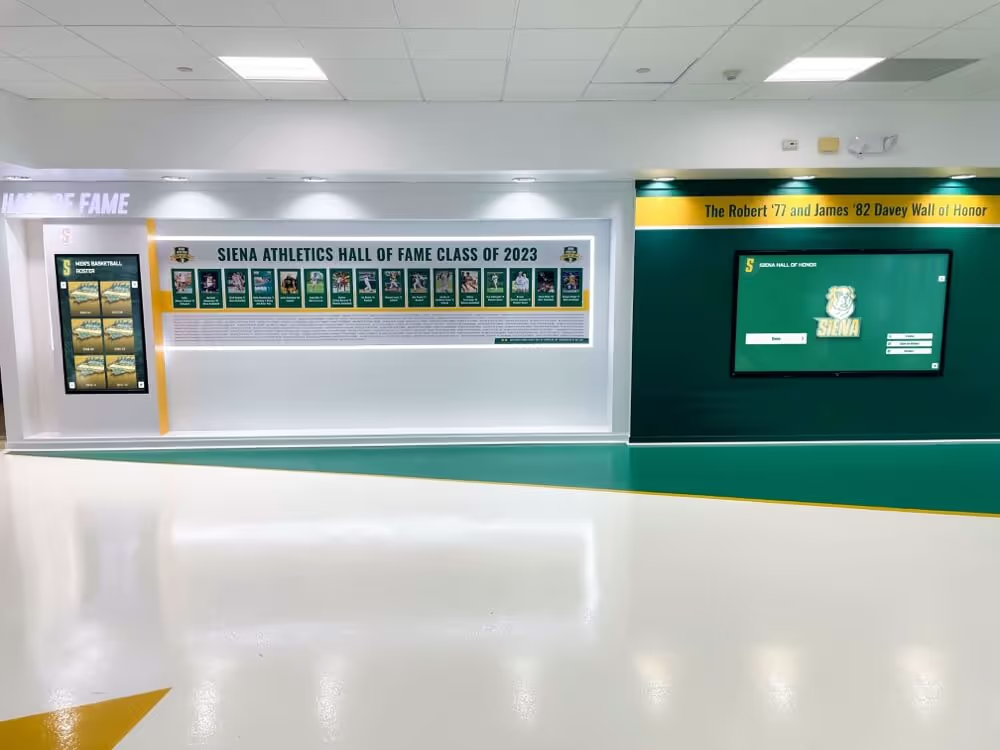
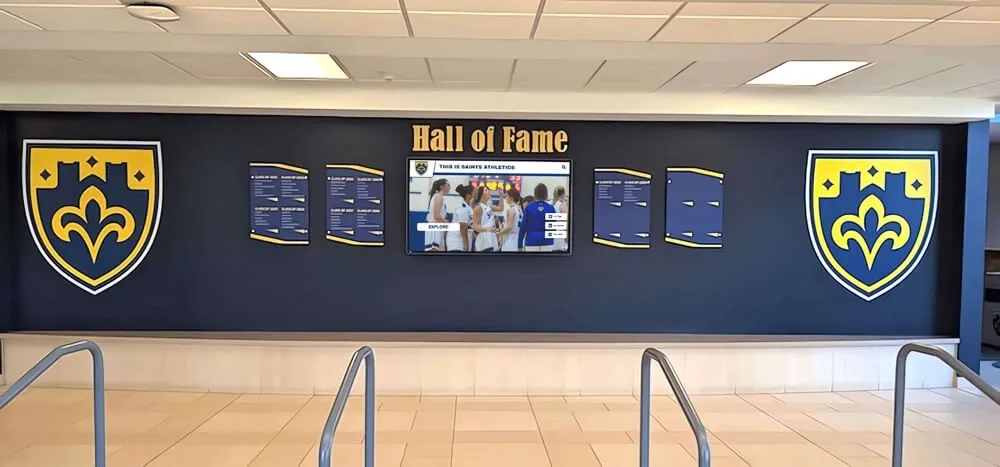
Athletics hall of fame displays designed in school colors create cohesive recognition environments where framed jerseys and other honors work together visually
The Athlete Story: What Makes Jersey Frames Meaningful
The physical frame holds the jersey. The story is what makes a visitor stop and stay.
This is the element most schools underinvest in, and it is the element that most directly determines whether a framed jersey inspires current athletes or becomes background scenery they stop noticing by October of their freshman year.
Building the Story Around Each Jersey
Every framed jersey display should answer at least three questions for a viewer who knows nothing about the athlete:
Who was this person? Name, sport, years — but also a glimpse of who they were. A single line about their role on the team, their impact on the program, or their path after graduation does more than any statistic alone.
What did they accomplish? Not just the championship year or the stat line — but the context that makes those numbers meaningful. Winning a regional title in a down year for the program means something different than winning it as a dynasty. That context belongs in the display.
Why does the school remember them? This is the connection to institutional values that distinguishes a recognition wall from a record board. The school isn’t just noting that someone scored a lot of points — it is saying that this person represented something worth remembering.
Physical frames accommodate this story through engraved plaques, printed panels, and photograph accompaniment. Digital displays can hold far more — video highlights, full career statistics, quotes from coaches and teammates, photographs from multiple seasons, and the ability to update the story as the athlete’s post-school career unfolds.
Signed Jersey Documentation and Story
Signed jerseys carry unique story requirements. A signed football jersey with no context is a curiosity. A signed football jersey with a clear account of who signed it, when, and why it matters to the school creates a recognition artifact with real institutional weight.
For schools building signed jersey collections, documentation should accompany every piece:
- Full name and position of the signing athlete
- Their connection to the school (former student-athlete, alum, community figure)
- The occasion of the signing (donation event, homecoming appearance, program milestone)
- Any notable context about the athlete’s career at the school and beyond
- Authentication information where applicable
Youth sports awards programs often touch on how to build recognition documentation habits early — the same discipline that makes youth award records valuable applies to maintaining signed jersey provenance at the school level.
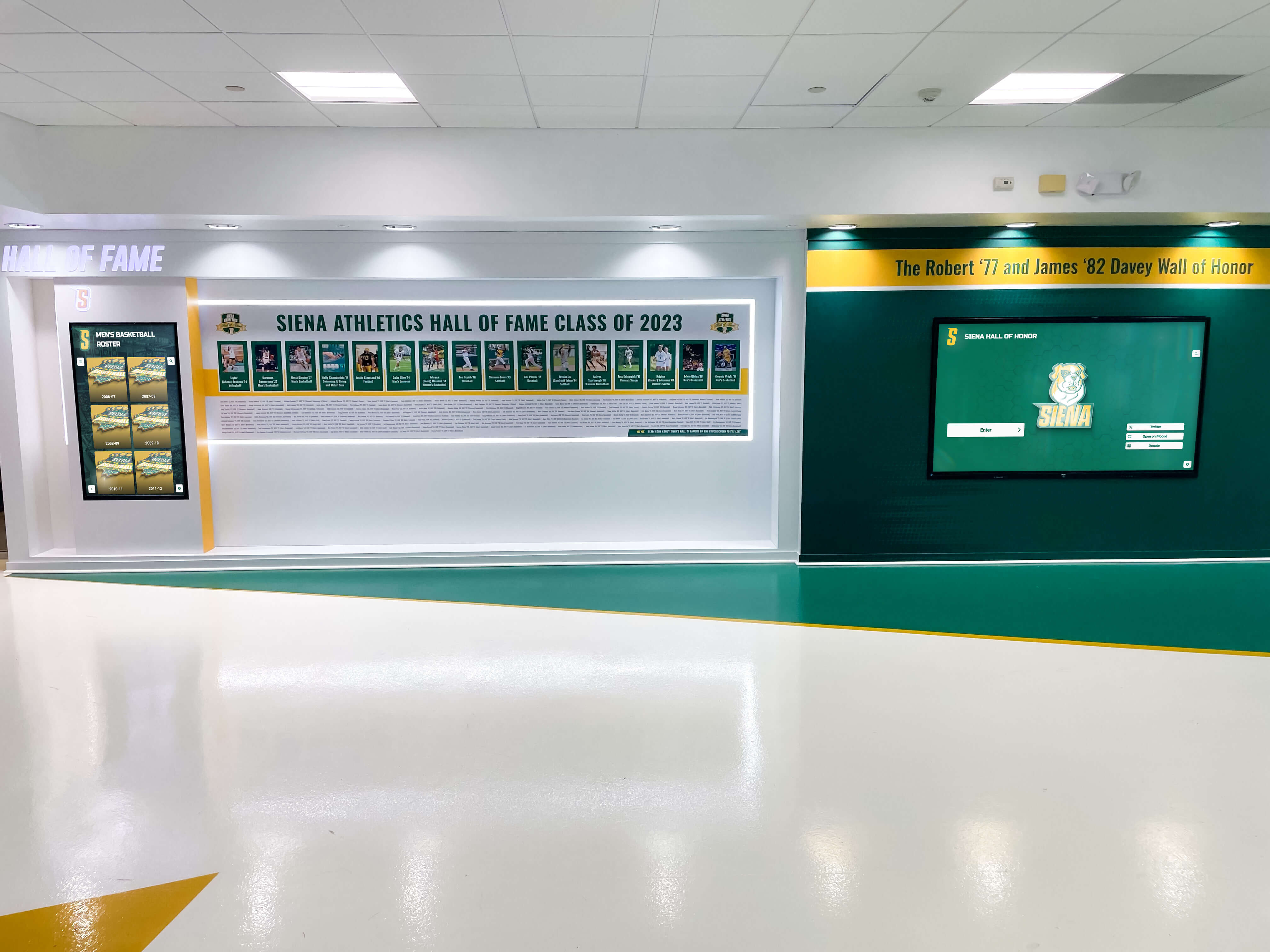
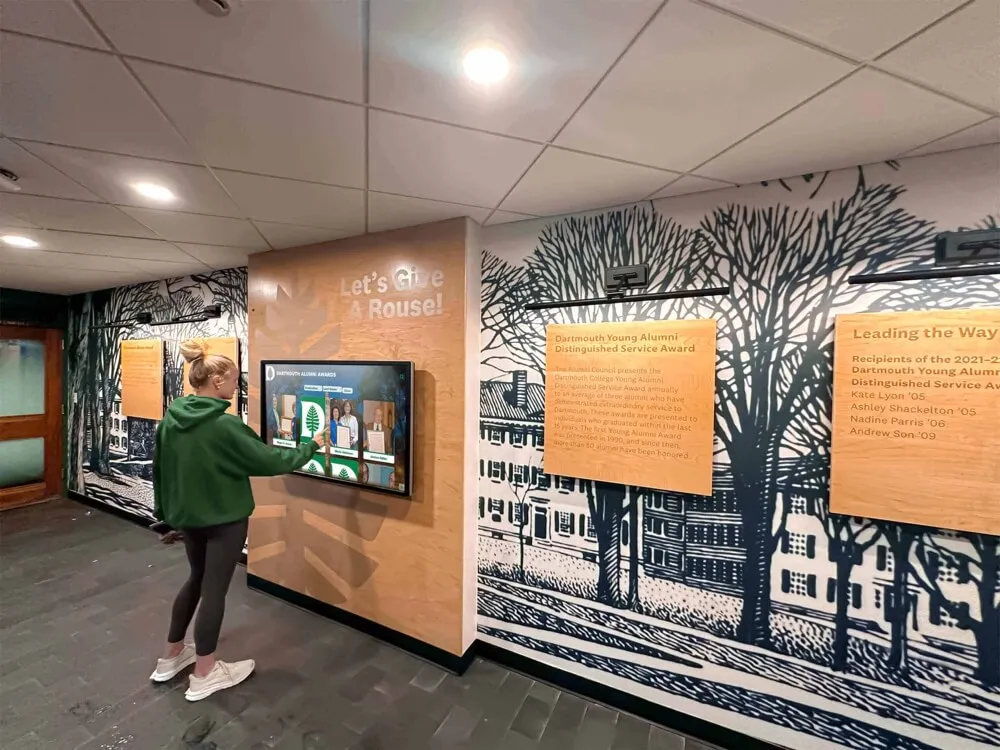
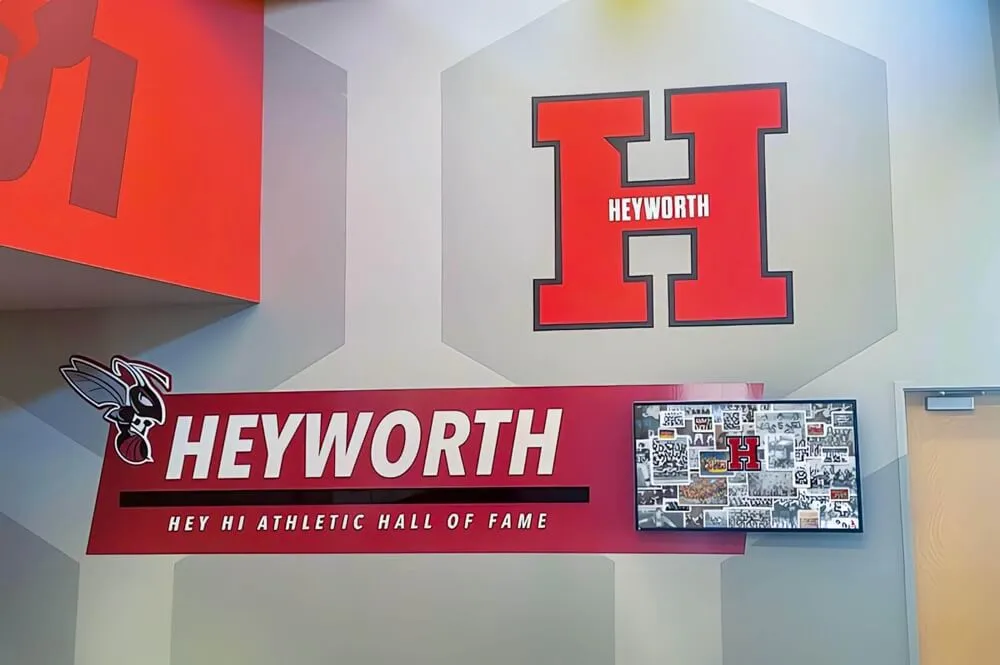
Multi-athlete hall of fame displays create the context that makes individual framed jersey recognition more powerful — each story gains meaning from the others surrounding it
Preservation Checklist for School Jersey Displays
Before any jersey goes into a frame for permanent display, a basic preservation protocol protects the fabric for decades:
- Jersey is professionally cleaned and fully dried before framing
- Any loose threads are stabilized (not cut) before mounting
- Acid-free backing material is used throughout
- UV-protective glazing selected for all frame fronts
- Jersey is not stretched beyond natural resting state during mounting
- No adhesives or staples contact the jersey fabric directly
- All accompanying photographs are archival quality (not regular inkjet prints)
- Frame hardware is rated for the weight of the completed display
- Documentation (player info, season, authentication) is included inside the frame or in a sealed accompanying envelope
- Location is assessed for direct sunlight, humidity, and temperature swings before mounting
Where Schools Display Framed Jerseys
Display location is a recognition decision as consequential as the frame choice itself. A beautifully framed jersey in a location no one visits accomplishes very little. Strategic placement turns jersey displays into daily recognition touchpoints.
Athletic Hallway and Trophy Case Integration
The most common location for school jersey frames is the dedicated athletic hallway — the corridor connecting gymnasium, fieldhouse, or locker room areas where student-athletes and visiting teams pass daily. This placement ensures consistent daily visibility with the audience most likely to be motivated by the recognition.
Integrating framed jerseys into existing trophy case environments strengthens both elements — the jersey gives the trophy case a personal, story-driven dimension, while the case gives the jersey display appropriate context and security. School hall of fame tools designed for athletic corridors can extend what any physical trophy case integration can hold.
Main Lobby and Entrance Displays
High-traffic lobby and entrance displays reach the broadest audience — prospective families, community visitors, and alumni arriving for events. Placing the program’s most significant jersey recognition here communicates institutional pride before any conversation begins.
Lobby jersey displays work best when they are part of a larger visual environment rather than isolated elements. A framed jersey flanked by championship banners and a digital display creates an arrival experience; a single framed jersey on an otherwise bare wall creates a curiosity at best.
Gymnasium and Field House Rafters
For formal retired jersey ceremonies, the rafter or scoreboard-adjacent banner is the traditional presentation format. The jersey number appears on a large-format banner that becomes part of the permanent visual environment of the competition venue.
Some programs pair this banner tradition with a secondary physical jersey display in an adjacent case — the banner announces the retirement at scale, the case holds the actual jersey and the supporting story at viewing distance. This two-element approach is particularly effective for programs conducting multiple retirements across sports.
Dedicated Hall of Fame Spaces
Schools with established athletic hall of fame programs often create dedicated spaces where retired jerseys, signed collections, and athlete recognition exist in a curated, permanent environment. These spaces function as destination recognition environments — places alumni seek out during homecoming, parents visit during recruitment, and current student-athletes draw motivation from during the season.
Effective hall of fame tools for these dedicated spaces combine the permanence of physical frames with the depth and searchability of digital platforms. The physical frame remains the anchor; the digital layer delivers the athlete story at a depth no engraved plaque can match.
Beyond the Frame: Digital Jersey Display Solutions
Physical jersey framing solves the visibility problem for the jerseys that receive it. Digital display solutions solve the scale problem that physical framing creates: there are always more athletes worth recognizing than frames worth hanging.

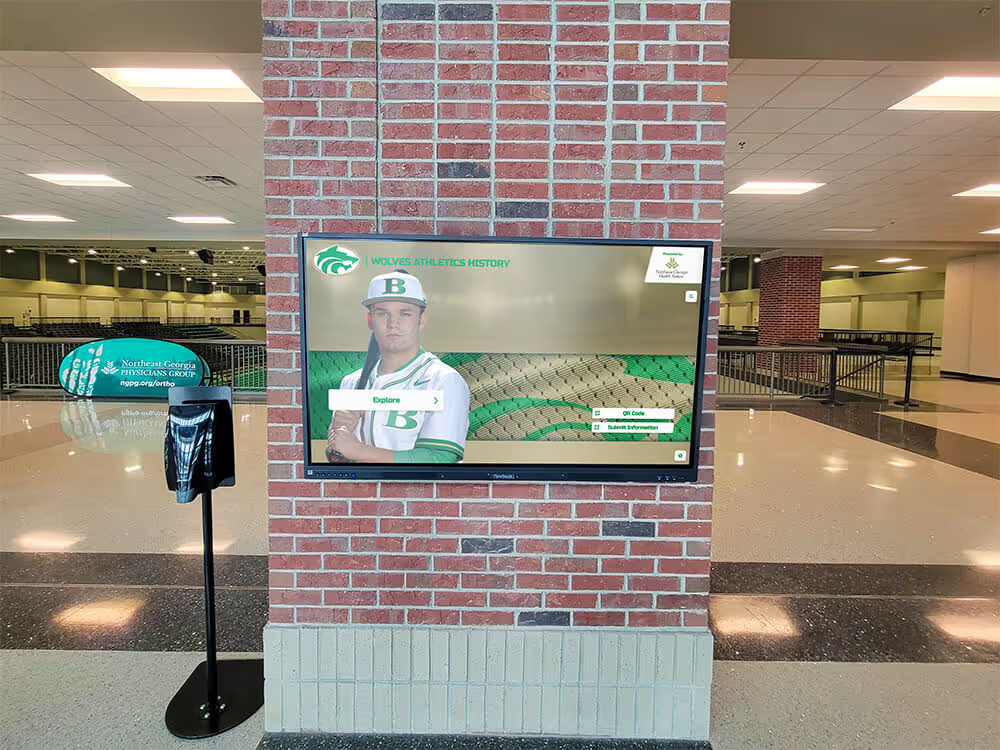
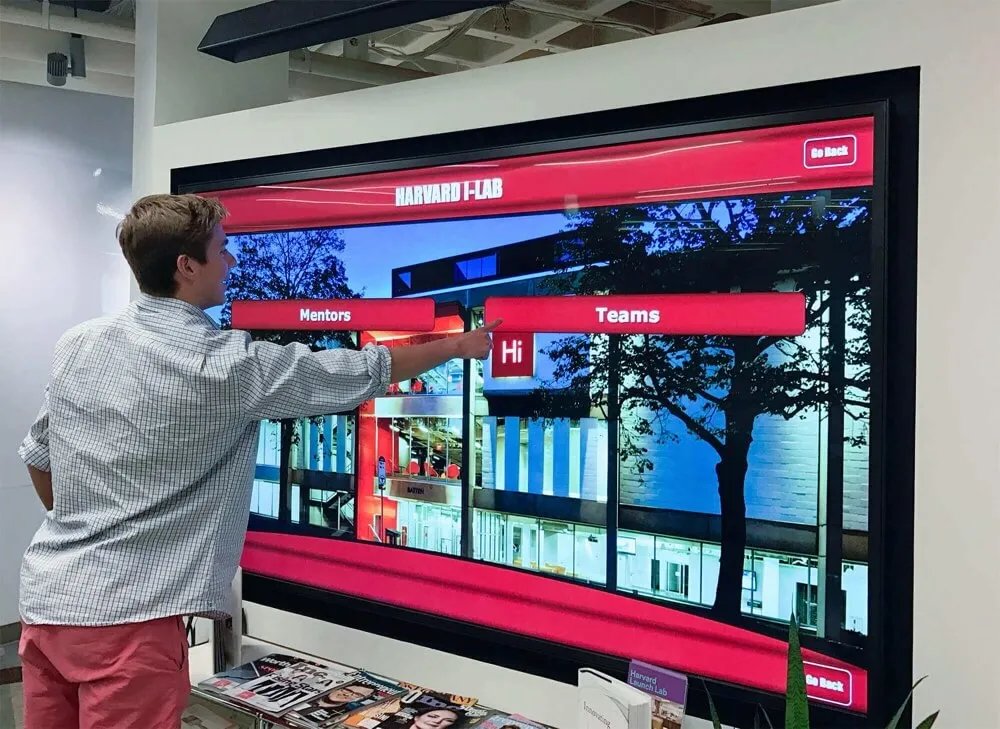
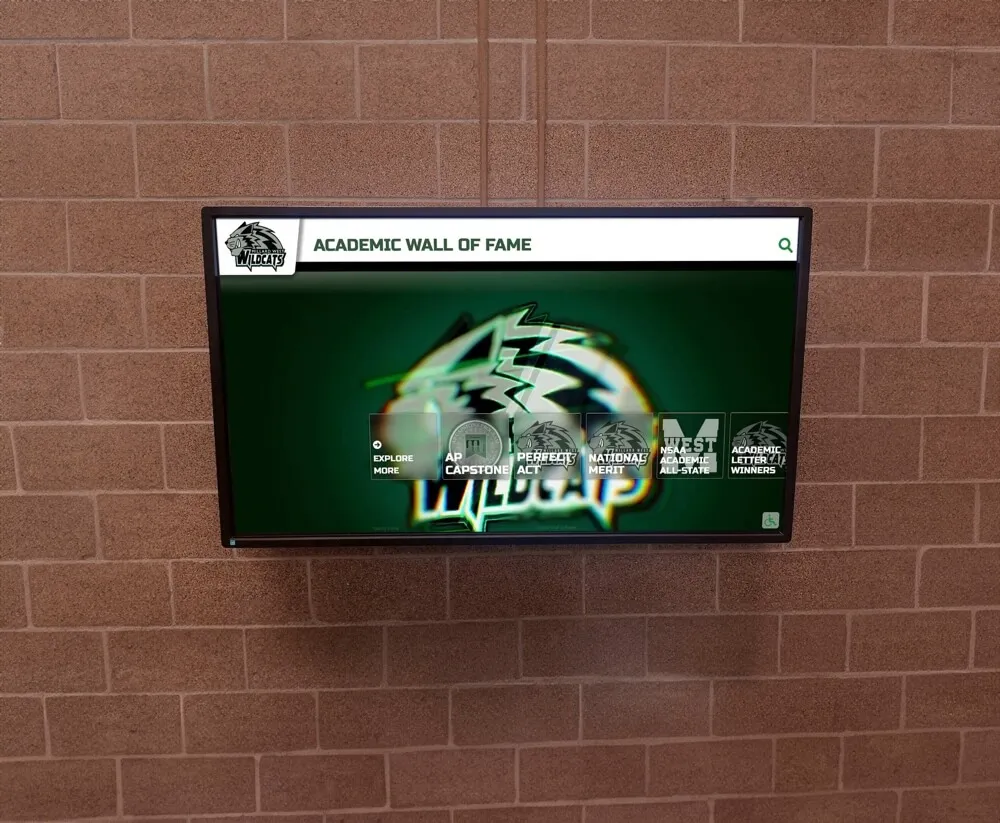
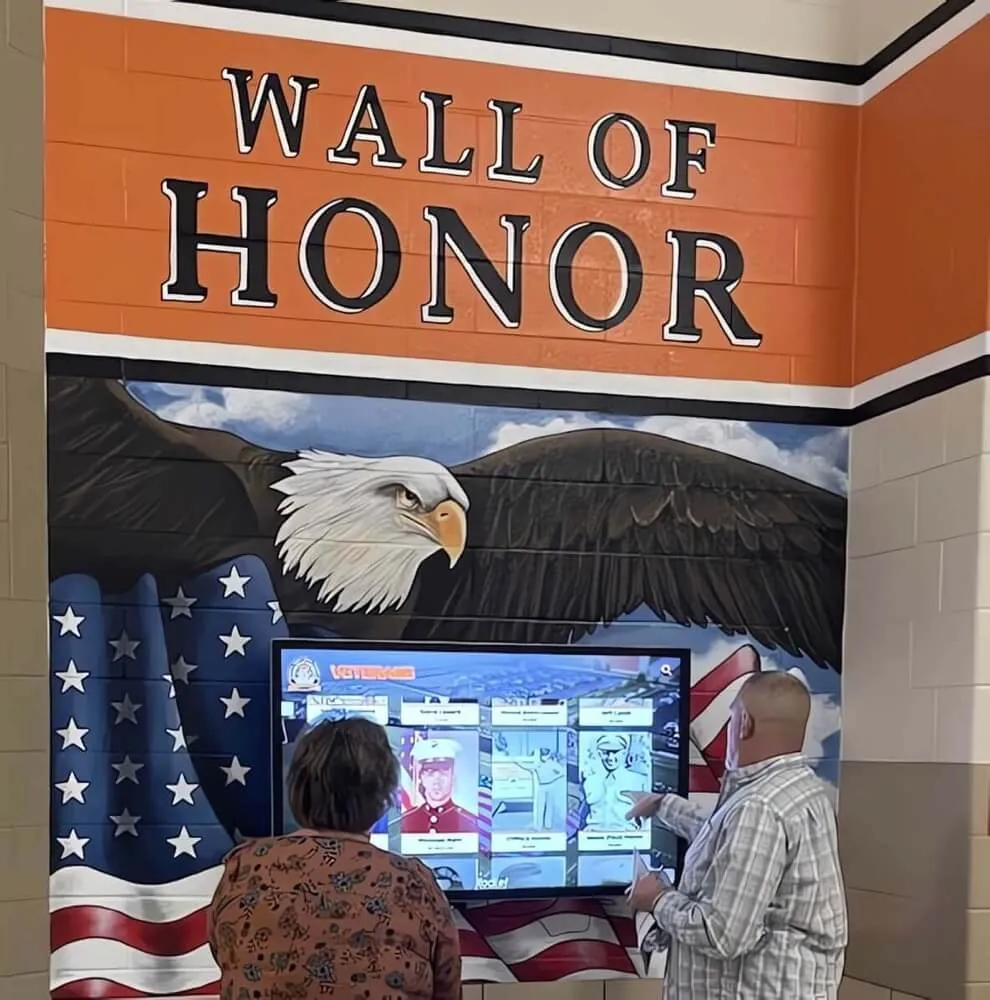
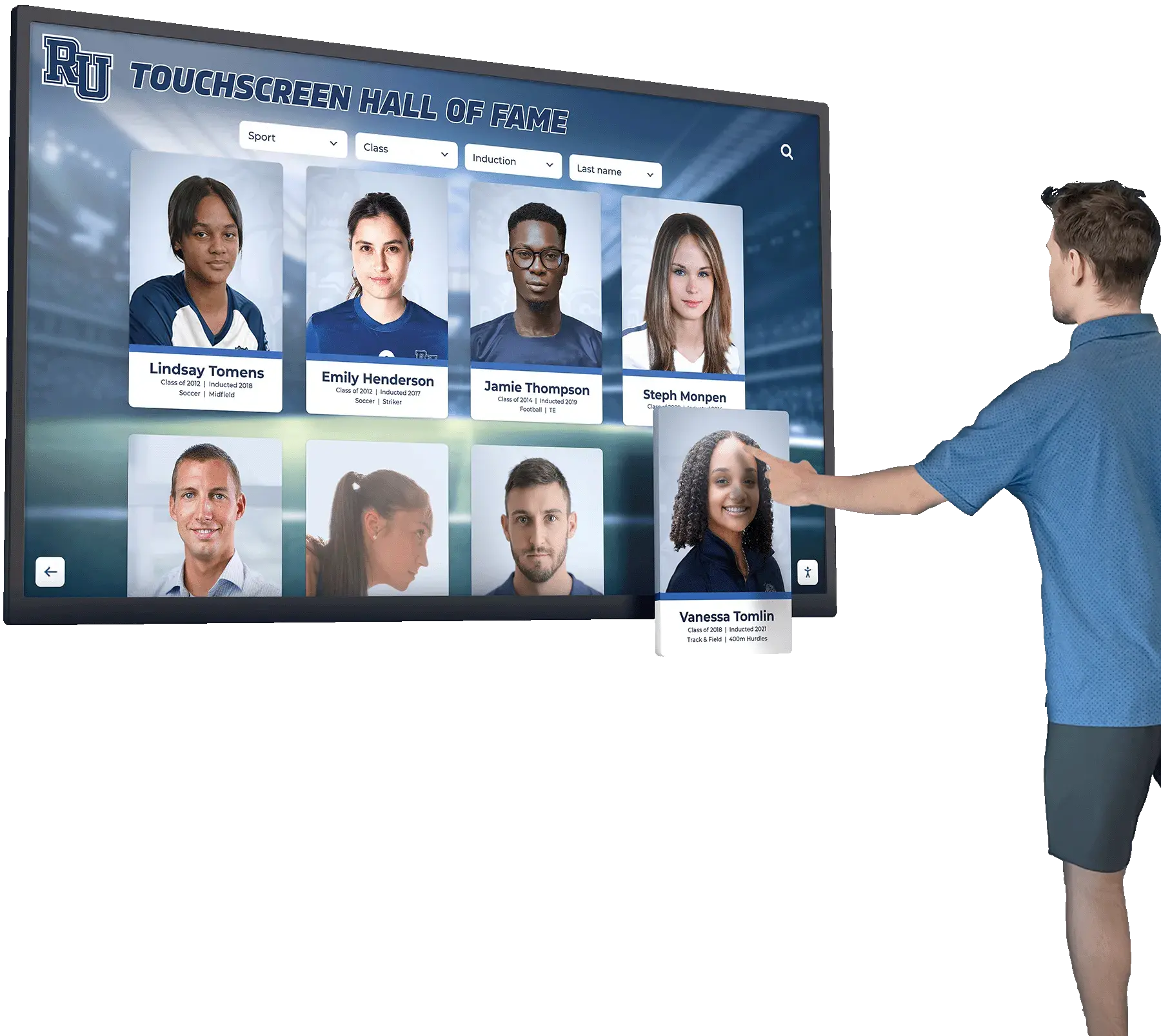
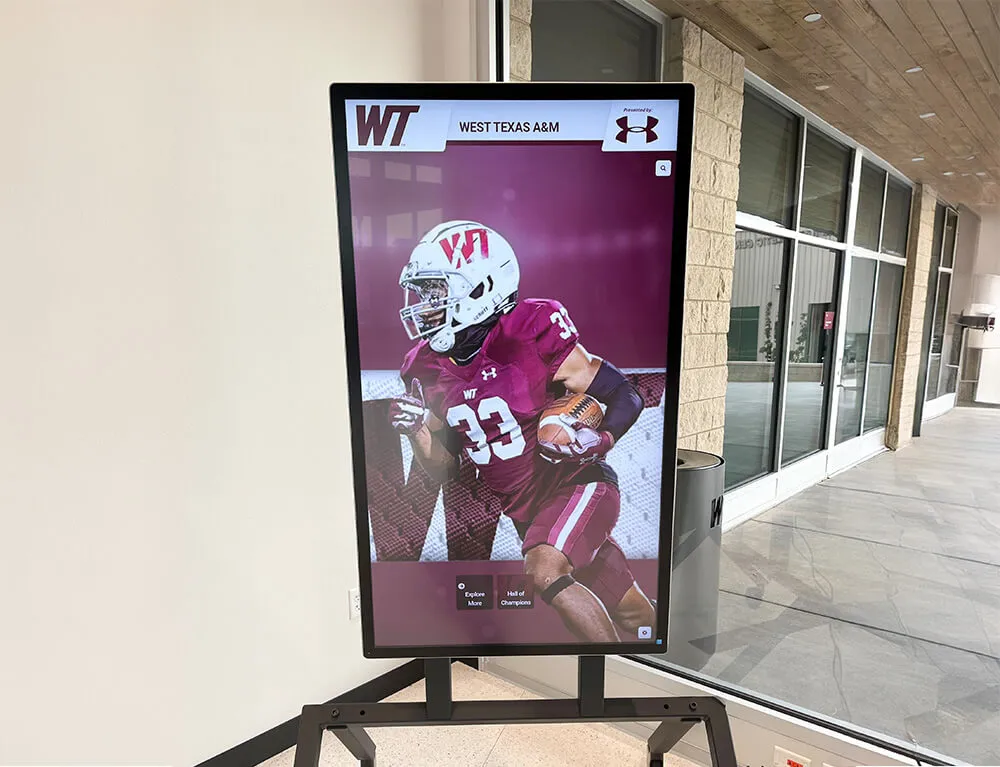
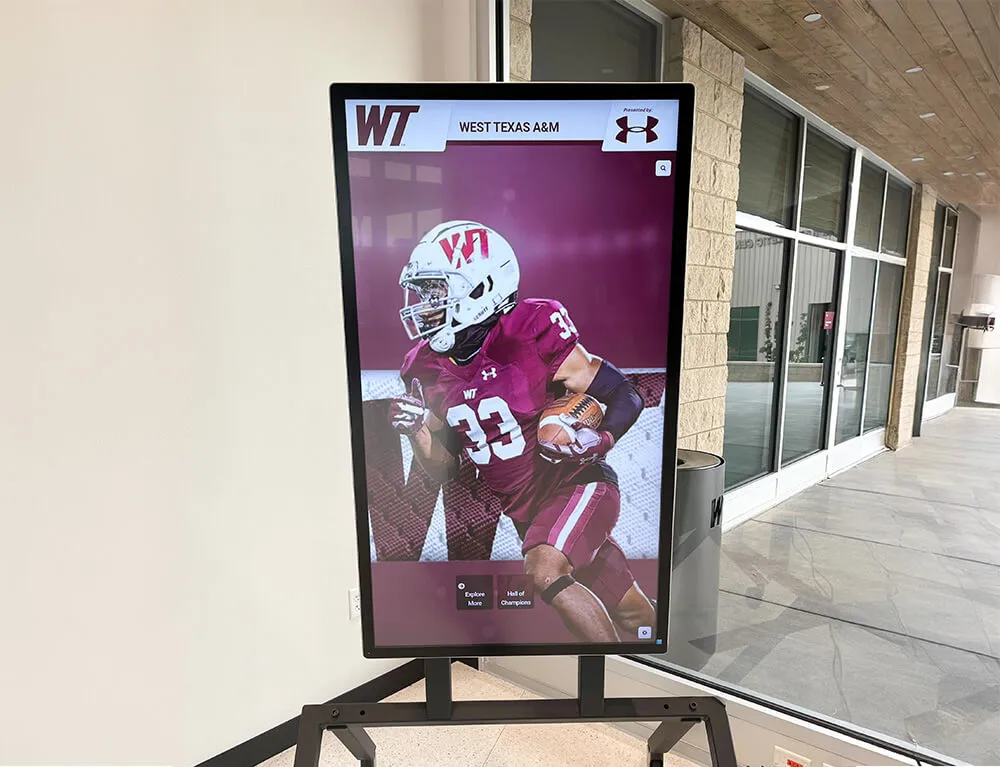
Touchscreen hall of fame platforms give every athlete — not just those with physical frames — a permanent, searchable recognition presence that visitors can explore at their own pace
What Digital Displays Add to Jersey Recognition Programs
A digital display paired with a physical jersey frame creates a recognition system that outperforms either element alone:
Unlimited story depth. A digital display alongside a framed jersey can hold the complete career statistics, a coaching tribute, photographs from multiple seasons, game highlight clips, and a post-graduation story that updates as the athlete’s career develops — content that no physical label can accommodate.
Searchable recognition. Visitors can search by sport, era, number, or name — turning a jersey display wall into a navigable archive rather than a static exhibit. Alumni visiting for homecoming can find their own history or search for teammates without needing to know exactly where their jersey is mounted.
All-athlete inclusion. Physical frames inevitably create a recognition hierarchy — the jerseys on the wall receive recognition; those in storage receive nothing. Digital platforms give every athlete in a program’s history a recognition entry, with the depth appropriate to their contribution, regardless of whether their jersey occupies a physical frame.
Remote access. QR codes placed alongside physical jersey frames connect in-person visitors to the full digital athlete profile — and allow alumni who cannot visit in person to access the same recognition content from anywhere.
Schools exploring digital record board solutions increasingly integrate jersey recognition into broader digital display strategies that cover records, championships, and honor roll alongside athletic hall of fame content.
Retired Jersey Ceremony Digital Integration
Retired jersey ceremonies represent the highest-visibility moments in any athletic recognition program. Schools that integrate digital platforms into these ceremonies extend the recognition impact far beyond the ceremony date.
Before the ceremony, digital displays can feature the retiring athlete’s career highlights and build community anticipation. During the ceremony, touchscreen displays allow guests to explore the athlete’s full history while the formal program proceeds. After the ceremony, the digital profile becomes a permanent searchable record — one that alumni, local media, and future recruits can access indefinitely.
This before-during-after integration transforms a single ceremony into an ongoing recognition asset rather than a one-night event.
Signed Jersey Collection Digitization
Signed jersey collections present a particular opportunity for digital integration. Many schools have accumulated signed jerseys across decades with inconsistent documentation — some with full provenance, others with notes in an office drawer, still others with no record at all.
A systematic digitization project for signed jersey collections typically involves:
- Photographing each jersey at high resolution
- Documenting provenance from available records and institutional memory
- Creating digital profiles for each athlete who signed
- Building cross-references between jerseys, athletes, and school history
- Publishing the full collection in a searchable digital platform
The result is a signed jersey archive that remains accessible regardless of which coach or administrator currently holds the office where jerseys are displayed — and one that can be shared with alumni and community members who have no way to visit the physical collection.
High school reunion programming increasingly incorporates digital jersey and athletic recognition displays as a way to reconnect alumni with their school era — making digitized jersey collections a resource that extends well beyond the athletic department.
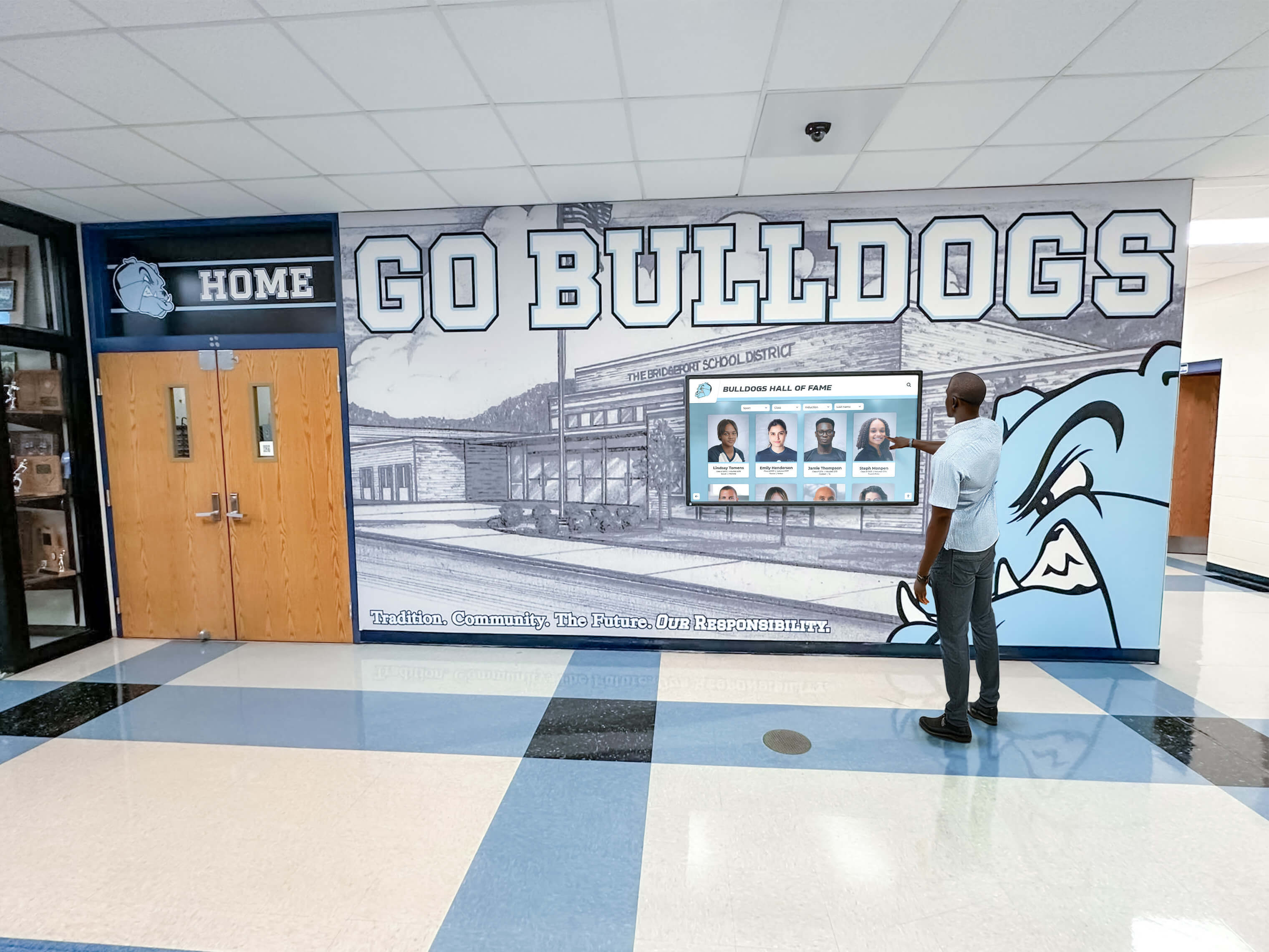
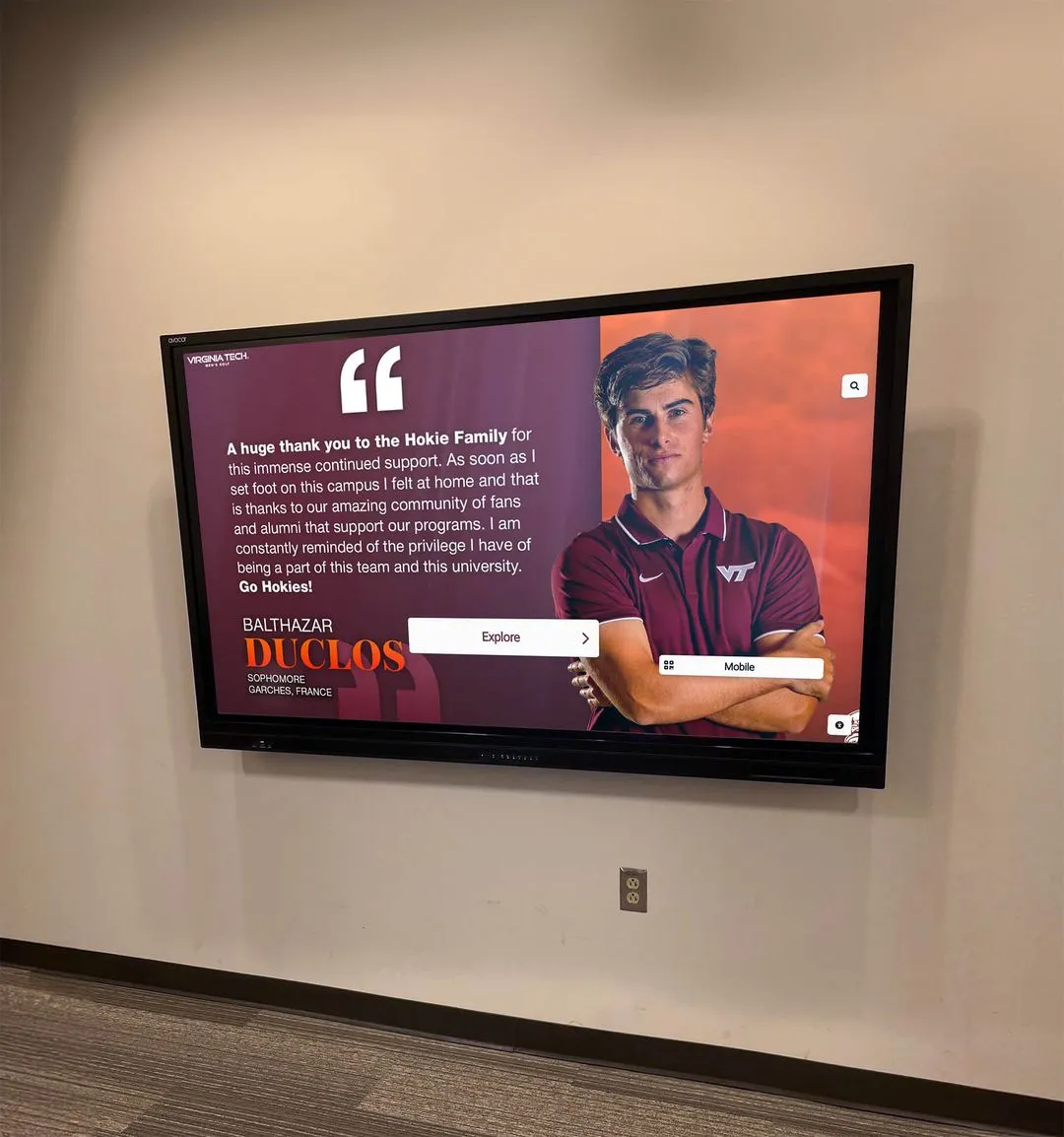
Interactive digital displays in athletic hallways create recognition environments that visitors engage with actively rather than passing by without stopping
Connecting Jersey Recognition to Hall of Fame Programs
Retired jerseys and signed collections are natural entry points for broader athletic hall of fame programming — and schools that treat them as connected elements rather than separate projects build more coherent recognition systems.
Jersey Retirement as Hall of Fame Induction
Many schools formalize the connection between jersey retirement and hall of fame induction by combining the ceremonies. When a jersey is retired, the athlete is simultaneously inducted into the athletic hall of fame. The physical jersey display becomes the anchor of the hall of fame entry; the digital hall of fame platform provides the depth of recognition the physical frame cannot.
This combined approach has practical advantages: it reduces the number of separate recognition events the athletic department must organize, it ensures every retired jersey has an associated hall of fame record, and it creates a clear institutional statement about what jersey retirement means — not just a number removed from circulation, but a permanent place in the program’s history.
Athletic hall of fame tools designed for school programs typically include dedicated sports recognition modules that accommodate exactly this kind of integrated retired jersey and hall of fame management.
Donor and Advancement Connections
Framed jersey displays — particularly signed jerseys from prominent alumni athletes — are also advancement assets. Donor recognition walls and athletic recognition programs increasingly share physical and digital real estate in schools that have recognized this connection.
An alumnus who donated a signed jersey, funded a jersey framing project, or endowed a sports recognition program can be honored alongside the athletic recognition itself — creating a virtuous cycle where recognition of donors strengthens the recognition assets available to athletes. Donor wall recognition programs at the school level increasingly handle both athletic and donor recognition within integrated display systems.
Building an Alumni Athlete Archive
The deepest value of a comprehensive jersey recognition program is the alumni athlete archive it builds over time. Every framed jersey, every signed uniform, every digital athlete profile contributes to an institutional record that becomes more valuable each year as the archive grows.
Schools with strong alumni athlete archives use them actively — in recruitment conversations, in alumni relations outreach, in advancement campaigns, and in community engagement around athletic events. The archive demonstrates institutional commitment to recognizing achievement, which strengthens the school’s relationship with every athlete who ever wore the uniform — framed or not.
Youth sports award systems that document athlete recognition from early in a career build the longitudinal records that make alumni archives meaningful. Schools that start documentation habits early rarely regret it; those that scramble to reconstruct decades of missing records universally do.
Implementation: From First Jersey to Full Program
Most schools don’t arrive at a complete jersey recognition program in a single project. They build it over time, starting with the highest-impact jerseys and expanding the system as capacity and budget allow.
Starting Point Recommendations
If you have one or two significant jerseys to display: Begin with high-quality shadow box framing for those specific jerseys, focusing on the accompanying story elements — engraved nameplate, action photograph, supporting context. Do this well for two jerseys rather than adequately for ten.
If you’re launching a retired jersey program: Design the visual system before the first retirement — consistent frame dimensions, backing colors in school palette, standard nameplate format, and a designated wall space that can grow with additional retirements over time. A retired jersey program launched without a coherent display plan typically produces visual inconsistency that undermines the recognition intent.
If you’re building an athletic hall of fame: Treat jersey display as one component of a larger recognition system that includes athlete profiles, career records, team histories, and searchable digital access. Hall of fame program tools built for school athletic programs provide the infrastructure to manage that full system without requiring IT involvement for routine updates.
If you have a large existing collection: Conduct a recognition audit before making new display investments — identify which jerseys are currently displayed, which are in storage, which have documentation, and which lack any institutional record. The audit findings should drive display priorities and documentation projects in parallel.
Budget Considerations
Physical jersey framing costs vary significantly based on frame quality, glazing type, custom fabrication, and accompanying engraving. Custom shadow boxes with UV glazing and professional installation typically run $150–$400 per jersey depending on size and complexity. Multi-jersey wall installations benefit from volume pricing when all frames are ordered from a single vendor.
Digital display platforms represent a separate budget category — one that serves far more athletes than the physical frame budget can reach. The comparison that matters is not the cost of one digital display versus one frame, but the cost of recognizing a hundred athletes via physical framing alone versus a hybrid system where physical frames anchor the highest-priority jerseys and digital platforms provide recognition depth and breadth for the full program history.
Schools that have made this shift consistently report that the digital platform extends their recognition reach dramatically — from the handful of athletes whose jerseys occupy frames to every athlete in program history — at a per-athlete cost that physical framing alone cannot approach.
Summary: Jersey Frame Ideas That Build Lasting Athletic Recognition
Effective jersey framing for school athletic programs means:
- Choosing the right physical format for each jersey type — shadow box frames with UV glazing and acid-free backing for retired jerseys; custom cases for jersey-plus-helmet combinations; banner-plus-case pairings for formal retired number ceremonies
- Building the story into every display with athlete context, career achievements, and institutional significance — not just a number and a name
- Placing displays strategically in athletic hallways, main lobbies, gymnasium rafters, and dedicated hall of fame spaces based on audience and impact goals
- Documenting signed jersey collections with full provenance before the institutional memory that holds that documentation disappears
- Integrating digital platforms to extend recognition to all athletes, add searchable depth to physical frames, and connect jersey recognition to broader hall of fame and alumni archive programs
- Following preservation protocols that protect jersey fabric for decades of display life
The schools with the strongest jersey recognition programs treat every framing decision as a recognition decision — one that either honors the athlete’s contribution or diminishes it.
Take Jersey Recognition Further with Rocket Alumni Solutions
Physical jersey frames are the starting point. The schools building recognition programs that engage alumni, motivate current athletes, and create lasting institutional archives pair physical displays with the digital infrastructure to give every athlete’s story a permanent home.
Rocket Alumni Solutions provides schools with touchscreen recognition platforms, digital trophy case systems, and cloud-managed hall of fame tools that work alongside — and dramatically extend — physical jersey displays. From retired jersey digital profiles to full athletic hall of fame archives, the platform handles the recognition depth that no frame alone can hold, with remote content management that doesn’t require IT tickets to update a single athlete record.
If your school is ready to move beyond the frame and build a recognition system that honors every jersey in your history — displayed or not — connect with the Rocket team to see how schools are doing it.