



A historic school glass trophy crizzling triage is a structured condition assessment for glass award objects — engraved glass cups, cut-glass championship bowls, blown-glass presentation pieces, and pressed-glass plaques — that show signs of crizzling: the fine network of surface or subsurface cracks, milky surface haze, iridescence, or moisture droplets that indicate active chemical deterioration in glass with an inherently unstable composition. Triage identifies what staff can safely document and segregate before any specialist arrives, and draws a clear line between interim protective actions and the treatment decisions that belong to a conservator. This guide addresses glass award objects — the trophies themselves — not trophy case glazing panels, tempered display glass, or modern resin and acrylic award materials, which fall under separate inspection protocols.
If you are responsible for a school’s athletic or academic trophy collection, you may have opened a display case during a seasonal rotation or a pre-event check and found a historic glass award that looks unmistakably wrong — a web of hairline cracks lacing across the surface, a milky or iridescent haze that no cleaning cloth has ever touched, or small droplets of moisture appearing on a piece stored in a dry interior space. These are not surface-cleaning problems, and they are not findings your custodial checklist covers. They are signs of crizzling: a form of chemical deterioration that originates in the glass composition itself and requires a different first response than any routine glass maintenance protocol.
This guide walks athletic directors, recognition-program coordinators, and the facilities or archival specialists who support them through the recognition criteria, interim handling steps, documentation fields, and digital-access strategies that put a crizzling glass trophy in the right hands — a conservator’s — without causing additional damage while that assessment is arranged.

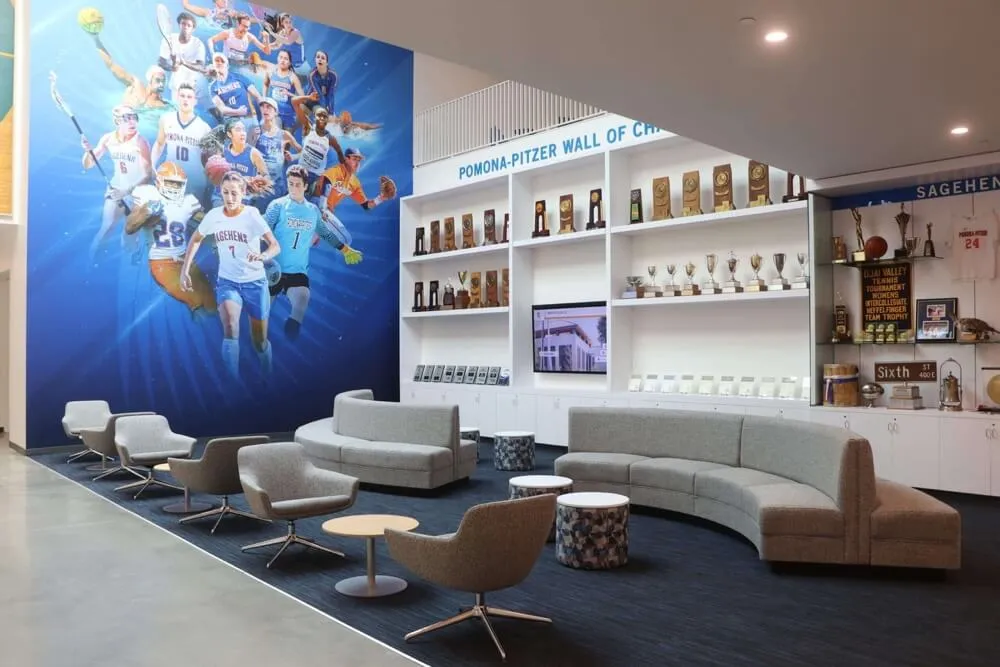
School trophy collections often hold glass award objects spanning decades — engraved cups, cut-glass bowls, and presentation pieces made from formulations that can become chemically unstable over time regardless of how carefully they have been stored
What Crizzling Is and Why It Affects Historic Glass Awards
Crizzling — also described in conservation literature as glass disease, sick glass, or in advanced stages weeping glass — is a deterioration process that originates in the chemical composition of the glass rather than in how a piece was handled or stored. Glass is a silica network held together by network modifiers, typically alkali compounds such as potassium or sodium, that affect structural stability over time. When the proportions of these components fall outside certain ranges, the glass can be inherently unstable: environmental moisture attacks the glass surface, alkali ions migrate outward, and the resulting chemical exchange gradually breaks the surface network into the fine crack patterns and haze that define crizzling.
The Canadian Conservation Institute’s preventive conservation guidance for ceramics and glass identifies crizzling as an active deterioration process driven by this underlying chemical instability. Display and storage conditions can accelerate or slow the rate of deterioration, but they cannot reverse what has already occurred or eliminate the inherent compositional problem. This matters for school trophy programs because it means that no cleaning, polishing, desiccant, or case adjustment will address the cause — only a conservator with appropriate knowledge of historic glass can assess the piece and determine what stabilization options exist.
For school athletic programs, historic glass trophies are particularly likely to include pieces from the late nineteenth century through the mid-twentieth century, a period when glass formulations varied considerably between manufacturers and long-term compositional stability was not always a production priority. Engraved presentation cups, cut-glass championship bowls, and blown-glass award vessels from that era may have been stable for decades under the specific conditions they were kept in, and then begin showing active crizzling when moved, when building conditions change, or as deterioration that was already in progress becomes visible under routine inspection.
Visual Signs That Trigger Triage
Triage begins when any of the following conditions are observed on a glass trophy or glass award object. Each finding warrants documentation before any handling decision is made.
Fine crack network. A web of hairline cracks on or near the glass surface, sometimes visible only in raking light — a flashlight held at a low angle to the surface. At early stages the network may be barely perceptible; at later stages it is visible in standard corridor lighting.
Surface haze or milkiness. A diffuse white or gray cloudiness on the glass surface that does not shift, smear, or partly clear when a cloth approaches (without touching). This is distinct from a dust film or fingerprint residue, which have a different visual character under raking light and respond differently to proximity testing.
Iridescence. A rainbow or oil-film sheen visible on the glass surface under certain lighting angles. On historic glass, iridescence can indicate that alkali compounds have migrated to the surface and formed a thin reaction layer with a refractive index different from the underlying glass.
Weeping or moisture droplets. Visible moisture — droplets or a damp film — on the glass surface in indoor conditions where condensation from temperature differential has been ruled out. Weeping is a sign of advanced deterioration in which the glass is actively releasing alkali-rich moisture from the network and is the most urgent crizzling indicator.
Loose or lifting surface material. Flaking, powdering, or lifting fragments associated with a crack network, distinct from label adhesive or surface coatings.
Display case inspections and seasonal rotation checks are the most common occasions when crizzling on glass trophies is first noticed — documenting the finding at that moment is the first triage step
The Four Interim Steps Before Conservator Review
When a glass trophy shows any crizzling indicator, these four steps represent the appropriate interim response. None of them constitute treatment or stabilization — that is the conservator’s domain. These steps protect the piece and the institutional record while specialist access is arranged.
Step 1: Document Before Touching
Photograph the piece before any handling. Use a camera or phone in good ambient lighting and, if the crack network or haze is difficult to see overhead, with a flashlight held at a low angle to the surface. Capture the full piece from front, back, and both sides, along with close-ups of any visible crack network, haze zone, iridescence, or moisture. Photograph the base and any engraved text recording the award date, recipient name, sport, and occasion. This condition record is exactly what a conservator needs for an initial remote assessment.
Step 2: Segregate Without Washing, Polishing, or Wiping
Move the piece to a separate, padded surface away from other case contents. Use clean cotton gloves for any handling. Do not wash the piece, do not wipe the surface with any cloth — dry or damp — and do not apply any polish, cleaner, or surface treatment of any kind.
The CCI’s guidance on glass conservation is clear that washing or wiping crizzling glass can remove alkali residue from the surface. That residue layer, while visually undesirable, has to some degree buffered further chemical reaction. Cleaning intervention before conservator assessment risks accelerating the same deterioration process that triage is designed to slow.
Step 3: Avoid Desiccants and Abrupt Humidity Transitions
Do not place a crizzling glass trophy in a sealed container with silica gel or any other desiccant. Rapid moisture removal from glass that has absorbed environmental moisture into an active crack network can cause differential contraction that widens or extends existing cracks. The CCI preventive conservation guidance specifically identifies aggressive drying as a risk for crizzling objects rather than a remedy.
Similarly, avoid moving the piece between environments with substantially different humidity levels while awaiting conservator review — for example, from a climate-controlled display corridor to an unheated storage room. Stable ambient conditions, without any attempt to dry the piece rapidly, are the appropriate environment during the interim period. This guidance does not prescribe a specific humidity target, as the appropriate stable range depends on the object’s history and current state — a question for the conservator.
Step 4: Record Findings and Contact a Conservator
Complete the triage field record (see below) and contact a conservator with experience in historic glass objects. In the United States, the American Institute for Conservation (AIC) provides a public Find a Conservator directory at culturalheritage.org. Regional history museums, university conservation programs, and state historic preservation offices are also common referral sources for school districts without existing conservation relationships.
The triage photographs and written field record created in Steps 1 and 2 give the conservator what they need to conduct an initial remote assessment, determine whether in-person examination is needed, and specify any storage adjustments warranted before an appointment can be arranged.
Routine collection checks create the opportunity to notice early-stage crizzling — fine crack networks visible in raking light or faint milky haze — before conditions reach weeping or structural fragmentation stages
Triage Evidence and Proposed Acceptance Table
The table below provides proposed school-level triage criteria for categorizing crizzling findings on glass trophy objects. These criteria are adapted from conservation descriptive language and are offered as a practical starting point for schools without in-house conservation resources. They are proposed criteria for internal triage purposes, not official conservation standards, and a conservator’s assessment may revise the category assigned to any individual piece.
| Observed Condition | Proposed Triage Stage | Interim Handling | Conservator Priority |
|---|---|---|---|
| Fine crack network visible only in raking light; no haze; no moisture | Stage 1 — Early active | Segregate; photograph; maintain stable conditions; avoid handling | Schedule within 6 months |
| Crack network visible in normal light; surface haze or milkiness present | Stage 2 — Progressive | Do not clean; segregate; photograph in detail; limit to gloved handling only | Schedule within 60–90 days |
| Iridescent surface film with or without crack network | Unconfirmed — assess needed | Document; do not clean or polish; consult conservator to confirm diagnosis | Consult within 30 days |
| Visible moisture droplets (weeping) on surface in dry indoor conditions | Stage 3 — Acute | Do not wipe; photograph immediately; isolate in breathable (not sealed) packaging; no desiccant | Contact conservator immediately |
| Loose or lifting glass fragments associated with crack network | Stage 3+ — Structural risk | Do not attempt re-adhesion; photograph before any movement; support from below if moved | Contact conservator before moving |
| Surface haze only; no crack network; haze location shifts under raking-light test | Not crizzling — likely surface deposit | Apply standard glass object cleaning protocol appropriate to the deposit type; monitor for crack network | Not required for this finding alone |
What to Avoid Before Conservator Review
These actions are commonly applied to glass display objects for routine maintenance or appearance improvement. For a crizzling glass trophy, each carries a specific risk that the triage protocol is designed to prevent.
Washing with water. Water contact on crizzling glass can accelerate the alkali leaching reaction, remove surface buffering layers, and introduce additional moisture into an existing crack network. This applies to all water sources — tap, distilled, or deionized — regardless of how gentle the application method.
Polishing or buffing. Any abrasive or semi-abrasive action on crizzling glass surfaces risks mechanically extending the already-compromised surface network and removing material that a conservator would need to assess the current deterioration state. This includes commercial glass polishes, cerium oxide compounds, and soft-cloth buffing.
Desiccants in sealed storage. As noted in Step 3, rapid humidity reduction through desiccant use can cause differential shrinkage stress in glass with an active crack network, potentially widening or extending cracks.
Abrupt environmental changes. Moving a crizzling piece between significantly different environments — higher or lower humidity, temperature extremes, or outdoor transport in winter — before a conservator has assessed the object’s current state imposes stress without a preparation protocol.
Any adhesive or consolidant. Applying adhesive to hold a crack network together, or any consolidant to stabilize a weeping surface, before conservator assessment may interfere with treatment options and bond in ways that are difficult or impossible to reverse. A conservator selects consolidants based on the glass composition and deterioration state; an uninformed choice may close off better options.
Triage segregates the specific pieces needing specialist review while the undamaged collection continues serving its recognition function — most cases will contain a mix of stable and at-risk objects that can be managed independently
Maintaining Digital Recognition Access While Originals Await Treatment
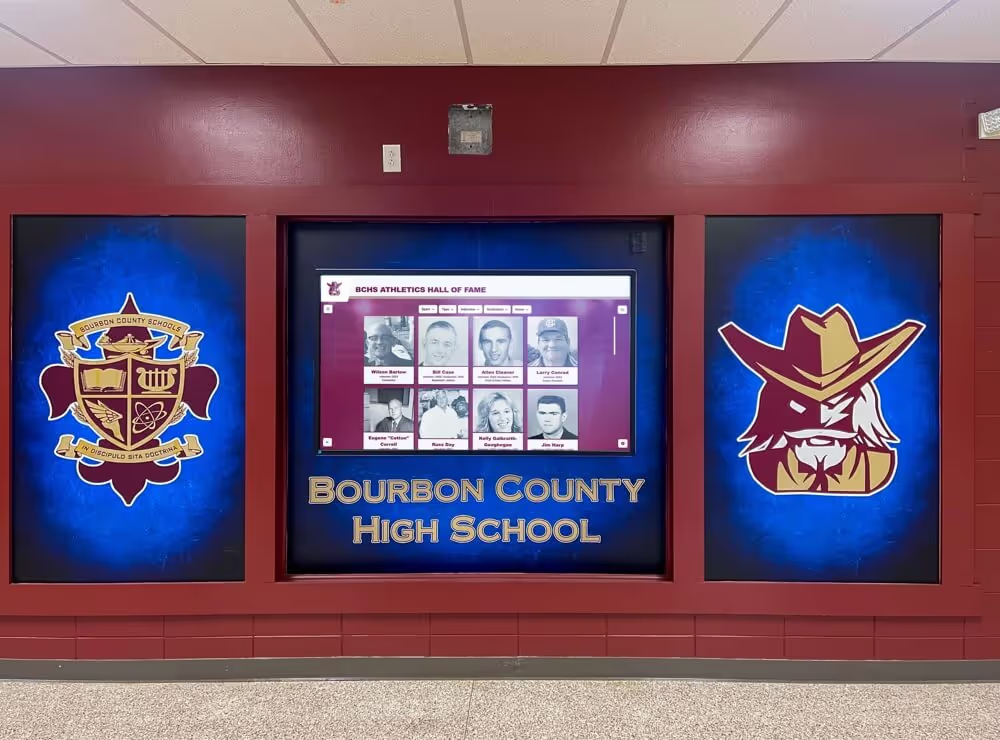
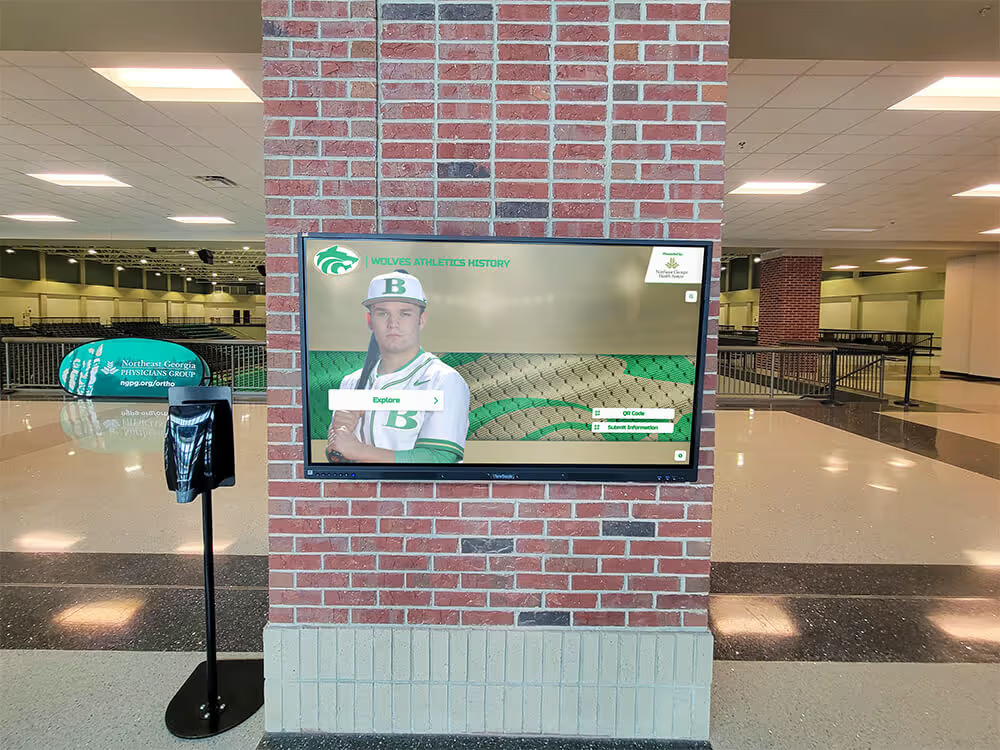
When a historic glass trophy is segregated from its display case pending conservator review, the recognition it represents does not have to disappear from public view at the same time. Schools that have built digital recognition records alongside their physical collections can maintain full access to that recognition content — recipient names, award year, sport, achievement — regardless of what is happening with the physical piece.
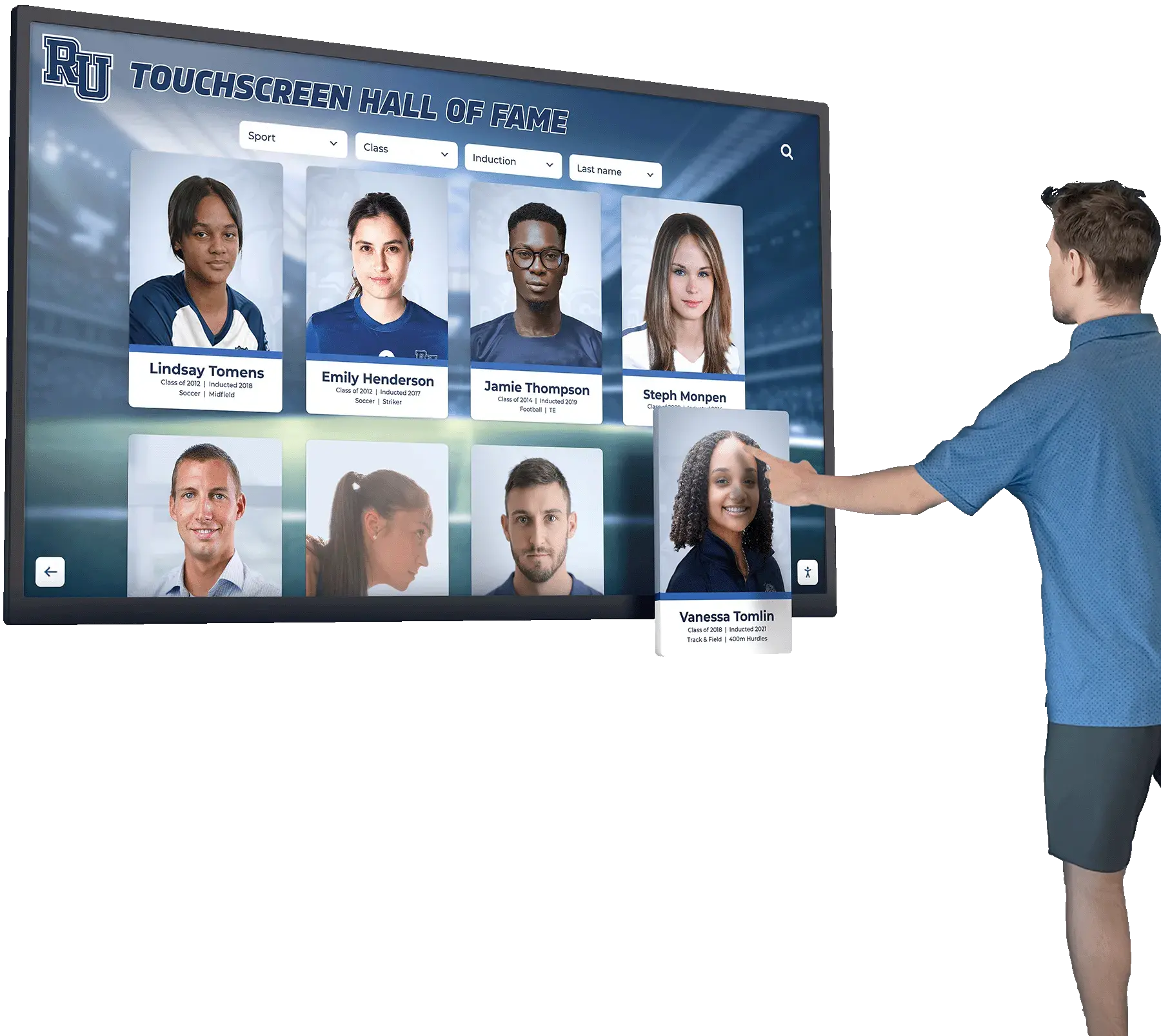
The practical workflow during a triage interval is straightforward: the digital record of the award remains available through the school’s recognition platform, accessible on touchscreens, through QR codes linked from the display case, or through a web-accessible archive. The physical trophy’s absence can be acknowledged with a brief notice that the original is under conservation assessment, with a QR code connecting visitors to the full digital entry. Students, alumni, and visitors see the recognition history without interruption.
Schools that have not yet built this parallel digital record face a more urgent situation when a crizzling trophy is removed: the recognition disappears entirely from visitor access, and staff must reconstruct information from memory, old yearbooks, and athletic records rather than a maintained archive. For schools considering what a modern digital recognition layer looks like, the guide on why schools are making the switch to digital trophy cases in 2025 covers the recognition continuity case alongside the practical transition path.
For schools that already maintain digital profiles for inductees and honorees, templates for announcing new hall of fame inductees through a press release illustrate how the digital recognition cycle manages recognition regardless of the physical state of the trophies that mark a person’s induction.
Triage Field Record
The following fields should be completed for each crizzling glass trophy at the time of triage. The record supports the conservator’s initial assessment and provides a baseline for any future condition tracking.
| Field | Record Content |
|---|---|
| Item ID | Unique identifier matching label on item or case inventory |
| Object description | Material form, approximate dimensions (e.g., “Cut-glass cup, approx. 25 cm tall, c.1938”) |
| Award inscription | Text engraved on piece: sport, season, recipient name, occasion |
| Approximate date | Year or decade based on inscription or collection records |
| Current location | Case number, shelf position, or interim storage location |
| Triage stage assigned | Stage 1 / 2 / 3 / Unconfirmed — per table above |
| Observed conditions | Check all that apply: crack network / haze / iridescence / weeping / loose fragments |
| Crack network extent | Surface only / body / base / handle area / all surfaces |
| Photographs taken | Y / N; number of images; file storage location |
| Prior cleaning or handling known? | Y / N; describe if known |
| Environment at time of finding | Building area; any recent HVAC changes or seasonal transitions noted |
| Staff completing triage | Name and title |
| Date of triage | Date record completed |
| Conservator contact initiated | Y / N; date; name of conservator or organization contacted |
| Interim storage | Padded box / separate shelf / other; note if monitored |
Connecting Triage to the Digital Athletic Archive
A crizzling glass trophy triage program has a second function beyond protecting individual objects: it creates a structured occasion to document historic award objects that may not yet have a complete digital record. The information gathered during triage — inscription text, award year, recipient names, sport, and season — is exactly the data that belongs in a searchable digital recognition archive.
Athletic program historians sometimes discover at this stage that a historic glass trophy is the only surviving record of a particular championship or an individual athlete’s recognition. The triage record then becomes an archival entry as much as a conservation document.
For schools building digital archives that are designed to survive the physical deterioration of original objects, the principles covered in the athletic archive bit rot detection and fixity checklist apply directly: digital records created from physical originals need their own integrity management to remain trustworthy over time. Capturing inscription data from a crizzling trophy during triage — when the piece is in hand, the text is legible, and context is still available — is significantly more accurate than reconstructing that information from secondary sources after the physical piece has deteriorated further.
Role Assignments for Glass Trophy Triage
Effective triage programs distribute responsibility clearly across the staff members best positioned to act.
Athletic director initiates triage when crizzling signs are observed during display rotations or collection checks, maintains the triage field record, contacts a conservator for Stage 2 and Stage 3 findings, and ensures that digital recognition content for the affected award is current and accurate in the school’s recognition platform before the piece leaves display.
Facilities coordinator or archivist handles interim storage logistics — padded surface preparation, environment monitoring if applicable, and transport coordination if the piece needs to leave the building for in-person conservator assessment. Facilities staff are not responsible for the conservation triage assessment itself but for the physical support of segregation and stable storage.
Principal or district archives coordinator authorizes conservator engagement for significant expenditures, provides institutional context for pieces where inscription information alone is insufficient, and approves any off-site transport of collection items. For schools where a booster organization holds title to historic trophies, this role also includes notifying relevant stakeholders before a piece is removed from public display.
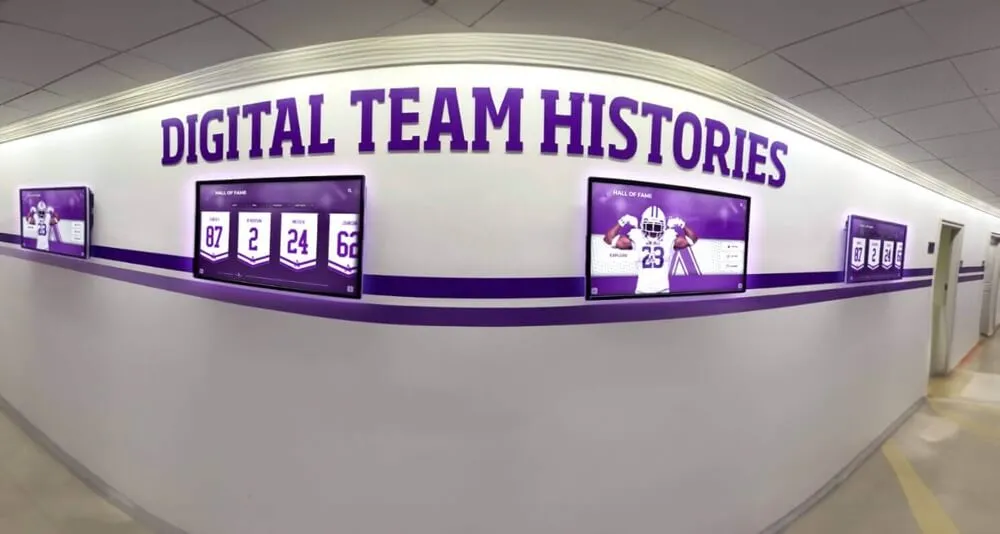
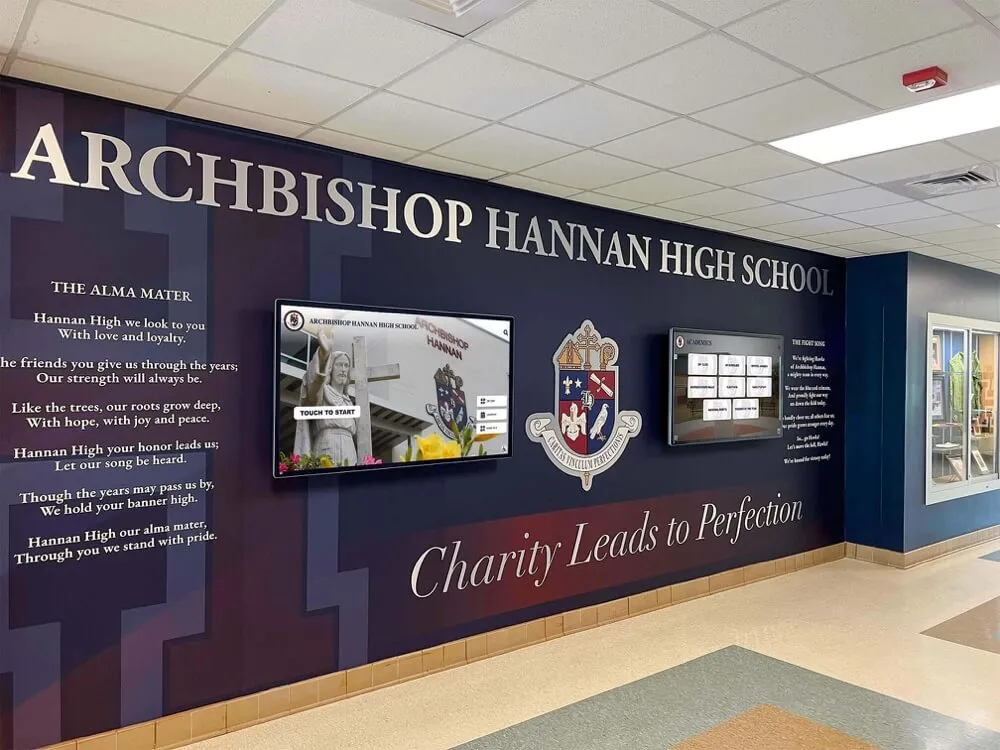
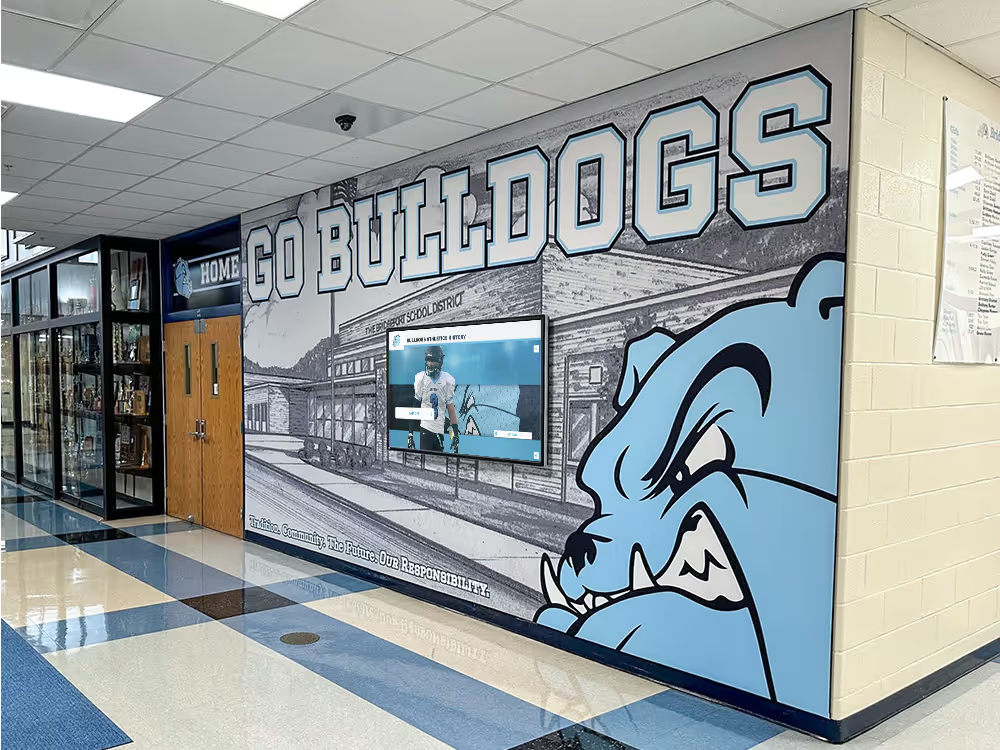
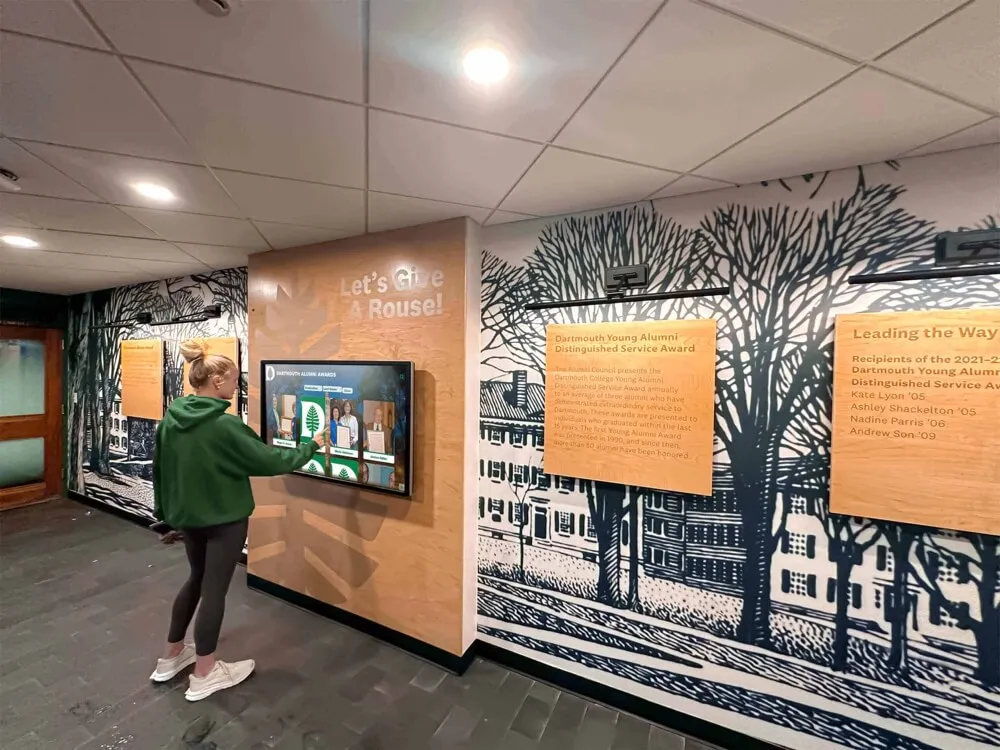
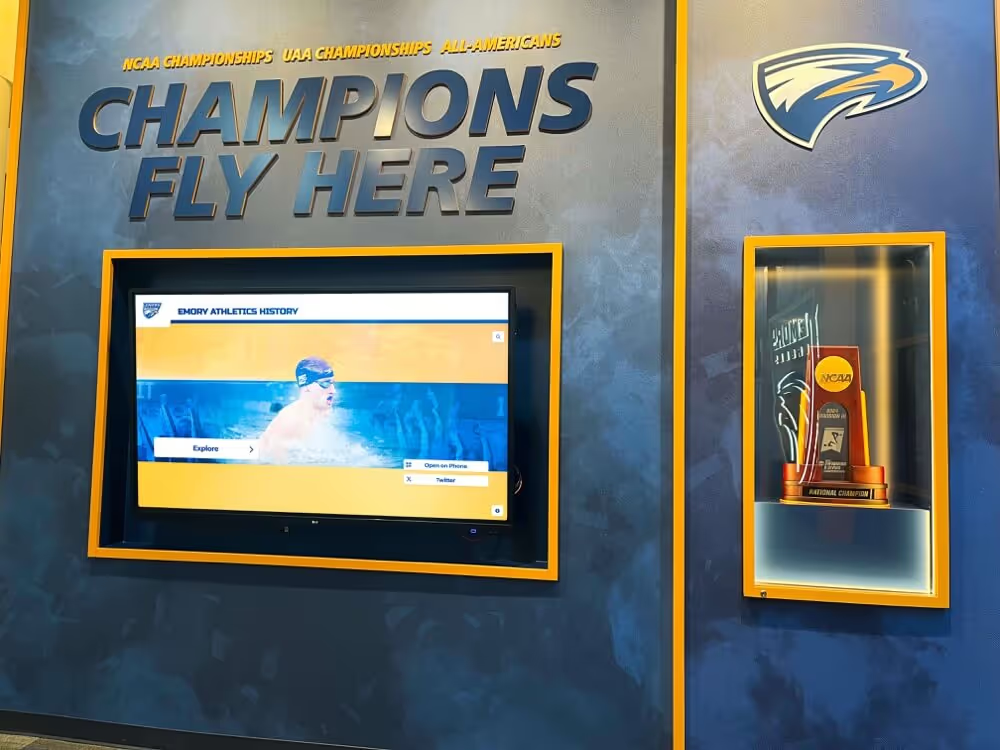
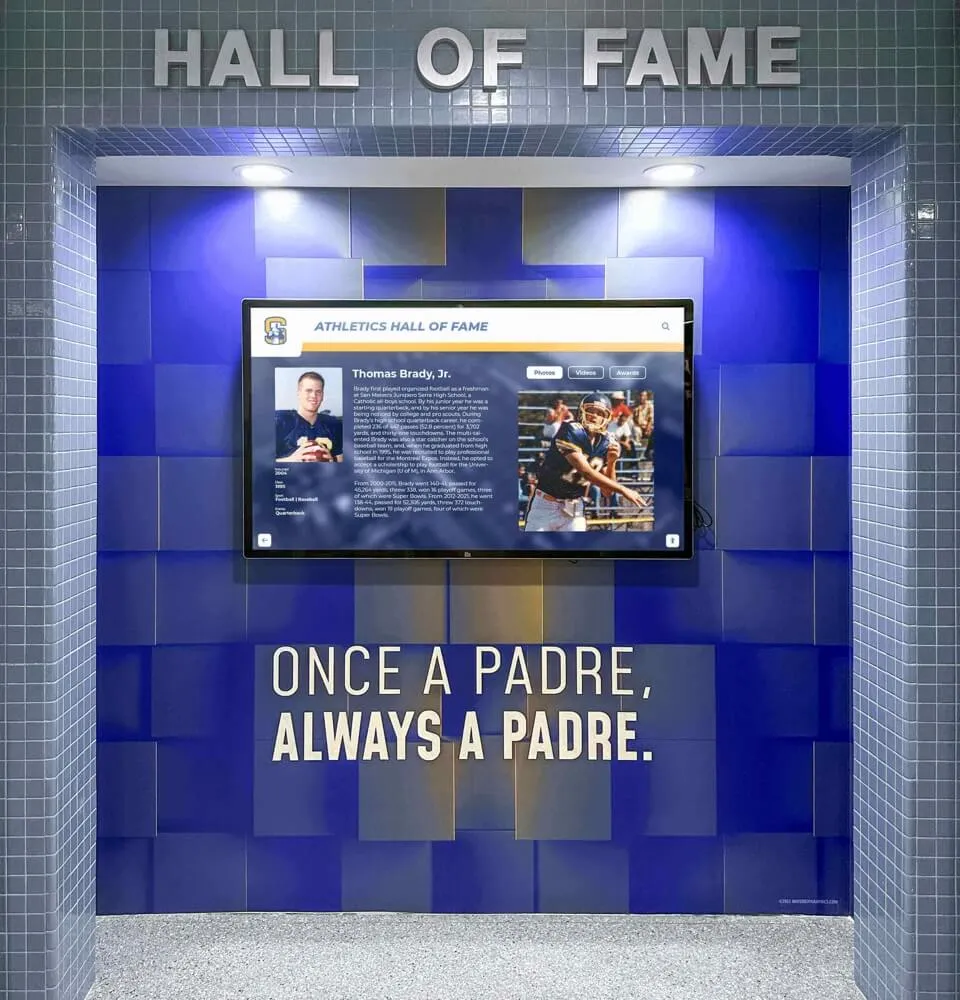
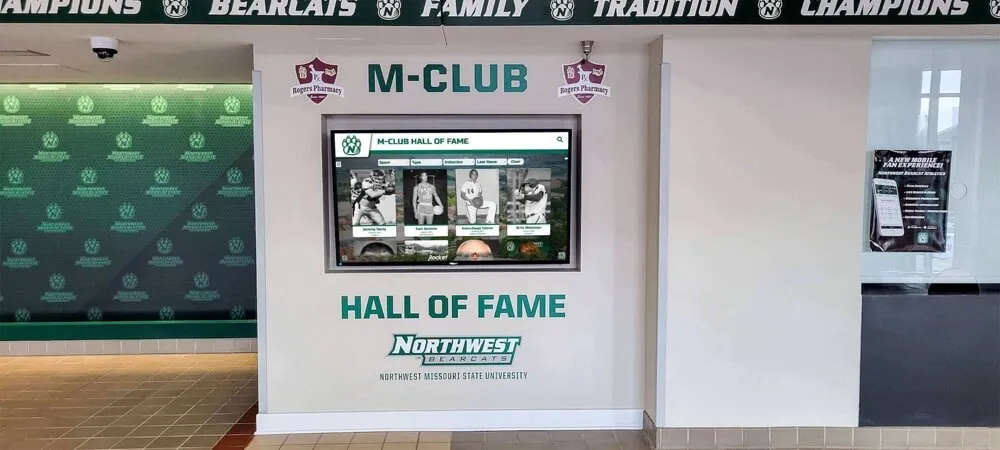
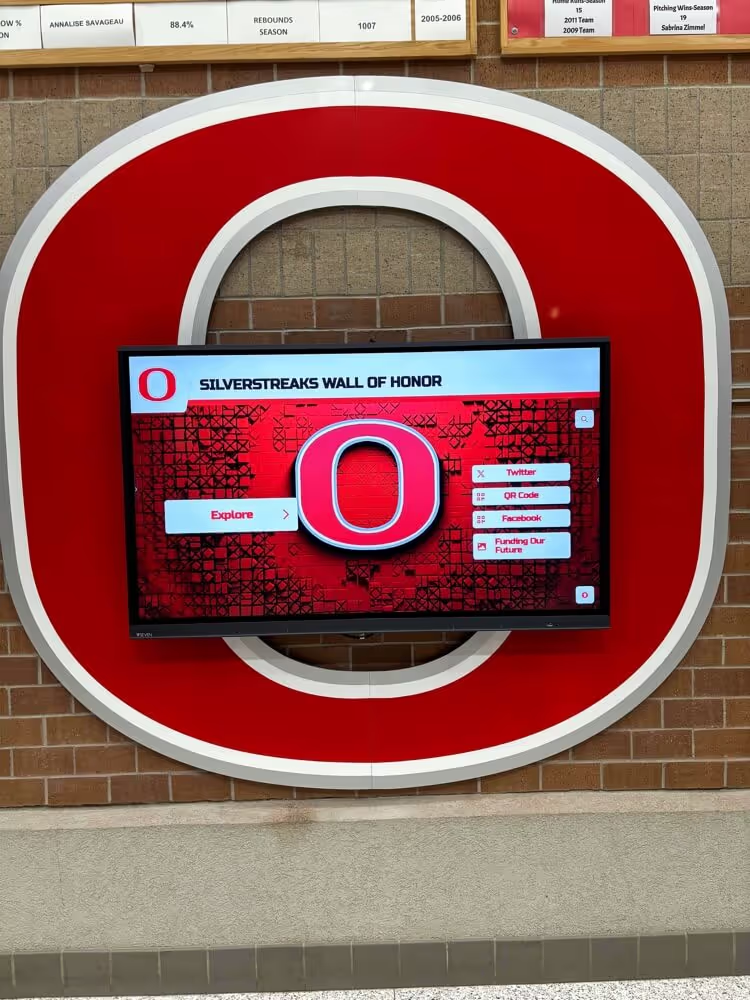
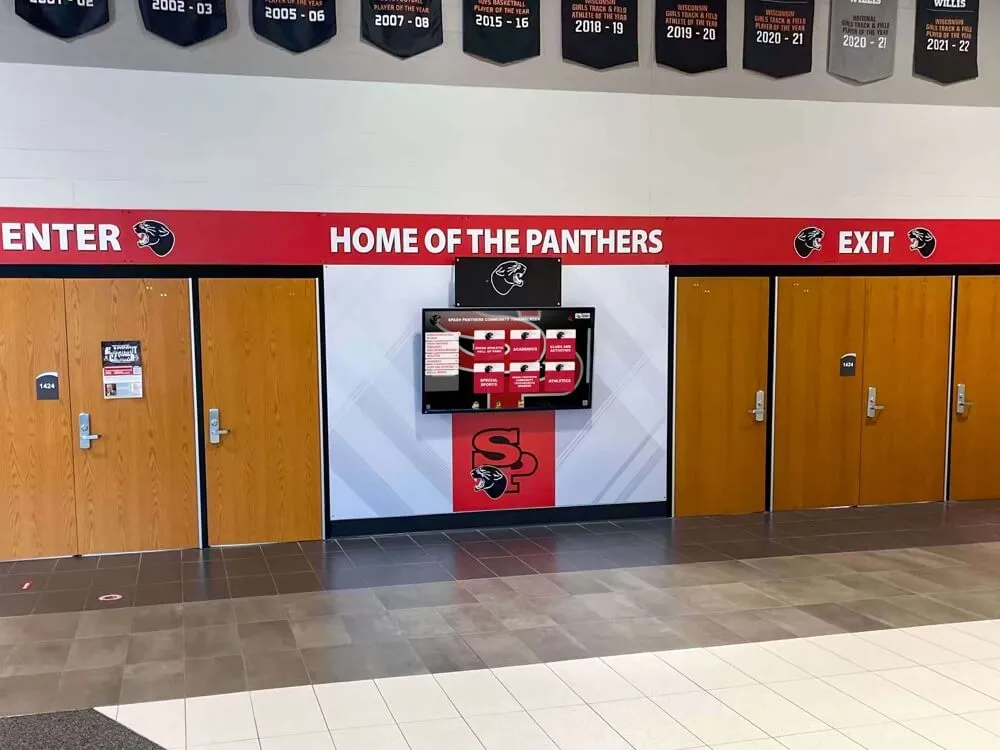
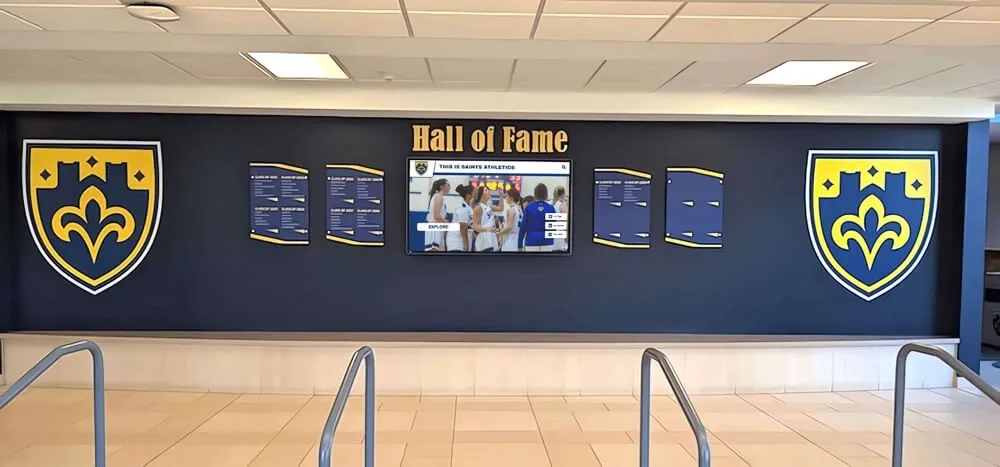
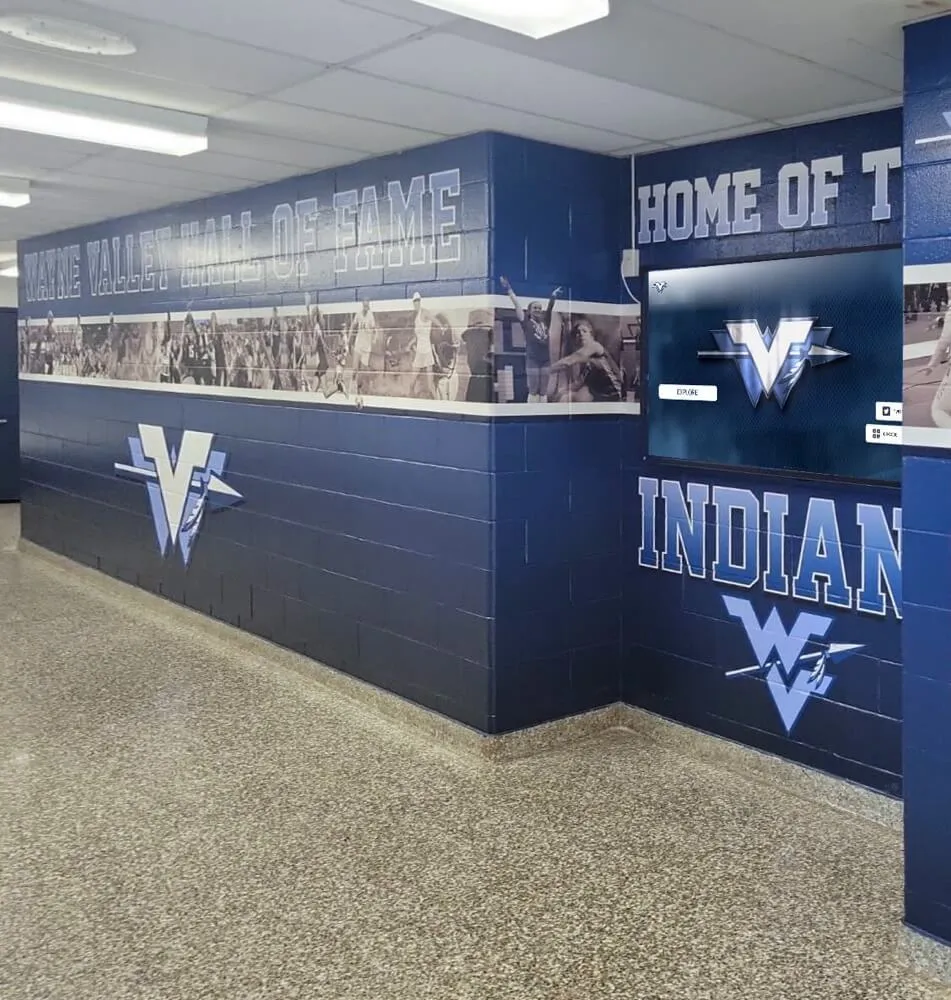
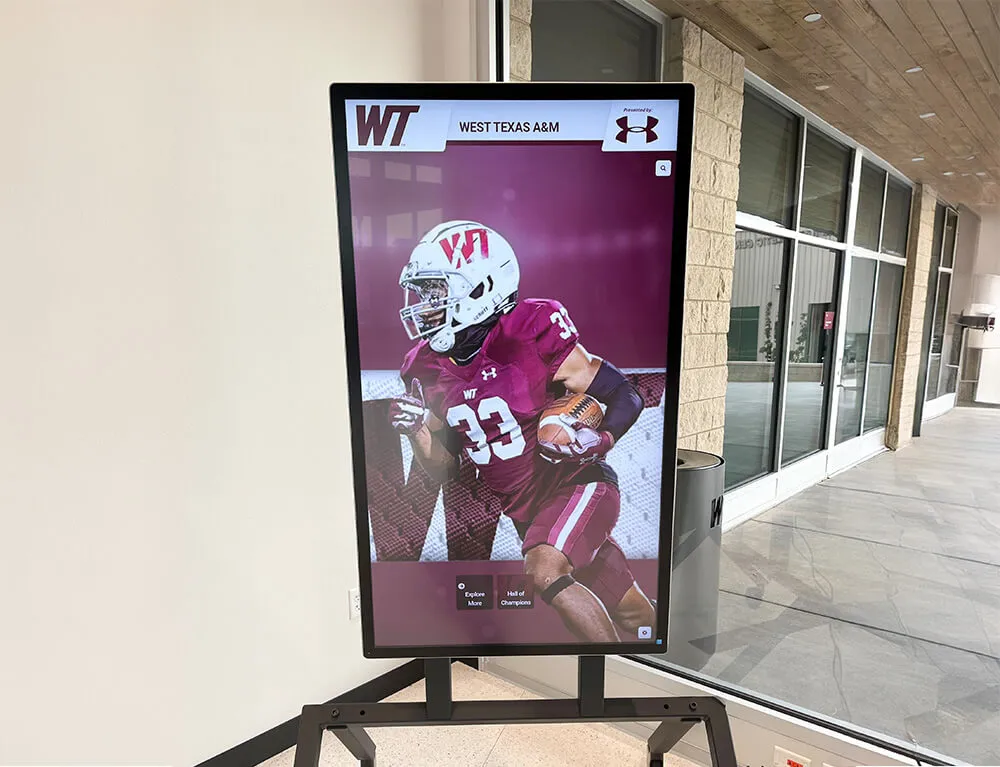
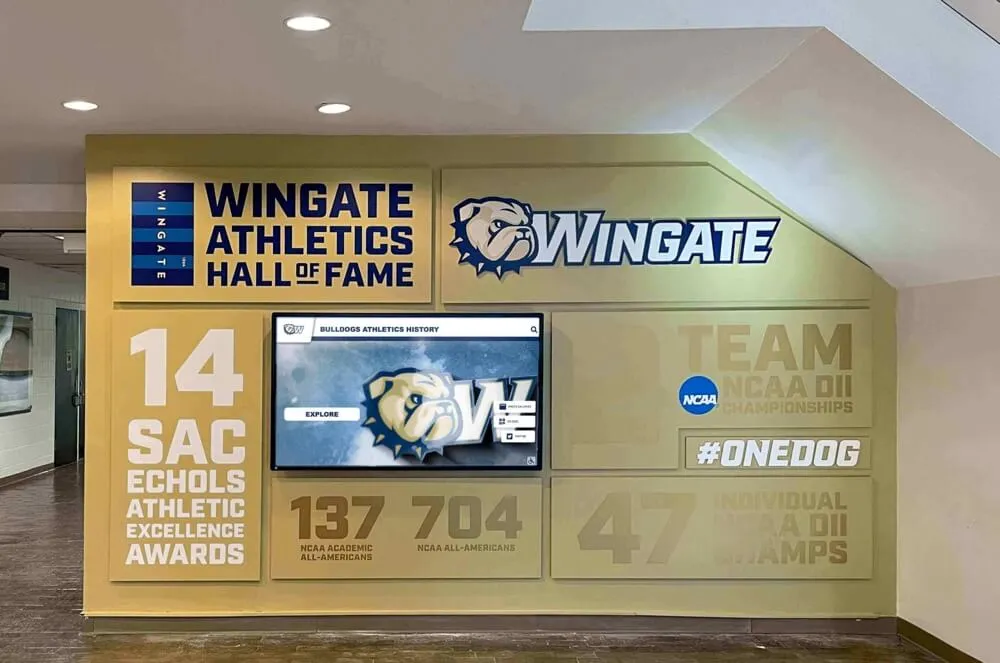
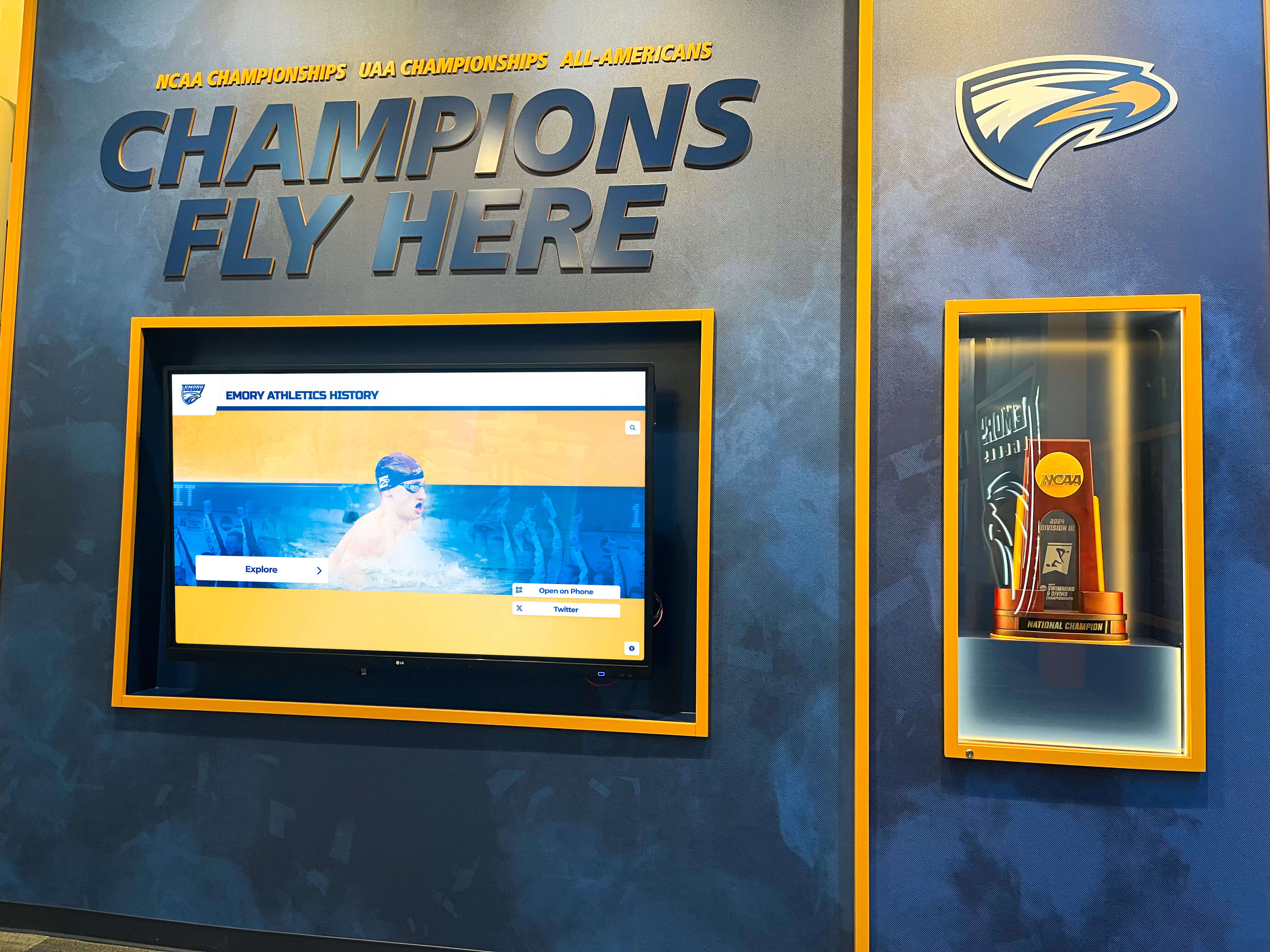
Digital recognition screens in athletic hallways maintain full access to award history when individual glass trophies are segregated for conservator review — the digital layer provides continuity the physical case alone cannot guarantee
Frequently Asked Questions
What is crizzling in a glass trophy? Crizzling is a form of chemical deterioration that originates in the composition of the glass itself. Glass with a high proportion of alkali network modifiers relative to its silica network can be inherently unstable: environmental moisture attacks the surface, alkali ions migrate outward, and the resulting chemical exchange produces a fine network of cracks, a surface haze or iridescent film, and in advanced stages visible moisture — weeping — on the piece. It is not caused by impact, thermal shock, or cleaning damage, though those conditions can coexist with crizzling and complicate assessment.
Is crizzling in a glass trophy the same as glass haze on a trophy case panel? No. Crizzling is a deterioration process within the glass composition of the award object itself. Glass haze on trophy case panels — the display glazing — originates from surface residues, mineral deposits, laminate failures, or sealant off-gassing that are addressed through completely separate glass maintenance protocols. An athletic director may encounter both in the same case during the same inspection, but they require different responses and different specialists.
Can crizzling be reversed or stopped? Chemical deterioration from crizzling cannot be reversed — damage already done to the glass network is permanent. A conservator may be able to stabilize an active condition, slow further deterioration, and consolidate loose surface material, but restoration to the original glass state is not achievable. This is why early documentation and conservator engagement, before weeping or structural fragmentation stages are reached, preserves the most treatment options.
Why should desiccants be avoided for crizzling glass? Desiccants in a sealed container rapidly reduce humidity around the piece. Glass that has absorbed moisture into an active crack network can experience differential contraction as it dries, which may widen or extend existing cracks. The CCI’s preventive conservation guidance on glass identifies rapid forced drying as a risk for crizzling objects, not a remedy. Stable ambient conditions are appropriate while the piece awaits assessment.
Who is the right specialist to contact? Contact a conservator with documented experience in historic glass objects. The American Institute for Conservation (AIC) provides a public Find a Conservator directory at culturalheritage.org. Regional history museums, university conservation departments, and state historic preservation offices are also common referral resources for school districts without existing conservation relationships.
How do we maintain recognition access for a trophy that has been removed from display? If the school has a digital recognition platform, ensure the award is represented with accurate inscription data, award year, and recipient information, then update the case with a brief notice and a QR code linking to the digital entry. For schools evaluating platforms, the guide to the best hall of fame tools for athletics, donors, and arts history covers the options available at different scales and budgets.
How does crizzling triage fit into the broader athletic awards program? Triage is one component of a complete recognition management program that encompasses award selection criteria, display maintenance, and long-term preservation. For schools building or updating that program, the athletic awards rubric for scoring leadership, sportsmanship, stats, and display eligibility addresses the selection and documentation side that connects to the physical preservation program covered here.
Should a crizzling glass trophy still be handled for ceremonies or alumni events? A crizzling glass trophy at any triage stage should not be handled for ceremonies, transported to alumni events, or loaned to other organizations until a conservator has assessed it and specified safe handling parameters. Digital recognition platforms allow the award to be represented at events through projected images or touchscreen displays without any physical handling of the original.
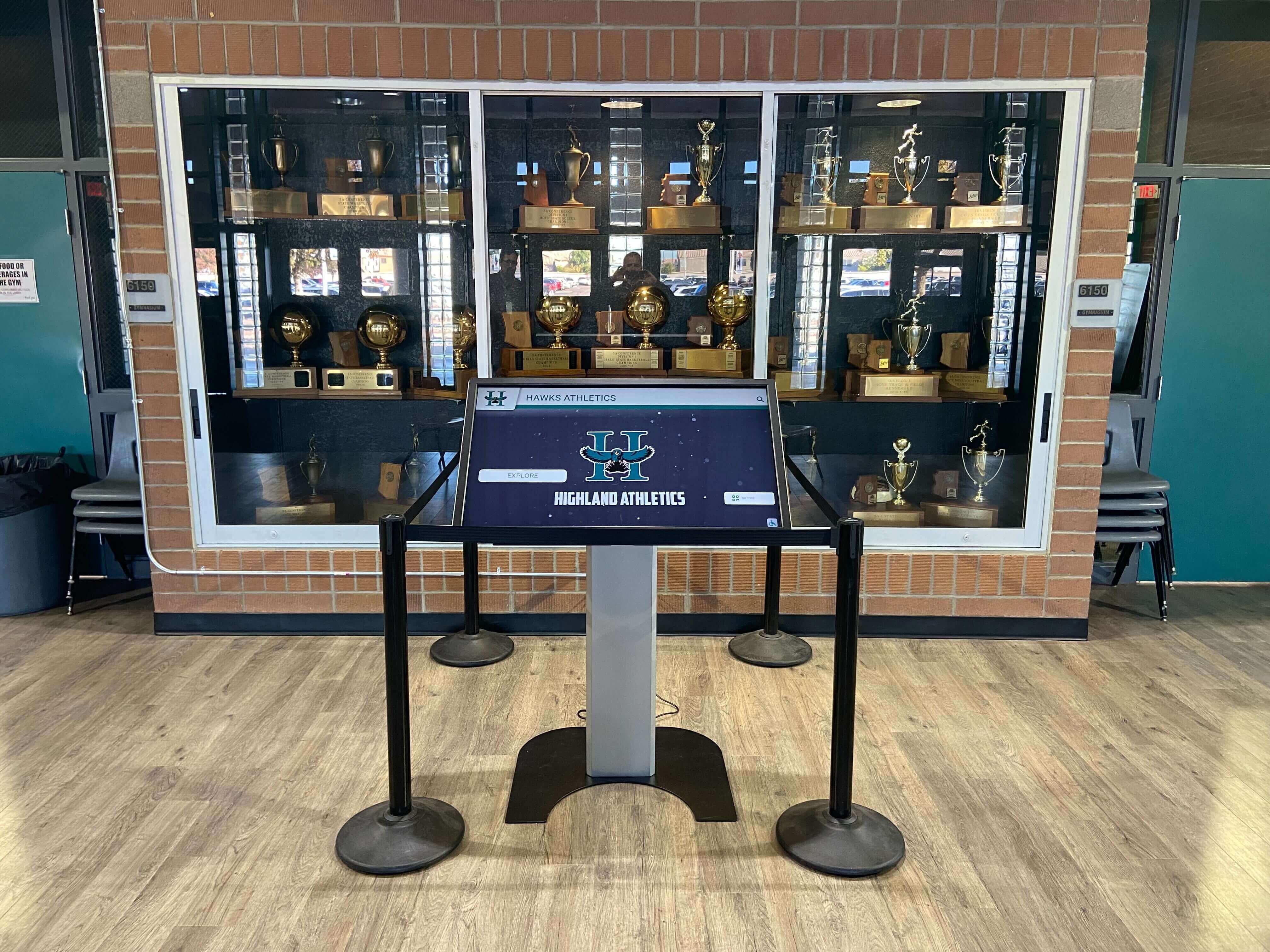
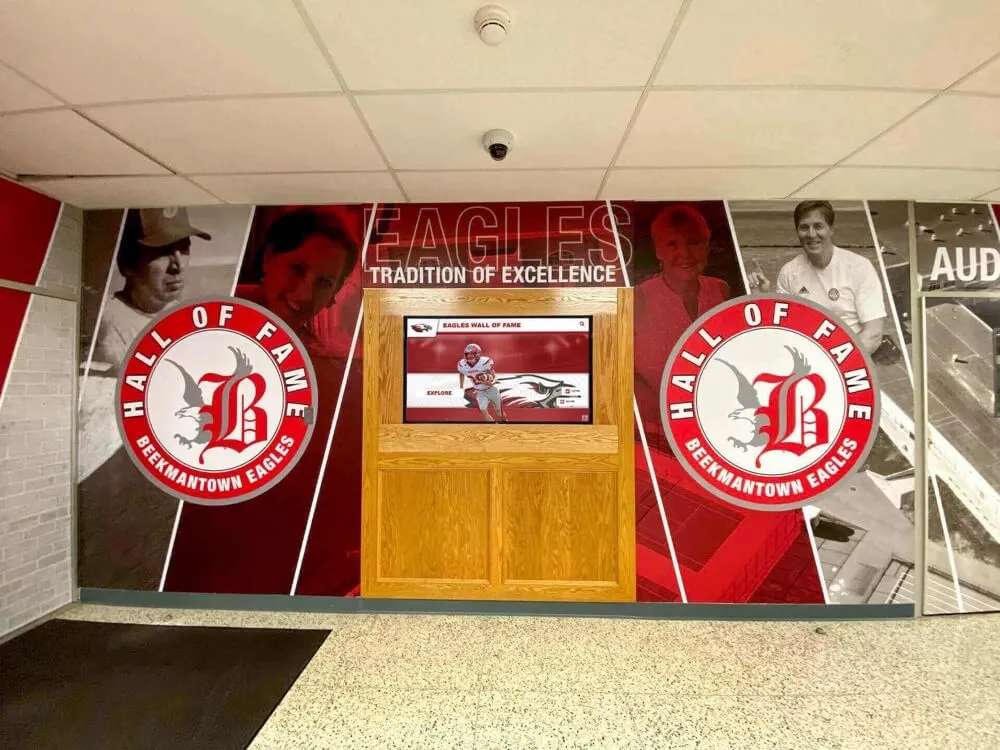
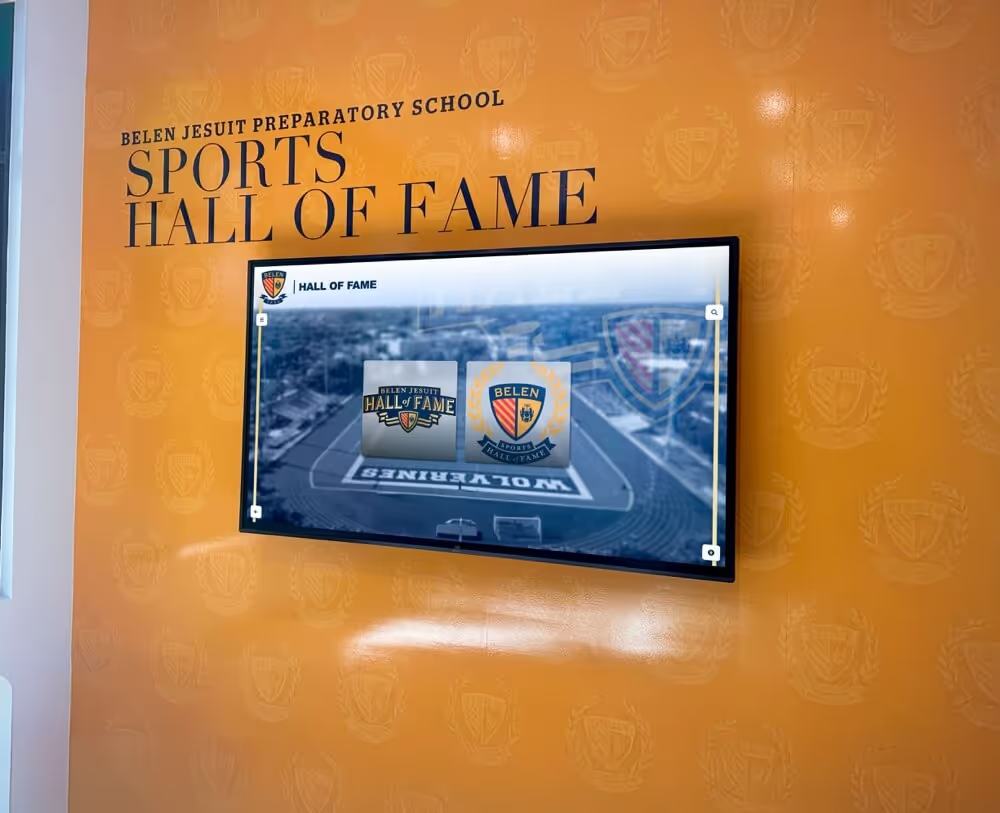
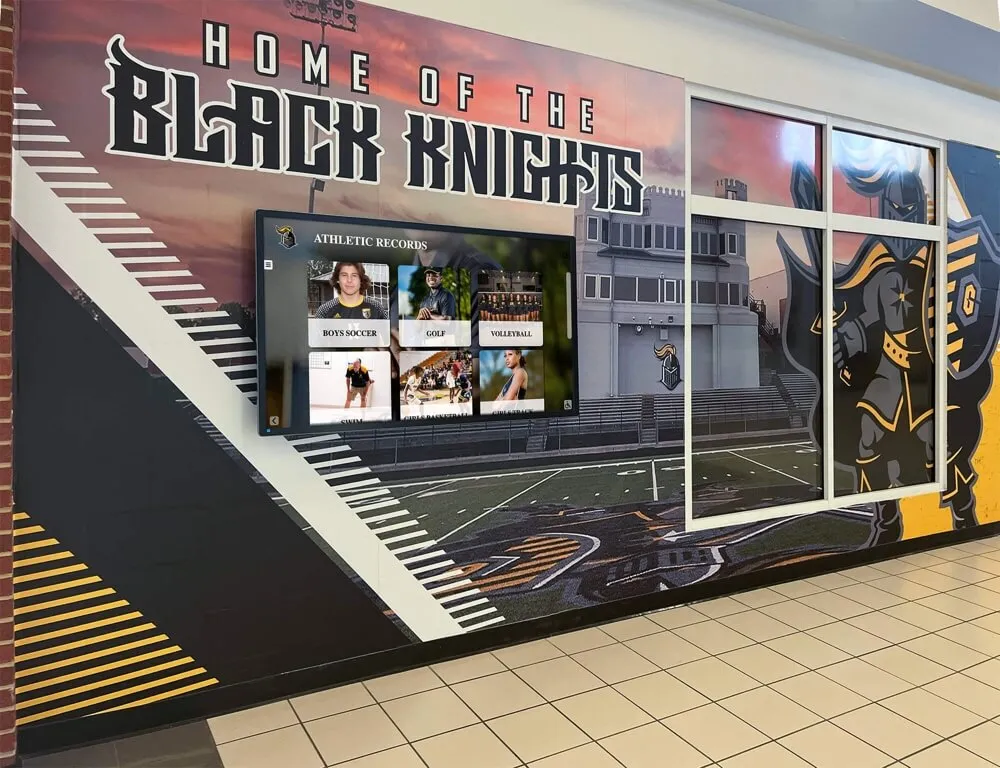
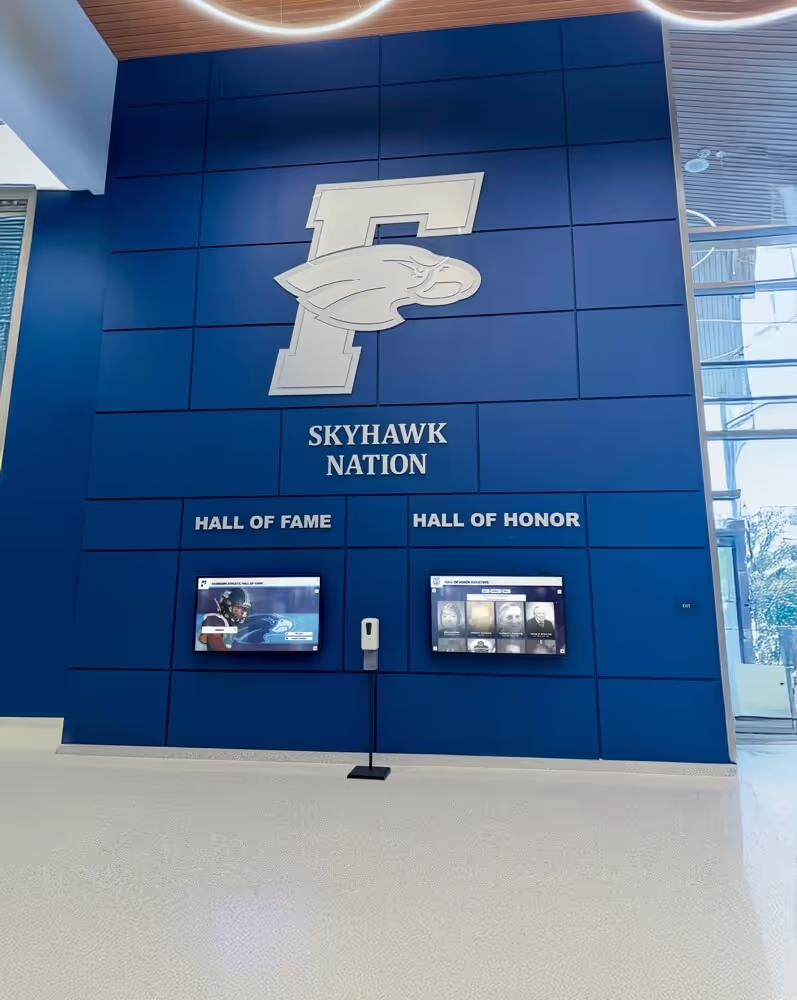
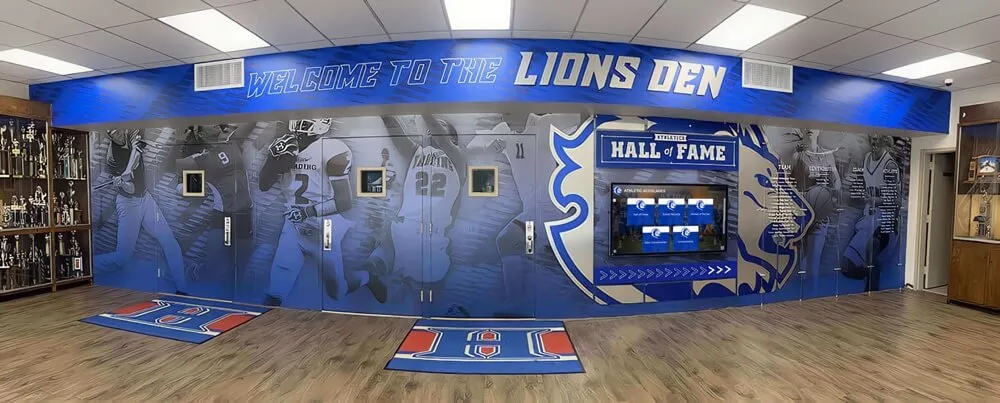
A digital recognition platform in the athletic hallway ensures that the achievement history represented by historic glass trophies remains fully searchable and accessible to students, staff, and alumni regardless of the physical condition of original objects
Keep Your School's Trophy Legacy Visible While Originals Await Care
Rocket Alumni Solutions builds cloud-managed digital trophy cases and touchscreen halls of fame for schools nationwide — unlimited recognition capacity, ADA WCAG 2.1 AA compliant displays, QR code mobile access, and remote content management. When historic glass trophies need a conservator's attention, the digital record keeps every championship, every name, and every achievement fully accessible to students, staff, and alumni. See how schools are building permanent digital recognition programs that protect their history regardless of what happens to the physical case.
Book A Demo