The Easiest Touchscreen Solution


Live Example: Rocket Alumni Solutions Touchscreen Display
Interact with a live example (16:9 scaled 1920x1080 display). All content is automatically responsive to all screen sizes and orientations.
Intent: define — This guide helps athletic directors and recognition editors build an accurate high school rodeo award display by separating athlete, event, and team credits into distinct entries before anything goes on the wall.
A student who earns the All Around Cowboy designation at the National High School Finals Rodeo earned a specific individual title in a specific category. A state delegation that finishes first in Boys Team Standings earned a separate result under a separate heading. The school that hosts a recognition display of either achievement is a third party to both — a community witness, not the named recipient. Keeping those three layers distinct is the core challenge of building a high school rodeo award display that remains accurate when anyone checks the record years later.
This guide answers the caption and attribution question first, then walks through how official results pages are organized, what that structure tells you about entry design, and how to handle the most common labeling decisions before they become errors.
The shortest answer to most rodeo display questions is this: use the honoring body’s label for the category, the honoring body’s name for the competing team, and the athlete’s own result for the athlete’s entry — then verify each from the primary source before the entry is finalized.
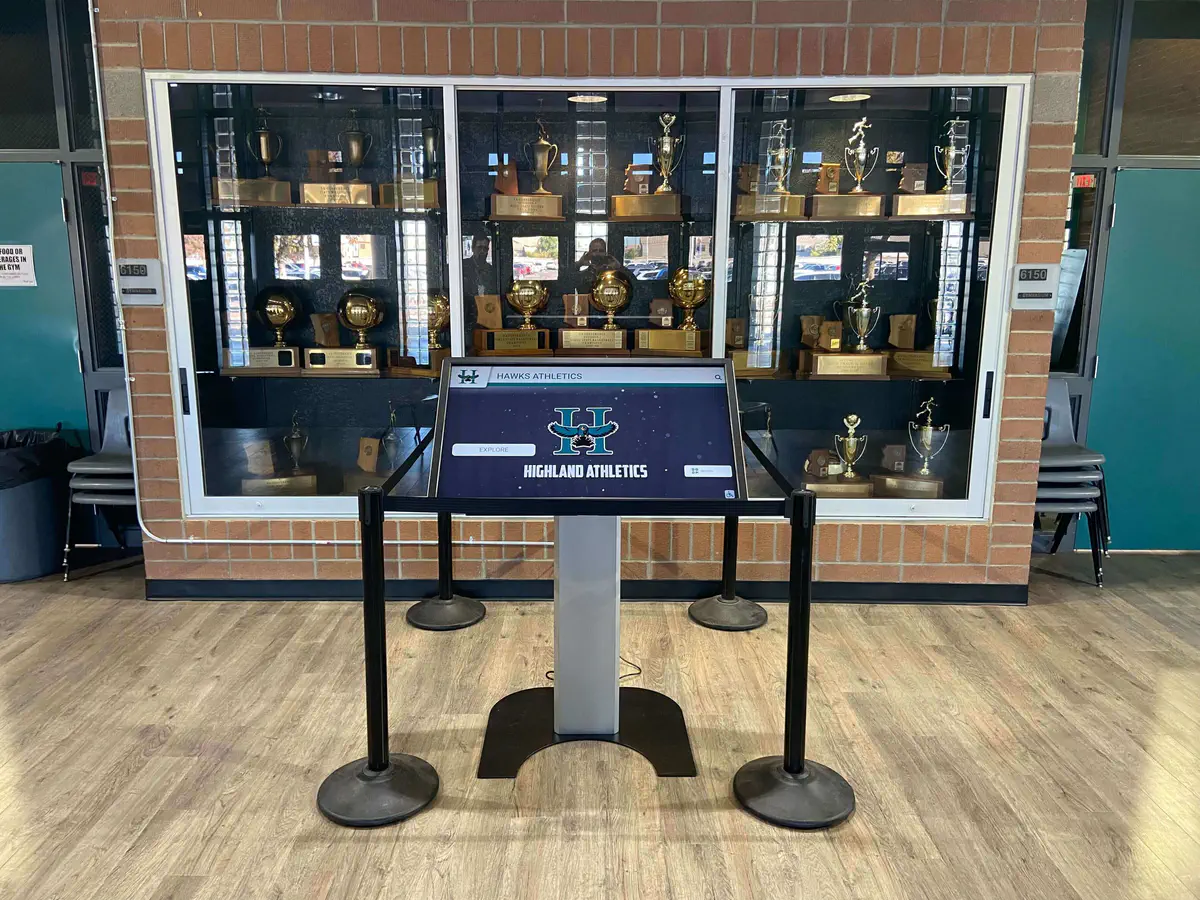
A digital recognition kiosk alongside a physical trophy case gives each award category its own accurately captioned entry without requiring new hardware for every update or correction.
The Caption and Attribution Question
A display entry for a high school rodeo honor needs five fields before it can stand on its own:
- Honoring body and year — the organization that conferred the award and the year (e.g., NHSRA, 2026)
- Exact event or category — the label used in the official results, word for word (e.g., “All Around Cowboy,” “Boys Team Standings,” “AQHA Boys Horse of the Year”)
- Earned designation — what the recipient actually received: a numbered finish, a named title, or a point total as published
- Recipient — the athlete, the state delegation, or the horse-and-rider pair named in that specific category’s source
- Source URL — the page or document where the result can be verified
A caption missing any of those five fields cannot be defended if someone checks. A caption that substitutes one field for another — using the school’s name in place of the competing state delegation, or combining an all-around rank with an individual event finish — produces an entry that misrepresents what the official record actually shows.
Placeholder caption — individual all-around result:
[Athlete first and last name] | [All Around Cowboy / All Around Cowgirl / All Around Rookie Cowboy / All Around Rookie Cowgirl] | Rank: [as published] | 2026 NHSFR | State association as listed: [abbreviation from source] | Source: nhsra.com/2026-nhsfr-team-allaround-horse-and-jackpot/
Placeholder caption — state delegation team standing:
[State name] delegation | [Boys / Girls] Team Standings — [rank as published] | 2026 NHSFR | Earned collectively by member athletes across events | Source: nhsra.com/2026-nhsfr-team-allaround-horse-and-jackpot/
Placeholder caption — school community recognition note:
[Athlete first and last name], a member of [school community], represented the [state] association delegation at the 2026 NHSFR and earned [exact designation from source]. | Source: [URL]
The third format lets a school recognize its community member’s documented outside-association achievement without claiming institutional ownership of the result. Community pride and accurate attribution are not in conflict — a school can hold the connection and the correct record at the same time.
How the NHSFR Results Hub Is Organized
The 2026 NHSFR Results hub at nhsra.com organizes competition outcomes across four views: By Performance, By Go-Round, By Aggregate, and the All-Around / Horse / Team / Jackpot page. Each view covers different data. A result visible under “By Performance” describes what happened in a specific performance session; it does not establish a final aggregate standing. A recognition editor who copies a session-level result into an aggregate-title caption is working from the wrong column.
The All-Around / Horse / Team / Jackpot page — the primary source for the award categories most commonly featured in school displays — organizes its content in separate tabs:
- All-Around / Rookie: Separate entries for All Around Cowboy, All Around Cowgirl, All Around Rookie Cowboy, and All Around Rookie Cowgirl. Each is an independent category with its own ranked list of recipients.
- AQHA Horse of the Year: Separate Boys and Girls divisions, each listing the equine partners and the NHSRA member riders who accumulated points across qualifying events.
- Team Standings: Boys Team Standings and Girls Team Standings listed by state delegation, with a combined table and division breakdowns (Divisions 1 through 5).
- Queen Contest and Jackpot: Further categories with their own headings and their own recipients.
Each tab contains information specific to that category. An all-around rank does not establish a first-place finish in any individual event. A team standing belongs to the state delegation as named, not to any single school within that state.
All-Around vs. Event-Specific vs. Rookie: Three Separate Labels
The All-Around categories and the event-specific results are parallel structures, not nested ones. An athlete who earns a top all-around rank accumulated points across multiple individual events — but that all-around designation is its own named award with its own category heading and should appear in a display as exactly that.
What an all-around result does not establish:
- A win in any single event (the aggregate is separate from individual event results)
- A “national champion” title in an event-specific discipline
- A standing shared with or exclusive of athletes who may have similar point totals in other categories
The Rookie categories — All Around Rookie Cowboy and All Around Rookie Cowgirl — are further distinct from the main All-Around results. A student named in the Rookie list earned that designation separately from the main All-Around standing. A display entry for a Rookie result should carry the “Rookie” label exactly as the official source uses it.

Separate display panels for each award category — with their own headings, recipients, and source citations — keep all-around, event, and team recognitions visible and distinct for any visitor reading the display.
Team Standings: State Delegations, Not School Teams
The Boys Team Standings and Girls Team Standings published at the 2026 NHSFR All-Around / Horse / Team / Jackpot page rank state delegations by points accumulated across events. Texas leads both the Boys and Girls tables in 2026 and also leads the combined standing. That means the Texas state delegation — collectively — earned those point totals across all participating events.
A recognition editor preparing a display entry for a team standing needs to hold two things simultaneously:
- The team-level credit belongs to the state delegation as named in the official results
- A school may recognize its students’ participation in the state delegation’s performance without claiming the delegation’s standing as the school’s own result
A caption reading “Texas delegation — Boys Team Standings, 1st — 2026 NHSFR” is accurate to the source. A caption reading “[School name] — Boys Team Champions — 2026 NHSFR” is not supportable from the source, unless the school itself is listed as the competing unit — which NHSRA team standings do not show.
The division breakdowns (Division 1 through Division 5 on the same page) follow the same logic: they rank state delegations within divisions, not individual schools. A school connected to a state that placed well in its division can recognize that connection without reassigning the delegation’s title to the school.
A school that wants to honor its community members who contributed to a state delegation’s standing can do so with an accurate note of connection alongside a correctly attributed team entry. Those two pieces of information complement each other without conflating them.
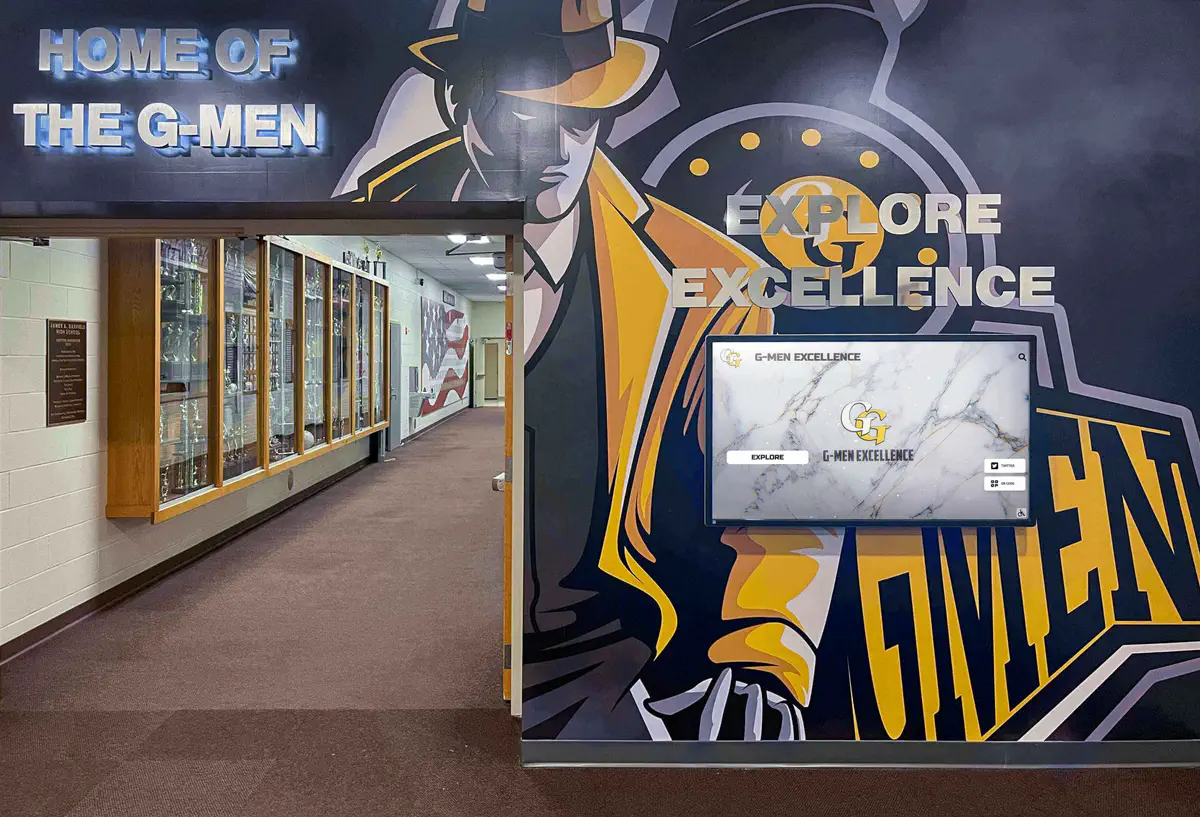
Physical trophy cases and a digital display side by side let staff maintain both the physical record and an accurately attributed digital entry without replacing either — corrections to captions can be made in the digital layer without new hardware.
AQHA Horse of the Year: A Separate Equine Category
The AQHA Horse of the Year categories — Boys and Girls — recognize the equine partners that accumulated the most points alongside their NHSRA member riders across qualifying events. The NHSRA source lists each horse by registered name, call name, entry number, the rider’s name, and the point total.
That structure has direct consequences for display entries:
- The honored recipient in this category is the horse-and-rider pairing as the source lists it, not the rider alone
- Points accumulated in this category reflect that horse’s performance across qualifying events, not the same tally as the rider’s all-around standing
- A rider may appear in both an all-around entry and a horse-of-the-year entry — those are separate recognitions from separate categories and belong in separate display entries
The AQHA Top Horse By Event listing on the same page further identifies the top horse in each individual event discipline. These are distinct from the overall Horse of the Year standings. A horse that earned the top position in a specific event does not hold the Horse of the Year designation unless that is specifically what the Horse of the Year source says.
A school recognizing a community member’s equine partner should draw the horse’s name and the category label directly from the NHSRA source, verify the entry number and rider association, and keep that entry separate from any all-around or team entry involving the same rider.
Building Display Entries Across All Three Layers
A school building a high school rodeo award display will often encounter all three attribution layers at once: an athlete who earned an all-around designation, that athlete’s state delegation who earned a team standing, and possibly an equine partner recognized in a horse-of-the-year category.
Keeping those three layers in separate entries — each with its own heading, its own named recipient, and its own source citation — prevents the most common display errors:
- Attributing a team standing to an individual school rather than the state delegation
- Combining an all-around rank with an individual event finish as though they are the same result
- Treating a Rookie designation as equivalent to the main All-Around title
- Using one category’s results to fill a caption for a different category
Each entry should be completable from the official source record before it goes up. If a field cannot be filled from a verified source, that entry should wait — not be estimated or filled from memory.

Digital athletic records screens organized by category let recognition staff add, correct, and update each entry independently without affecting surrounding records on the same display.
The guide to planning and labeling a school championship display covers the broader framework for organizing multi-sport recognition across layout and label decisions — useful context when rodeo entries are one of several athletic recognition categories in a single display.
A Planning Table for Rodeo Display Entries
Staff preparing rodeo display entries can use this table to gather required information before writing any caption. A row that cannot be completed from primary source records is a prompt to gather the remaining information, not a reason to skip the entry entirely. Verified entries can go up while others wait.
| Honoring body / year | Category (exact label from source) | Recipient (athlete, delegation, or horse–rider pair) | Earned designation / rank | Verified school connection (if applicable) | Source URL |
|---|---|---|---|---|---|
This table is a staff planning aid for your athletics office or recognition editor. Missing an optional field — such as a school connection that cannot be independently confirmed — does not hold up other verified entries from being published.
How a Digital Display Holds Multiple Layers
Physical trophy cases hold the objects — trophies, buckles, plaques — but they fix their captions at the time of engraving. Correcting an attribution error after the fact means new hardware, and the original caption may persist in photographs, programs, and published records for years. A digital recognition display lets staff edit captions, add source citations, separate entries that were incorrectly combined, and update the record as corrected information becomes available.
A school that has students who competed in multiple NHSFR categories — an individual all-around result, a state delegation team standing, and an equine category — can hold all three as distinct, accurately attributed entries in a single display. Each entry carries its own heading, its own named recipient, and its own source. When a recognition editor needs to correct a category label or add a source URL that was initially missing, that update can be made without replacing the surrounding entries.
Platforms like those offered by Rocket Alumni Solutions are built for exactly this kind of multi-layer recognition: cloud-managed systems that let staff make updates remotely without IT intervention, maintain each category separately, and keep the display current as new results are added across sports and seasons. The physical trophies can remain on their shelves. The digital layer carries the context, the source citations, and the category distinctions that an engraved plate cannot accommodate.

Physical trophies and digital recognition can coexist in the same space — the digital layer carries the attribution context, category labels, and source citations that a fixed plate or shelf display cannot accommodate after the fact.
Checklist: Before a Rodeo Entry Goes on the Display
Before publishing any rodeo recognition entry, run through these four checks:
Category match: Does the caption heading use the exact category label from the source — not a paraphrase, not a combined label?
Recipient match: Does the named recipient in the caption match who the source names for that specific category — the athlete for an individual result, the state delegation for a team standing, the horse-and-rider pair for an equine category?
Earned designation match: Does the caption state only what the source actually records — not an inference, not a combined result, not an approximation?
Source linkable: Can a staff member or visitor follow the source URL and find the exact entry that supports the caption?
If any check fails, that entry needs revision before it goes up. A single unverifiable field does not hold up other confirmed entries from being published — the confirmed entries can go up while the unverified one waits.
Schedule a conversation about your school’s rodeo and athletic recognition display
Live Example: Rocket Alumni Solutions Touchscreen Display
Interact with a live example (16:9 scaled 1920x1080 display). All content is automatically responsive to all screen sizes and orientations.