The Easiest Touchscreen Solution


Live Example: Rocket Alumni Solutions Touchscreen Display
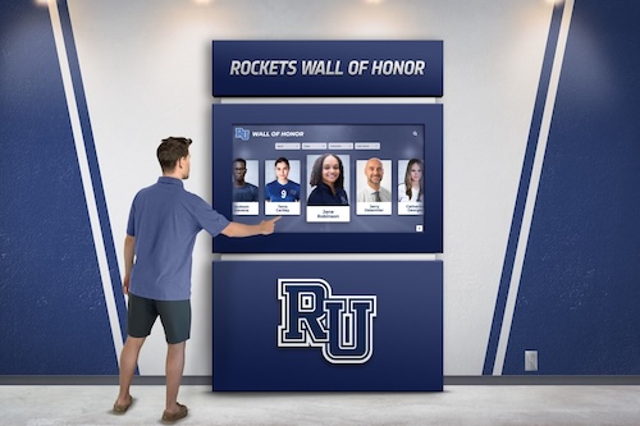
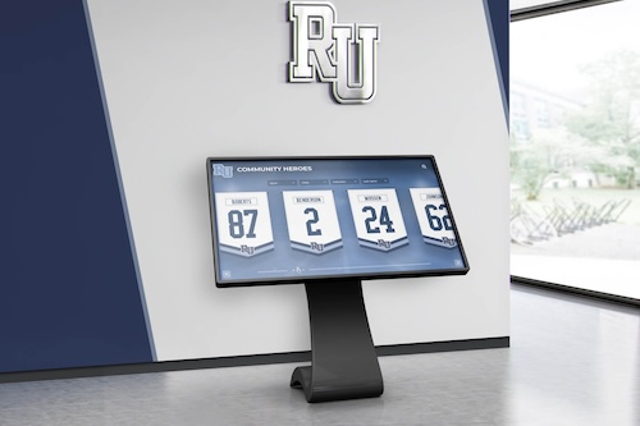
Interact with a live example (16:9 scaled 1920x1080 display). All content is automatically responsive to all screen sizes and orientations.
The display label decision starts here: you have a canoe paddling championship trophy and you need a caption that will still be accurate when someone checks the HHSAA source record three years from now. The core challenge is that the official results hub does not present the same information the same way across years — the 2025 HHSAA Canoe Paddling State Championship results names Boys, Girls, and Mixed champions without printing a Division I or Division II qualifier, while the 2026 HHSAA Canoe Paddling State Championship hub explicitly separates Division I and Division II winners within each gender and crew category. A caption that accurately reflects one year’s source format may not reflect another’s — and a caption built from memory rather than the source may not accurately reflect either.
This guide helps athletic directors and recognition editors write trophy display labels that hold up against the original record, year after year. It covers how to separate division honors from crew category honors, how to use the HHSAA Canoe Paddling Record Book to verify school names, and how to build a planning worksheet that lets staff complete entries before anything goes on the wall or screen.
The shortest answer to most canoe paddling display label questions is this: carry the category label from the HHSAA source into the caption exactly as it appears for that year, include the year, and verify the school name against the official record before publishing. Missing any of those three steps creates a caption that may still look correct on the wall but cannot be defended if someone checks the source.
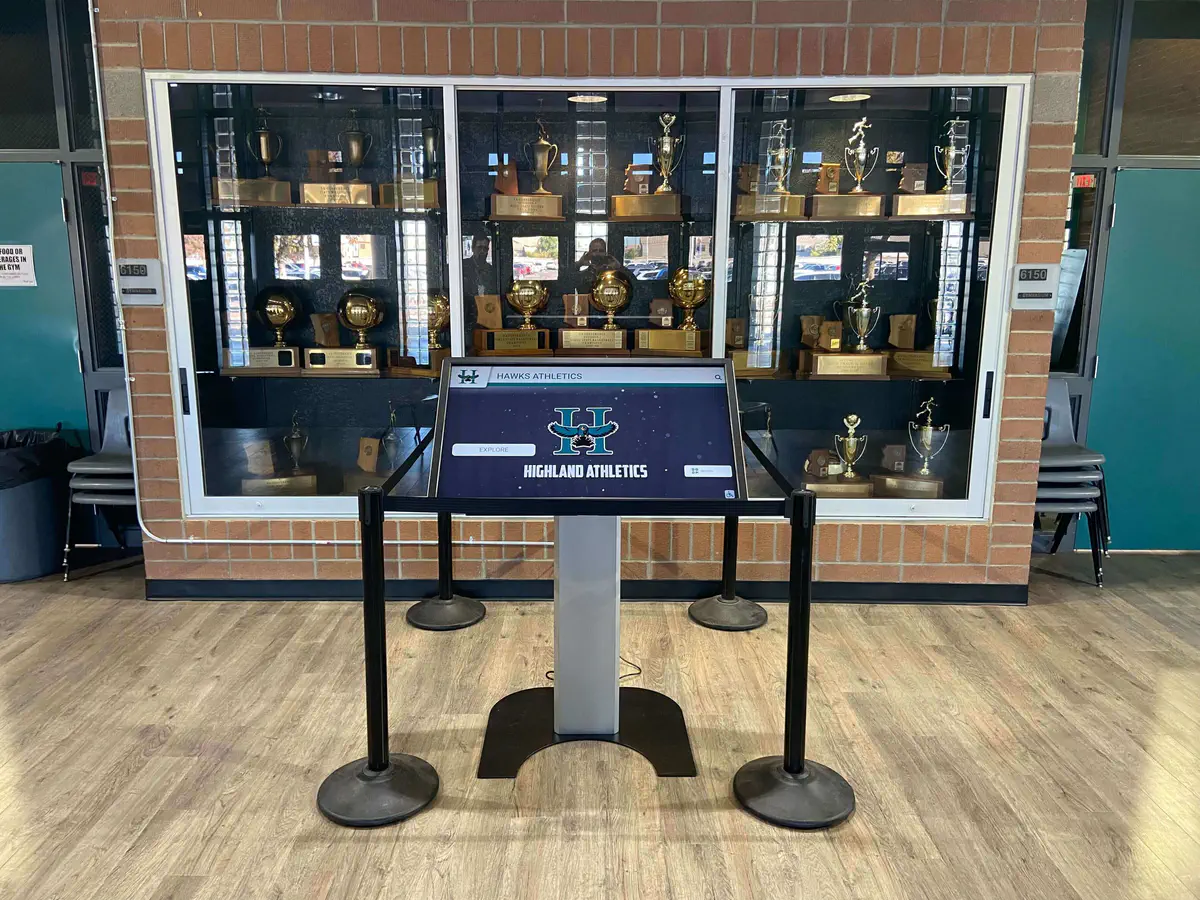
A digital recognition kiosk beside a physical trophy case gives each award category its own accurately captioned entry without requiring new hardware for every update or caption correction.
Why the Source Format Differs Across Years
The HHSAA canoe paddling results pages are dated records. Each one captures what the association published for that specific year’s championship, in that year’s format.
The 2025 results hub presents championship outcomes by gender and crew category — Boys, Girls, and Mixed — without printing a division qualifier alongside each result. That presentation is the official record for 2025. A recognition editor writing a caption from a 2025 championship trophy should use the gender and crew designation that the 2025 source shows, not substitute a division label that did not appear in that year’s published record.
The 2026 results hub presents championship outcomes differently: Division I and Division II winners appear separately within each gender and crew grouping. That is the official record for 2026, and a caption for a 2026 championship should carry both the division designation and the crew category exactly as published.
This distinction does not mean divisions were absent before 2026, that the format was introduced that year, or that division labels must be assigned retroactively to earlier entries. It means the archival caption must reflect what the official source actually printed for the year in question. A caption written from one year’s source format belongs to that year — transposing a 2026 division label onto a 2025 entry would produce a caption that cannot be matched back to the 2025 source.
The practical consequence for a recognition editor building a high school canoe paddling trophy display: pull the original source page for the specific year before writing any caption. Do not assume the presentation is the same year to year.
Division and Crew Category: Two Separate Caption Fields
A canoe paddling championship result carries two distinct identification layers, and each belongs in its own caption field.
Division — When the source names a Division I or Division II result, that is a classification grouping set by the HHSAA for that year’s competition structure. A Division I championship belongs to the team named in the Division I bracket. A Division II championship belongs to the team named in the Division II bracket. Those are separate recognitions, earned by different teams in separate competitive pools, and they belong in separate display entries.
Crew category — Boys, Girls, and Mixed are distinct competitive categories. A Mixed crew championship is not the same result as a Boys crew championship, even if both are from the same year and the same division. Each crew category has its own named winning team, and each belongs in its own display entry.
A caption for a 2026 championship result should identify all relevant layers: the year, the division as the source states it, and the crew category. If the source says Division I Girls, the caption should say exactly that — not Girls alone, not Division I alone, and not a combination that derives from available facts rather than from the source directly.
A caption for a 2025 championship result should carry the gender and crew category as the 2025 source states it. Adding a division label that the 2025 source did not print would change the entry from an archival record to an editorial construction.
Reading the 2026 and 2025 Results Side by Side
Looking at the two most recent HHSAA tournament hubs side by side clarifies the labeling task.
The 2025 results hub names champions across Boys, Girls, and Mixed categories. The source label for each champion is the category heading under which the result appears. That label — whatever HHSAA printed for that year — belongs in any 2025 caption.
The 2026 results hub names champions in separate Division I and Division II groupings within each gender and crew category. A Boys Division I champion and a Boys Division II champion earned separate recognitions in separate divisions. A caption for one of those results that omits the division label is a caption that is incomplete against the source.
The recognition editor’s job is to match the caption to the source, not to standardize format across years. Two entries in a school’s canoe paddling display may legitimately look structurally different from each other because they derive from source pages that presented results differently. That difference is accurate record-keeping. It reflects the reality that HHSAA publishes its results as it sees fit each year, and the display is a faithful record of what those publications actually said.
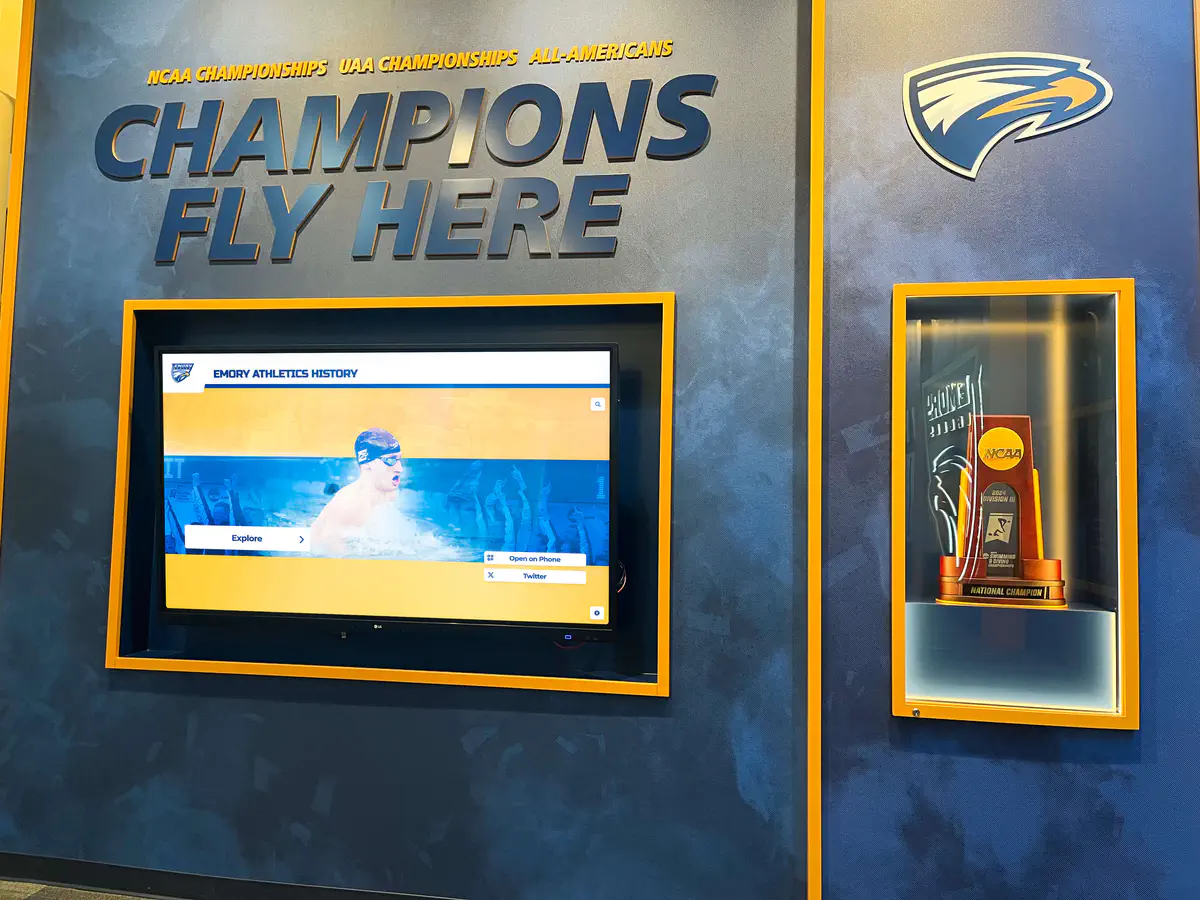
A champions recognition display that assigns each award category its own labeled panel — separated by year and competitive grouping — makes it possible to verify any entry against the original source without ambiguity.
Verifying School Names from the Record Book
The HHSAA Canoe Paddling Record Book is the reference for reconciling credited school names across years. School names change, programs are restructured, and official spellings may include accent marks or punctuation that differ from common use or from an engraved trophy plate.
Three principles apply when using the record book for caption verification:
Use the verified source spelling. If the HHSAA record book spells a school’s name with a specific accent mark or uses particular punctuation, that spelling belongs in the caption — not a flattened version that drops the character because it is inconvenient to reproduce. A caption that changes the official school name changes the official record.
Do not flatten distinct campuses. Some school systems include multiple campuses that share geographic names but are distinct institutions with their own athletic programs and their own records. A championship earned by one campus is not interchangeable with a championship earned by another, even if the names look similar. The record book is the place to verify whether a given trophy belongs to the correct campus before the caption is written.
Prefer verified source spelling over program memory. If a staff member recalls a school’s name one way and the record book shows it differently, the record book takes precedence for the caption. The display caption should reflect what the official record says. Corrections can be noted in an internal document, but the external-facing entry should match the HHSAA source.
A recognition editor who is uncertain whether a trophy belongs to a school’s documented record should verify from the record book before writing the caption — not after the entry is already on the wall or screen, where corrections require additional work.
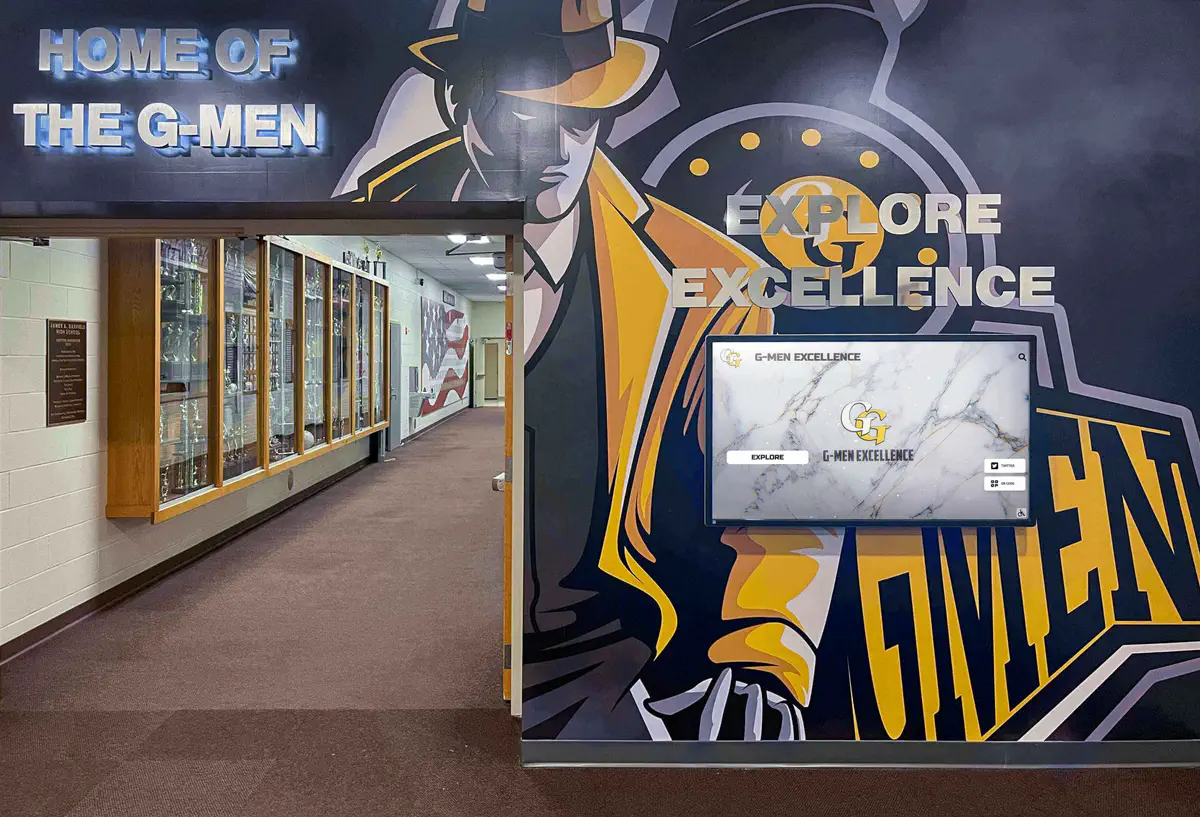
Physical trophy cases hold the objects; a digital recognition screen carries the category labels, source citations, and division designations that an engraved plate cannot accommodate or correct after the fact.
Crew Category Labels: What the Source Name Covers
Canoe paddling events are organized by gender and crew composition. The HHSAA uses specific category labels for each competitive grouping. Those labels belong in display captions exactly as published.
What those category labels do not establish:
- The number of paddlers in the crew or the specific boat class used. A recognition editor should not add a crew size to a caption unless the source specifically identifies it as part of the award category name.
- The race distance or course conditions. Those are performance details, not part of a championship title.
- Margin of victory, finishing time, or comparative standing against other events or years.
- Roster composition or the names of individual crew members, unless those specific individuals are separately identified in the source as individual award recipients.
A championship trophy for a crew event honors the team as the named competing unit. Recognizing individual crew members who contributed to that championship is a separate entry from the team’s championship result — the same logic that separates a team championship from an individual all-state or all-tournament selection in any team sport. The two recognitions can and should coexist in the display, but they should coexist as distinct entries with distinct category headings.
Record Boards and Championship Labels: A Useful Contrast
A school’s canoe paddling record board and its championship trophy display serve different purposes, and understanding the difference protects both from attribution errors.
A record board tracks performance benchmarks — typically the best documented results in specific events over time, organized by event and year. It is an ongoing ledger of results. A championship display entry, by contrast, reflects a specific dated outcome: a named team earned a named title on a named occasion.
The guide to what canoe and kayak record boards track explains that structure in detail — it is a useful frame for understanding why record board entries and championship entries are built differently and belong in separate display categories.
The practical consequence: a school’s best documented result in a given event belongs on the record board, sourced from the documented performance result. The school’s championship win in a given year belongs on the trophy display, sourced from the HHSAA tournament results page for that year. Combining them into a single entry — or treating a strong performance result as equivalent to a championship title — produces a caption that misrepresents both achievements. Each deserves its own correctly labeled entry.

Trophy display shelves that separate individual sport categories and years let staff maintain accurate attribution for every result without consolidating entries that belong in distinct sections.
Caption Placeholder Examples
The following placeholder templates show how a complete, source-faithful canoe paddling display caption reads for each of the two most recent tournament formats. These use hypothetical school names.
2026 format — Division I result:
[School name] | Boys Division I State Champion | 2026 HHSAA State Canoe Paddling Championship | Source: hhsaa.org/sports/canoe_paddling/tournament/2026
2026 format — Division II result:
[School name] | Girls Division II State Champion | 2026 HHSAA State Canoe Paddling Championship | Source: hhsaa.org/sports/canoe_paddling/tournament/2026
2025 format — crew category result:
[School name] | Mixed State Champion | 2025 HHSAA State Canoe Paddling Championship | Source: hhsaa.org/sports/canoe_paddling/tournament/2025
Each placeholder uses the category label as the HHSAA source presents it for that year. Each includes the year. Each includes a source URL that can be followed and verified. What these placeholders do not include: crew size, race distance, margin of victory, individual athlete names, roster details, or any characterization of the result beyond what the source states. Those omissions are not gaps — they are the correct boundaries of a championship display entry.
If a field cannot be completed from a verified source, that entry should wait rather than be estimated or filled from memory. Verified entries can go up on the display while the incomplete entry waits for the missing information.
A Planning Table for Canoe Paddling Display Entries
Staff building a canoe paddling trophy display can use this table to gather required information before writing any caption. A row that cannot be completed from primary source records is a prompt to gather the remaining information, not a reason to skip the entry. A school need only show its own documented honors — there is no obligation to include every year’s results, only to represent accurately the results that are shown.
| Honoring body / year | Crew category (exact label from source) | Division (as published, if applicable) | School name (verified from record book) | Source URL |
|---|---|---|---|---|
This table is a staff planning aid for your athletics office or recognition editor. A missing optional field does not hold up other verified entries from being published — confirmed entries can go up while unverified ones wait.
How a Digital Display Handles Multiple Years and Divisions
Physical trophy cases hold the hardware — the trophies themselves — but their captions are fixed at the time of engraving. When a caption is later found to be missing a division label, uses a school name that differs from the official record, or omits a source reference, correcting it means new hardware. The original plate may persist in photographs and printed programs for years.
A digital recognition display lets staff edit captions, add source URLs, separate entries that were incorrectly combined, and update year over year as the HHSAA adds new results. A school that has earned canoe paddling championships across multiple years and multiple presentation formats can hold all of those as distinct, accurately captioned entries in a single display — each with its own year, its own category designation, and its own source URL pointing back to the HHSAA record.
Platforms like those offered by Rocket Alumni Solutions are built for multi-category recognition: cloud-managed systems that let staff make updates remotely, maintain each entry independently, and add new championships as they are earned without touching the existing entries. The physical trophies remain on the shelf. The digital layer carries the context, the category distinctions, and the source citations that an engraved plate cannot accommodate or correct after the fact.
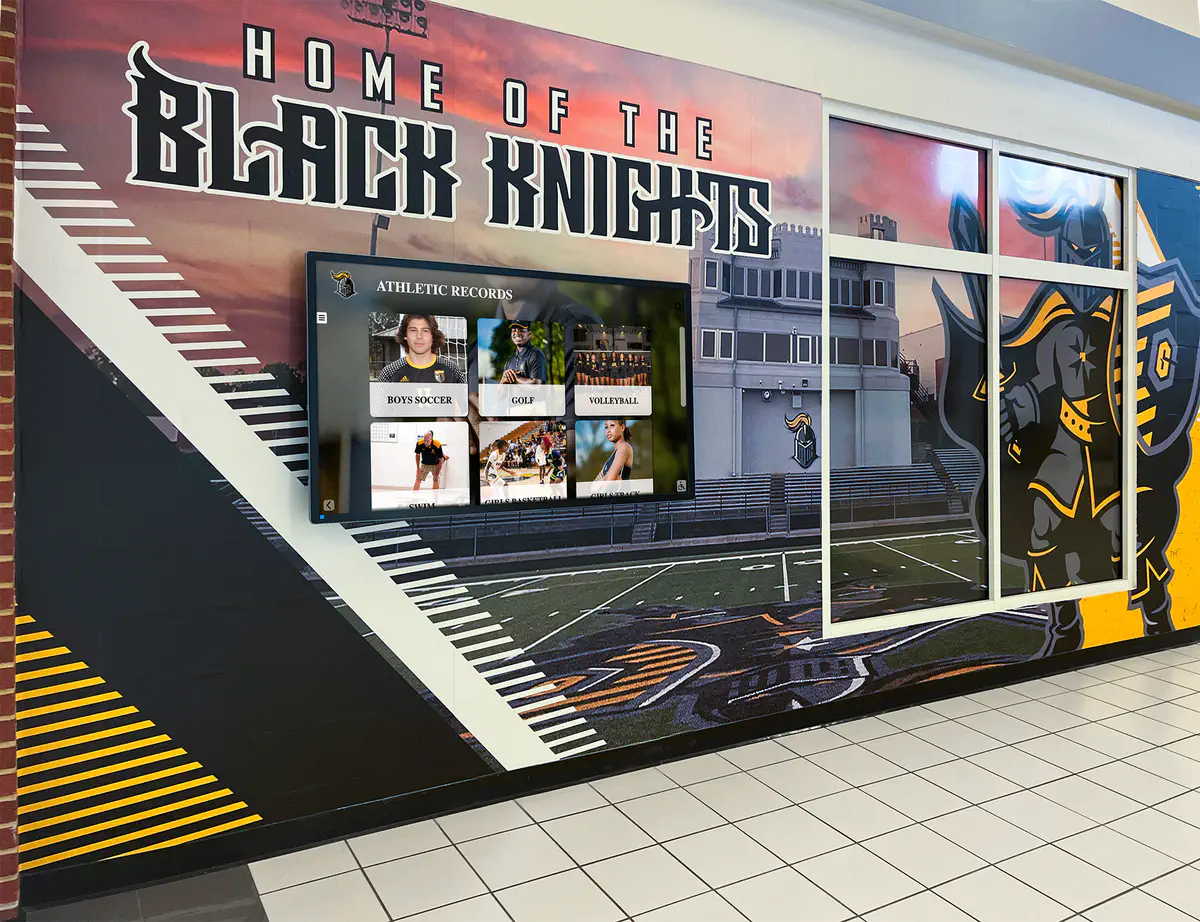
Digital athletic records screens organized by sport category let recognition staff add, correct, and update each canoe paddling entry independently without affecting surrounding records on the same display.
Checklist: Before a Canoe Paddling Entry Goes on the Display
Before publishing any canoe paddling recognition entry, run through these four checks:
Category and division match: Does the caption heading use the exact category label from the HHSAA source for that specific year — including the division designation if the source names one, and excluding a division label if the source does not?
School name verified: Does the school name in the caption match the HHSAA record book spelling exactly, including any accent marks or campus-specific punctuation?
Year and source included: Does the caption include the year of the championship and a URL pointing to the HHSAA source page where the result can be confirmed?
No inferred details: Does the caption omit any detail that was not explicitly stated in the source — crew size, time, margin, roster, or anything derived rather than verified from the original record?
If any check fails, that entry needs revision before it goes up. A single unverifiable field does not hold up other confirmed entries from being published — verified entries can appear on the display while the incomplete one waits for the missing information.
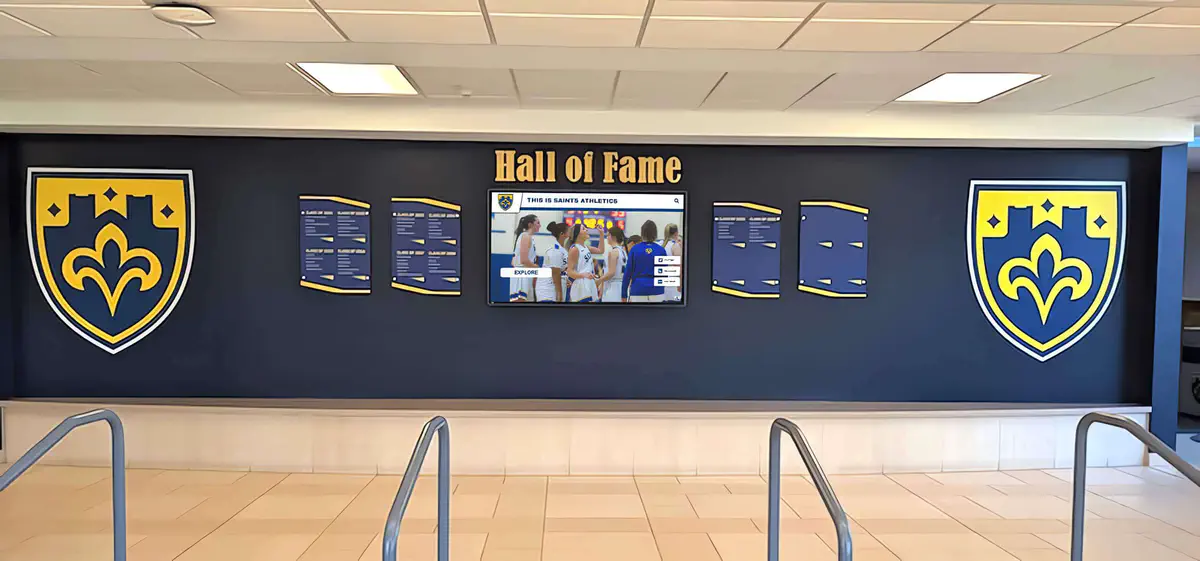
A recognition wall that assigns each award category its own panel — separated by year, division, and crew category — lets staff verify any entry against its original source without ambiguity and correct individual entries without disturbing the rest of the display.
Schedule a conversation about your school’s canoe paddling recognition display
Live Example: Rocket Alumni Solutions Touchscreen Display
Interact with a live example (16:9 scaled 1920x1080 display). All content is automatically responsive to all screen sizes and orientations.