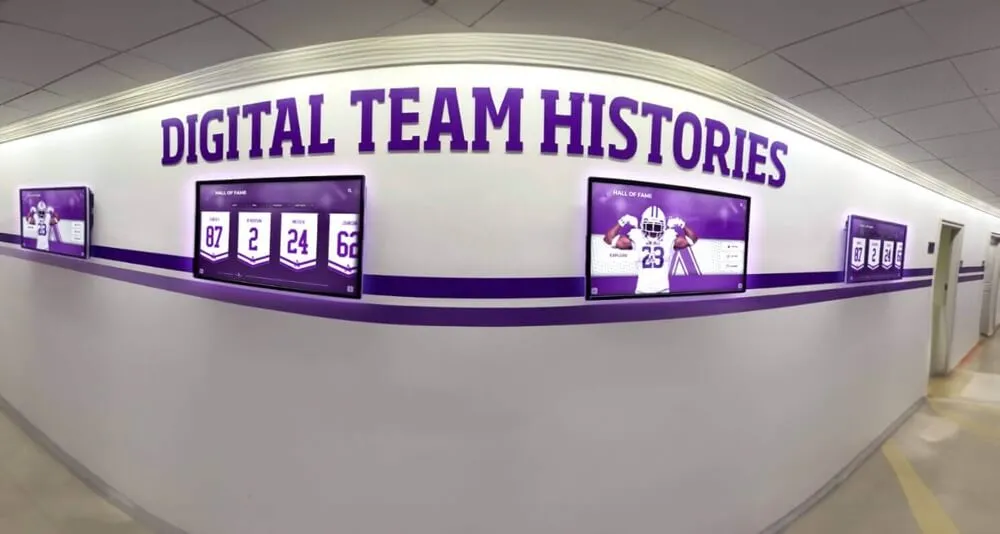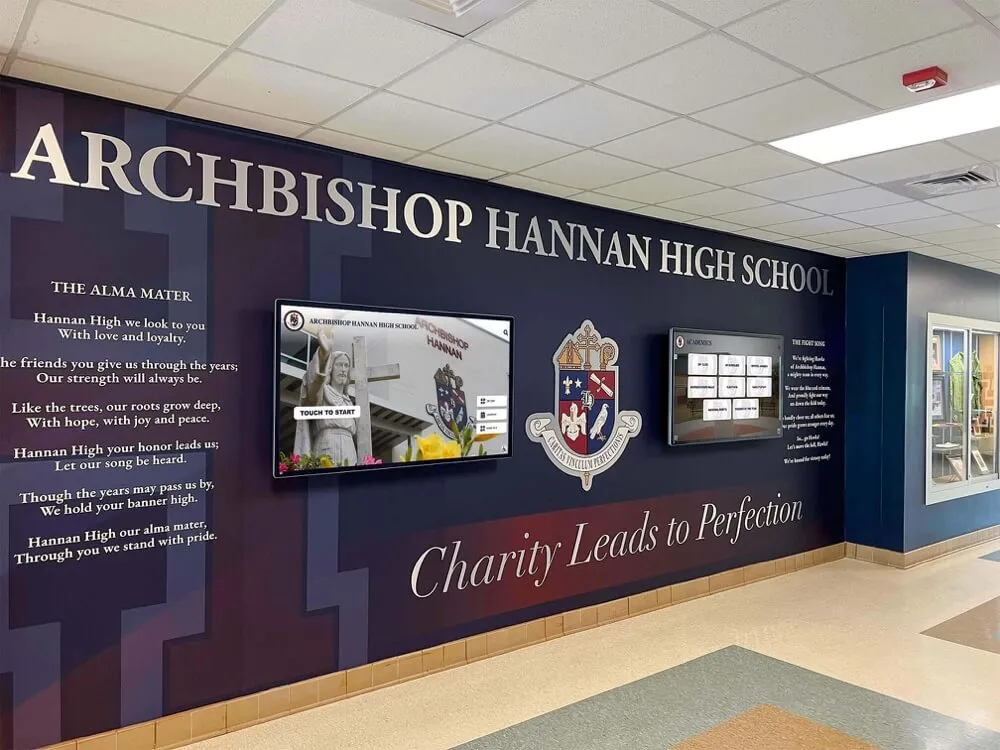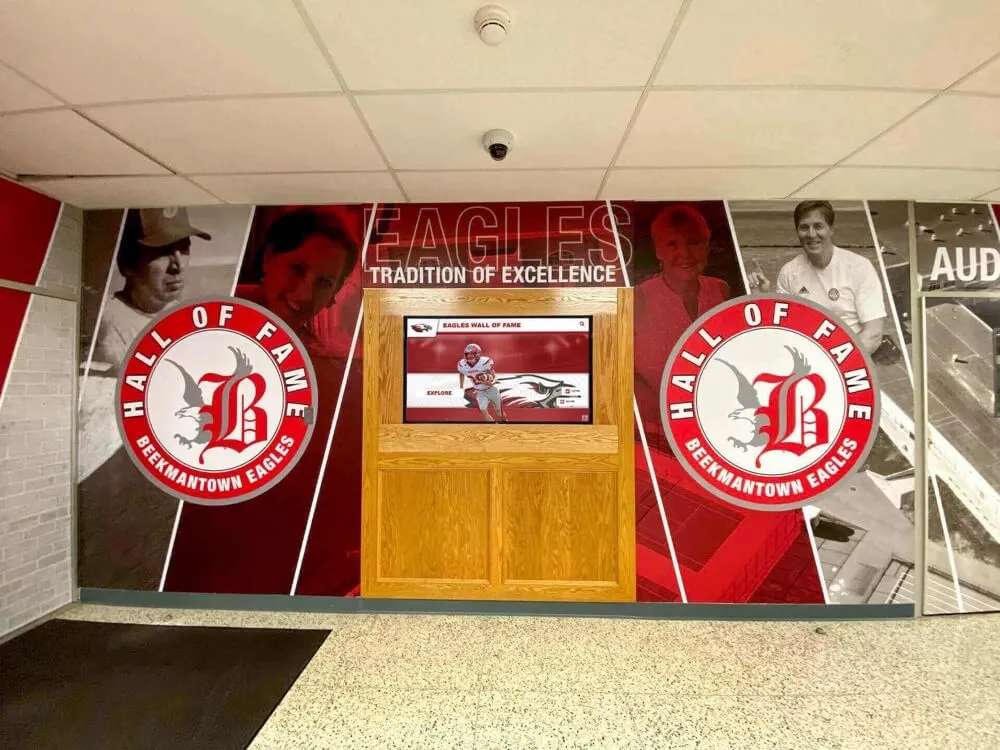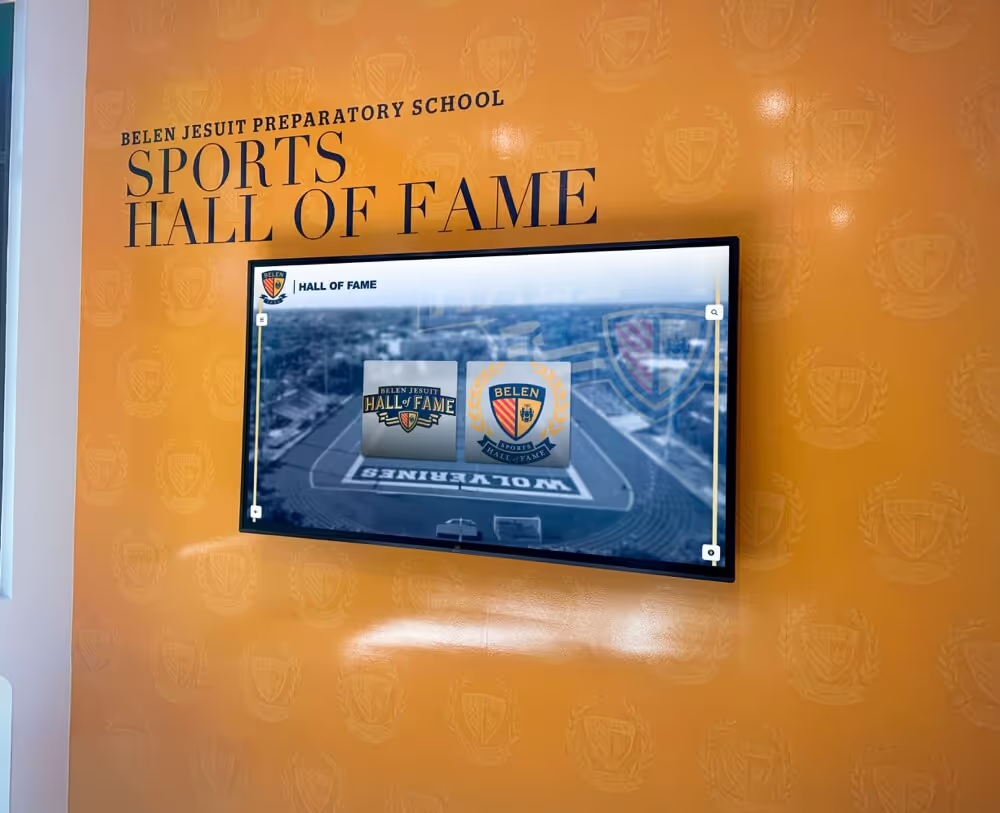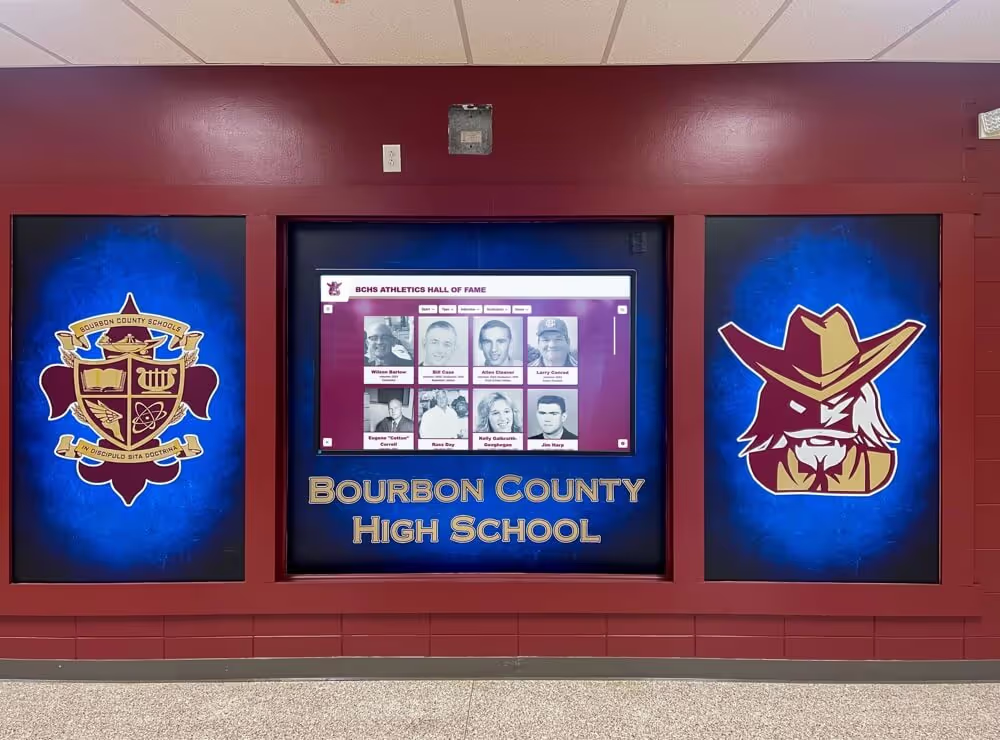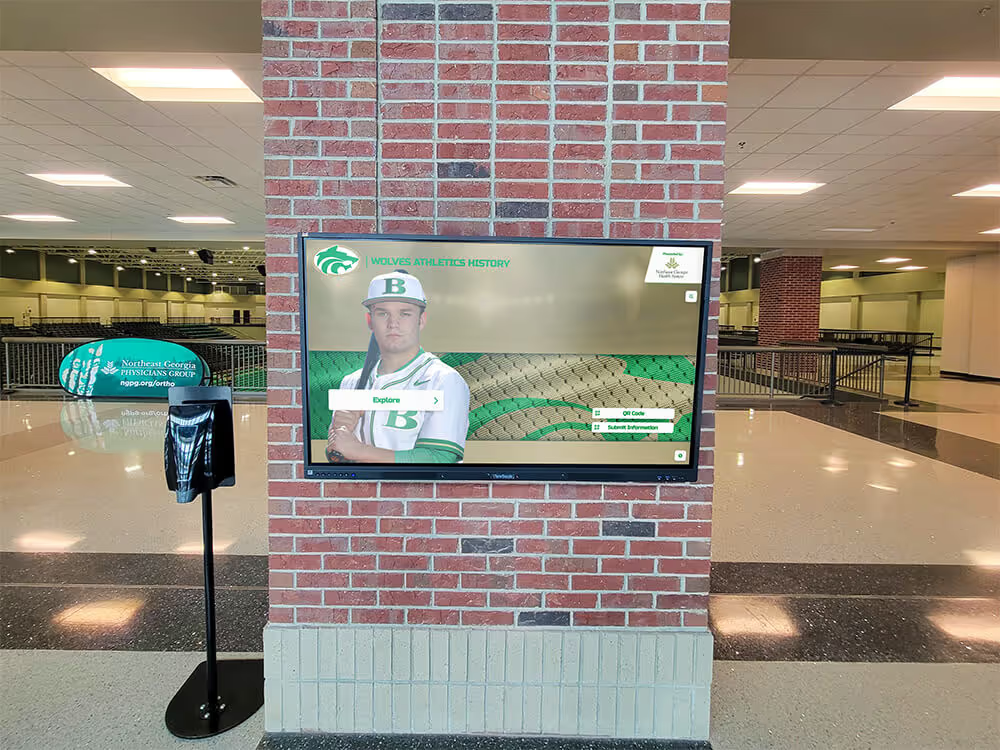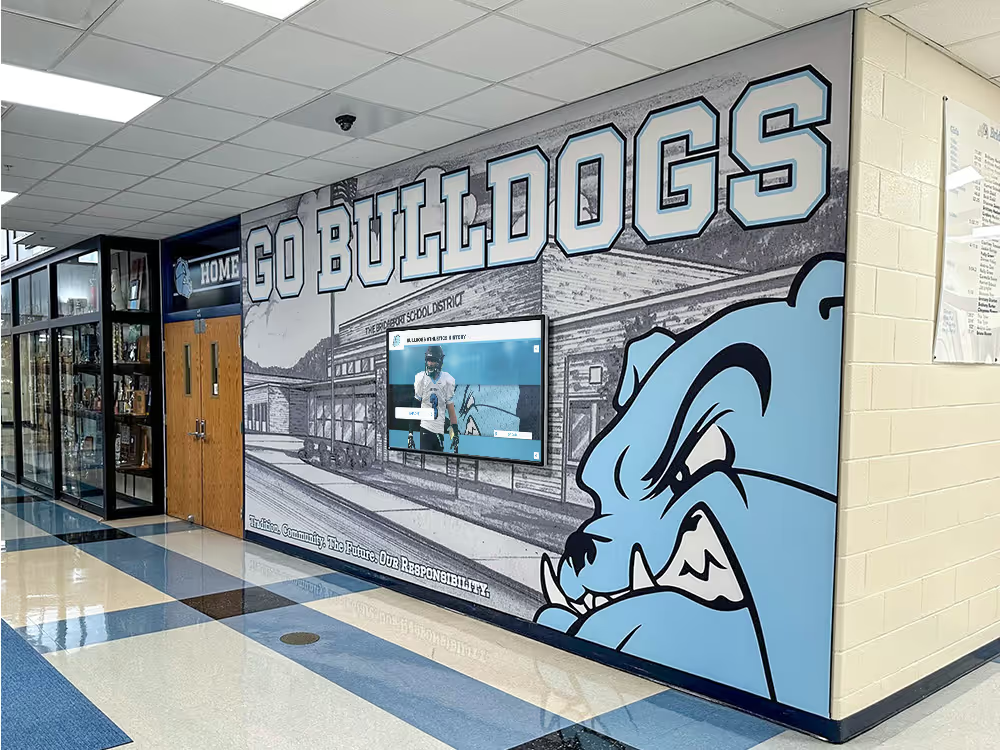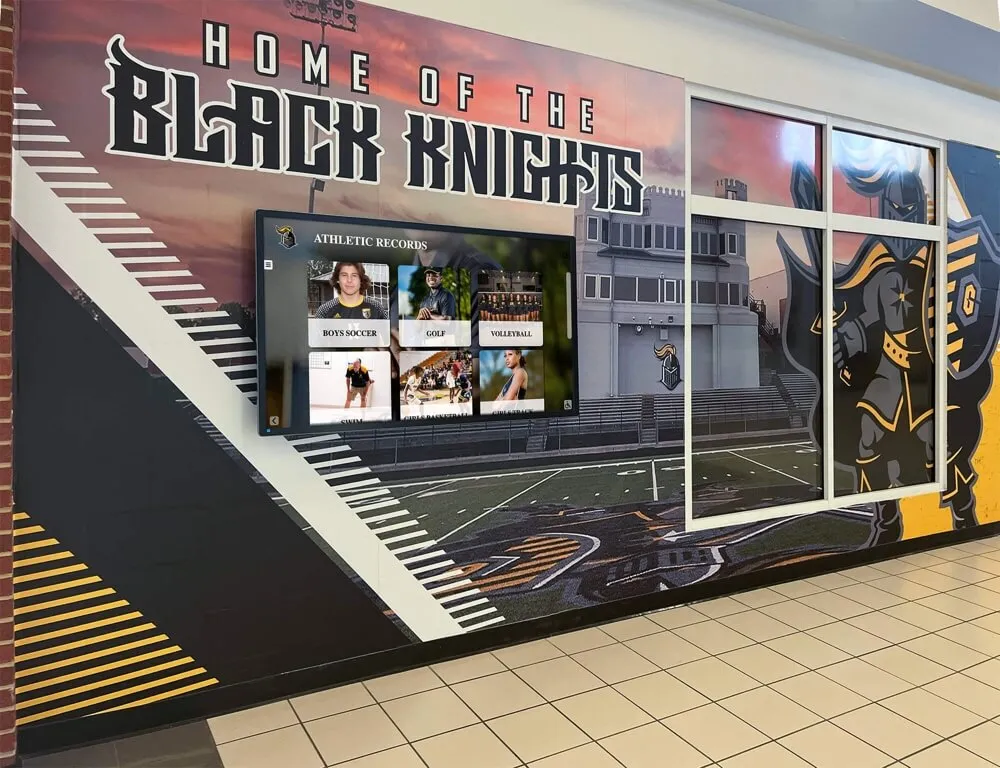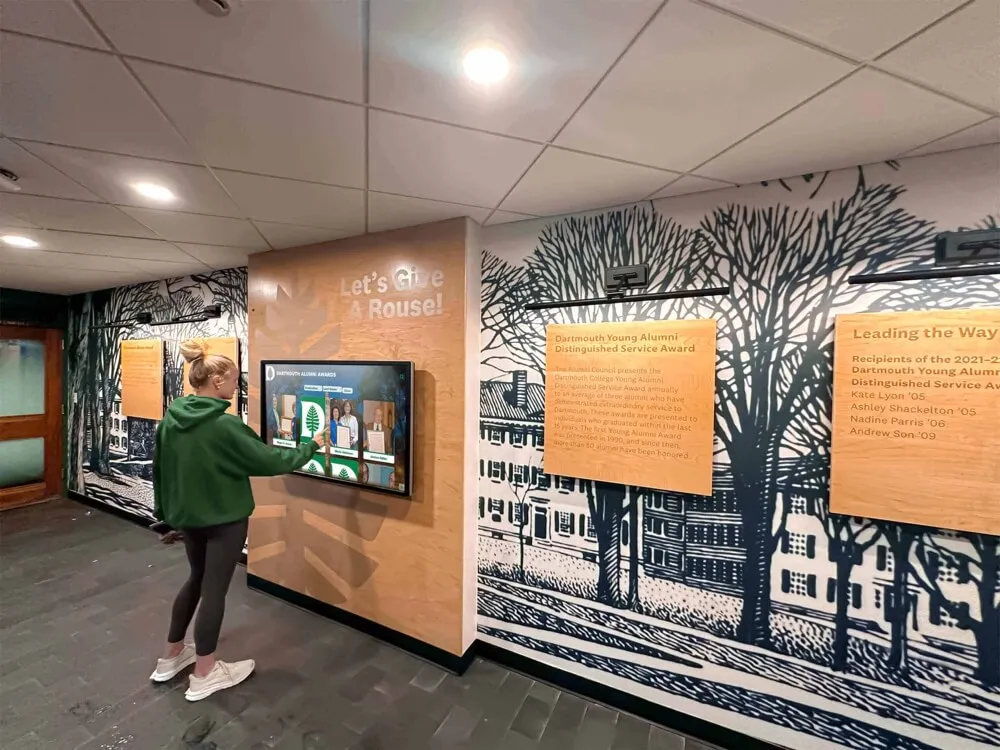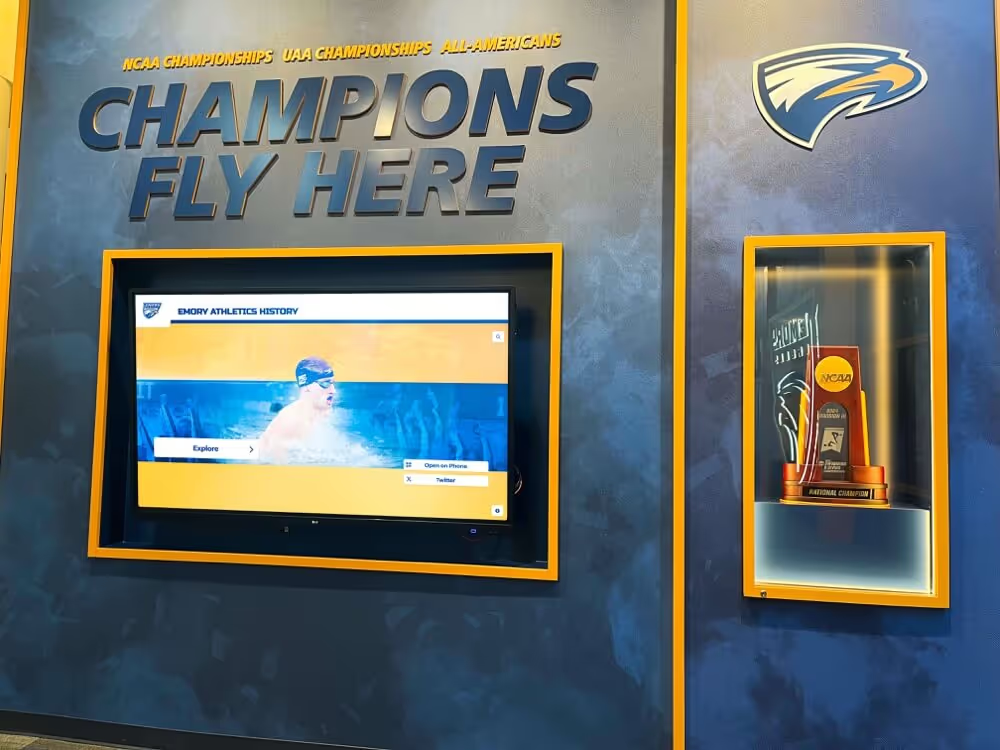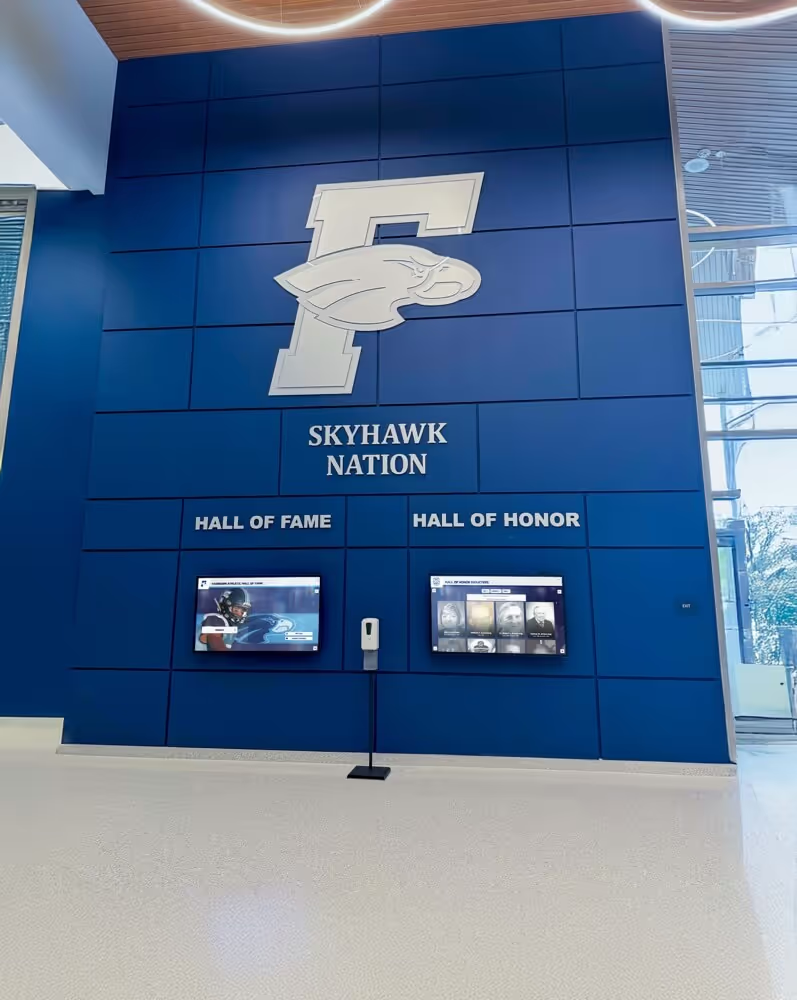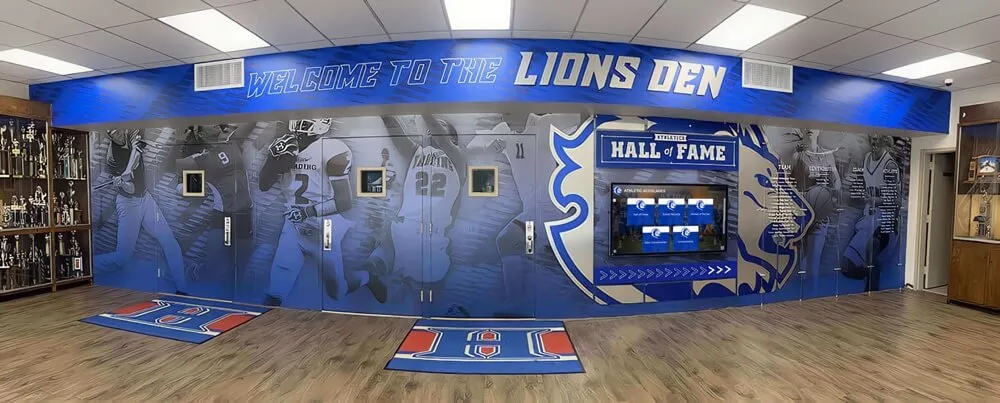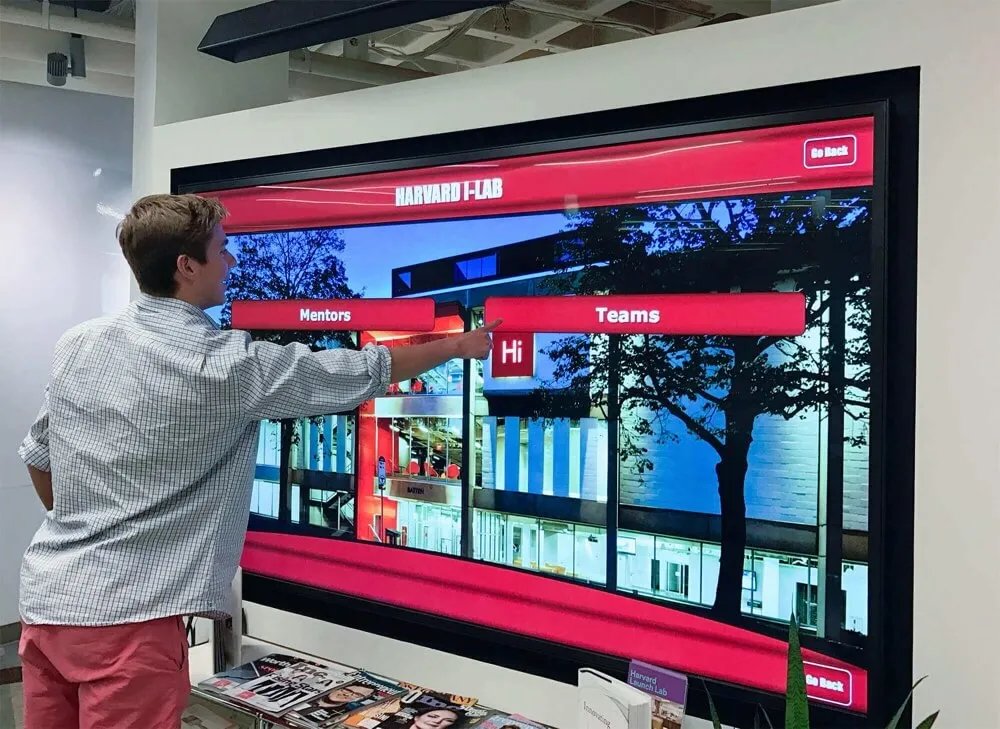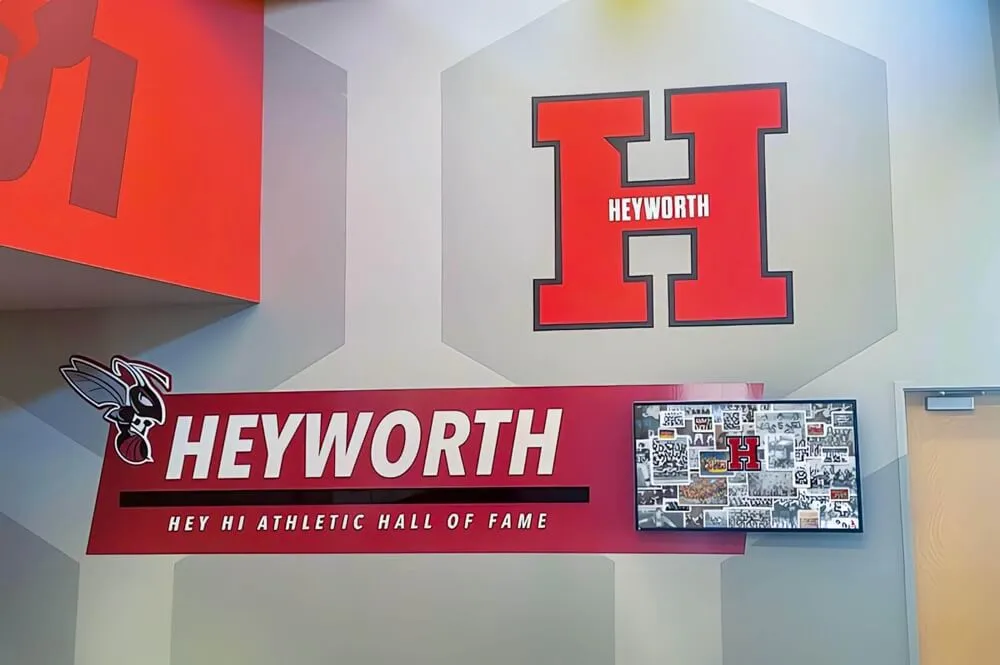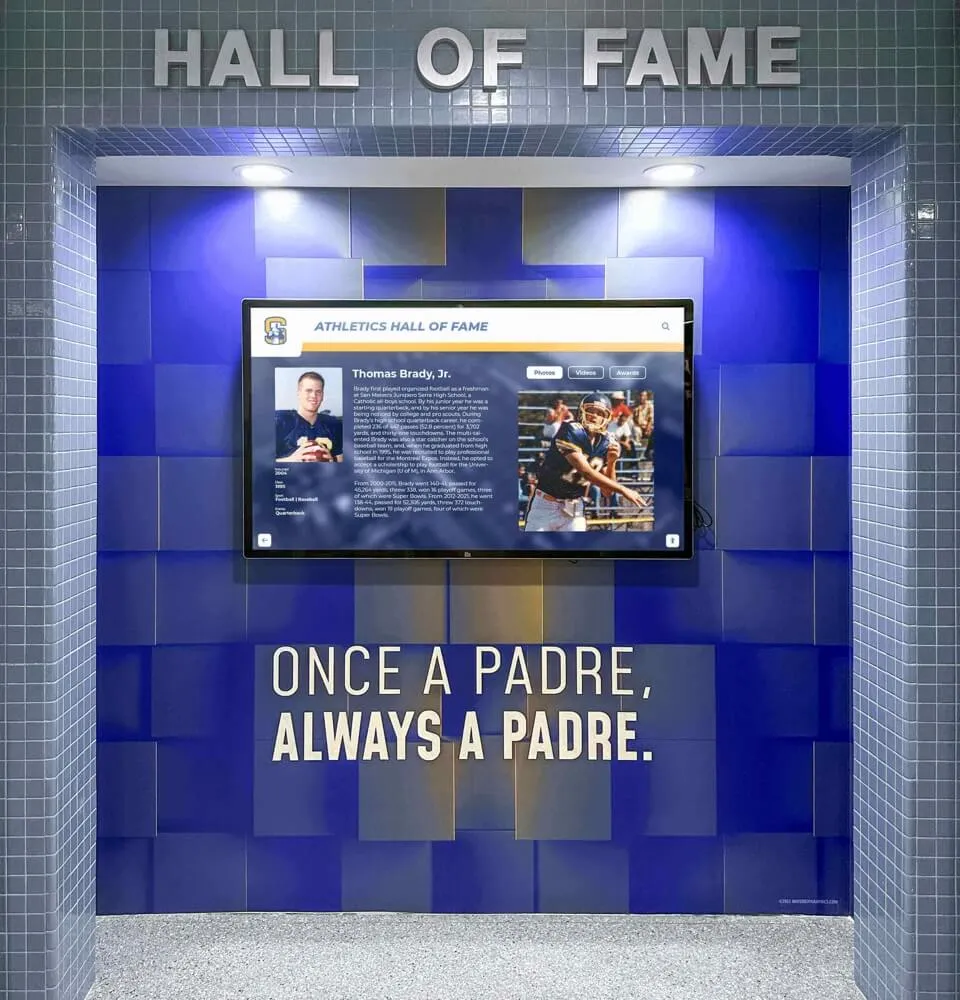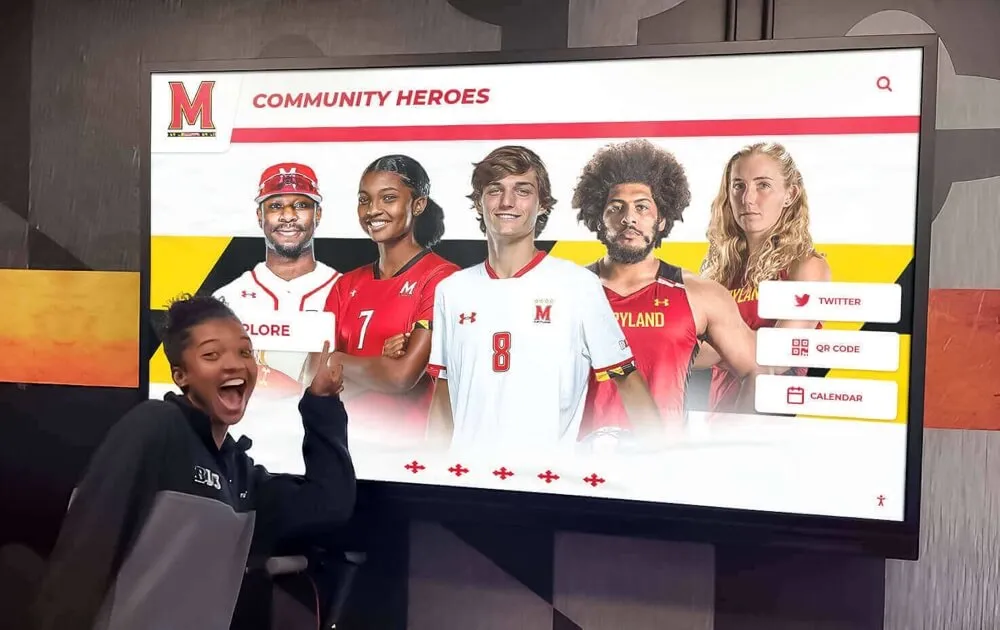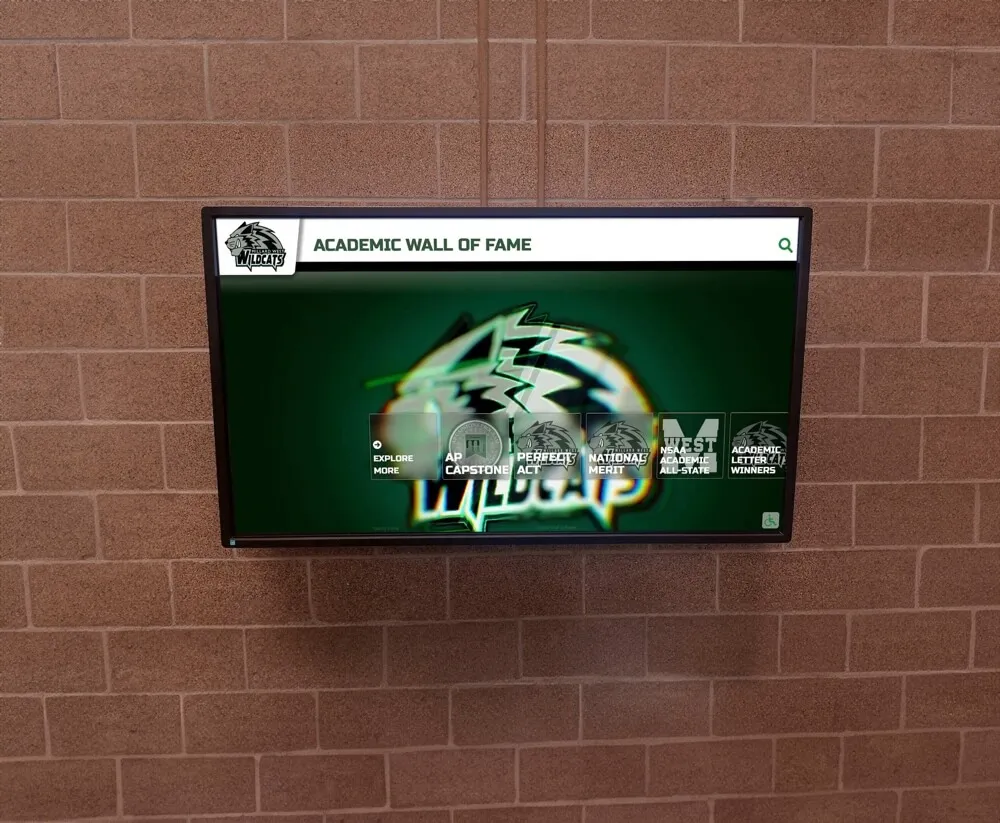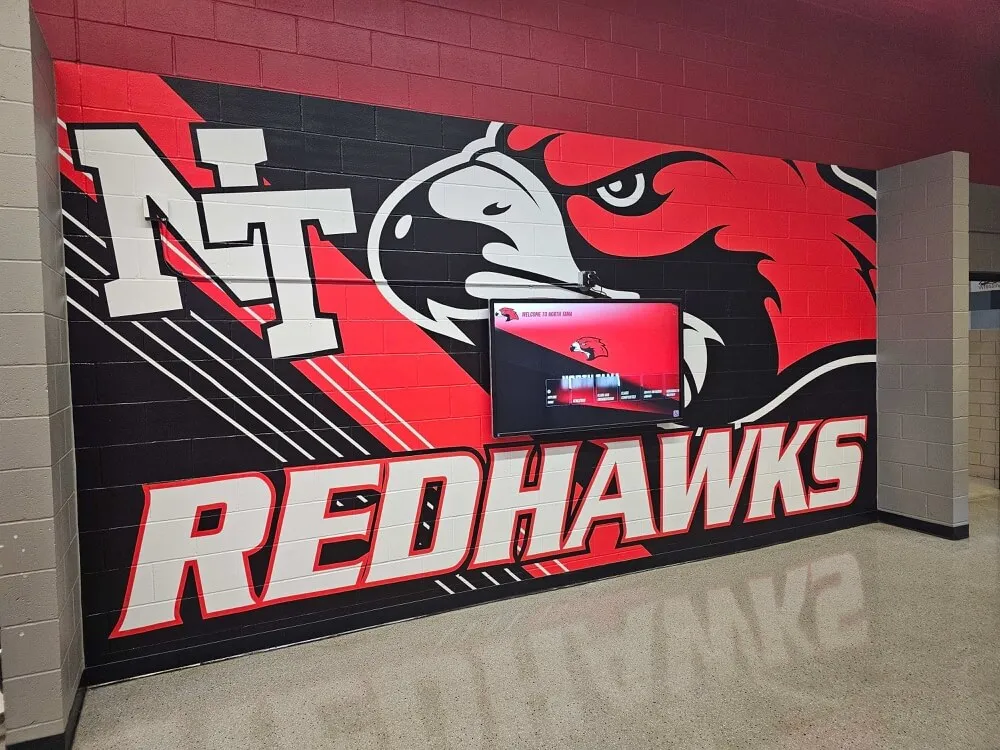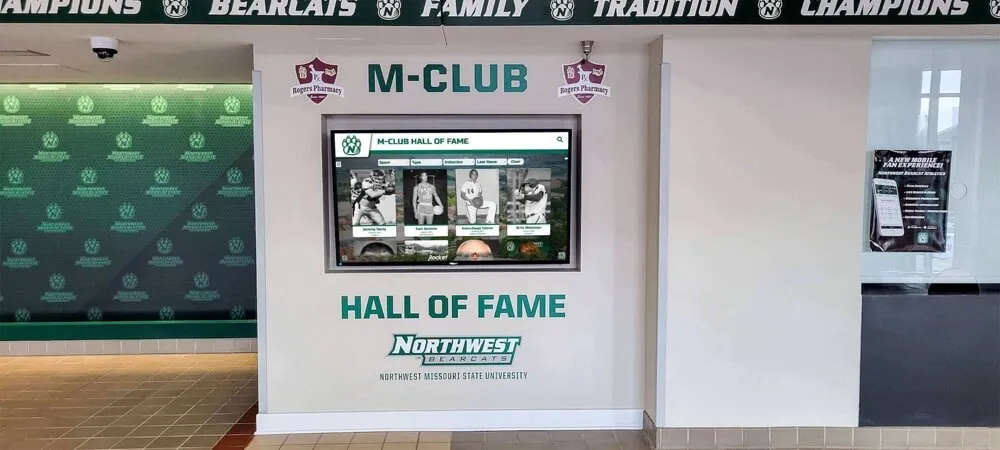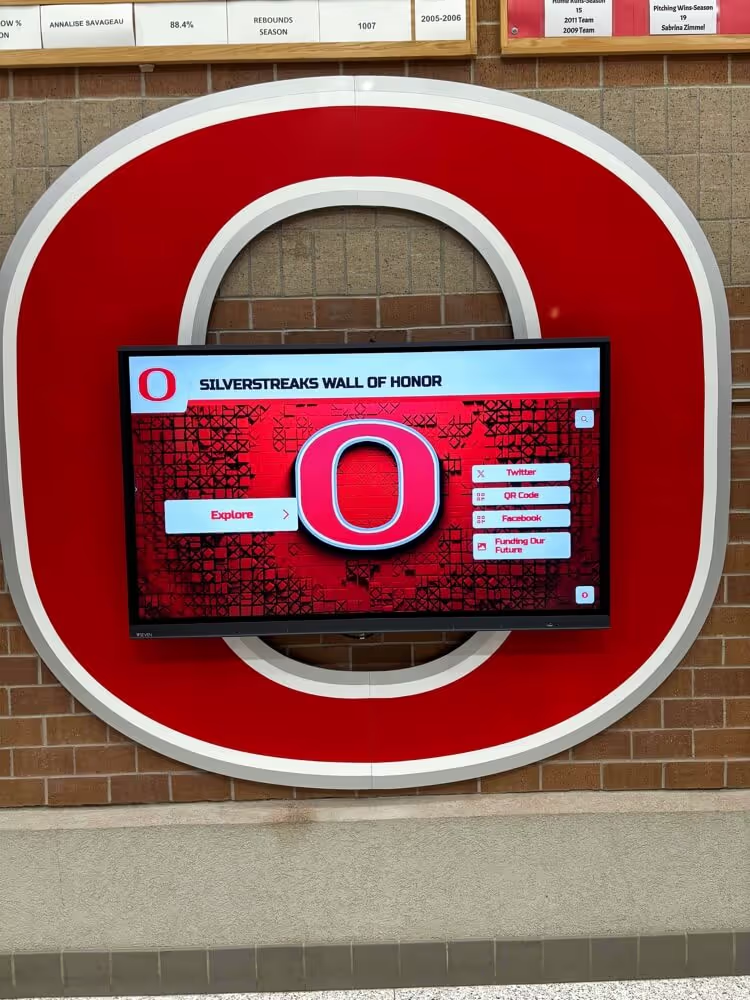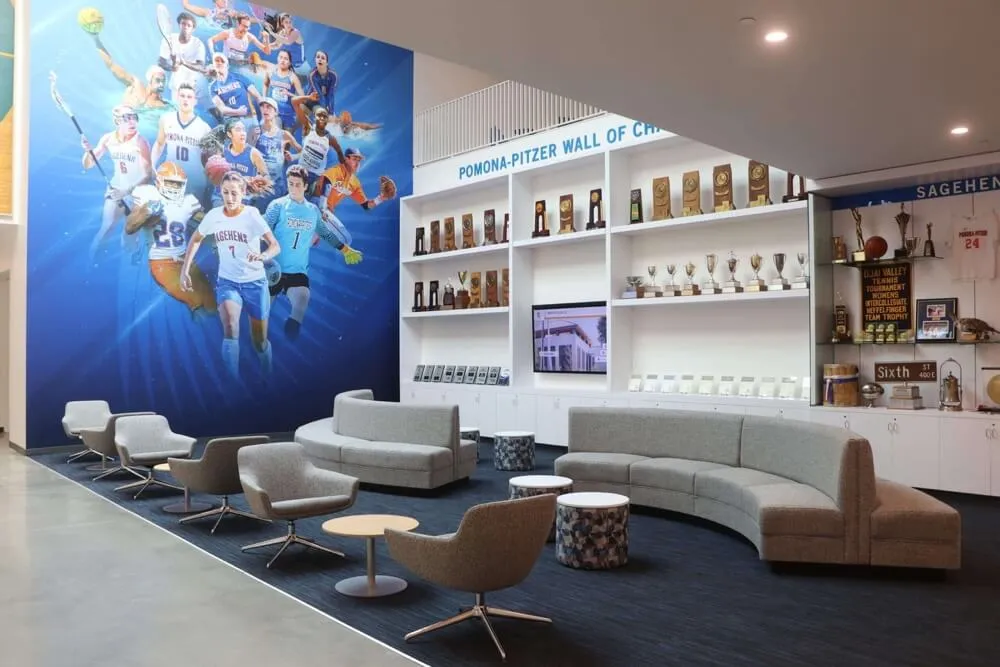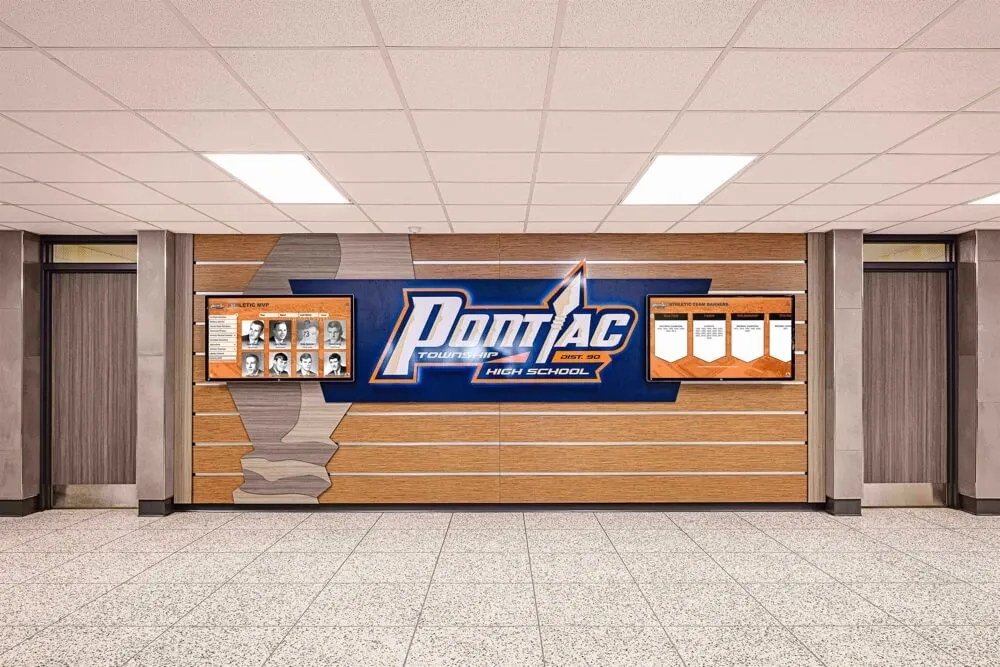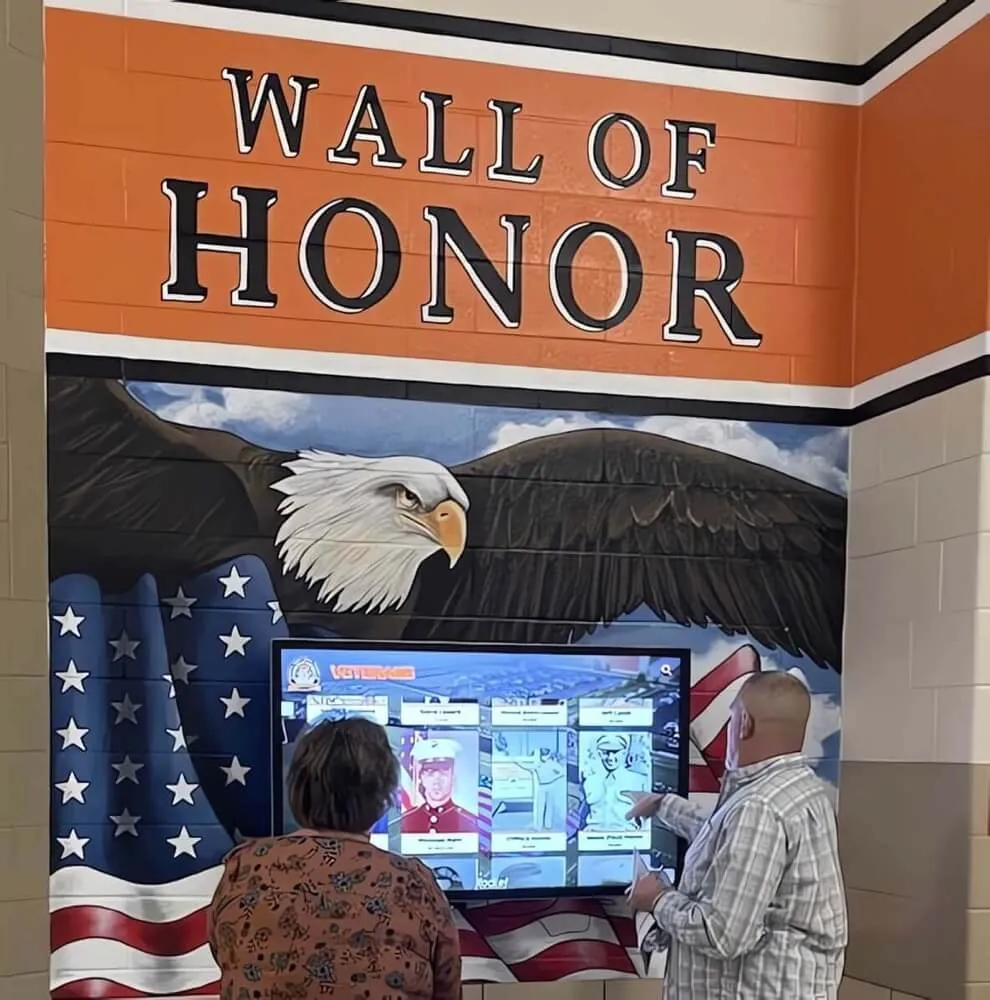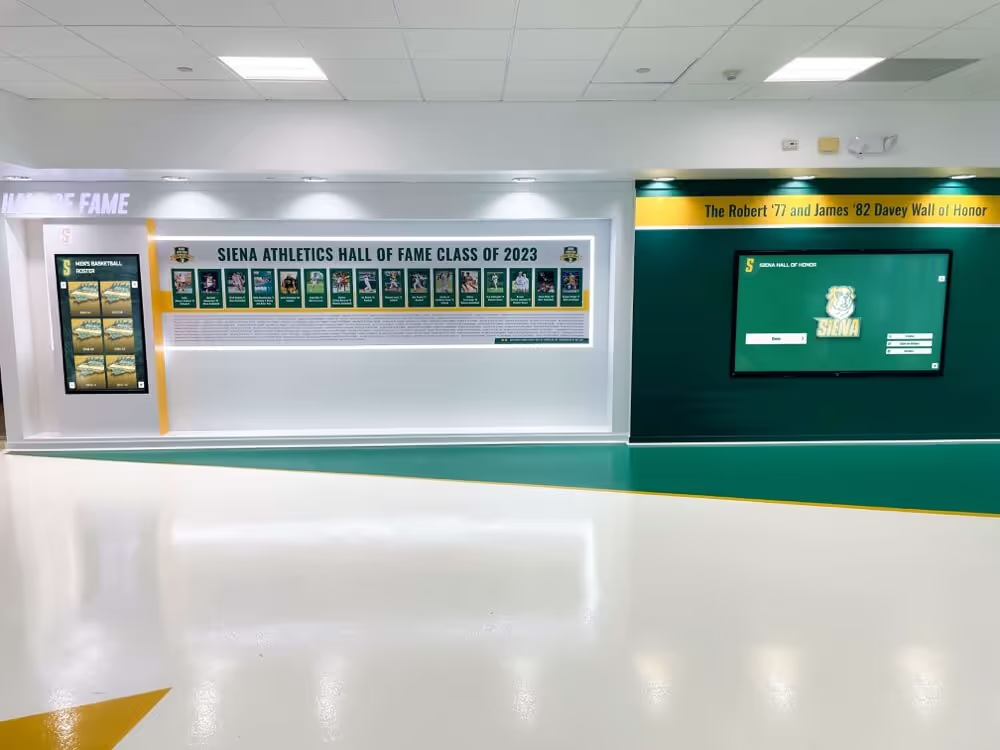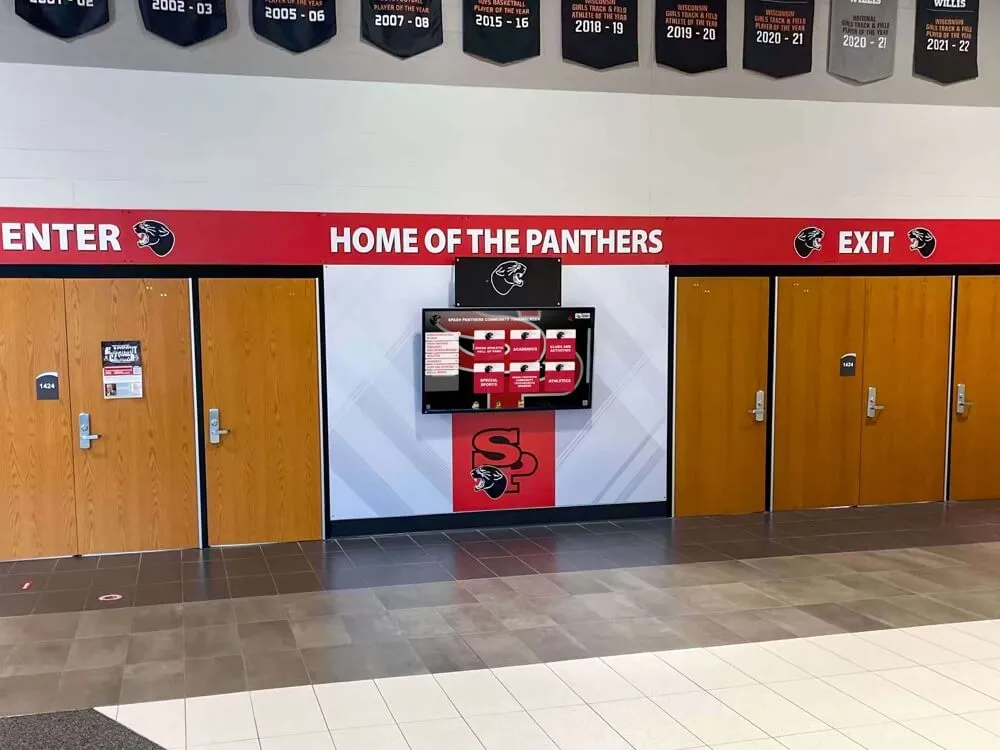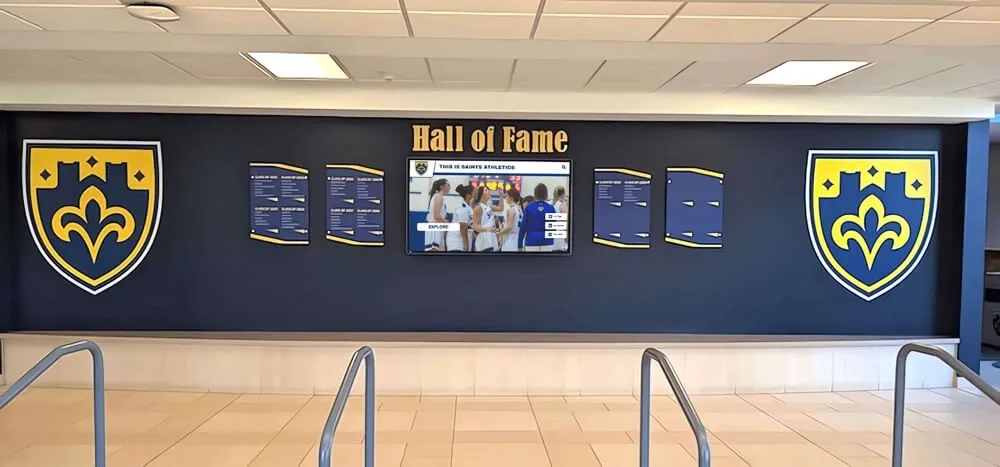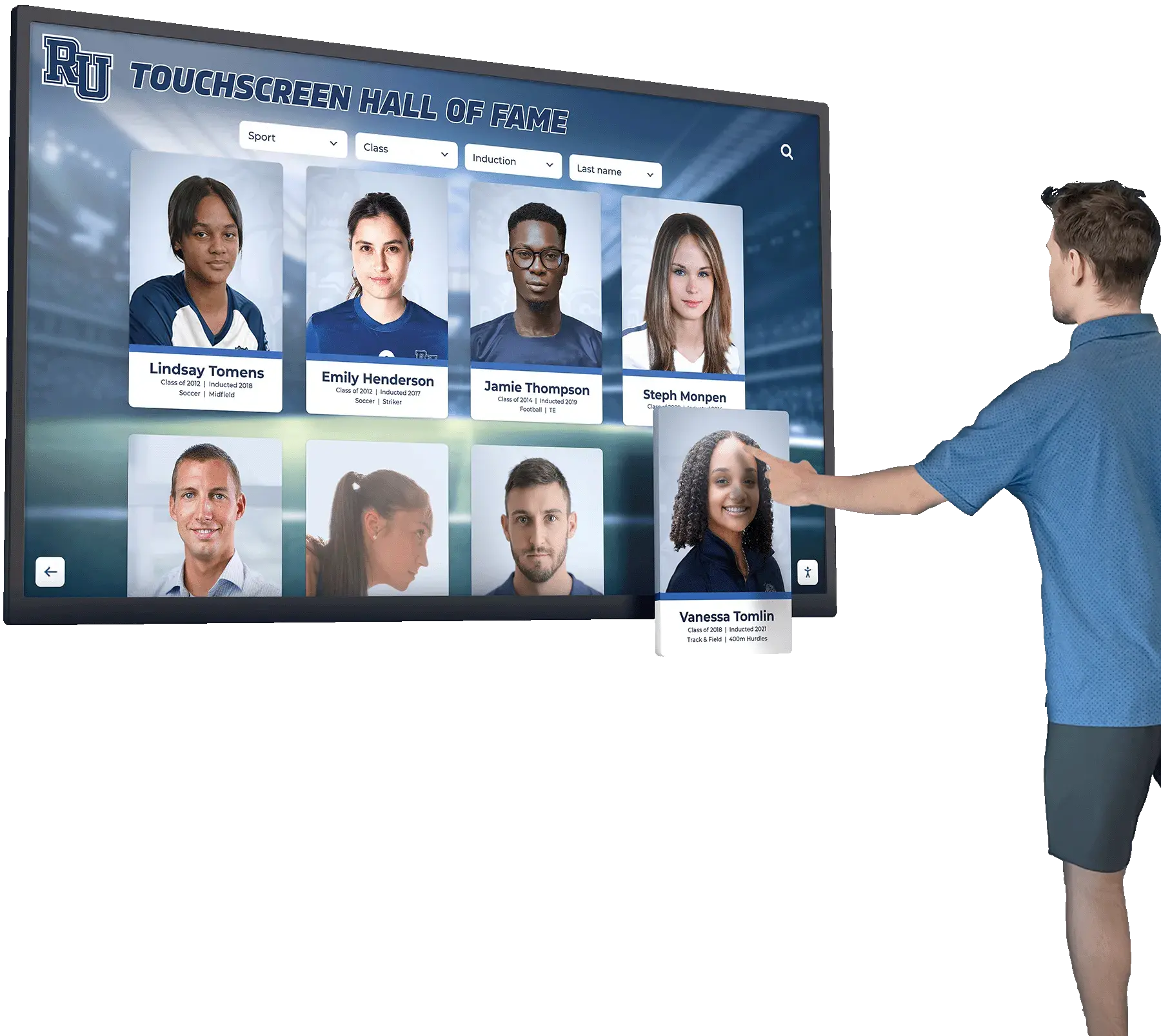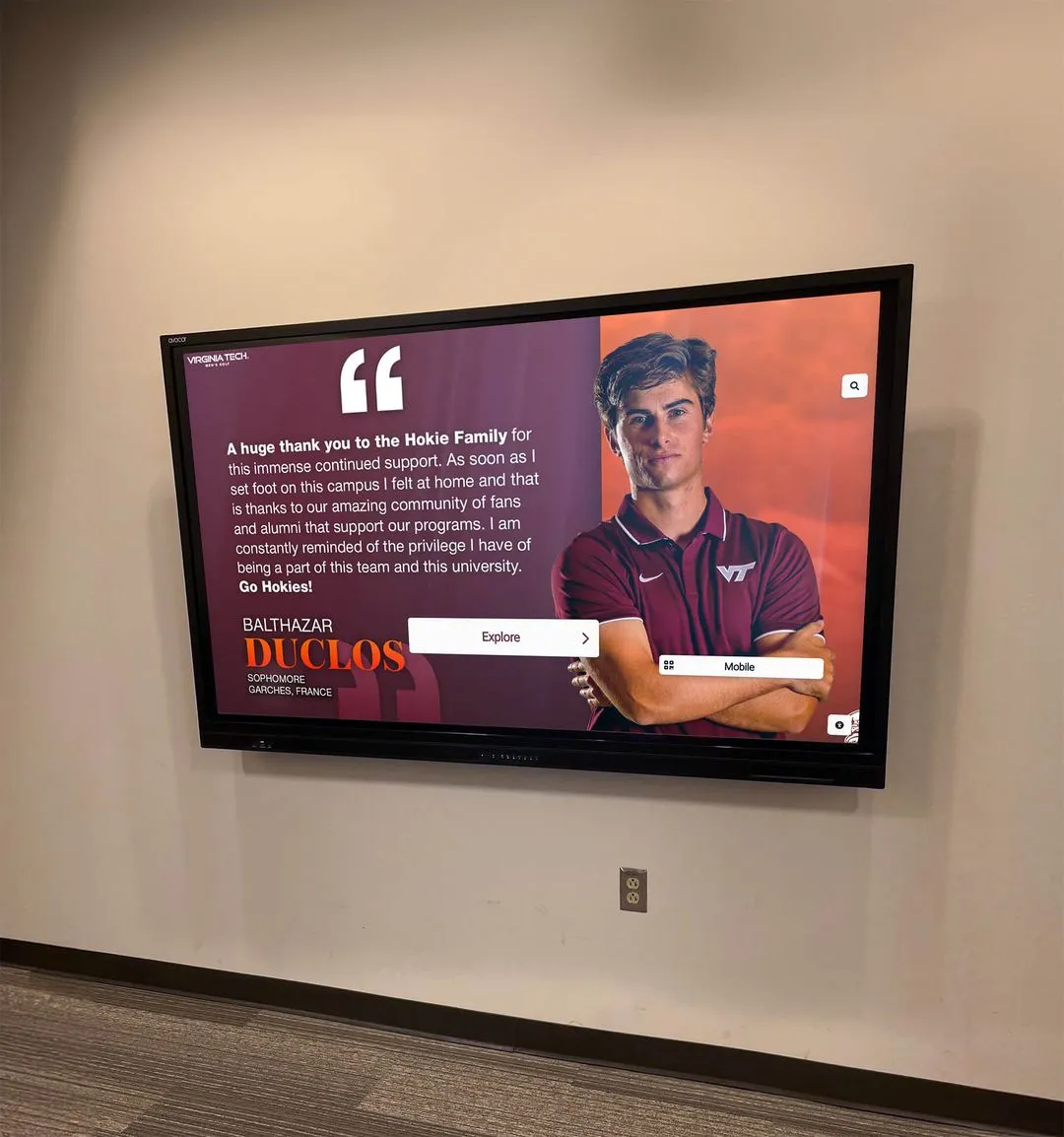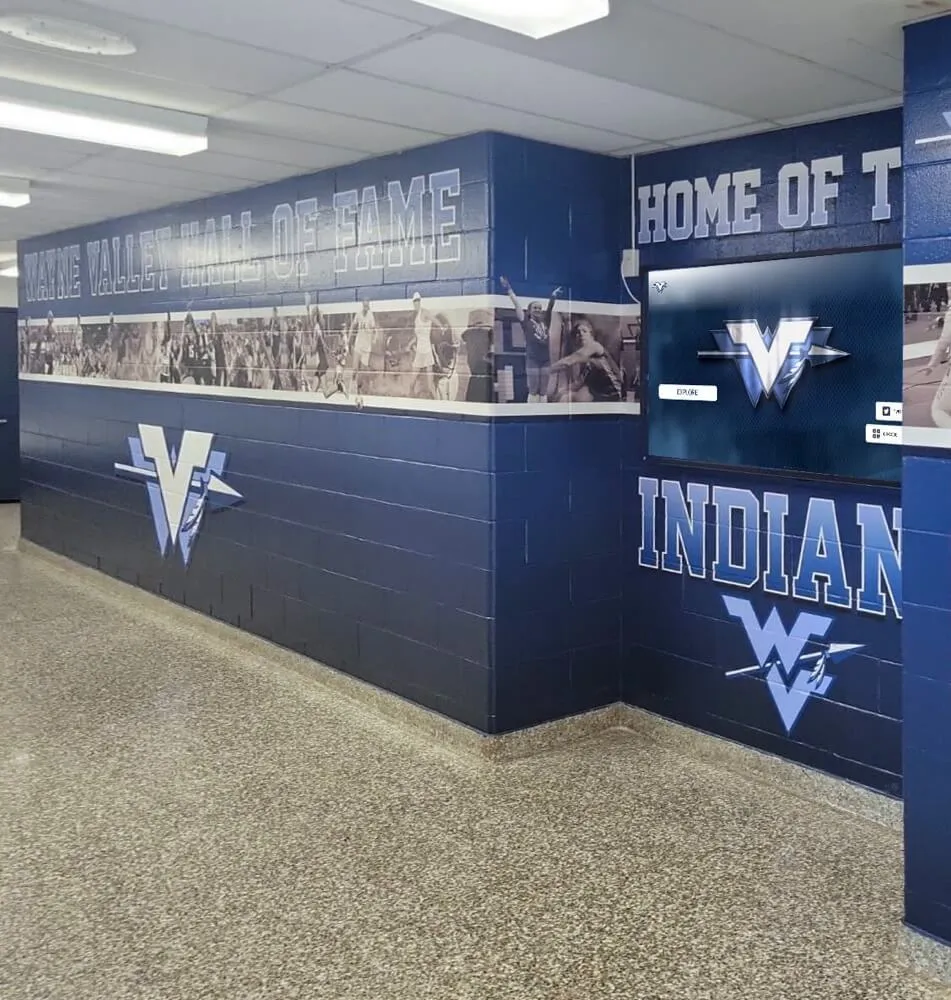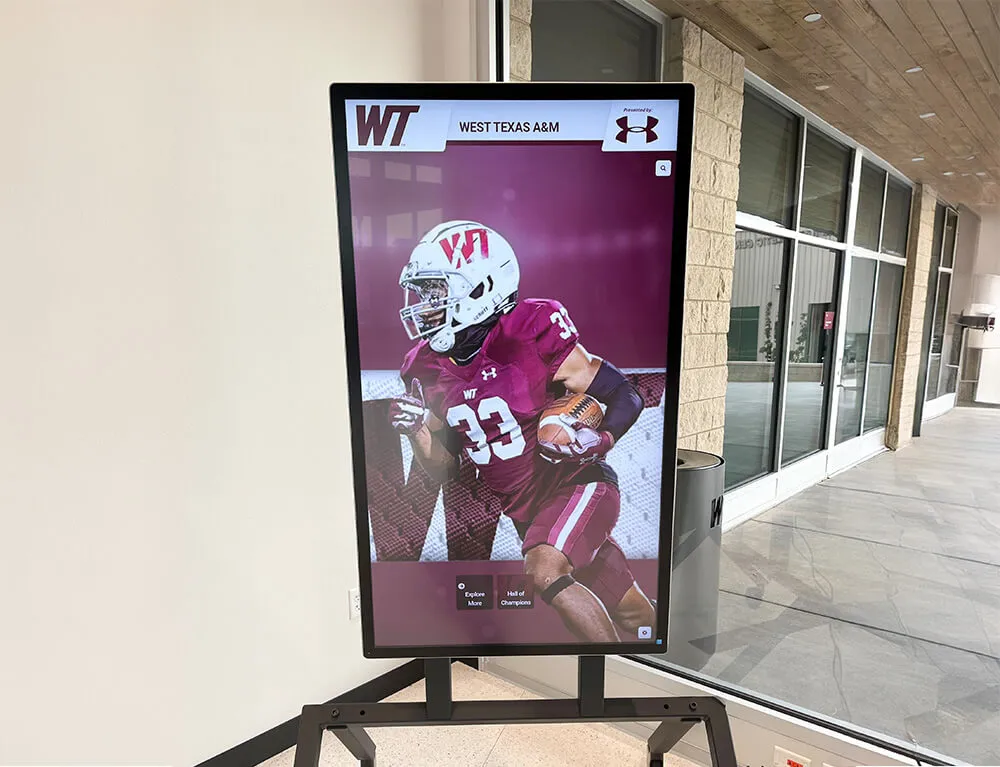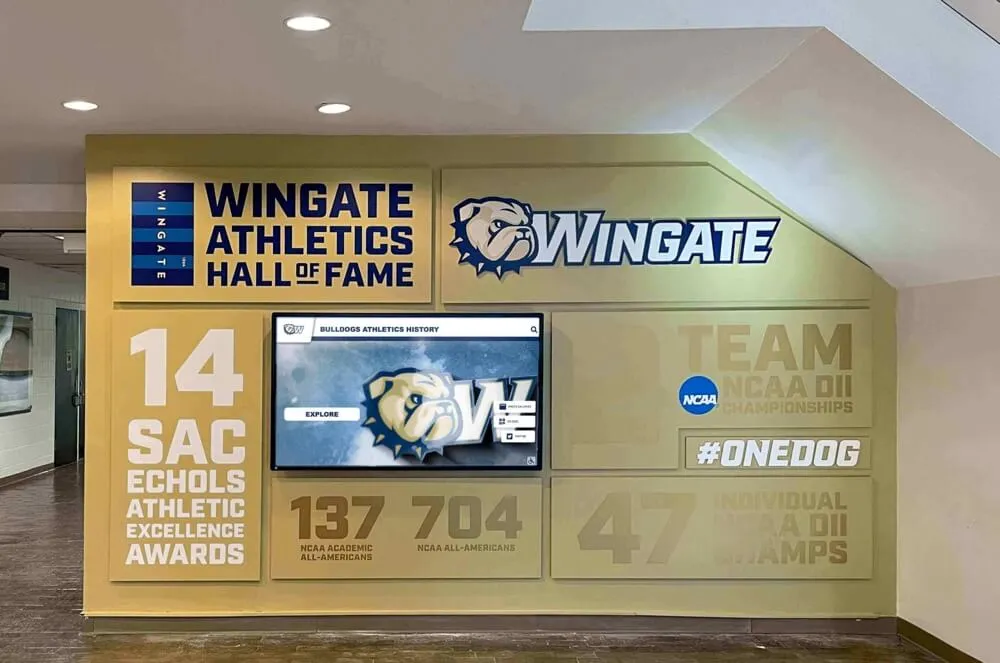




The hardware decision is easy: a touchscreen kiosk replaces a glass cabinet, and the hallway looks modern. The harder decision is the software running on that screen. Every school that has replaced glass trophy cases with interactive displays will tell you the same thing—the platform powering the experience matters far more than the display hardware itself.
Digital trophy case software is the application layer that stores achievement records, serves content to touchscreen kiosks, controls who can edit entries, handles photos and video, and preserves school history for decades to come. Choosing the right software before installation determines whether your digital trophy case grows into a living archive or becomes an expensive slide show that nobody updates.
This guide covers the specific software features athletic directors, school administrators, and advancement teams should evaluate before signing any contract.
Schools evaluating digital recognition systems often focus on hardware specs—screen size, brightness, touch sensitivity—while treating software as an afterthought. That order should be reversed. The software determines what content you can store, how easily staff can add records, whether alumni can be recognized across multiple graduating classes, and whether your data remains yours if you ever switch vendors.

The right software turns a touchscreen kiosk into a searchable, updatable archive—not just a static display
What Digital Trophy Case Software Actually Does
Before reviewing individual features, it helps to understand the functional layers involved:
- Content management system (CMS) — the back-end where staff create, edit, and organize records
- Display engine — the front-end shown on hallway kiosks, lobby screens, or embedded web pages
- Media library — storage and delivery of photos, videos, and documents
- Search and navigation — how visitors browse records by sport, year, name, or award category
- Access and permissions — controls over who can view, edit, or publish content
- Data portability — how records can be exported, backed up, or migrated
Each layer contains decisions that affect your staff workload, visitor experience, and long-term institutional memory. The sections below walk through each in detail.
Feature 1: Searchable, Structured Records
The single most important software capability is a structured record system that makes every achievement discoverable. A database of flat text entries or uploaded PDFs fails this test. What schools need is a records model where each entry has defined fields—athlete name, graduation year, sport, award title, season, coach, team record—so that visitors and staff can search and filter across the full archive.
Why structure matters more than content volume
A glass trophy case that holds 40 trophies is limited by space. A digital system that stores 10,000 records as unstructured files is limited by findability. Structure converts raw data into a navigable archive.
Look for software that supports:
- Named fields with consistent data types (years as numbers, not free text)
- Cross-reference linking (an athlete profile connected to a team championship record)
- Category taxonomies you define (sport, award type, academic vs. athletic)
- Full-text search across all fields simultaneously
- Filter combinations (e.g., “Women’s Soccer + State Champions + 2010–2020”)
Schools with long athletic histories often discover that digitizing older paper records is the highest-value activity they can do with this software. A system that supports bulk import by CSV or spreadsheet—not just one-at-a-time form entry—cuts that project from months to weeks.
Feature 2: Photo and Media Management
Recognition without photos is a list. Recognition with photos is a story. Digital trophy case software should treat media as a first-class feature, not an optional attachment.
What adequate photo management looks like
| Capability | Why It Matters |
|---|---|
| Multiple photos per record | One team photo plus action shots plus awards ceremony |
| Automatic image resizing | Staff upload any file; software handles kiosk dimensions |
| Photo tagging and search | Find every image featuring a specific athlete |
| Historical photo upload | Support for scans of older prints and negatives |
| Video embedding or hosting | Championship game highlights, coach tributes |
| Rights and caption fields | Proper attribution for archived images |
Many schools also want to connect photo archives with yearbook images and alumni records. Ask vendors whether their system integrates with existing photo databases or whether it requires re-uploading everything from scratch.
For context on how visual storytelling transforms static trophy areas into engaging recognition hubs, see our guide on digital trophy case ideas for schools replacing glass cabinets.
Feature 3: Role-Based Permissions
A glass trophy case has one update mechanism: someone with a key physically opens it. Digital trophy case software needs a more sophisticated permissions model because multiple people across multiple departments will need to contribute records.
A practical permissions hierarchy for schools
System administrator — full access to all records, settings, and integrations. Typically the IT coordinator or database manager.
Athletic director — can create, edit, and publish all athletic records; cannot change system settings or access academic award records.
Sport-specific coordinator — can create and edit records for their assigned sport only; cannot publish without approval.
Communications or advancement staff — can edit captions, biographical text, and photos; cannot delete records.
Alumni relations — can flag records for updates or corrections; cannot directly edit published entries.
Read-only staff — can view all records including unpublished drafts; cannot make changes.
This granularity matters because schools have high staff turnover. An assistant coach who managed football records for three years leaves, and their replacement should be able to pick up exactly where they left off—with appropriate access to exactly the records they need and no more.
Ask every vendor: Can I assign permissions at the sport or category level, not just the system level? Many simpler platforms offer only two tiers (admin and viewer), which forces schools to give broad access to anyone who needs to update any record.
Feature 4: Touchscreen Kiosk Display Engine
The display engine is what visitors actually interact with. Good software ships with a kiosk interface that has been tested on real hallway hardware, not just desktop browsers. Features to evaluate:
Navigation and interaction
- Touch targets sized for hallway use — buttons readable and tappable from arm’s length, not optimized for a mouse
- Idle/attract mode — when nobody is using the kiosk, it should cycle through featured content to draw attention
- Wayfinding — visitors should reach any record in three touches or fewer
- Accessibility — text size options, high-contrast mode, and compliance with WCAG 2.2 AA standards (see our WCAG 2.2 AA compliance guide for digital recognition displays for details)
Display hardware compatibility
Software should run on commercial-grade Android or Windows touchscreen hardware without requiring proprietary kiosks sold only by the vendor. Vendor lock-in on hardware means that when a screen fails five years from now, you are forced to buy replacement hardware from one supplier at whatever price they set.
Ask: Does your software run on standard commercial display hardware, or does it require your proprietary kiosk?
Platforms like Rocket Alumni Solutions are designed to deploy across a range of commercial touchscreen hardware, which protects the school’s long-term investment regardless of which display vendor they use for replacements.
Feature 5: Remote Content Updates Without On-Site Access
One of the core promises of digital trophy case software is that content updates happen instantly, without anyone needing to physically open a case. Verify that promise extends across these scenarios:
- Staff update a record from home — the change appears on the kiosk the next time the page loads
- A photo is added at 11 PM before a Saturday event — it is live the next morning without IT involvement
- A typo is corrected in a coach’s biography — the correction propagates to all displays showing that record, not just one screen
The opposite of this is a system where content is “pushed” to kiosks manually, requiring a staff member to log in to each screen separately or export files to a USB drive. These workflows defeat the purpose of cloud-connected software.
Questions to ask vendors:
- How long does it take for a content edit to appear on kiosk screens?
- Can updates be scheduled in advance (e.g., publish a new inductee profile on a specific date)?
- Do updates require IT department involvement, or can administrative staff do them independently?
Feature 6: School History and Archive Depth
Digital trophy case software should not just display current-year achievements—it should be capable of holding a school’s complete record history back to founding. This matters for three reasons:
- Alumni engagement — graduates from the 1970s return to campus and want to see their records preserved
- Historical equity — sports programs added in recent decades deserve the same archive depth as legacy programs
- Institutional continuity — when staff turn over, the institutional memory lives in the software, not in someone’s head
Evaluate archive capabilities with these questions:
- What is the record limit? (Some platforms cap entries or charge per record)
- Can you import historical data from spreadsheets, old websites, or paper yearbook scans?
- Are records preserved permanently, or does older content expire or get automatically archived?
- Can you mark records as “historical” to distinguish from active programs?
Athletic trophy case archives connect directly to school identity. A digital trophy case that only holds five years of data is not an archive—it is a current-events board. For a deeper look at how thoughtful display choices reflect on athletic legacy, see athletic trophy case display ideas for showcasing school legacy.
Feature 7: Integration With Existing School Systems
Few schools maintain achievement records in a single place. Athletic databases, yearbook platforms, school information systems, alumni CRMs, and advancement donor databases often hold overlapping data. Digital trophy case software that cannot connect to any of these systems becomes another silo to maintain separately.
Integration types to ask about
Data import — Can you bring in records from an existing system via CSV, JSON, or API? This is the minimum acceptable standard.
Two-way sync — Can records updated in the trophy case software automatically update a connected system (or vice versa)? This is rare but valuable for schools with robust alumni relations operations.
Single sign-on (SSO) — Can staff log in using their existing school credentials (Google Workspace, Microsoft 365, Clever) rather than a separate username and password?
LMS or website embedding — Can the recognition database be embedded on the school’s public website, athletic department pages, or alumni portal so that digital recognition extends beyond hallway kiosks?
Schools that have invested in Hall of Fame recognition programs find that software connecting the touchscreen kiosk display with the public-facing website doubles the reach of every recognition entry without duplicating the data entry work.
Feature 8: Data Ownership and Export
This feature is the one schools most often overlook until it is too late. Before signing any software contract, get explicit written answers to these questions:
- Who owns the data? Your school should own all records, photos, and media it uploads—not the vendor.
- Can you export everything? You should be able to download a complete export of all records and media in standard formats (CSV for data, original file formats for images and video).
- What happens if you cancel? How long does the vendor provide access for data export after a subscription ends? Some vendors delete data 30 days after cancellation.
- Are records backed up? Where, how frequently, and who is responsible for restoration if something goes wrong?
Data portability is not a hypothetical concern. Software vendors get acquired, change pricing models, or discontinue products. A school that cannot export its 40-year athletic archive has effectively lost institutional memory if the vendor goes dark.
Feature 9: Recognition Beyond Athletics
The strongest argument for investing in full-featured digital trophy case software—rather than a simpler slideshow tool—is that it can expand beyond athletics to serve the entire school community.
Academic recognition programs, arts and performing arts awards, service leadership honors, and alumni achievement recognition all benefit from the same searchable, photo-rich database structure. A single platform serving multiple departments consolidates maintenance, reduces software costs, and creates a more unified recognition experience for students.
Programs that benefit from shared recognition software:
- Athletic Hall of Fame inductees
- Academic letter and honor society records
- Performing arts and fine arts awards
- Student government leadership recognition
- Community service and volunteerism honors
- Alumni distinguished graduate programs
- Donor recognition and scholarship histories
Benefits of a unified platform:
- Staff train once on one system
- Consistent visual presentation across all program types
- Cross-program search (find all records for one person across sports and academics)
- Single data backup and export process
- One vendor relationship to manage
For ideas on how recognition extends to less-visible student groups, see how schools approach color guard captain recognition as part of a broader digital honor system.
Feature 10: Reporting and Analytics
Schools investing in digital recognition increasingly want to demonstrate that the investment produces engagement. Software should provide basic analytics covering:
- Kiosk interaction volume — how many touches per day, which records are most viewed
- Content completeness — what percentage of records have photos, what fields are most commonly left blank
- Update frequency — when was each record last edited, which programs are behind on updates
- Search queries — what terms visitors search for most (useful for identifying gaps in the archive)
This data helps athletic directors make the case for continued investment, identify which sports programs need more archival work, and demonstrate alumni engagement when reporting to school boards or advancement donors.
Software Evaluation Checklist
Use this checklist when comparing platforms:
| Feature | Questions to Ask | Minimum Standard |
|---|---|---|
| Record structure | Are fields defined or free-form? | Structured fields with defined data types |
| Search | Can visitors filter by sport, year, and award simultaneously? | Full-text + multi-field filter |
| Permissions | Can access be scoped to specific sports or departments? | At least 4 permission levels |
| Media | Does it support multiple photos and video per record? | Yes, with automatic resizing |
| Updates | How long for an edit to appear on kiosk screens? | Under 5 minutes, no IT required |
| Hardware | Does software run on standard commercial hardware? | Vendor-agnostic |
| Archive depth | Is there a record cap? | No cap or very high limit |
| Integrations | Can you import via CSV? Is SSO available? | CSV import minimum |
| Data ownership | Can you export all records and media on request? | Full export in standard formats |
| Analytics | Are basic kiosk interaction metrics available? | Yes, accessible to admins |
Common Mistakes Schools Make When Choosing Software
Prioritizing hardware over software
A beautiful 75-inch touchscreen running limited software becomes a maintenance burden within two years. Evaluate software depth first; treat hardware as the delivery mechanism.
Choosing the cheapest option without testing record import
Many lower-cost platforms look fine for new records but have no path for importing historical data. If you have 30 years of athletic records in spreadsheets, verify import capability with a real test—not a vendor demo using their sample data.
Ignoring what happens at contract renewal
Introductory pricing structures often change at year two or three. Ask for multi-year pricing in writing before signing, and understand exactly what features are included versus metered.
Underestimating the initial data entry project
Even the best software requires someone to enter records. Budget staff time—or a student worker or alumni volunteer program—to populate the archive before launch. A kiosk that launches with 12 records disappoints visitors. One that launches with 500 records creates an experience people return to.
How Digital Trophy Case Software Compares to a Traditional Glass Case
| Consideration | Glass Trophy Case | Digital Trophy Case Software |
|---|---|---|
| Capacity | Fixed (20–50 items) | Unlimited records |
| Update process | Physical access, keys, manual | Remote, web browser, immediate |
| Historical depth | Limited by physical space | Complete school history |
| Search capability | None (visual browse only) | Full-text, multi-field filter |
| Photo and video | Static or none | Full media library per record |
| Staff access | One person with key | Role-based, multi-user |
| Public website | No connection | Embeddable on school site |
| Data portability | Physical objects in storage | Exportable digital records |
| Cost over 10 years | Low hardware, high maintenance labor | Higher initial, lower ongoing labor |
| Alumni engagement | Passive display | Active, searchable recognition |
The transition from glass to digital is not purely about modernization—it is about what an institution owes to the people it has recognized. A championship team from 1987 deserves to be discoverable, not buried behind newer hardware on a shelf. Software that makes that possible is the genuine value proposition of digital trophy case technology. For a broader look at how schools are approaching this transition, see our comparison of digital hall of fame displays versus traditional trophy cases.
Frequently Asked Questions
What is digital trophy case software? Digital trophy case software is the application that stores, organizes, and displays school achievement records on touchscreen kiosks, web pages, and digital displays. It functions as a content management system specifically designed for school recognition programs, handling athlete profiles, championship records, photos, video, and access permissions.
How much does digital trophy case software cost? Pricing varies widely based on record volume, number of kiosk displays, and feature depth. Schools typically see annual software subscription costs ranging from a few thousand dollars for basic platforms to higher tiers for systems with full integrations, analytics, and unlimited records. Hardware (touchscreen kiosks) is usually a separate one-time cost.
Can digital trophy case software replace a physical glass case? The software replaces the content management function of a glass case and extends it with search, multimedia, and remote updating. Many schools keep physical trophy hardware in place while adding a digital kiosk alongside it to serve as the navigable archive. The hardware and software complement each other rather than the digital system completely replacing physical display.
What happens to data if the vendor goes out of business? This depends entirely on the contract. Before signing, confirm in writing that your school owns all uploaded data, that you can export records and media on demand, and that the vendor provides a minimum data export window (30–90 days recommended) after any contract termination. Schools with long athletic histories should treat data portability as a non-negotiable contract term.
How long does it take to populate a digital trophy case with historical records? Timeline depends on how records currently exist. Schools with organized spreadsheet data can import bulk records quickly—days rather than months. Schools working from paper yearbooks, physical trophy plaques, and scattered archives typically treat historical digitization as a multi-semester project, often involving student workers, history classes, or alumni volunteers. Starting with the most recent decade and working backward ensures the kiosk is immediately useful while the historical archive grows.
Does digital trophy case software work for academic awards, not just athletics? Yes—and the strongest platforms are designed from the start to support multiple recognition categories. Academic honor society records, performing arts awards, student leadership recognition, and alumni distinguished graduate programs all benefit from the same searchable database structure. A unified platform serving multiple departments is more cost-effective and creates a richer recognition experience than sport-specific or single-purpose tools.