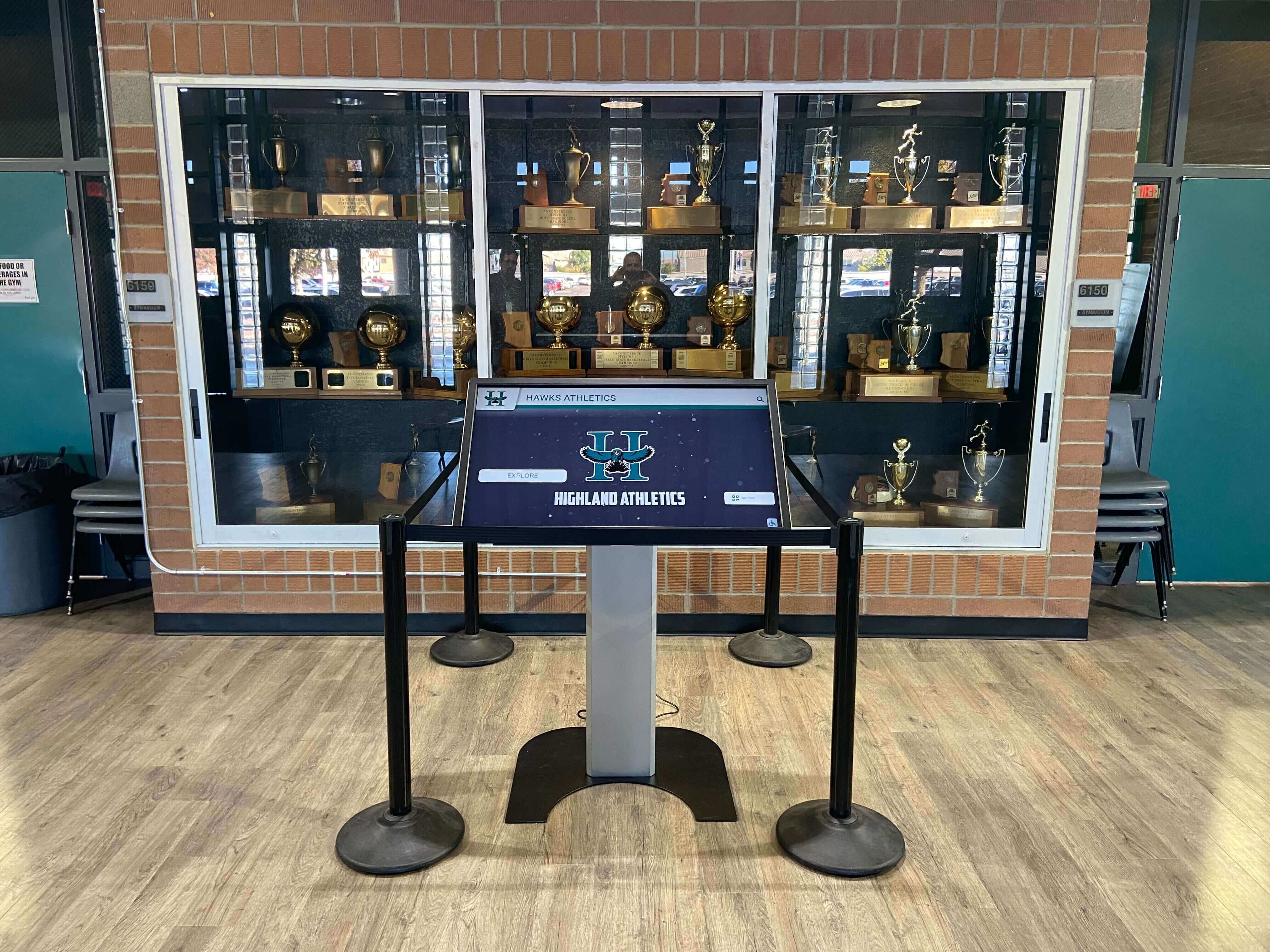
The Easiest Touchscreen Solution


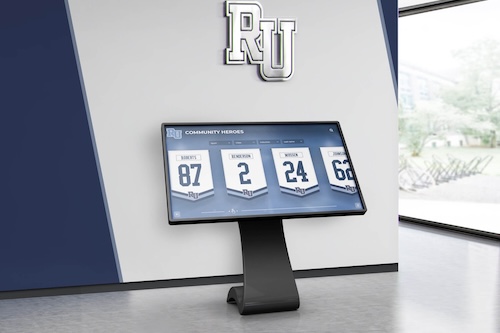

Live Example: Rocket Alumni Solutions Touchscreen Display
Interact with a live example (16:9 scaled 1920x1080 display). All content is automatically responsive to all screen sizes and orientations.
When your students earn a championship as part of a cooperative team, the celebration belongs to every school that contributed players, coaches, and community support—not just the one whose name appears on the building where the trophy sits. As the athletic director at a partner school, you may have watched this play out: the physical award goes to the host school, while your community wonders where it fits in the story.
A co-op team trophy display done well resolves that tension. The goal is one verified team narrative, visible at both schools, that gives accurate credit to every athlete and coach who earned the result. This guide walks through what a co-op team is, how to plan that shared story, how to think clearly about the three separate questions that often get tangled together—ownership, physical location, and community recognition—and what practical display options exist. It closes with a blank planning table, a caption template, and a joint end-of-season checklist your two athletics offices can work through together.
What Is a Co-op Team?
A cooperative team—commonly called a co-op—draws student-athletes from two or more partner schools to form one combined competitive team. The team competes as a unit under an official name recognized by the state athletic or activities association. Each student remains enrolled at their home school; the cooperative arrangement creates one team, not a new or merged institution.
This definition matters because it shapes how you tell the story and what your co-op team trophy display should say. A few important distinctions:
A co-op is not a school merger. The partner institutions remain separate, with their own enrollments, programs, and communities. When the co-op arrangement ends, the schools continue as before.
A co-op championship is not the same as co-champions. Co-champions are two distinct teams that tied for a title in separate competition. A co-op team is one team—one roster, one set of coaches, one award—that happens to draw students from more than one school. Conflating these two creates inaccurate displays.
Rules and structures vary. How co-ops form, which sports are eligible, how the team is named, and how ownership of trophies is handled all depend on your state association and your specific local agreement. The guidance here is general. Your association office and your current cooperative agreement are the authoritative sources for your situation.

A well-organized trophy case display can present a co-op team's full story alongside a school's other athletic achievements
Planning One Accurate Team Story
Before any display element goes up at either school, both athletics offices need to agree on one complete, verified team narrative. This is where co-op recognition most commonly goes wrong: one school posts a photo with only its students labeled, or a trophy case caption lists only the host school’s coaches. A student who transferred eligibility to the co-op and earned that honor sees their name missing. That is not shared pride—it is selective credit.
Work through the following elements with your counterpart at the partner school before producing any display materials.
Official Team Name and Competition Record
Use the official co-op team name exactly as it appeared on the competition bracket, the award, and the association’s records for that season. If the association registered the team under a combined name, that name belongs on the display—not a shorthand, not either school’s standalone mascot, and not an improvised combination created after the fact.
Document the sport, competition level (varsity, junior varsity, junior high, or other as applicable), and the exact honor earned: conference championship, regional title, state tournament placement, or another recognized distinction. Record the awarding body—your state association, conference, or sanctioning organization—and the season and date. These specifics are the foundation for every caption, plaque, and digital entry that follows.
Full Roster and Coaching Staff
The team’s story belongs to every player and coach, regardless of which school they attend. Compile the complete roster from official association records or scorebooks, not from a single school’s game-day program or memory. Where school affiliation is part of the official record and both schools have decided it is appropriate for publication in the display context, it can be noted—but verify this decision against your local agreement and applicable student privacy considerations before including it in any public-facing material.
Recognize the full coaching staff as they appear in official records. Do not present only home-school coaches as “the coaches” for the season.
Approved Photo and Short Narrative
Obtain the team photo taken under authorized conditions—typically an image that both schools, coaches, and relevant administrators have approved for publication. Confirm that photo rights are clear: who holds them, whether student or parent release forms were completed at both schools, and what publication contexts those forms cover. A photo authorized for the athletic department’s internal archive may not carry the same permissions as one approved for a public lobby display.
Write a brief narrative—two to four sentences—describing the team, what they achieved, and the season. Both athletics offices should review and approve that text before it appears anywhere. This approved text becomes the single source of truth for captions, plaques, and digital entries at both locations.
Three Questions to Keep Separate
Co-op recognition gets complicated quickly when three distinct questions are treated as one problem. Keeping them separate from the start prevents the most common disputes.
Who owns the physical trophy?
Physical trophy ownership is determined by your local cooperative agreement and, where applicable, your state association’s rules. Do not infer ownership from where the trophy currently sits—a trophy in School A’s case does not automatically mean School A owns it. Review the agreement. If the agreement is silent on this point, contact your association office before either school makes representations about ownership.
Where is the physical trophy displayed?
Trophy location is often determined by the host-school structure of the co-op, practical storage conditions, or other logistical factors. This is a separate question from legal ownership. A trophy can belong jointly to both schools, to one school, or be held by the association—different agreements produce different answers, and location is not evidence of ownership.
How does each school recognize the shared achievement?
This third question is the one most directly within your control as an athletic director. Even when the physical trophy lives at a partner school, your community can see the team’s story through approved display elements: a framed team photo with the agreed-upon caption, a narrative panel, a digital story display, or other recognition that uses authorized assets and accurate text.
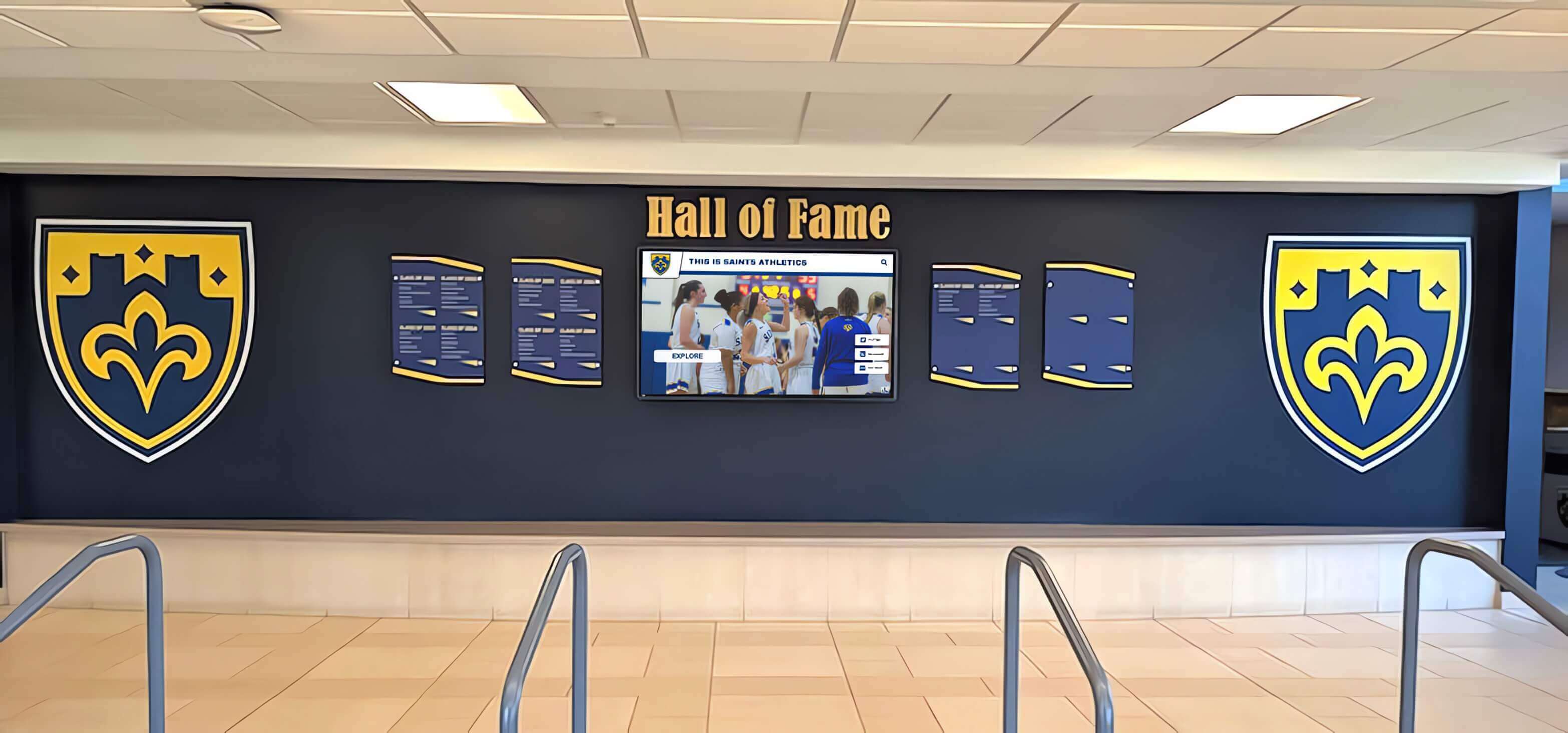
Recognition spaces can incorporate physical display elements alongside digital screens to present complete team stories
Display Options for Partner Schools
Once the ownership and location questions are answered—through the agreement and association guidance—each school’s athletics office can decide how to recognize the achievement in its own building. Three practical approaches cover most situations.
Option 1: Trophy at Its Authorized Location, Story Display at the Partner School
The most straightforward arrangement keeps the physical trophy where the agreement places it and adds an approved display at the other school. That display typically includes the official team photo with the agreed caption, a brief printed or framed narrative, and any other approved materials such as a season summary.
This approach does not require duplicating the physical artifact, so it does not depend on association approval for a duplicate. It can be implemented as soon as the approved photo and story are ready. It also keeps questions about physical artifact custody simple.
Option 2: Authorized Duplicate Trophy Where Permitted
Some state associations offer a pathway for ordering a duplicate trophy in co-op situations. As one example of what an association process can look like: the Minnesota State High School League’s awards and trophies order information page includes a Duplicate Trophy Order Form that covers scenarios including schools in co-ops. According to that page, the School Activities Director emails MSHSL to request an order form. This is a Minnesota-specific example, described here to show that a state association may have a co-op duplicate-trophy route—not to suggest that every association does, that duplicates are automatically available or free, that every award type qualifies, or how ownership of the duplicate would be assigned. Contact your own association office to learn whether a similar process applies in your state and what the current requirements are. Costs, duplication rights, and approval decisions vary.
Option 3: Physical Trophy Plus Digital Team Story at Each School
A third approach pairs the physical trophy at its authorized location with a digital team story display at both schools. Both locations show the same approved team photo, caption, and narrative—each school tells the same accurate story in its own hallway, using assets it has received and cleared locally.
This works well when schools already have digital display infrastructure in athletic hallways or trophy case areas. It is worth being clear about what this means in practice: a digital display does not substitute for preserving the original physical artifact, and creating digital recognition at both schools is not the same as establishing shared database access or automatic content synchronization between institutions. Each school maintains its own display using approved content it controls and has cleared locally.
No single option is universally the correct or fairest choice. The right approach depends on your local agreement, your association’s available processes, your budget, and your facilities.

Hybrid display spaces pair physical case elements with digital screens for a flexible co-op team recognition presentation
Co-op Team Display Planning Table
Use this table as a starting point. Adapt the fields to match your local agreement and association requirements. These are suggested planning fields, not mandatory fields and not fields built into any particular software system.
| Planning Field | Details to Record |
|---|---|
| Sport and season | |
| Official co-op team name (as registered with association) | |
| Partner schools | |
| Exact honor earned and awarding body | |
| Season dates | |
| Full roster source (official record or scorebook) | |
| Full coaching staff (as listed in official records) | |
| Physical artifact owner (per agreement) | |
| Physical artifact authorized location | |
| Approved display copy and assets (photo, caption, narrative) | |
| Photo rights documentation | |
| Reviewer name and role at School A | |
| Reviewer name and role at School B | |
| Correction contact at each school | |
| Archive storage location for originals | |
| Date both schools approved display caption |
Caption Template
Use this blank template as a starting point. Fill in each bracket with verified information only. Do not publish the caption until both athletics offices have reviewed and approved the final text.
[Official co-op team name] — [Sport], [Season year] [Exact honor earned], [Awarding body]. Coaches: [Full coaching staff as listed in official records]. A cooperative team drawing student-athletes from [Partner School A] and [Partner School B].
Keep the caption factual and brief. Do not include individual student names unless both schools have confirmed that the student’s name, school affiliation, and the specific publication context are covered by applicable release documentation or policy. Do not include statistical claims unless drawn from an official source both offices can verify and agree to cite.
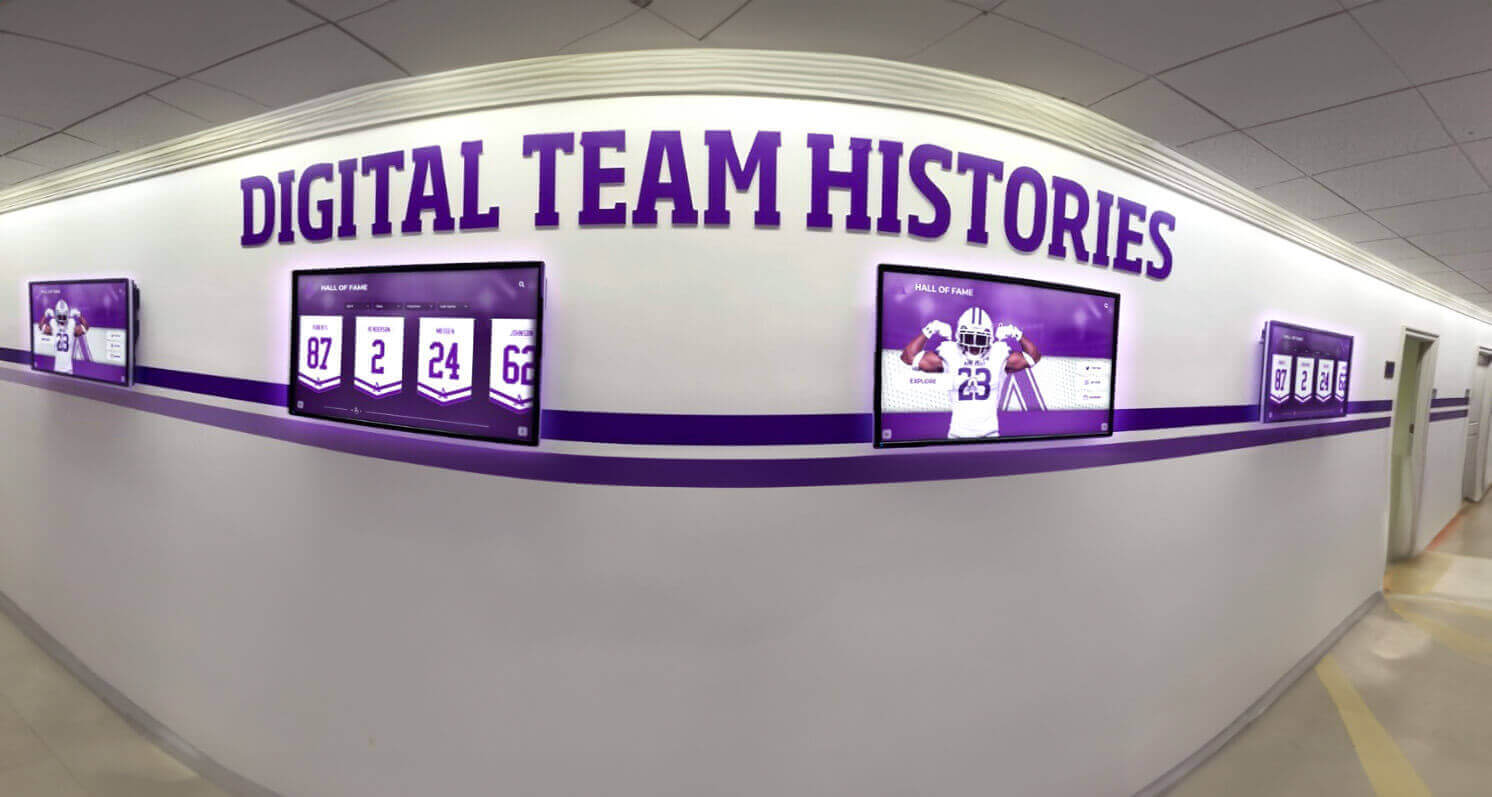
Digital screens in athletic hallways can display full team histories—including co-op seasons—with consistent formatting and approved content
Content Coordination Before Publishing
Before any display element goes live at either school, both athletics offices should complete the following steps together. This is content coordination between two institutions—it is not a claim that any particular technology platform automatically syncs content or shares administrative access between schools.
- Confirm the official team name against association records for that season, not from memory or a printed program
- Verify the full roster and coaching staff against official scorebooks or association records; do not omit any student or coach
- Check name spellings for every player and coach against official documents before any text is published
- Confirm photo rights at both schools—verify release or permission status before using any image in a public display; document what was confirmed and where those records are stored
- Review for private information—keep student medical, eligibility, and other protected information out of all public-facing display elements
- Agree on one approved caption—both offices sign off on the identical text before either school publishes it; a correction at one location should trigger a correction at the other
- Document where original records are stored—official photos, season results, and source documents should be held in institution-approved archives, with each school retaining an authorized copy of the agreed public story
Preserving Co-op History When Arrangements Change
Co-op arrangements end. Partner schools change. When that happens, the historical record for each past season should remain intact.
A championship earned by a co-op team in a given season belongs to the team as it existed that season—under the name it competed under, with the roster that earned the result. When the arrangement ends:
- Do not relabel a past co-op title as a standalone-school title
- Do not remove a former partner school from historical displays because the co-op has since dissolved or changed
- Do not automatically award varsity letters or hall-of-fame status based on co-op participation without the deliberate policy decision your school’s process requires
- Retain the team name and membership that applied to each historical season as its own entry
Accurate historical records protect all the students who competed under that team name. Each historical co-op season should be preserved as its own entry, with the name and roster that applied at the time.

Interactive displays can store historical seasons as individual entries, preserving co-op team records accurately alongside standalone-school seasons
Joint Review, Publish, and End-of-Season Archive Checklist
Work through this checklist at the end of each co-op season before publishing any display element and before archiving season materials.
Before publishing:
- Official team name confirmed against association records for this season
- Full roster confirmed from official records; no student omitted
- Coaching staff listed as it appears in official records
- Caption reviewed and approved by both athletics offices; text is identical at both locations
- Photo rights confirmed at both schools; release or permission documentation on file
- Private student information excluded from all public-facing content
- Name spellings verified against official documents
Archiving:
- Official season results stored in each school’s institution-approved archive
- Team photo (original, highest available resolution) stored at both schools with rights documentation
- Approved public caption and narrative stored with season file at both schools
- Local agreement language related to trophy ownership and display retained on file
- Record of which display options each school implemented and where displays are located
How Rocket Alumni Solutions Can Help
Schools managing co-op recognition often find that the biggest challenge is not sorting out ownership or association rules—it is presenting the approved team photo and achievement story in a way that is clearly organized, easy to update when a correction is needed, and visible to the community year-round rather than only during championship season.
Rocket Alumni Solutions helps schools display approved team photos and achievement stories—including co-op seasons—through an interactive recognition display. Athletic directors can enter the official team name, season, honor, and the approved narrative, and the display presents that record alongside other program history in a format that students, families, and visitors can explore. When a correction is needed—a name misspelling, an updated photo, a revised caption—the content can be updated without physically replacing a plaque or reprinting materials. Each school maintains its own display with the content it has approved and cleared locally.
This is a content presentation tool. It does not replace the step of getting both offices to agree on what the content says before it is entered.
Related Resources
Organizing original athletic photos, videos, and season files in a school archive
Schedule a conversation about your school’s co-op team recognition display
Live Example: Rocket Alumni Solutions Touchscreen Display
Interact with a live example (16:9 scaled 1920x1080 display). All content is automatically responsive to all screen sizes and orientations.