The Easiest Touchscreen Solution



Live Example: Rocket Alumni Solutions Touchscreen Display
Interact with a live example (16:9 scaled 1920x1080 display). All content is automatically responsive to all screen sizes and orientations.
Intent: research — ceramic school trophy glaze crazing describes a network of fine lines in the glaze surface of a ceramic award — a condition that may be intentional, age-related, or both, and that looks markedly different from a crack through the ceramic body, a loose patch of separating glaze, or an old adhesive repair join. Recognition-program staff who encounter these surface lines on a historic ceramic plaque, tile award, or decorated trophy need one thing first: a documented intake record created before the trophy is cleaned, repositioned, or placed in a display case. The Canadian Conservation Institute’s guidance on ceramics and glass preventive conservation makes clear that handling and condition decisions for ceramic objects require careful visual assessment — and that probing, flexing, tapping, or wetting a surface cannot substitute for that assessment. This guide explains what to look for, what to record, and when to stop and seek conservator guidance rather than proceeding with cleaning.
Ceramic awards occupy a particular corner of the school recognition archive. A hand-painted tile commemorating a state championship season, a glazed ceramic plaque given to a retiring coach, a decorative fired-clay trophy from a decades-old invitational — each of these objects carries recognition history that is not duplicated anywhere else in a school’s collection. They also carry something else: a glaze surface that has aged under display conditions that were rarely designed with ceramic preservation in mind, and that may show a network of fine surface lines that staff encountering the piece for the first time cannot immediately interpret.
Those surface lines may be crazing — a network of fine cracks confined to the glaze layer. They may have been present the day the award was made, deliberately induced as part of the glaze finish. They may have developed gradually over years as the glaze and the ceramic body expanded and contracted at slightly different rates through seasonal temperature and humidity cycles in a school building. Or the trophy may have additional conditions present alongside the crazing: a crack through the body itself, a patch of glaze that has begun to separate from the underlying ceramic, or evidence of an earlier repair. Appearance alone cannot confirm which combination is present, or whether what looks like stable glaze crazing is, in fact, a more urgent condition.
The intake record created before any cleaning or display decision gives staff, future handlers, and any conservator who later assesses the piece an accurate starting point. Without it, every handling session after the first is working blind.

School athletics collections often hold ceramic and mixed-media awards alongside metal hardware — each material type requires a separate condition assessment before handling, cleaning, or display decisions are made
What Ceramic Glaze Crazing Is — and What It Is Not
Glaze crazing in ceramics is a network of fine cracks that forms in the glaze layer — the vitrified mineral coating applied to the ceramic body before firing. The CCI’s ceramics and glass preventive conservation guidance addresses glaze crazing as a distinct surface condition, separate from the types of structural damage that require more urgent intervention.
Understanding that distinction matters for recognition staff who are not ceramic conservation specialists. The surface of a crazed ceramic trophy can look alarming — a fine web of lines covering what was once a smooth or glossy finish. But glaze crazing is not the same as a crack through the ceramic body, and it does not automatically indicate an unstable or damaged object. Several categories of ceramic surface condition can occur together or separately, and each has different conservation implications.
Intentional Crazing Versus Age-Related Crazing
Glaze crazing can be deliberate. Some glaze formulations are designed to produce a characteristic craze pattern as part of the finished surface aesthetic. Raku-fired ceramics, certain celadon and crackle glazes, and numerous studio ceramic traditions use intentional crazing as a decorative element. A school award made by a local studio ceramicist, a kiln-fired tile trophy presented at a fine-arts banquet, or a decorative ceramic plaque produced through a school arts program may have been crazed from the day it was completed.
Crazing also develops over time on glazes that were not intended to craze. When the thermal expansion coefficient of the glaze differs from that of the clay body beneath it, repeated temperature and humidity cycles — including the ordinary seasonal variation inside a school building — can produce a progressive craze network in glazes that were originally fired smooth. This type of crazing typically develops gradually and may become more pronounced over decades.
The visual appearance of a craze network — its density, the width of individual lines, the pattern — cannot reliably tell staff whether the crazing was intentional at manufacture or developed later. Both can produce similar surface patterns, and a historic ceramic trophy may have undergone some of each.
Glaze Crazing Versus Body Fractures
A crack through the ceramic body is a fundamentally different condition from glaze crazing. Body fractures penetrate the clay, porcelain, or stoneware beneath the glaze layer and may extend through the wall of the trophy. The CCI ceramics and glass guidance distinguishes these clearly as different categories of damage with different implications for handling and conservation.
In practice, distinguishing between a deep glaze craze line and a body fracture requires careful visual inspection under good lighting — and sometimes raking light, a light source held at a low angle to the surface, to reveal the depth and character of the lines. A glaze craze line typically has a characteristic appearance at its edges: the glaze on either side of the crack remains intact and level with the adjacent surface. A body fracture may show slight displacement between the two sides, a wider gap, or continuity through a visible chip or edge break.
For purposes of the intake record, any line that cannot be clearly identified as a glaze surface crack should be documented with its location, approximate dimensions, and the uncertainty noted — not investigated by probing or tapping.
Loose Glaze Versus Stable Crazing
Crazed glaze that remains firmly adhered to the ceramic body is a different condition from glaze that has begun to separate. Loose or flaking glaze — patches that have partially lifted from the body and are at risk of falling — is a more urgent conservation concern than stable glaze crazing. The CCI guidance on ceramics identifies loose or flaking glaze as a condition requiring conservator attention before further handling.
Signs that glaze may be loose rather than firmly adhered:
- A section of the glaze surface that appears slightly raised compared to the surrounding field
- Glaze pieces that have already separated and are present as fragments in or around the case
- A frosted or hazy appearance within a bounded area that differs from the general glaze condition elsewhere on the trophy
If any of these signs are observed during intake, the trophy should not be cleaned or repositioned without a conservator’s assessment. The intake record documents the location and extent of what was observed so that the conservator has an accurate baseline when they review the piece.
Ceramic Glaze Crazing, Acrylic Panel Crazing, and Glass Crizzling: Three Separate Phenomena
These three terms describe distinct conditions affecting three different materials. Encountering them together in school recognition program documentation — where ceramic trophies, acrylic display panels, and glass-enclosed cases may all be present — makes it worth distinguishing them precisely.
Ceramic glaze crazing is a network of fine surface cracks in the mineral glaze coating on a ceramic object. It may be intentional or age-related. When the glaze remains firmly adhered, crazed ceramic objects can be stable for very long periods without further intervention.
Acrylic panel crazing describes a stress-cracking or micro-fracture pattern that develops in acrylic (polymethyl methacrylate) plastic — the material commonly used for the front panels of school trophy cases, and for the bodies of some clear acrylic trophies themselves. Acrylic crazing results from mechanical stress, UV radiation, thermal cycling, or chemical exposure, and represents a failure of the plastic material rather than a surface glaze condition. Trophy case acrylic panel crazing is a facilities maintenance concern; ceramic glaze crazing is a collection care concern. The inspection approaches, causes, and appropriate responses are entirely separate.
Glass crizzling is a condition specific to glass objects — not ceramic and not acrylic. Also called “sick glass” or “weeping glass,” crizzling results from a chemical instability in the glass composition itself, typically an excess of alkali relative to silica in the original batch. Chemically unstable glass releases moisture and develops a network of fine cracks throughout its body. Unlike ceramic glaze crazing, which can be stable indefinitely when the glaze remains adhered, glass crizzling is a progressive and irreversible deterioration. High relative humidity accelerates the process; stable lower humidity slows it but cannot halt it. A school trophy collection may include glass-bodied awards alongside ceramic ones — recognizing that an object showing surface cracks may be either a ceramic with crazed glaze or a glass object with crizzling requires identifying the material first, because the conservation response differs significantly.
Before the Intake: What Not to Do
The intake record for a ceramic trophy with surface crazing begins before the trophy is touched. Several actions commonly taken during trophy case cleaning and organization are contraindicated for ceramic objects — particularly older pieces with glaze crazing, visible body fractures, or signs of loose glaze.
Do not probe or flex the surface. Running a fingernail, tool, or any object along craze lines to test their depth risks dislodging glaze at the crack edges. Flexing the trophy body to assess whether a crack moves can extend body fractures and displace loose glaze. The intake record covers what is visible from the exterior without contact.
Do not tap the surface or body. Tapping ceramic objects to assess structural integrity by sound is a technique used by trained conservators under controlled conditions — it is not an appropriate first-response action for staff without ceramic conservation training, particularly when loose glaze may be present.
Do not wet the glaze surface. The CCI ceramics and glass guidance notes that dampness and water on ceramics can cause rapid and obvious damage. Even a damp cloth applied to clean dust around craze lines carries risk for a fragile historic glaze surface. Water entering craze lines can cause localized stress as it dries, and damp conditions actively accelerate deterioration in some glaze types.
Do not apply solvents, cleaning sprays, or household products. No commercial polish, cleaning agent, or surface treatment should be applied to a ceramic award with crazing, loose glaze, or repair evidence before a conservator has assessed the piece. Dishwasher cleaning, soaking, bleach applications, crack fillers, glaze sealers, and adhesives applied by non-specialists can cause irreversible damage to glaze surfaces and existing repair joins. The CCI guidance on ceramics is consistent with broader conservation principles that cleaning and treatment of historic glazed surfaces belongs to specialists.
Do not handle by protruding elements. Handles, spouts, finials, attached figurines, raised lettering panels, and decorative projections are the most structurally vulnerable points on a ceramic trophy. The CCI ceramics and glass guidance recommends supporting ceramic objects from the base and the most stable section of the body — never by any protruding or attached element that may be separately adhered or more fragile than it appears. If visual inspection during intake reveals any element that may be unstable, the trophy should not be moved until a conservator has been consulted.
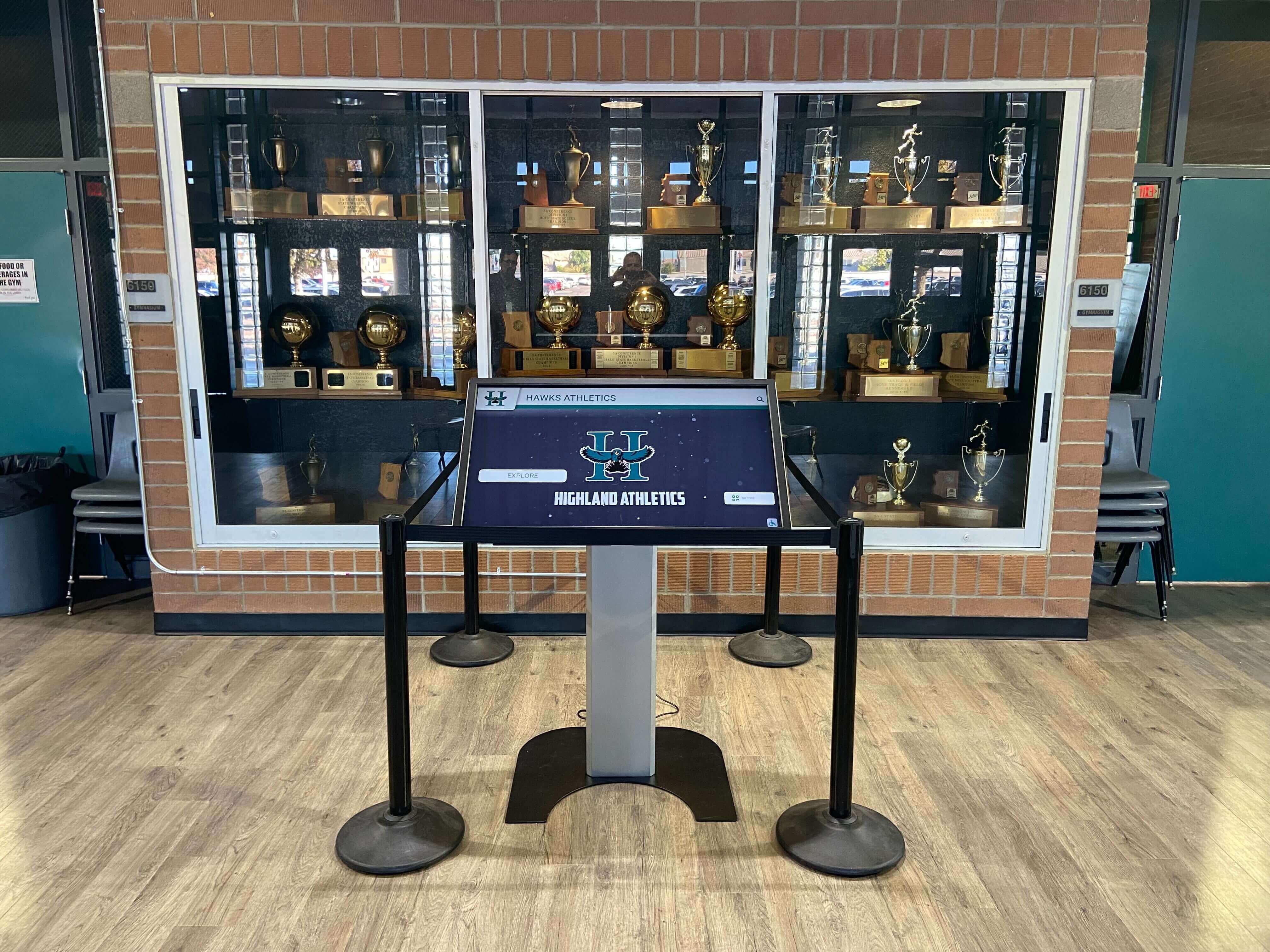
Trophy cases holding ceramic awards alongside metal hardware require separate handling protocols for each material type — the intake record documents condition before any ceramic object is removed from its case position
The Ceramic Trophy Glaze Crazing Intake Record
The intake record for a ceramic trophy with observed glaze crazing is a non-invasive, visual exterior document. Its purpose is to describe the object’s condition accurately — before any cleaning or handling changes that condition — in enough detail that a conservator reviewing it later can understand what staff observed and what they could not determine from the exterior.
What the Record Includes
Object identification. The trophy’s common name, any inscribed text (award title, recipient name, date, presenting organization), visible maker marks or kiln stamps on the base or underside, and its current location within the collection.
Overall condition summary. A plain-language description of the general glaze surface condition across the trophy, noting which areas appear intact and which show visible variation from the surrounding field.
Crazing description. Where crazing is present: its distribution (localized to one section or across the entire surface), the approximate density of the craze network (fine and widely spaced versus dense and closely packed), and any areas where craze lines are noticeably wider or where the glaze at the crack edges appears to differ from adjacent intact glaze.
Body fracture documentation. Any line that appears to penetrate deeper than the glaze surface, documented with its location, approximate length, and whether displacement between the two sides of the fracture is visible. Do not probe or flex to investigate.
Loose glaze locations. Any area where the glaze appears raised, where the surface does not sit flush with adjacent areas, or where fragments have already separated. These locations should be flagged for conservator review before further handling.
Repair evidence. Any area where the glaze color, texture, or sheen differs noticeably from surrounding material in a way that suggests a previous fill, overpaint, or adhesive repair. Repair joins documented at intake prevent confusion about the trophy’s original condition during later conservation assessment, since prior repairs may have different solubility and stability than the original glaze.
Existing photographs. If the school holds existing photographs of the trophy from earlier periods — yearbook images, athletic banquet programs, awards ceremony photographs — these should be noted in the record as reference comparators. They may allow a conservator to assess whether the crazing visible today was present in earlier documentation or has developed since.
Provenance notes. The trophy’s history within the collection: when it was acquired, any notes about its condition at the time of acquisition, whether it has been cleaned or treated previously, and how it has been stored or displayed.
Loose particle locations. Any glaze fragments or dust-like particles visible in or around the trophy’s display location — noted at intake so they are part of the record rather than cleaned away before a conservator has the opportunity to assess them in context.
Ceramic Trophy Glaze Crazing Intake Checklist
| Intake Item | What to Document | Flag for Conservator If: |
|---|---|---|
| Glaze surface — overall | Intact / Uniformly crazed / Partially crazed / Varies by area | Glaze appears actively separating or lifting anywhere |
| Craze line density | Fine and sparse / Moderate network / Dense, closely packed | Lines appear to be widening or edges show glaze lifting |
| Surface variations | Any area where sheen, color, or texture differs from surrounding glaze | Differences suggest prior repair or localized re-glazing |
| Body fractures | None visible / Location, approximate length, visible displacement | Any fracture showing displacement or continuing to a break edge |
| Loose glaze | None visible / Location and approximate extent | Any raised, separated, or detached glaze section |
| Repair joins | None visible / Location, apparent material, color match quality | Multiple repairs, failing adhesive, or areas of suspected previous fill |
| Protruding elements | All stable / Any element showing movement or visible separation | Any handle, finial, or figure showing instability |
| Maker marks / kiln stamps | Present / Location / Photographed | — |
| Inscriptions | Complete / Partially legible / Location / Photographed | — |
| Existing collection photos | Yes / No / Reference location noted | — |
| Loose particles in display | None / Fragment locations recorded | Any significant fragment loss since last documentation |
| Recommended next action | Proceed to storage / Proceed to display with record / Refer to conservator | See conservator flags above |
Assigning an intake record number that connects to the school’s broader recognition database gives the ceramic trophy a persistent catalog identity. For programs building structured award archives, athletic archive accession numbering systems provide practical guidance on creating stable identifiers that connect physical objects to their digital records across program transitions and staff changes — the same numbering logic that applies to photographs and trophies applies equally to ceramic pieces.
Hallways housing both physical trophy cases and digital displays benefit from condition records that connect ceramic and mixed-material pieces to searchable entries in the digital recognition system
Photographs as Part of the Ceramic Trophy Intake
A written description of glaze crazing, however detailed, is incomplete without photographs that document what was visible at the time of intake. For ceramic trophy documentation, the photograph sequence serves two purposes: it creates a reference condition record that is immune to memory drift, and it provides a conservator with visual evidence of what the object looked like before any subsequent handling.
Recommended photograph sequence for a ceramic award with observed crazing:
- Overall images from each face — front, back, both sides, base, and top — with consistent, even lighting that shows the whole surface without strong shadows obscuring the craze network
- Raking light images of the crazed areas — a light source held at a low angle to the surface often reveals craze pattern depth and density more clearly than overhead lighting
- Close-up documentation of any body fractures — photographed with a scale reference if one is available, from the angle that best shows the line character
- Loose glaze locations — close-up images showing the raised or separated edge from the angle that reveals it most clearly
- Maker marks and inscriptions — photographed under even lighting for legibility
- Full case context — a photograph showing the trophy in its current display location before removal, with neighboring objects visible for spatial reference
For recognition programs systematically documenting their award collections through photography, the athletic photo archive guide for high school digitization addresses how photograph metadata, naming conventions, and archival storage decisions affect the long-term usefulness of the record — considerations that apply equally to condition photographs of historic ceramic trophies and to the athletic photographs that may themselves be part of the school’s recognition collection.
When to Refer to a Conservator
The intake checklist identifies conditions that require conservator referral before any further handling. Stable glaze crazing — crazing distributed across the glaze surface with the glaze remaining firmly adhered — does not necessarily require immediate conservation intervention. The CCI ceramics and glass guidance distinguishes between conditions that are stable and those that represent active risk of material loss.
Refer to a conservator before further handling if:
- Loose or separating glaze is present anywhere on the trophy
- A body fracture shows visible displacement or extends to a broken edge
- A protruding element — handle, finial, attached figure, raised plaque — shows any instability or visible separation from the body
- Glaze fragments or particles were present in the case at intake, suggesting ongoing loss
- The trophy has a repair join whose adhesive or fill material appears to be failing or lifting
Refer to a conservator before cleaning if:
- The full surface condition is unclear — crazing is present alongside other conditions that have not been fully identified from the exterior
- The trophy appears to have had prior cleaning or treatment that affected the glaze surface in ways not fully documented
- Any solvent, adhesive, or cleaning product has previously been applied to the surface, whether known or only suspected from surface appearance
Conservation referral does not require that the trophy be removed from the school immediately. An intake record with photographs allows a conservator to review the documented condition remotely before scheduling an in-person assessment. It also allows the school to continue its recognition program — with a complete digital record of the award visible in a cloud-managed display — while the physical object awaits assessment in a stable, padded storage environment away from direct light and temperature fluctuation.
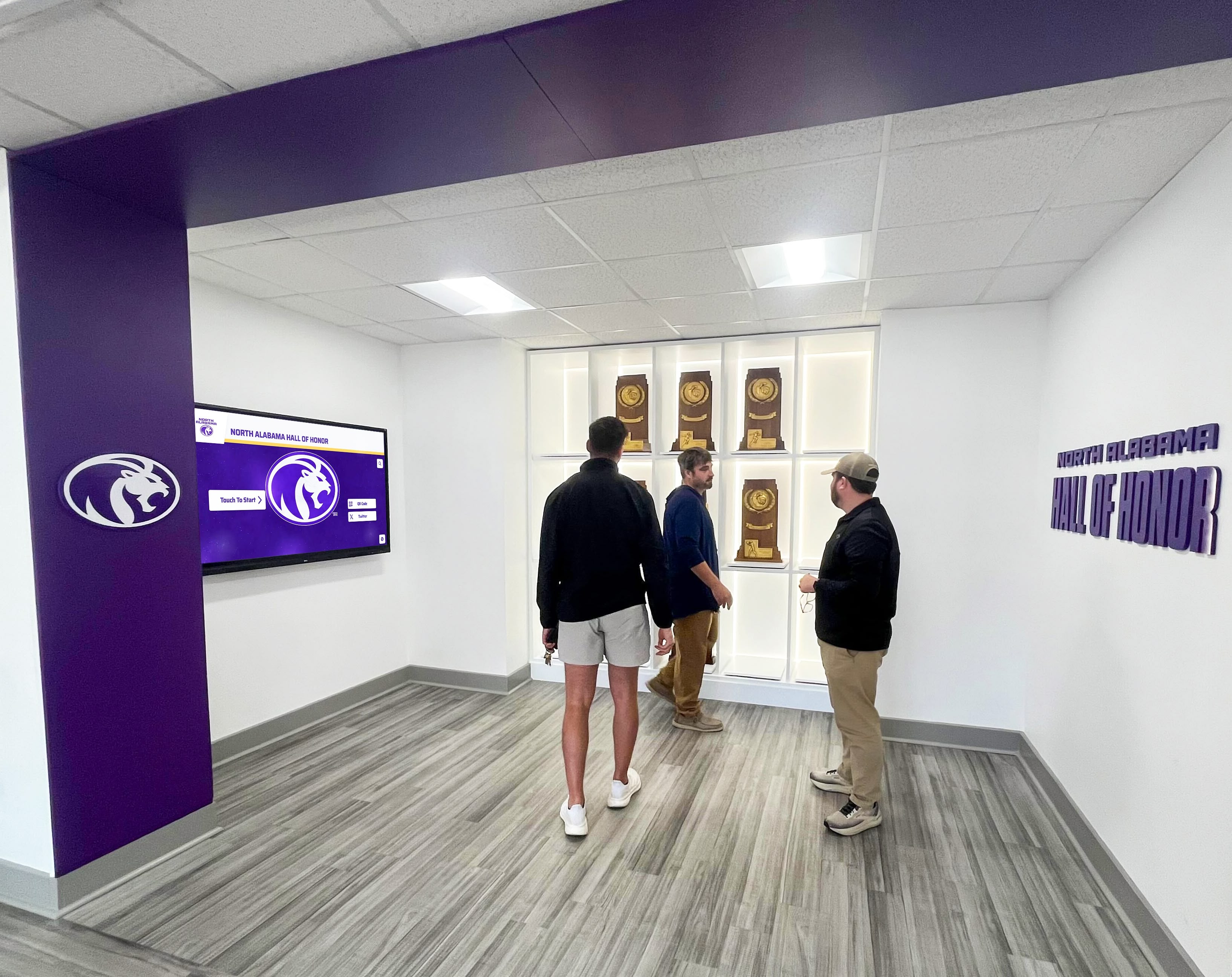
Staff engagement with trophy collections is strengthened by condition records that provide a clear baseline — intake documentation makes conservator consultations and future display audits far more productive
Connecting the Ceramic Trophy Record to Your Recognition Database
The intake record for a ceramic trophy is the source document for that object’s entry in the school’s recognition database. Once condition is documented, the object’s award history — recipient name, sport or program, season, presenting organization, significance to the school’s recognition narrative — belongs in a persistent catalog record that connects the physical condition documentation to the recognition story the trophy represents.
Consistent field naming within the awards database ensures that a ceramic trophy documented today can be found, compared, and referenced by staff who were not present at the intake. Standardized data fields for award type, material, condition status, and current location are especially important when a collection holds multiple ceramic pieces acquired across different eras. For programs building structured recognition records around consistent fields, the hall of fame profile data dictionary template addresses how to standardize name, team, award, and media fields in ways that serve both current display needs and long-term archive integrity — the same field-level discipline that produces reliable athlete records produces reliable object records.
Controlled vocabulary for material type and condition terms — applied consistently across the ceramic trophies in a collection — allows filtering and reporting that would not be possible with free-text notes alone. For programs building structured tagging systems for their athletic archives, controlled vocabulary frameworks for athletic collections provide practical guidance on creating tag sets for teams and awards that remain useful as collections grow and staff change. Extending those vocabularies to include material categories and condition status terms gives ceramic trophies the same findability as jerseys, photographs, and championship hardware.
The software stack managing recognition records, rosters, and physical artifact documentation should provide the intake record with a stable home that is accessible to the athletic director, recognition-program staff, and — when relevant — a conservator reviewing the collection. For programs assessing which digital tools best serve athletic department collection management, athletic department management software guidance covers what capabilities belong in the stack for records, rosters, and recognition across a complete program — including the document management and access-control features that keep condition records accessible across staff transitions.
A cloud-managed digital trophy case that houses the complete recognition record of the ceramic award — including its intake photographs, condition status, and the award history it documents — allows the school to continue displaying the achievement while the physical object is in storage awaiting conservation assessment. The athlete who earned the ceramic plaque, the season it commemorates, and the significance of the recognition remain accessible to current students, alumni, and families on a touchscreen display, regardless of what is happening with the physical object in the collection room.
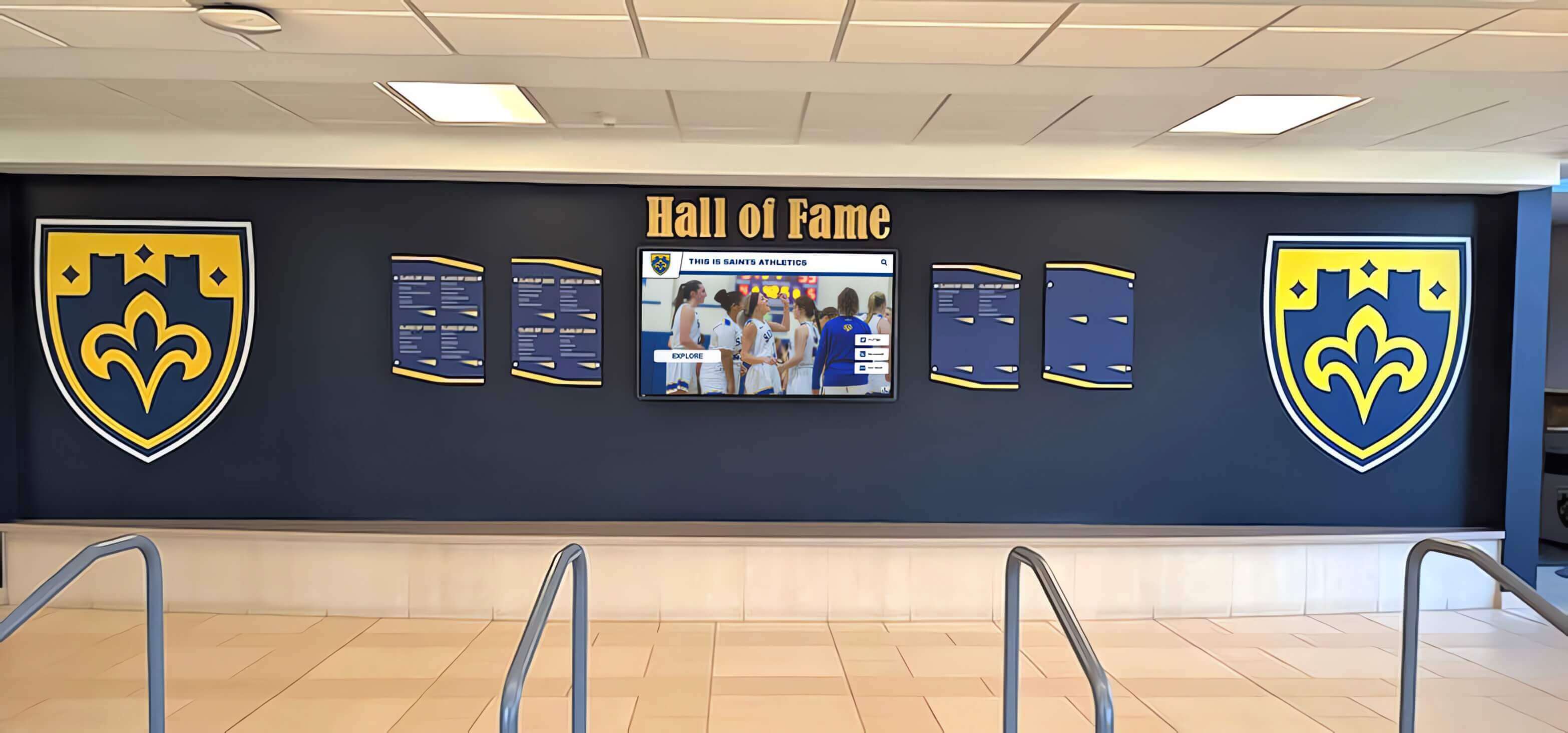
Digital recognition systems allow a school to display the full achievement record associated with a ceramic award — including the recipient's story, season, and significance — even when the physical trophy is in stable storage awaiting conservator assessment
Frequently Asked Questions
What is ceramic school trophy glaze crazing? Ceramic glaze crazing is a network of fine cracks confined to the glaze surface of a ceramic object. It is distinct from a crack through the ceramic body and from loose or flaking glaze. Crazing may have been intentional at manufacture — some glaze formulations are designed to produce a craze pattern — or it may develop over time as the glaze and ceramic body expand and contract at slightly different rates through temperature and humidity cycles. Appearance alone cannot determine which is the case.
Can glaze crazing on a school trophy be filled or sealed? Crack fillers, adhesives, glaze sealers, and cosmetic restoration products applied by non-specialists to ceramic glaze surfaces can cause irreversible damage and complicate future conservation treatment. No filling or sealing of glaze craze lines should be attempted before a conservator has assessed the piece. Stable glaze crazing does not require filling; the goal of intake documentation is to record the condition accurately before any action alters it.
How do I tell if glaze crazing is stable or if the glaze is about to separate? Stable glaze crazing typically presents with the glaze surface flat and even across the craze lines — the glaze on either side of each crack remains at the same level and appears firmly adhered to the ceramic body beneath. Loose or lifting glaze shows one or more edges raised above the surrounding surface. Any area that looks raised, presents differently from adjacent glazed areas, or where fragments are visible in the case should be flagged for conservator review and the trophy should not be handled further until assessed.
How does ceramic glaze crazing differ from acrylic crazing on a trophy case panel? They are unrelated conditions in entirely different materials. Acrylic crazing is a stress-cracking or micro-fracture pattern in the plastic panels of a trophy display case, or in the body of an acrylic trophy, resulting from mechanical, chemical, or UV exposure. Ceramic glaze crazing is a condition in the mineral glaze surface of a fired ceramic award. The inspection approaches, causes, and conservation responses are separate, and the terms should not be used interchangeably.
What about glass crizzling — is that the same as ceramic glaze crazing? No. Glass crizzling is a condition specific to glass objects caused by chemical instability in the glass composition itself. Crizzling produces a progressive, irreversible network of cracks throughout the glass body and may cause the glass to release moisture. Ceramic glaze crazing, by contrast, is confined to the glaze surface layer and can be stable for very long periods when the glaze remains adhered. A school collection may include both ceramic and glass-bodied awards — identifying the material before assessing the condition is necessary, because the conservation response differs.
Who should complete a ceramic trophy intake record? Any recognition-program staff member can complete the visual exterior intake checklist — no conservation training is required to record what is visible without contact. The value of the record is in its consistency and timing: completed before any cleaning or handling, documenting what is present before any change occurs. If the intake surfaces conditions that require conservator assessment, that record is what allows the conservator to begin an informed review.
What if the ceramic trophy has already been cleaned before intake? Document the current condition as accurately as possible, noting in the intake record that the trophy was cleaned prior to documentation and that the pre-cleaning condition is unknown. This is less useful than a pre-cleaning record, but it still creates a baseline for all future handling sessions. For any ceramic awards not yet cleaned, completing the intake record before the next cleaning session preserves the option the first session eliminated.
Preserve the Recognition Story While the Trophy Is Assessed
Rocket Alumni Solutions builds cloud-managed digital trophy cases and touchscreen halls of fame that display every award, athlete story, and school milestone — including ceramic awards currently in conservator review. Keep your complete recognition record accessible to students, alumni, and families on an ADA WCAG 2.1 AA compliant display, updated remotely without IT tickets, while physical objects receive the care they need off the shelf.
Book a DemoCeramic school trophy glaze crazing is a condition worth understanding precisely because it is so easy to misread. Fine surface lines on a historic glazed plaque or tile award look like damage that calls for immediate action — a cleaning cloth, a filler, a coat of something protective. The intake record that documents what is actually present, before any of those actions change the surface, is the intervention that costs nothing and risks nothing, and that preserves the school’s options regardless of what a conservator’s subsequent assessment finds. The athlete whose achievement the trophy records deserves both the physical preservation of the original object and the recognition story that belongs permanently in your school’s digital collection.
Live Example: Rocket Alumni Solutions Touchscreen Display
Interact with a live example (16:9 scaled 1920x1080 display). All content is automatically responsive to all screen sizes and orientations.